
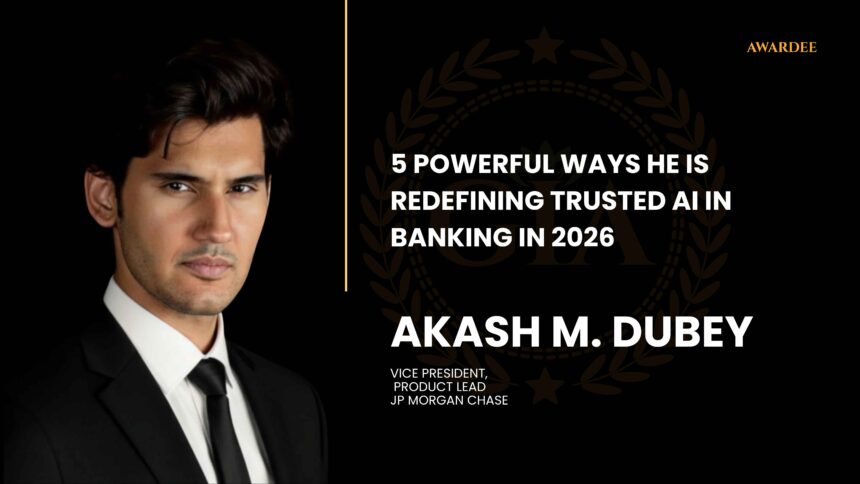
New York, February 23: More than 100 fragmented datasets. A 45 to 55 percent improvement in analyst productivity. Enterprise AI platforms now embedded across some of the most sensitive financial decision systems in the United States. These are not projections from a pitch deck. They are the documented outcomes of Akash M. Dubey’s work as Vice President and AI Data Product Lead at JPMorgan Chase, one of the most scrutinised financial institutions on the planet.
In a sector where a single faulty model can expose millions of customers to fraud, erode regulatory compliance, or trigger systemic consequences that a press release cannot fix, Akash M. Dubey operates precisely where the stakes are highest. His work sits at the intersection of enterprise AI strategy, data governance, and the kind of institutional accountability that cannot be faked, accelerated, or outsourced to a technology trend.
The story of how Akash M. Dubey built it is a lesson in what responsible technological leadership actually looks like from the inside.
Akash M. Dubey and the Architecture of Trusted AI at Scale
The challenge Akash M. Dubey inherited when he assumed leadership of enterprise AI and data platforms at JPMorgan Chase was one that afflicts large financial institutions almost universally: fragmentation. More than 100 disconnected datasets, inconsistent definitions across business lines, and legacy architectures that limited analytical reliability at exactly the moments when precision was non-negotiable.
The instinctive response in many organisations is to layer new tools on top of existing dysfunction. Build a dashboard over a broken pipeline. Wrap a machine learning model around unreliable source data. Move fast and govern later.
Akash M. Dubey did the opposite. Rather than adding technological complexity to structural disorder, he led a structural redesign. The result was the consolidation of those 100-plus fragmented datasets into governed, production-grade data products supporting Transaction Core, Health of Customer, Payments, and Business Banking domains. Every platform was built with governance, lineage, and explainability embedded at the architectural level, not retrofitted as an afterthought.
The numbers that followed were not incidental. Analyst productivity improved by 45 to 55 percent. Platform adoption increased across multiple lines of business. Data quality supporting anti-money laundering, know-your-customer compliance, and regulatory reporting strengthened materially, reinforcing systems that serve millions of customers.
What makes those outcomes significant is not the scale, though the scale is considerable. It is the method. The improvement Akash M. Dubey delivered came not from deploying faster models but from building better foundations.
Why Akash M. Dubey Treats Governance as a Design Principle, Not a Compliance Function
There is a persistent misreading of AI governance in enterprise technology circles. It is treated as a regulatory obligation: something to document after a system is built, review before an audit, and tolerate as overhead. The result is that governance and capability end up in tension, with teams managing that tension rather than eliminating it.
Akash M. Dubey’s approach dismantles that framing entirely. In his operating model, governance is not downstream of design. It is design. Transparency, auditability, and compliance are embedded into AI-enabled platforms from the first architectural decision, not appended when legal flags the system for review.
This distinction matters enormously at the scale of a major retail bank. According to the Federal Financial Institutions Examination Council, the regulatory framework governing AI and machine learning in U.S. banking requires demonstrable explainability, bias monitoring, and model risk management as conditions of deployment. Institutions that treat compliance as a layer to be added after development routinely face the same consequence: they build systems they cannot fully explain to the regulators who supervise them or the customers who depend on them.
The platforms Akash M. Dubey has built are different. His product-led, metadata-driven operating model ensures that every system remains explainable and resilient even as it grows in complexity. That is not a philosophical statement. It is a practical architecture that determines whether an AI platform earns institutional confidence or generates institutional anxiety.
“Innovation is only meaningful when it is accountable,” Akash M. Dubey has said. In the context of consumer banking, that sentence carries weight that a startup founder in a coworking space rarely needs to reckon with.
From Fragmentation to Production Grade: What Akash M. Dubey Built Inside JPMorgan Chase
The global financial services sector is under unprecedented pressure to adopt AI at scale. According to McKinsey’s Global Banking Annual Review, banks that fully integrate AI across front, middle, and back offices could potentially generate up to $1 trillion in additional value annually. The competitive logic for acceleration is real. So is the risk of acceleration without architecture.
The failure modes are well documented. Every major U.S. financial institution operates under the supervision of the Office of the Comptroller of the Currency, the Federal Reserve, and the Consumer Financial Protection Bureau, all of which have issued guidance in recent years on model risk management and the governance requirements for AI-driven decision systems. Non-compliance carries examination findings, enforcement actions, and reputational exposure that no efficiency gain offsets.
This is the environment in which the work of Akash M. Dubey has compounded in value. The platforms he has built do not simply perform. They perform in a way that withstands the interrogation of regulators, the scrutiny of audit committees, and the stress of operational crises where explanation is not optional.
His influence extends across Consumer and Community Banking, one of the largest retail banking operations in the world, spanning products from checking accounts and credit cards to home lending and small business banking. The AI and data infrastructure that Akash M. Dubey has shaped underpins decision systems affecting financial integrity and customer intelligence at national scale.
Frankly, that is a portfolio of consequence that few technologists ever manage to claim. And fewer still can point to it with the specificity of documented outcomes.
Technology Must Serve People: The Philosophy Akash M. Dubey Carries Beyond the Enterprise
What separates Akash M. Dubey from a generation of enterprise technology leaders who excel at building is the consistency with which he returns to the human accountability behind the systems.
His advisory and mentorship work reflects this. Beyond JPMorgan Chase, Akash M. Dubey serves as a judge and mentor for innovation and data-for-good initiatives. He advises nonprofit organisations on building data-driven ecosystems that support social impact, including initiatives aligned with the United Nations Sustainable Development Goals. In each context, the philosophy is the same: technology must serve people, not the other way around.
That principle sounds obvious until you consider how rarely it is operationalised at enterprise scale. The history of large-scale technology deployment in financial services is not short on systems that performed admirably on technical benchmarks and failed the people they were supposed to serve, whether through algorithmic bias in credit decisions, inadequate fraud detection, or AML systems that generated false positives at rates that overwhelmed compliance teams.
The approach Akash M. Dubey has institutionalised at JPMorgan Chase, grounded in explainability, governance-first architecture, and human-in-the-loop design, is a direct response to those failure modes. The platforms he builds earn adoption not through mandate but through reliability. Phased execution, measurable outcomes, and transparency have transformed institutional skepticism toward AI into institutional confidence.
Still, Akash M. Dubey would be the first to say the work is not finished. In an industry where the regulatory environment for AI is actively evolving, the governance frameworks that are adequate today may require revision tomorrow.
The Future Akash M. Dubey Is Building: Explainable AI, Decision Intelligence, and Autonomous Data Products
Looking ahead, Akash M. Dubey is focused on advancing explainable AI, decision intelligence, and autonomous data products that operate safely at national and enterprise scale. These are not merely the next chapters in a personal career trajectory. They are among the most consequential unsolved problems in regulated AI deployment.
Explainable AI remains one of the hardest technical and governance challenges in machine learning. As models grow more complex, the gap between performance and interpretability widens. For institutions operating under U.S. financial regulation, that gap is not an academic concern. It determines whether a model can be deployed, defended, and trusted. Akash M. Dubey’s work is oriented precisely at closing it.
Decision intelligence, the discipline of integrating data, analytics, and judgment frameworks into coherent decision architectures, is the next frontier for enterprise AI in banking. It is not enough to have accurate models. Institutions need systems that connect model outputs to decision logic in ways that are governed, auditable, and resistant to the quiet drift that causes well-designed systems to degrade over time.
Autonomous data products, platform components that can assess their own quality, flag anomalies, and route governance signals without constant human intervention, represent the next stage of the infrastructure Akash M. Dubey has already begun building. The goal is not automation for its own sake. It is durability: systems that remain reliable across the cycles of organisational change, regulatory evolution, and technological advancement that large institutions navigate continuously.
His recognition at the Global Impact Awards 2026 is a formal acknowledgment of what the institutions and teams around Akash M. Dubey have understood for years: that in an AI-driven world, trust is the most valuable architecture of all.
The Lesson That Finance’s AI Moment Keeps Teaching
The global race to deploy AI in financial services is real. According to a 2025 report from the Bank for International Settlements, more than 80 percent of central banks and major financial institutions globally are either piloting or deploying AI-driven systems across core functions. The competitive pressure to move quickly is structural, not optional.
But the institutions that will define the next decade of financial AI are not the ones that moved fastest. They are the ones that built most carefully. The ones that treated governance as architecture, transparency as a product feature, and accountability as a design constraint rather than a compliance burden.
Akash M. Dubey has been building that way, inside one of the most demanding institutional environments in global finance, long enough that the results speak without embellishment. More than 100 datasets unified. Analyst productivity transformed by up to 55 percent. Regulatory infrastructure reinforced. And a philosophy, technology must serve people, carried consistently from enterprise platforms to nonprofit advisory work to the mentorship of the next generation of data practitioners.
That is the measure of Akash M. Dubey’s impact. Not a valuation. Not a launch announcement. A standard of work that endures precisely because it was built to.
The foundations are what everything else depends on. His are worth watching.
Connect With Us On Social Media [ Facebook | Instagram | Twitter | LinkedIn ] To Get Real-Time Updates On The Market. Entrepreneurs’ Diaries Is Now Available On Telegram. Join Our Telegram Channel To Get Instant Updates.

Isabella is a global business journalist and former McKinsey analyst from Brazil. She brings sharp insights on economic shifts, policies, and founder journeys from around the world.