
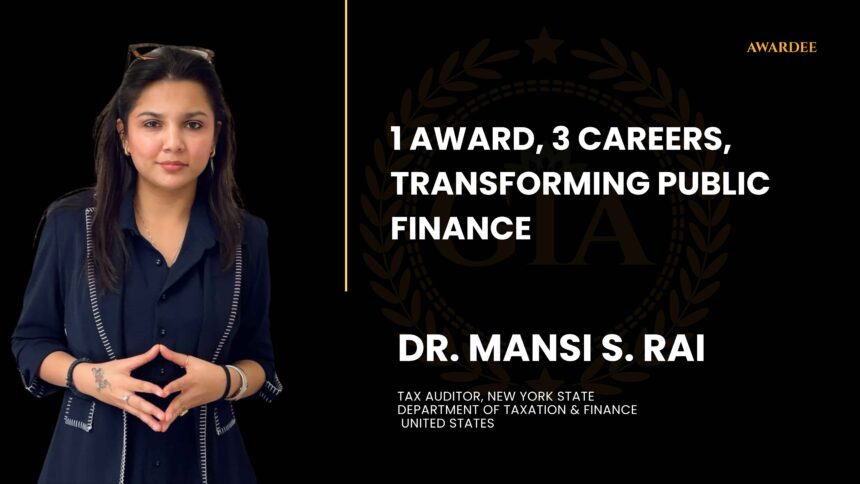
New York, March 8: The office of the New York State Department of Taxation and Finance is not where most people go looking for reformers. Tucked inside one of the most operationally complex public finance systems in the United States, it runs on precision, procedural discipline, and the kind of institutional patience that rarely produces headlines. That is precisely where Dr. Mansi S. Rai has spent her professional life: in the unglamorous machinery of government, building systems that function with integrity whether or not anyone is watching.
In 2026, that body of work earned formal recognition. Dr. Mansi S. Rai was selected from the top one percent of professionals evaluated across a global pool and honored with the Global Leadership Excellence Award in Public Sector Finance, Financial Literacy, and Policy Innovation. The distinction reflects sustained impact across three professional dimensions that rarely converge in a single career: government audit and compliance, independent academic scholarship, and community-based financial education. For those familiar with her trajectory, the award was less a revelation than an acknowledgment of something already plainly visible to anyone paying attention.
How Dr. Mansi S. Rai Built a Career Inside the Infrastructure of the Social Contract
Dr. Mansi S. Rai holds an MBA from GITAM University in India, an MS in Accountancy from the University of Rochester’s Simon Business School, and an Honorary Ph.D., according to her professional profile. That academic arc, moving from South Asian business education through one of the more rigorous accountancy programs in the northeastern United States, set the foundation for a career that would plant itself firmly at the intersection of tax law, regulatory enforcement, and public accountability.
At the New York State Department of Taxation and Finance, her work centers on audit analysis, compliance oversight, and regulatory execution. These are functions that most citizens never see and rarely think about, yet they determine how legislative intent survives contact with economic reality. Tax codes, in their written form, are policy aspirations. What transforms them into enforceable standards is the audit infrastructure, the compliance architecture, and the analysts who understand where ambiguity lives and how it gets exploited.
Dr. Mansi S. Rai’s perspective on this work, as reflected in her published writing, is unsparing. Tax systems, in her framing, are not administrative conveniences. They are the scaffolding of the social contract. When they function with integrity, they fund education, infrastructure, healthcare, and civic protection. When they corrode through underfunding, under-enforcement, or deliberate manipulation, the costs are not distributed equally. The vulnerable, with fewer resources to navigate complexity or retain counsel, absorb a disproportionate share of the damage.
That conviction is not rhetorical. It shapes the orientation of her research.
Where Dr. Mansi S. Rai’s Research Confronts Digital Commerce
Parallel to her government role, Dr. Mansi S. Rai has carved a distinct identity as an independent researcher, with her work published internationally and indexed on platforms including the Social Science Research Network. Her scholarship focuses on a set of questions that are reshaping public finance globally: how do tax systems built for physical economies govern corporations that exist primarily in digital space?
Her 2025 paper “Corporate Taxation in the Digital Era,” published via SSRN and affiliated with the University of Rochester’s Simon Business School, examines New York’s Article 9-A corporate franchise tax framework in relation to the evolving landscape of digital commerce. The research draws on the implications of South Dakota v. Wayfair, the landmark 2018 Supreme Court decision that expanded economic nexus for sales tax purposes, and interrogates how its logic does and does not extend to corporate income attribution, multistate apportionment, and digital receipt sourcing.
The legal and fiscal stakes are significant. As corporations increasingly derive revenue from intangible assets, algorithmic platforms, cloud infrastructure, and remote workforces, the traditional metrics of physical presence that once anchored tax jurisdiction become increasingly inadequate. States lose revenue. Policy intent frays. And the burden of that erosion tends to fall on compliant businesses and ordinary taxpayers who lack the legal architecture to exploit the ambiguity.
Dr. Mansi S. Rai’s research resists the easy move toward pure theory. She writes as someone who has seen policy enforced and watched ambiguity exploited at close range. The scholarly framing is rigorous, drawing on constitutional commentary, comparative state policy literature, and published legal analysis. But the urgency is operational. These are not abstract questions. They have regulatory consequences today, inside the very systems she works in every day.
Her work as an executive contributor to an international leadership publication extends that intellectual labor into a different register. There, she translates intricate regulatory frameworks into language that institutional leaders and policymakers can act upon, bridging the gap between scholarly precision and the practical demands of governance.
Dr. Mansi S. Rai on Financial Literacy as a Civic Obligation
There is a dimension of Dr. Mansi S. Rai’s work that operates at greater remove from audit floors and academic journals, but arguably carries the most direct human consequence. For years, alongside her government career and research commitments, she has directed sustained energy toward financial literacy, youth education, and the particular challenges facing immigrant communities navigating American financial systems for the first time.
The work is driven by a specific diagnosis: information asymmetry. Tax systems, benefits programs, financial instruments, and regulatory frameworks are theoretically available to all. In practice, access is stratified. Those with professional networks, educational backgrounds, or financial resources to pay for guidance can move through these systems with competence. Those without such resources are left to navigate complexity that was never designed to be self-explanatory.
Through mentoring initiatives, publicly accessible educational content, and community-based tax assistance, Dr. Mansi S. Rai has worked to close that gap. The goal is not charity in the conventional sense. It is the dismantling of a structural barrier: restoring the capacity for informed participation to populations that systems nominally serve but practically exclude.
For a professional whose primary career sits inside the enforcement architecture of the state, this work carries particular weight. It reflects a clear-eyed understanding that the legitimacy of public finance systems depends not just on their technical integrity but on the public trust they earn through transparent, equitable, and accessible operation.
What the Global Leadership Excellence Award Confirms About Dr. Mansi S. Rai
Born in Noida, India, and now professionally rooted in New York State government, Dr. Mansi S. Rai has built a career that resists easy categorization and resists even easier self-promotion. In an era that rewards velocity and personal branding, she has staked her identity on something less fashionable: the slow, exacting work of making systems trustworthy.
That orientation shows up in how she speaks about leadership itself. In her framing, leadership is stewardship. To lead is to safeguard systems for those who come next, to exercise authority with restraint, and to privilege long-term integrity over short-term recognition. Those are not decorative sentiments. They describe a professional posture that shows up consistently across her government work, her scholarship, and her community commitments.
The Global Leadership Excellence Award in Public Sector Finance, Financial Literacy, and Policy Innovation captures something true about the kind of impact that rarely surfaces in the metrics business culture tends to celebrate: careers that strengthen institutional infrastructure, close knowledge gaps, and treat governance as a moral responsibility rather than a management exercise.
Those careers do not always announce themselves. That, Dr. Mansi S. Rai would likely argue, is rather the point.
Engineering Responsibility Into Systems That Last
What distinguishes Dr. Mansi S. Rai from many professionals who occupy the space between government service and academic research is the coherence of purpose that runs through every layer of her career. The audit work informs the scholarship. The scholarship illuminates the community education. The community education circles back to the understanding of what is at stake when public systems fail to function as advertised.
That coherence is not accidental. It reflects a deliberate choice about what a professional life is for: not the accumulation of credentials or the construction of a personal brand, but the patient, sustained effort to make systems more just, more legible, and more trustworthy for the people who depend on them.
In a period of significant institutional strain, when public trust in government finance and regulatory systems is contested globally, that work carries weight that extends well beyond any individual career. The professionals who take seriously the obligation to govern carefully, to research rigorously, and to educate equitably are, in a meaningful sense, the people on whom the integrity of those systems depends.
Dr. Mansi S. Rai builds quietly. She governs carefully. And she leaves every system she touches stronger than she found it.
Connect With Us On Social Media [ Facebook | Instagram | Twitter | LinkedIn ] To Get Real-Time Updates On The Market. Entrepreneurs’ Diaries Is Now Available On Telegram. Join Our Telegram Channel To Get Instant Updates.

Isabella is a global business journalist and former McKinsey analyst from Brazil. She brings sharp insights on economic shifts, policies, and founder journeys from around the world.