
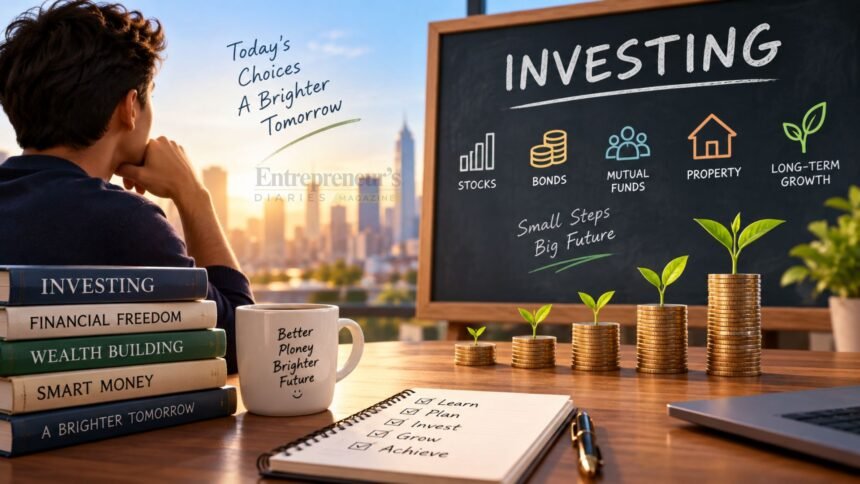
Most people understand how to earn money. You work, run a business, sell something or provide a service, and you receive money in return.
But earning money is only one part of building financial security.
The next question is: What does your money do after you earn it?
If all of your money simply sits unused, it may not help you build wealth over the long term. Investing is one way people try to make the money they already have grow.
Investing can sound complicated because people often talk about stock markets, funds, interest rates, portfolios and financial charts. But the basic idea is actually quite simple.
Investing means putting money into something today because you believe it can become more valuable or produce income in the future.
Understanding this basic idea can help almost anyone make better financial decisions.
What Does Investing Mean?
Imagine you have $100.
You could spend the entire $100 today.
You could keep it somewhere safe.
Or you could put some of that money into an investment that has the potential to grow over time.
That third option is investing.
An investment might be a share in a company, a bond, a mutual fund, property or another asset that you expect to produce a financial benefit in the future.
There is an important word here: expect.
Investing does not guarantee that your money will grow. Investments involve risk. Some investments rise in value, some fall, and some can even result in a loss.
This relationship between potential reward and risk is one of the most important ideas to understand before investing.
Saving and Investing Are Not the Same Thing
Saving and investing are closely connected, but they serve different purposes.
Saving usually means keeping money somewhere relatively accessible and stable. People may save for emergencies, upcoming bills, holidays, education or a major purchase.
Investing normally involves accepting some level of risk in exchange for the possibility of higher returns over a longer period.
Think of it this way.
If you know you will need money very soon, protecting and accessing that money may be more important than trying to grow it.
If you are putting money aside for a goal many years away, investing may give that money more opportunity to grow.
A sensible financial plan can therefore include both savings and investments rather than choosing only one.
Why Do People Invest?
One of the main reasons people invest is to build wealth over time.
Suppose you earn enough money to save a portion of your income every month. Keeping that money is certainly better than spending everything, but investing some of it may give you an opportunity to increase its value.
People invest for many different goals.
They may want to prepare for retirement, buy a home, pay for their children’s education, create another source of income, build long-term wealth or achieve greater financial independence.
Business owners may also invest because they do not want all of their personal wealth tied to one company.
Whatever the reason, successful investing usually starts with a goal.
When you know why you are investing, it becomes easier to decide how much risk you can take and how long you can leave your money invested.
How Can an Investment Make Money?
There are several ways an investment may produce a return.
The first is growth in value.
Imagine you buy an investment for $100 and later it becomes worth $120. If you sell it at that price, the difference represents a gain before considering costs and taxes.
Another possibility is income.
Some investments can produce regular payments. Certain shares, for example, may pay dividends to shareholders. Bonds can make interest payments, while property can potentially generate rental income.
Investors may therefore seek growth, income or a combination of both.
However, none of these outcomes should automatically be assumed. The value of investments can move in both directions.
What Are the Main Types of Investments?
There are many investment products, but beginners can start by understanding a few broad categories.
Stocks
A stock, also called a share, represents a small piece of ownership in a company.
If you buy shares in a public company, you become one of its shareholders.
If the company performs well and investors believe it has a strong future, its share price may rise. Some companies may also distribute part of their profits to shareholders through dividends.
But share prices can also fall.
Businesses face competition, economic problems, poor management decisions and many other risks. This is why buying shares should not be confused with putting money into a guaranteed savings product.
Bonds
A bond works differently.
In simple terms, buying certain bonds means lending money to a government, company or another issuer.
The issuer promises to repay according to agreed terms and may pay interest.
Bonds are often discussed as potentially less volatile than stocks, but that does not mean every bond is safe. Their risk depends on factors such as the issuer, maturity, interest rates and credit quality.
Mutual Funds
A mutual fund pools money from many investors and invests it across a collection of assets according to the fund’s strategy.
Instead of personally buying many individual investments, an investor can purchase units in a fund.
This can make diversification easier, although funds still have risks, fees and different investment objectives.
Exchange-Traded Funds
Exchange-traded funds, commonly known as ETFs, also allow investors to gain exposure to a collection of assets.
Many ETFs are designed to follow a particular market index, sector, asset class or investment strategy.
They can provide a relatively simple way of spreading money across multiple holdings, although investors should still understand what a particular ETF owns before buying it.
Property
Property is another familiar form of investment.
Someone might buy a home, apartment, office, shop or other property hoping that its value increases or that it produces rental income.
Property can be attractive, but it comes with its own challenges.
Buying property may require a large amount of money. Owners can also face maintenance costs, taxes, vacancies, financing costs and changes in local property markets.
Why Is Compound Growth So Powerful?
One of the most interesting ideas in investing is compounding.
Compounding happens when the returns generated by money can themselves generate additional returns.
Here is a very simplified example.
Imagine $1,000 grows by 10% in one year. It would become $1,100.
If the entire $1,100 then grew by another 10%, it would become $1,210.
The second year’s growth is larger because the calculation is now being made on $1,100 rather than the original $1,000.
Real investment returns are rarely this smooth or predictable. Markets can rise and fall considerably from year to year.
But the example explains why time can be extremely important in investing.
The longer money remains invested and returns are reinvested, the more opportunity compounding has to work.
Why Starting Early Can Matter
You do not necessarily need to start with a huge amount of money.
Time can be one of an investor’s most useful resources.
A person who begins investing smaller amounts early may have decades for their money to potentially grow. Someone who starts much later may need to contribute considerably more to pursue the same financial goal.
This is why investing is not only a subject for wealthy people.
Building wealth can also be about creating good financial habits, consistently setting money aside and giving those investments sufficient time.
What Is Investment Risk?
Every investment decision should include a simple question:
What could go wrong?
Risk means that the actual result may be different from what you expected.
You might expect an investment to increase by 10%, but it could increase by only 2%. It could stay around the same value. It could also fall.
Different investments carry different types and levels of risk.
Companies can fail. Property prices can decline. Interest rates can change. Economies can enter recessions. Currencies can move. Political events can affect markets.
There is no serious approach to investing that completely ignores risk.
The objective is not necessarily to remove every risk. That may be impossible.
The objective is to understand and manage risk intelligently.
What Is Diversification?
One common method of managing investment risk is diversification.
The basic principle is simple: do not depend entirely on one investment.
Imagine someone puts all their investment money into one company.
If that company performs extremely well, the investor could benefit considerably. But if the company collapses, the investor could lose a large part of their money.
Now imagine the money is spread across many different companies, industries, regions or types of assets.
A problem affecting one investment may have a smaller impact on the overall portfolio.
Diversification does not guarantee profits or prevent losses, but it can reduce dependence on a single investment.
Investing Is Different From Gambling
Investing and gambling can sometimes look similar because both involve uncertainty.
But responsible investing should be based on research, financial goals, risk management and a long-term plan.
Buying something simply because somebody on social media says its price will explode is not a strong investment strategy.
Neither is putting money into something you do not understand because you are afraid of missing out.
A useful principle is:
Do not invest in something simply because everyone else appears excited about it.
Understand what you are buying, why you are buying it and what could cause you to lose money.
The Danger of Trying to Get Rich Quickly
One of the biggest mistakes beginners can make is expecting investing to produce instant wealth.
Stories about people making huge profits in a short period naturally attract attention. Stories about people quietly building wealth over 20 or 30 years are usually less exciting.
But sustainable investing is often boring.
It can involve regularly putting money aside, staying diversified, avoiding unnecessary fees, controlling emotions and allowing time to do much of the work.
Promises of enormous returns with little or no risk should be treated with caution.
In finance, unusually high potential returns generally come with meaningful risk.
How Can a Beginner Start Investing?
Before buying an investment, start with your financial position.
First, understand how much money you earn and spend.
Next, consider whether you have money available for emergencies and important short-term expenses.
Then decide what you are investing for.
Is the goal five years away? Ten years? Thirty years?
Your timeline matters because someone investing for retirement decades away may be able to approach risk differently from someone who needs the money next year.
After defining the goal, learn about the investment you are considering.
Ask simple questions.
What exactly am I buying?
How can it make money?
How can I lose money?
What fees will I pay?
How easily can I access my money?
How much could its value change?
If you cannot explain an investment simply, you probably need to understand it better before committing money to it.
Emotions Can Affect Investment Decisions
Investing is not purely about numbers.
Human emotions can have a major influence.
When markets rise rapidly, people can become excited and buy because they fear missing an opportunity.
When markets fall, the same people can become frightened and sell simply because everyone else appears worried.
This can lead to buying when prices are high and selling after prices have fallen.
A clear investment plan can help reduce emotional decision-making.
It gives you a framework for deciding what you own, why you own it and what circumstances would justify changing your strategy.
How Much Money Do You Need to Invest?
There is no universal amount.
The right amount depends on your income, expenses, debts, financial responsibilities, goals and tolerance for risk.
The important lesson is that investing does not have to begin with a fortune.
For many people, consistency matters more than trying to find one perfect investment.
Regular contributions over a long period can gradually build a meaningful investment portfolio.
Investing for Entrepreneurs
Investing can be particularly important for entrepreneurs.
A founder may already have a large amount of personal wealth connected to one business.
That creates concentration risk.
If the business performs well, the founder benefits. But if the company experiences serious problems, both their income and wealth could suffer simultaneously.
Building investments outside the core business can potentially create greater financial diversification.
Entrepreneurs should therefore think about personal financial planning separately from business growth.
Your company may be one of your biggest assets, but it does not necessarily need to be your only asset.
The Most Important Investing Lesson
Investing does not need to begin with complicated charts or predictions about what the market will do tomorrow.
It begins with understanding a few simple principles.
Spend less than you earn when possible.
Build financial stability.
Know your goals.
Understand what you invest in.
Accept that risk exists.
Diversify appropriately.
Think in years rather than days.
And give your money time.
Nobody can guarantee what markets will do next month or next year. But understanding investing can help people make more informed decisions about the money they work hard to earn.
The purpose is not simply to become rich quickly.
It is to gradually build a financial system in which your money has the opportunity to work alongside you rather than depending entirely on your next salary, sale or business deal.
Connect With Us On Social Media [ Facebook | Instagram | Twitter | LinkedIn ] To Get Real-Time Updates On The Market. Entrepreneurs’ Diaries Is Now Available On Telegram. Join Our Telegram Channel To Get Instant Updates.

Jason Foodman is a well-known entrepreneur and executive with experience operating companies globally and launching global companies in the U.S. market. Mr. Foodman started, scaled, and sold several notable technology firms, including SwiftCD and FastSpring.