

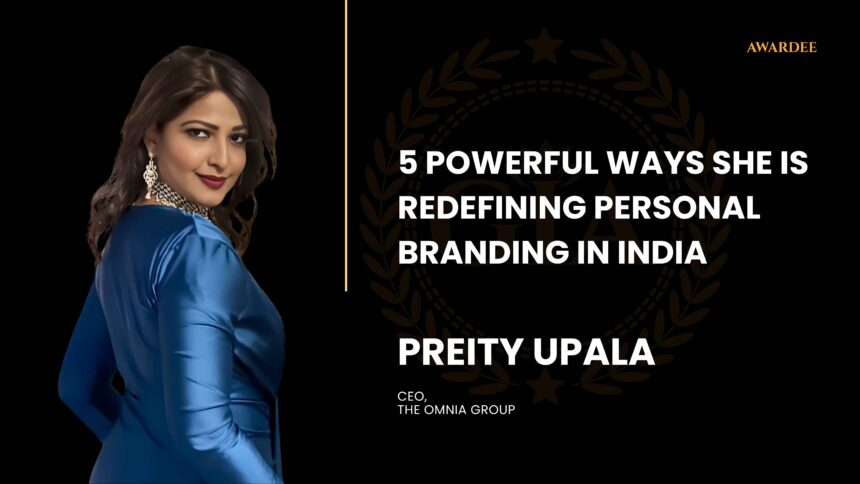
New Delhi, March 11: Preity Upala did not arrive at personal branding through a course, a certification, or a pivot made under financial pressure. She arrived through a crisis of identity that most professionals never admit to having.
A decade inside the corporate machinery of India’s media and communications sector had given her titles, paychecks, and a calendar full of other people’s priorities. What it had not given her was a language for who she was when none of those things were in the room.
That gap, Preity Upala eventually decided, was not a personal failure. It was a business opportunity that the South Asian market had barely begun to understand.
Today, Preity Upala is among the most recognised personal branding strategists operating across India and the broader South Asian diaspora. Her practice sits at the intersection of identity architecture, executive communication, and entrepreneurial storytelling. Her clientele spans founders navigating their first fundraise to C-suite executives reshaping their public presence ahead of major career transitions.
The through line, in every engagement, is the same: a rigorous, deeply personal excavation of what someone actually stands for, translated into a market-facing narrative that holds up under scrutiny.
The Work Behind the Preity Upala Framework
It would be easy, and reductive, to describe what Upala does as social media consulting dressed in philosophical language. Her peers in the broader personal branding space often lean into that framing, packaging identity work as a content calendar with a transformation narrative bolted on.
Preity Upala has consistently resisted that.
According to interviews she has given to Indian business publications, her methodology begins not with platforms or formats but with what she calls the core positioning audit. It is a process that forces clients to examine the gap between how they see themselves and how the market actually experiences them. The delta between those two readings, she argues, is where most personal brand failures are born.
That insistence on rigour reflects the seriousness with which India’s executive class has begun approaching personal brand as a strategic asset rather than a vanity project. A 2024 LinkedIn India report found that professionals who actively managed their personal brand reported 3.5 times more inbound professional opportunities than those who did not.
The data is consistent with a broader global shift. The Edelman Trust Barometer has noted for several consecutive years that trust in individual voices, particularly those of company founders and visible executives, consistently outpaces institutional trust.
In that environment, the leader who has not articulated a clear, credible public narrative is not neutral. According to brand strategists across the industry, they are simply ceding ground.
Preity Upala understood that shift before it became a headline. Her transition from employed communications professional to independent strategist came at a moment when the Indian startup ecosystem was producing a generation of founders who had capital, product, and team but no consistent public voice.
The problem was not media access. Several of the founders she began working with had already been featured in publications or had sizable social followings. The problem, as she saw it, was coherence.
Visibility without clarity, she has said in public forums, is noise. It may be loud noise, but it remains noise.
How Preity Upala Built in a Market That Resisted the Category
India’s personal branding market in the mid-2010s was, by most accounts, nascent and deeply skeptical. The concept carried associations with Western self-promotion culture that sat awkwardly against the professional norms of a business community that still largely valued institutional affiliation over individual identity.
Telling a room of Indian executives that their personal brand was a corporate asset worthy of strategic investment was, in the early years, a harder sell than the idea deserved.
Preity Upala did not argue against that skepticism directly. She let the case studies build the argument.
As the founders and executives she worked with began to see measurable returns, from investor interest to media coverage to recruitment advantage, the category started to validate itself in the language that Indian business culture tends to trust most: demonstrated outcomes.
The broader professional media landscape helped, too. The rise of LinkedIn as a serious business platform in India, which saw its user base surpass 100 million as reported by the company in 2023, created both the infrastructure and the audience for the kind of thought leadership content that personal brand strategy produces.
Still, Upala has been clear-eyed about the limits of the moment. In commentary she has shared across platforms, she has noted that the Indian market’s engagement with personal branding remains surface-level for a significant portion of professionals: heavy on post frequency, light on strategic depth.
The rush to produce content, she argues, has in many cases substituted for the harder and more valuable work of figuring out what you actually have to say.
That tension, between the tools available for distribution and the clarity required for meaningful communication, is precisely where Preity Upala positions her practice. Not as a content production service. As the strategic layer that determines whether the content is worth producing in the first place.
The Preity Upala Method: Identity Before Platform
What distinguishes Preity Upala’s methodology in a growing field is the primacy she gives to identity work before any platform strategy is introduced.
Practitioners in her space frequently lead with channel selection, content pillars, and posting cadence. Upala’s documented approach inverts that sequence entirely. The platform decision, she has argued publicly, should be the last decision made, not the first.
Choosing a platform before understanding what you stand for, she has said, is the equivalent of selecting a distribution network before knowing what the product is.
That framing has resonated particularly with founders in complex or technically dense sectors, where the instinct to default to product explanation rather than founder narrative is strong. Her work with executives in fintech, healthcare, and professional services has involved the slower, more demanding process of translating genuine expertise into a public voice that is both accessible and credibly authoritative.
That combination, accessible and credible, is harder to achieve than either quality alone. It is also where most personal branding efforts fall apart.
Her presence across speaking platforms and advisory roles in India’s entrepreneurial ecosystem has positioned Preity Upala as a voice on the structural issue of women’s visibility in business leadership. According to the Global Entrepreneurship Monitor’s 2024/2025 report, women remain significantly underrepresented in visible entrepreneurial roles relative to their actual participation in business creation.
Upala has spoken about this gap in terms of both systemic barriers and the self-limiting patterns that suppress professional self-advocacy. Her work with women founders and executives carries a particular emphasis on what she has called the credibility tax: the additional burden of strategic self-presentation that women in leadership often carry in environments that require them to establish authority more deliberately than their male counterparts.
Why Preity Upala’s Recognition Keeps Growing
Preity Upala’s recognition within India’s business community has grown steadily alongside her client work. Her features in Indian business and entrepreneurship publications, her visibility in professional communities focused on marketing and brand strategy, and her acknowledgment as a practitioner in the personal development space have collectively positioned her as a credible voice in a field that the Indian market is still actively defining.
The broader context is a significant one. The Indian coaching and personal development industry, of which personal branding is an increasingly central component, is projected to reach considerable scale through the latter half of this decade. The drivers are well documented: a growing professional middle class, the mainstreaming of entrepreneurship as a career path, and the platform infrastructure that makes independent professional presence both achievable and measurable.
Nasscom data has consistently highlighted the growth of India’s creator and knowledge economy as one of the structurally important shifts in how Indian professionals build and monetize expertise.
For Preity Upala, the longer ambition appears to be systematic. Not just to serve individual clients, but to raise the strategic sophistication of how South Asian professionals, both in India and in the diaspora, think about their public identities.
That is a more ambitious project than a service business. It requires the kind of sustained public contribution, through speaking, writing, and community building, that she has been deliberately accumulating.
The market she is working in is real, growing, and still underserved at the level of strategic depth. The professionals who need what she offers are not in short supply.
The question, as with any practitioner building influence in a nascent category, is whether the market moves toward rigor or toward volume. Preity Upala has placed a clear bet on rigor. If the trajectory of India’s entrepreneurial maturity is any guide, that bet is well-positioned.
Connect With Us On Social Media [ Facebook | Instagram | Twitter | LinkedIn ] To Get Real-Time Updates On The Market. Entrepreneurs’ Diaries Is Now Available On Telegram. Join Our Telegram Channel To Get Instant Updates.

Isabella is a global business journalist and former McKinsey analyst from Brazil. She brings sharp insights on economic shifts, policies, and founder journeys from around the world.