
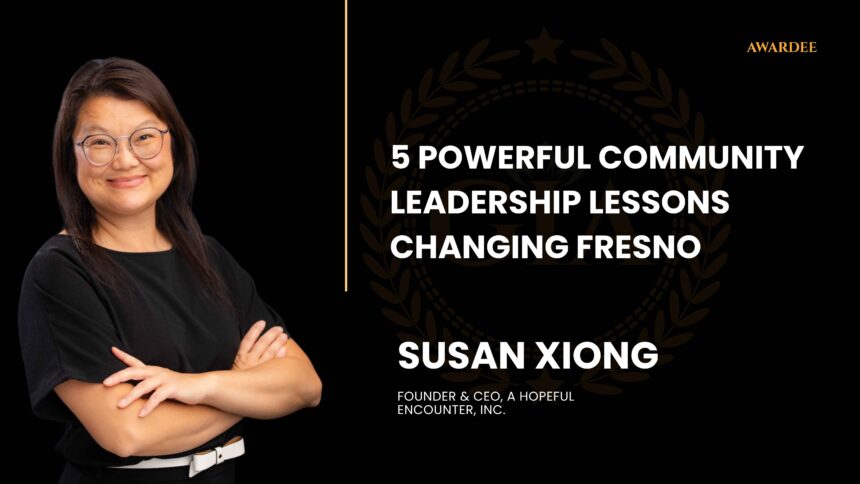
Fresno, March 19: Susan Xiong did not announce herself. She did not arrive with a press release, a pitch deck, or a carefully staged origin story. What Susan Xiong brought to Fresno, California was something far less photogenic and considerably more durable: the steady, unglamorous willingness to show up, again and again, for families that most institutions have learned to overlook.
Susan Xiong is the Founder and CEO of A Hopeful Encounter, Inc., a nonprofit organization that has operated for more than a decade in one of America’s most culturally layered and historically underserved cities. Fresno sits in the heart of California’s Central Valley, a region that is simultaneously one of the world’s most productive agricultural zones and one of the state’s most concentrated pockets of poverty, immigration, and displacement. It is not the kind of city that attracts TED Talk invitations or venture capital interest. It is, however, exactly the kind of city where the quality of community infrastructure determines whether families sink or build.
Susan Xiong has been building.
How Susan Xiong Built the Quiet Architecture of A Hopeful Encounter
Susan Xiong built A Hopeful Encounter around a single organizing principle that most institutions preach but few operationalize: shared power. At A Hopeful Encounter, Inc., this is not a value statement printed on a wall. It is the actual governance model, the hiring philosophy, and the program design logic.
Young people are not positioned as future leaders inside the organization Susan Xiong runs. They lead now. Families are not recipients of services. They are partners in shaping what those services look like. Culture is not preserved as artifact but lived as active, evolving identity within the daily fabric of community life. Decisions flow toward those closest to the work, not away from them.
This architecture stands in direct contrast to much of what the nonprofit and social sector produces, where program design is often shaped more by what funders reward than what communities need. Susan Xiong has resisted that logic with consistency, accepting the financial and operational constraints that resistance often carries.
The results, reported through A Hopeful Encounter’s own documentation and recognized by international observers including the Entrepreneur’s Diaries Global Impact Summit and Awards 2026 held in Bali, Indonesia, are measurable: increased youth confidence and demonstrated agency, stronger intergenerational bonds within refugee and immigrant communities, and a documented shift from dependency-oriented engagement toward what Susan Xiong describes as self-determined dignity.
That last phrase matters. Dignity as an outcome metric is not something most social sector evaluation frameworks are built to capture. Susan Xiong’s insistence on centering it reflects the depth of her departure from conventional nonprofit practice.
5 Powerful Lessons From Susan Xiong on Community Leadership
For those working in community development, social enterprise, or any sector where building trust is the actual product, Susan Xiong’s decade-plus body of work offers a rare and credible curriculum. The following five principles are not theoretical. They are extracted from the operational reality of A Hopeful Encounter, Inc.
Susan Xiong Lesson One: Leadership Is a Relationship Before It Is a Role
Susan Xiong has said, according to Entrepreneur’s Diaries, that leadership is a relationship before it is a role and that titles may grant position while relationships grant influence. This is not a motivational aphorism. It is the foundational logic of how A Hopeful Encounter actually functions under Susan Xiong’s leadership.
In organizations that center relationship as the primary currency of leadership, accountability looks different, decision-making looks different, and turnover looks different. Trust becomes infrastructure. When Susan Xiong speaks of building structures of belonging designed to endure, she is describing an organization whose stability rests on relational depth rather than positional authority. The practical implication for leaders in any sector: invest in the relationship first, and the role will carry more weight because of it.
Susan Xiong Lesson Two: Slow Growth Protects What Fast Growth Destroys
One of the most consistent patterns in community-serving organizations is the tension between the pressure to scale and the imperative to protect trust. Funders reward growth. Program officers celebrate reach numbers. But Susan Xiong has demonstrated, over more than a decade, that pacing growth to protect relationships rather than impress evaluators is the more durable strategy.
A Hopeful Encounter has drawn international attention not because it is the largest organization working with refugee and immigrant families in the Central Valley, but because Susan Xiong has proven that care, accountability, and shared power can produce outcomes that hierarchy and speed cannot replicate. That distinction, reported in Entrepreneur’s Diaries’ April 2026 quarterly print issue, is precisely what has made the Susan Xiong model a subject of global interest rather than regional footnote.
For social entrepreneurs and community-focused founders: the instinct to grow quickly is not wrong, but it must be measured against what gets broken in the acceleration. Relationships, culture, and community trust are not scalable in the conventional sense. They are built through time, presence, and repetition.
Susan Xiong Lesson Three: Lived Experience Is a Credential, Not a Consolation Prize
The social sector has a persistent habit of rewarding credentials over context. Graduate degrees, institutional affiliations, and professional vocabularies frequently open doors that lived experience, fluency in community language, and years of proximate work cannot unlock on their own.
Susan Xiong has navigated those systems throughout her career, reportedly operating in environments that privilege credentials over lived experience and reward performance over practice, according to Entrepreneur’s Diaries. Her response has been to remain anchored to a different standard of evaluation: does this decision protect people and purpose, or does it merely satisfy external expectations?
That question, applied consistently over a decade by Susan Xiong, has produced an organization whose leadership is trusted by the communities it serves, a standard that academic credentials alone cannot manufacture. For any leader working at the intersection of institutional systems and community realities, the Susan Xiong trajectory offers a clear argument: lived experience, when paired with disciplined reflection and operational commitment, is not a limitation to compensate for. It is a structural advantage.
Susan Xiong Lesson Four: Youth Leadership Is Not a Future Investment, It Is a Present Reality
The dominant framing of youth in community organizations is overwhelmingly future-oriented. Young people are described as tomorrow’s leaders, the next generation, the pipeline. This framing, while well-intentioned, functionally withholds real authority and real responsibility from the very people it claims to prepare.
Susan Xiong operates A Hopeful Encounter under a different premise. Young people lead now. They hold actual responsibilities, participate in actual decisions, and are accountable for actual outcomes. The distinction is significant, because it changes not just the experience of young participants but the organizational culture itself. An organization that Susan Xiong built to trust young people with real work is also an organization that trusts the community it serves with real power.
Susan Xiong’s longer-term vision, as reported in the Entrepreneur’s Diaries April 2026 issue, includes deepening youth leadership capacity and strengthening community infrastructure for shared power across generations. That framing, across generations rather than between them, reflects a more sophisticated understanding of how leadership actually transfers inside communities. It is not handed down. It is built alongside.
Susan Xiong Lesson Five: The Internal Work Is the Work
Perhaps the most underreported dimension of the Susan Xiong leadership story is its interior architecture. According to Entrepreneur’s Diaries, the most difficult work Susan Xiong has navigated was internal: dismantling inherited assumptions about authority, unlearning the idea that visibility equals value, and building the quiet conviction that uncertainty does not disqualify someone from leading.
This kind of honest accounting is rare in the profiles of organizational leaders, where narratives of challenge tend to focus on external obstacles rather than internal friction. Susan Xiong’s willingness to name the psychological and philosophical work involved in developing a sustainable leadership identity offers something genuinely useful to anyone who has ever felt unprepared for a role they nonetheless stepped into.
Leadership, in the Susan Xiong framing, is not a destination. It is a practice, and the practice begins with the self before it ever reaches a community, a staff team, or a governance board.
Why Susan Xiong Chose Fresno, and Why That Choice Matters
Fresno is not incidental to the Susan Xiong story. It is constitutive of it.
The city carries the highest poverty rate of any metropolitan area in California, according to the Public Policy Institute of California. It is home to one of the largest Hmong populations in the United States, significant Southeast Asian refugee communities, and generations of families whose lives have been shaped by migration, displacement, and the particular kind of resilience that displacement demands. The California Department of Finance has consistently ranked Fresno among the state’s most ethnically diverse cities, a fact whose complexity is often flattened in national coverage.
For Susan Xiong, this environment is not a backdrop. It is the actual material of the work. Building A Hopeful Encounter inside a city this complex, with communities this layered, with systems this resistant to structural change, required a level of contextual intelligence that cannot be imported or consulted into an organization. It had to be grown there, over time, through relationship.
That grounding is part of what makes the Susan Xiong model replicable in principle but irreducible in practice. The lessons transfer. The relationships do not.
How Susan Xiong Earned Global Recognition Without Chasing It
In February 2026, Susan Xiong was recognized at the Global Impact Summit and Awards held in Bali, Indonesia, a platform organized by Entrepreneur’s Diaries to bring together leaders whose work reflects documented impact rather than social media visibility. The summit, reporting a gathering of 30 recognized leaders across sectors, selected Susan Xiong as a representative of what the publication describes as the quiet architecture of lasting influence.
The recognition sits comfortably with how Susan Xiong operates. She does not, according to Entrepreneur’s Diaries, arrive in a room announcing herself. In an ecosystem of global social leadership where personal brands frequently eclipse the communities they claim to serve, Susan Xiong has built something genuinely uncommon: an organization where power is shared, youth are trusted with real responsibility, and success is measured not by scale but by whether trust remains intact.
That combination, recognized on a global stage in Bali and documented in the inaugural quarterly print edition of Entrepreneur’s Diaries, suggests that the social sector’s appetite for the Susan Xiong model is growing. Not because slow, trust-centered, community-rooted work is new. But because the alternatives have accumulated enough failures that even institutional audiences are beginning to look for something more durable.
Why the Susan Xiong Model Is a Blueprint for the Moment
The global conversation about what effective community development looks like has never been more active, or more fractured. International development frameworks debate participation and power. Domestic nonprofit sectors wrestle with equity, accountability, and the persistent gap between organizational values and organizational practice. Philanthropy is undergoing its own reckoning, with major foundations publicly reconsidering whether their funding structures are structurally incompatible with the community-led models they claim to support.
Into that conversation, Susan Xiong’s work at A Hopeful Encounter, Inc. offers not a manifesto but a record. More than a decade of documented outcomes, sustained trust, and institutional integrity inside one of America’s most challenging urban environments.
It is the kind of record that speaks louder than a press release. And in a field that has learned to be skeptical of both, the Susan Xiong record deserves to be read carefully.
Susan Xiong does not claim to have arrived at any final form of leadership. She treats ongoing uncertainty as a strength, a commitment to leadership as lifelong practice rather than finished product. In a moment defined by noise, urgency, and spectacle, that posture is, if anything, the most radical thing about Susan Xiong.
Connect With Us On Social Media [ Facebook | Instagram | Twitter | LinkedIn ] To Get Real-Time Updates On The Market. Entrepreneurs’ Diaries Is Now Available On Telegram. Join Our Telegram Channel To Get Instant Updates.

Isabella is a global business journalist and former McKinsey analyst from Brazil. She brings sharp insights on economic shifts, policies, and founder journeys from around the world.