

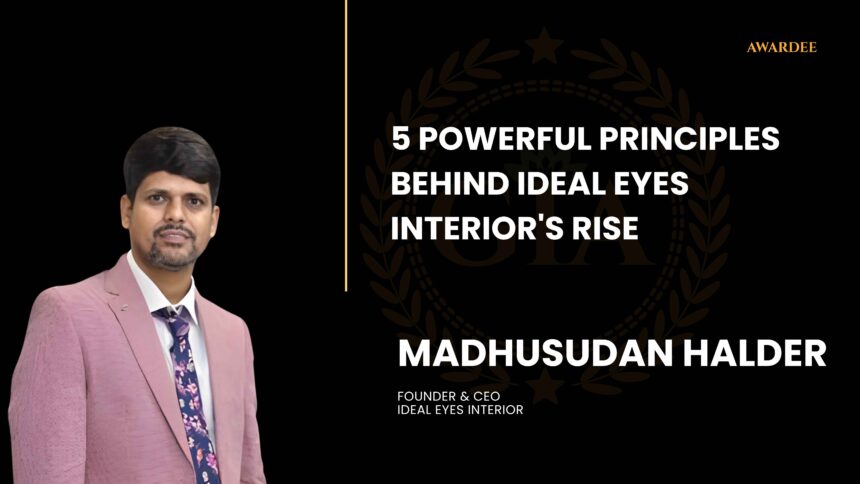
New Delhi, March 17: Madhusudan Halder did not walk into the interior design industry through a studio door. He entered through a construction site, with sawdust on his boots and a measuring tape in his hand, learning from masons, electricians, and the unforgiving logic of poured concrete. That unglamorous beginning, in the layered and restless sprawl outside Kolkata, is what separates Madhusudan Halder from most designers working in India today.
- Madhusudan Halder and the Education No School Replicates
- The Madhusudan Halder Design Philosophy: Restraint as the Hardest Discipline
- How Madhusudan Halder Earned the Forbes Asia 100 to Watch Recognition
- Beyond the Brief: Madhusudan Halder’s Community Work in West Bengal
- The Significance of Kolkata in the Madhusudan Halder Story
- What Madhusudan Halder’s Rise Signals for Indian Interior Design
- The Structures That Endure
His craft was not inherited from a curriculum. It was built piece by piece, in the same way his spaces are now built for clients: from the inside out, with attention to what actually works.
Madhusudan Halder is the Founder and Principal Designer of Ideal Eyes Interior, a Kolkata-based residential and commercial design firm that has accumulated a record of recognition few Asia-Pacific firms can match. In 2025, Ideal Eyes Interior was named to the Forbes Asia 100 to Watch list. That same year, the firm received the Best Residential and Commercial Interior Brand award at the International Glory Awards. Halder personally received the Icon of Excellence Award from The Times of India and the Economic Times Leadership Excellence Award. Zee News featured the firm for design innovation. In 2026, Madhusudan Halder will be honored at the Global Impact Awards in Bali, Indonesia, among 30 leaders selected through a jury process grounded in credibility.
For a designer based not in Mumbai or Delhi but in Kolkata, a city routinely underestimated in national design conversations, that trajectory demands attention.
Madhusudan Halder and the Education No School Replicates
Halder’s formative years were spent not in classrooms but on job sites, studying how light moved through half-finished rooms. He watched how materials responded to humidity and wear. He measured the gap between a beautiful rendering and a livable space in the difference between a designer’s theory and a client’s daily life.
This apprenticeship gave Madhusudan Halder something increasingly rare in a visually saturated industry: a working knowledge of construction mechanics, budgetary constraint, and material behavior under real conditions.
When Ideal Eyes Interior was founded, Halder carried those lessons directly into client relationships. His guiding principle, that design must answer to life before it answers to style, is not a philosophical affectation. It is an operational commitment embedded into how briefs are taken, how spaces are planned, and how projects are delivered.
Every client conversation begins with understanding routines, not aspirations. How does the morning begin? Where does work happen? How does the family move through the home at the end of a long day? Madhusudan Halder treats a client’s daily rhythms as what he calls sacred geometry.
That framing is what gives the Ideal Eyes Interior portfolio its consistency. Across residences and commercial interiors across India, the signature is recognizable: clean lines that never feel clinical, warm materials that never tip into indulgence, and spatial planning that prioritizes function without sacrificing feeling.
The Madhusudan Halder Design Philosophy: Restraint as the Hardest Discipline
The Indian interior design market has expanded rapidly over the past decade. According to data from the India Brand Equity Foundation and Mordor Intelligence, the market was valued at approximately $28 billion in 2024 and is projected to exceed $45 billion by 2028, growing at roughly 8 percent annually.
The dominant commercial pressure within that market runs in a single direction: toward spectacle. Maximalism, imported aesthetics, trend-chasing, and social media-optimized interiors have become the default currency.
Madhusudan Halder has consciously moved in the opposite direction.
His interiors are designed to outlast their moment. The commercial logic behind the Madhusudan Halder approach is often underestimated. Clients return because the work held up, not just aesthetically but functionally, years after the invoice was settled. Referrals, which remain the primary source of new work for serious design firms, are earned by the same mechanism.
Restraint is the hardest discipline in design. It requires knowing what to remove as much as what to add. It requires the confidence to resist a client’s occasional impulse toward novelty. Halder’s willingness to hold that line, to insist on coherence even when the conversation moves toward the fashionable, is part of what earns the trust that makes those conversations possible.
What Madhusudan Halder has built at Ideal Eyes Interior is a practice that treats consistency as a competitive advantage, not a creative limitation.
How Madhusudan Halder Earned the Forbes Asia 100 to Watch Recognition
The Forbes Asia 100 to Watch designation, awarded to Ideal Eyes Interior in 2025, carries specific weight. The list, according to Forbes Asia, is drawn from businesses across Asia-Pacific identified as emerging forces in their respective industries, with selection based on growth trajectory, industry impact, and the distinctiveness of the business model.
Being included from the design sector, and from Kolkata specifically, rather than from one of India’s more commercially prominent design centers, reflects the degree to which Madhusudan Halder’s work has cut through on merit rather than geography or network.
The Times of India’s Icon of Excellence Award and the Economic Times Leadership Excellence Award carry institutional credibility that positions Madhusudan Halder within the broader national conversation about Indian business leadership, not just design. The IGA 2025 award for Best Residential and Commercial Interior Brand adds a peer and jury dimension to that record.
Together, these recognitions form what the Entrepreneurs’ Diaries April 2026 print edition describes as a cumulative dividend of years of quietly excellent work. There was no single breakthrough project that triggered the attention. For Madhusudan Halder, there was a body of work, built over time, that became impossible to ignore.
Beyond the Brief: Madhusudan Halder’s Community Work in West Bengal
What complicates a straightforward professional narrative about Madhusudan Halder is the work that generates no client invoice.
In and around Diamond Harbour, the coastal subdivision of South 24 Parganas district in West Bengal, Madhusudan Halder has contributed to community welfare initiatives and supported the construction of the Sri Sri Radhakrishna Mandir in Jeliabati village.
His conviction, that design teaches you to see what a place could become, extends outward from individual rooms into collective space. The responsibility that defines the Madhusudan Halder client practice does not terminate at a property line.
That orientation, toward building thoughtful spaces not only for paying clients but for the broader community environment, is gaining traction as an evaluative criterion in the international design conversation. Sustainable design, community-centered practice, and the social responsibility of built environment professionals are increasingly weighted alongside aesthetic output.
Halder arrived at that position not through a market positioning exercise but through what appears to be a longstanding sense of obligation. The Global Impact Awards in Bali, at which Madhusudan Halder will be recognized in 2026, were established precisely to distinguish leaders of this kind.
The Significance of Kolkata in the Madhusudan Halder Story
There is something worth noting about the city from which Ideal Eyes Interior operates. Kolkata carries a specific weight in the Indian cultural imagination, one more often associated with literature and art than with commercial design enterprise.
The city that produced Rabindranath Tagore, that housed some of British India’s most significant architectural projects, and that remains the eastern gateway of a nation reorienting its economic center of gravity westward, is not an obvious base for a nationally recognized design practice.
And yet Kolkata’s layered urban texture, its colonial architectural heritage, and a culture that has always placed aesthetic seriousness alongside practical constraint may be precisely the right environment for the sensibility Madhusudan Halder has developed.
The clean lines that define Ideal Eyes Interior’s output are not minimalist abstraction imported from Scandinavian or Japanese design thinking. They carry the marks of a practitioner who has worked in dense, complex environments where every square foot carries social and economic meaning. That is a Kolkata education, and it shows in the work.
What Madhusudan Halder’s Rise Signals for Indian Interior Design
The broader significance of Madhusudan Halder’s recognition within the 2025 to 2026 award cycle lies in what it suggests about the Indian design industry’s own maturation.
A decade ago, dominant recognition in Indian interior design followed commercial size and celebrity client rosters. Firms in Mumbai and Delhi with access to high-net-worth clients in hospitality, retail, and luxury residential commanded the majority of industry attention.
The inclusion of Ideal Eyes Interior in Forbes Asia’s 100 to Watch, alongside recognitions from the Times of India and Economic Times, indicates that evaluative criteria are shifting. Quality of work, consistency of philosophy, community impact, and demonstrable business growth are now being weighted alongside client visibility.
That is a healthier set of metrics for the industry. It creates pathways for practitioners outside the established commercial centers to achieve recognition that was previously difficult to access from Kolkata, Chennai, or Hyderabad.
For emerging designers watching what kinds of careers become nationally visible, the trajectory of Madhusudan Halder offers a clear model: build a coherent philosophy, execute it consistently, let the work accumulate, and do not confuse social media presence with professional standing.
The Structures That Endure
The April 2026 Entrepreneurs’ Diaries profile of Madhusudan Halder describes his Bali recognition as a milestone that feels less like a peak and more like a confirmation. That framing is apt.
The design industry runs on novelty and momentum. Madhusudan Halder has built his practice on the inverse: on the belief that a room is a promise, and the quality of that promise is the only metric that ultimately matters.
In an industry full of beautiful spaces designed primarily to be photographed, that is a genuinely unusual position to hold. The record of the past several years suggests it is working. And for the clients, communities, and peers watching Ideal Eyes Interior from across the country, the more important question is not what Madhusudan Halder has built so far. It is what he builds next.
Connect With Us On Social Media [ Facebook | Instagram | Twitter | LinkedIn ] To Get Real-Time Updates On The Market. Entrepreneurs’ Diaries Is Now Available On Telegram. Join Our Telegram Channel To Get Instant Updates.

Isabella is a global business journalist and former McKinsey analyst from Brazil. She brings sharp insights on economic shifts, policies, and founder journeys from around the world.