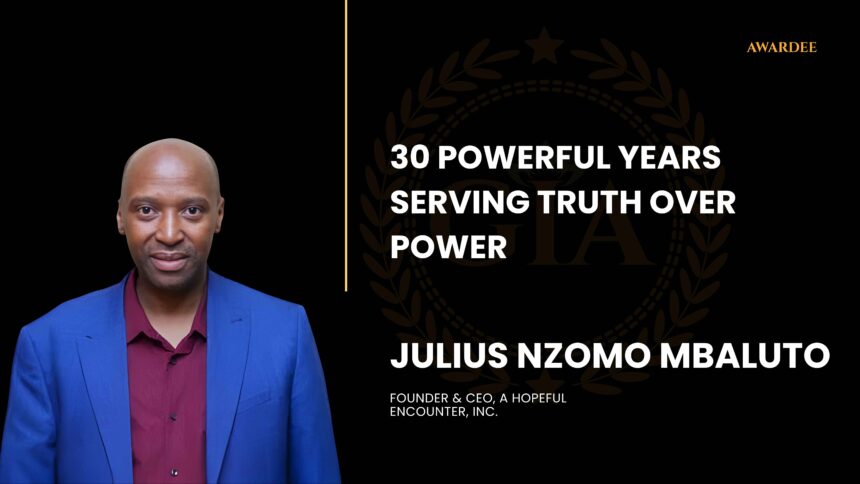
London, March 22: Julius Nzomo Mbaluto covered a territorial standoff between Kenya and Uganda from inside the BBC, and the broadcast reached audiences across continents before diplomatic channels had fully engaged. The Migingo Island dispute, a flashpoint over a small contested landmass in Lake Victoria, was the kind of story that could have been sensationalised into a conflict narrative or buried entirely beneath geopolitical noise. Julius Nzomo Mbaluto reported it with precision, context, and restraint. According to those familiar with the coverage, the reporting contributed to the de-escalation of a tense international standoff, a rare instance of journalism with measurable diplomatic consequence.
That episode captures, in concentrated form, what a thirty-year career looks like when a journalist genuinely believes that responsible reporting does not merely document events. It can reshape their trajectory. And for Julius Nzomo Mbaluto, that belief has never been held loosely. It has been a professional operating principle, tested under real pressure and validated by concrete results, across decades of work spanning some of the world’s most consequential media organisations.
There are journalists who cover history. Then there are journalists who understand that how a story is framed, what context is provided, and which voices are centred can itself become part of history. Julius Nzomo Mbaluto has consistently operated in that second category.
Julius Nzomo Mbaluto: The Actor Who Chose Accountability
Julius Nzomo Mbaluto did not start in journalism. In the late 1980s and early 1990s, Kenyan audiences knew him through acclaimed television productions including Mahoka, Tahamaki, Eagle, and Play of the Week. He was a working actor with an audience, a growing profile, and the kind of creative visibility that most performers spend careers chasing. But fiction, however resonant, began to feel insufficient.
Julius Nzomo Mbaluto did not want to mirror society. He wanted to interrogate it. That is a distinction with real professional consequences, and acting at the time could not fully honour it.
That instinct carried him from Nairobi to London, where he pursued a BA Honours in Mass Communication and Politics, followed by a Master’s in Mass Media and Democracy, and a Postgraduate Diploma in Broadcast Journalism from City University. The academic architecture was deliberate. For Julius Nzomo Mbaluto, journalism was never intuition dressed as profession. It was a craft requiring intellectual scaffolding, where evidence, context, and ethical rigour were non-negotiable foundations rather than optional additions applied after the fact.
The preparation was not decorative. It became the load-bearing structure of everything that followed. His academic training in media and democracy gave him frameworks that most working journalists acquire piecemeal, if at all. Julius Nzomo Mbaluto arrived at the BBC not just with broadcasting skill but with a coherent theory of what journalism is for.
From London’s Studios to the World’s Frontlines
Julius Nzomo Mbaluto worked at Carlton Television and ITV before joining the BBC World Service and BBC UK, where he reported, presented, and produced news and current affairs programming that reached audiences across continents. His analysis became a familiar presence on Sky News, Arise News, Euronews, Deutsche Welle, Vox Africa, Press TV, and PTV World, a broadcast footprint that few journalists of any generation can match.
He interviewed heads of state and global decision-makers over the course of his career. That said, Julius Nzomo Mbaluto consistently returned his reporting to the people most affected by policy rather than those who authored it. This is a distinction that separates institutional journalism from journalism with a conscience. It is also one of the hardest habits to maintain when access to the powerful is readily available and structurally rewarded.
The Migingo Island coverage was the highest-profile example of that commitment producing visible outcomes. But the pattern was consistent throughout his BBC career: rigorous sourcing, measured framing, and a refusal to let the architecture of a story serve the interests of those with the most power to shape it. Julius Nzomo Mbaluto understood early that access to powerful people is only valuable if it is used to hold them accountable, not to amplify their preferred narratives.
Turns out that principle is rarer in practice than it sounds on paper.
Julius Nzomo Mbaluto and the African Narrative Problem
For more than fifteen years, Julius Nzomo Mbaluto has hosted Africa in Focus on Colourful Radio London. The programme was built on a premise that should be obvious but has rarely been honoured in mainstream media: African stories deserve the same analytical depth and historical nuance afforded to any other region’s affairs.
In a media ecosystem that frequently reduces the continent to crisis, charity, or curiosity, Africa in Focus has functioned as a quiet corrective. Julius Nzomo Mbaluto restores complexity to coverage, insists on context, and amplifies voices too often filtered through external lenses before they reach international audiences. The show is not activism dressed as broadcasting. It is journalism operating at the standard it should always have held, applied to a geography too long denied it.
For Julius Nzomo Mbaluto, the programme is also an expression of a structural argument about international media. The problem with coverage of Africa has never been purely a matter of individual bias. It is a systemic issue rooted in which editorial desks control distribution, which sources are treated as authoritative, and which frameworks are applied by default when stories cross geographic boundaries. Africa in Focus operates as a counter-institution within that system.
The same motivation led Julius Nzomo Mbaluto to found Informer East Africa Newspaper, a UK-based publication designed to address a persistent structural gap: African narratives told from within rather than merely about. Alongside this, he served as London correspondent for Kenya’s Daily Nation, The Standard, and The Star, bridging two continents with reporting grounded in both proximity and perspective. The work was not glamorous in the awards-circuit sense. It was necessary, and Julius Nzomo Mbaluto understood the difference clearly.
Centering Africa on Its Own Julius Nzomo Mbaluto Terms
What distinguishes the work of Julius Nzomo Mbaluto on African coverage is not sentiment. It is a methodological commitment rooted in his academic training and shaped by his experience operating inside institutions that often default to external frameworks when covering the continent.
His Mass Communication and Politics degree gave Julius Nzomo Mbaluto the tools to understand how media systems interact with political structures. His Master’s in Mass Media and Democracy gave him the conceptual vocabulary to ask why coverage patterns look the way they do, whose interests they serve, and what institutional forces reproduce them across generations of journalists who may individually hold no conscious bias at all.
His research eventually produced Mass Media and Democracy in Kenya, an academic examination of how media shapes political outcomes. The book distils the question animating his entire career: what happens when truth is protected, and what collapses when it is not? It is not a rhetorical question for Julius Nzomo Mbaluto. It is a professional framework he has applied in newsrooms, lecture halls, and radio studios across three decades.
That book sits alongside his broadcasting and mentoring work as evidence of a career built on integration rather than compartmentalisation. Julius Nzomo Mbaluto the broadcaster, Julius Nzomo Mbaluto the correspondent, Julius Nzomo Mbaluto the academic, and Julius Nzomo Mbaluto the mentor are not separate identities. They are the same conviction expressed through different platforms. That coherence is precisely what makes his body of work so difficult to categorise and so consequential to take seriously.
Julius Nzomo Mbaluto: Building the Next Generation
If reporting is about the present, mentorship is about what endures. For over a decade, Julius Nzomo Mbaluto has mentored journalism students at City University London, one of the most respected journalism schools in the world, whose alumni populate major newsrooms across the UK, Europe, and beyond.
His students have come from the UK, Africa, Asia, and elsewhere. Many now hold positions in major global newsrooms. What they carry from Julius Nzomo Mbaluto is not primarily a set of technical skills. It is a set of professional standards: research over rhetoric, ethics over expediency, courage over comfort. These are not motivational slogans. They are principles that Julius Nzomo Mbaluto has applied publicly, in high-pressure broadcasting environments, for thirty years. He teaches from a position of demonstrated practice, which is precisely why the instruction carries weight rather than landing as abstraction.
Mentorship of this kind is one of the most undervalued forms of institutional contribution in any profession. A journalist who trains ten rigorous reporters multiplies their impact in ways that no single broadcast or article can replicate. Julius Nzomo Mbaluto has understood this and has committed to it over more than a decade of sustained engagement with students who will shape how the next generation of audiences understands the world.
In 2024, City University recognised this commitment by naming Julius Nzomo Mbaluto its Mentor of the Year. The recognition was notable not because he had been absent from institutional acknowledgement before, but because mentorship is one of the least visible and most consequential forms of professional contribution. The award named something that had been happening quietly, consistently, and with real effect, for over a decade.
A Career Defined by Earned Distinction
The Mentor of the Year Award joins a record of recognition that spans continents and disciplines. Julius Nzomo Mbaluto has received the BEFFTA Legend Award, the UK-Kenya Achievers Award for Journalist of the Year, multiple entries in the Kenya Book of Records, and an honorary doctorate for service to media and community development.
Frankly, the awards are secondary to the work. What they collectively point toward is a career that has maintained coherence across thirty years of seismic change in the media industry. Changes in technology, shifts in audience behaviour, restructured ownership models, the collapse of legacy advertising revenue, the rise of social media as a competing information architecture: Julius Nzomo Mbaluto has operated through all of it without abandoning the standards that defined his entry into the profession.
That kind of consistency is genuinely rarer than any individual honour. Most journalists who have been in the industry as long as Julius Nzomo Mbaluto has been in it have made accommodations that gradually erode the principles they started with. The record shows he has not. The awards are a recognition of that resistance, not just of the volume of work produced.
Julius Nzomo Mbaluto and the Standard the Profession Needs
Julius Nzomo Mbaluto does not speak of legacy as a completed structure. He speaks of it as a ladder, one he intends to keep widening. More mentorship. More platforms for young journalists. More space for reporting that prioritises integrity over immediacy and conscience over convenience.
Still, it is worth stepping back and naming what three decades of this particular career represents for the profession as a whole. In an era of fractured attention, contested fact, and media ecosystems shaped more by engagement algorithms than editorial judgment, the work of Julius Nzomo Mbaluto stands as evidence of something increasingly valuable: that journalism, practised with discipline and moral seriousness, remains one of the most powerful stabilising forces a society can possess.
The Global Impact Summit and Awards has recognised Julius Nzomo Mbaluto not merely for a career, but for a standard. It is a standard the profession would do well to remember. It is also one that a generation of journalists now entering newsrooms will have encountered through his teaching before they ever fully understood its significance.
Truth, when responsibly handled, can recalibrate societies. Julius Nzomo Mbaluto has spent thirty years proving it, on air, in print, in classrooms, and in the quiet work of building the reporters who will carry that conviction forward.
Connect With Us On Social Media [ Facebook | Instagram | Twitter | LinkedIn ] To Get Real-Time Updates On The Market. Entrepreneurs’ Diaries Is Now Available On Telegram. Join Our Telegram Channel To Get Instant Updates.

Isabella is a global business journalist and former McKinsey analyst from Brazil. She brings sharp insights on economic shifts, policies, and founder journeys from around the world.