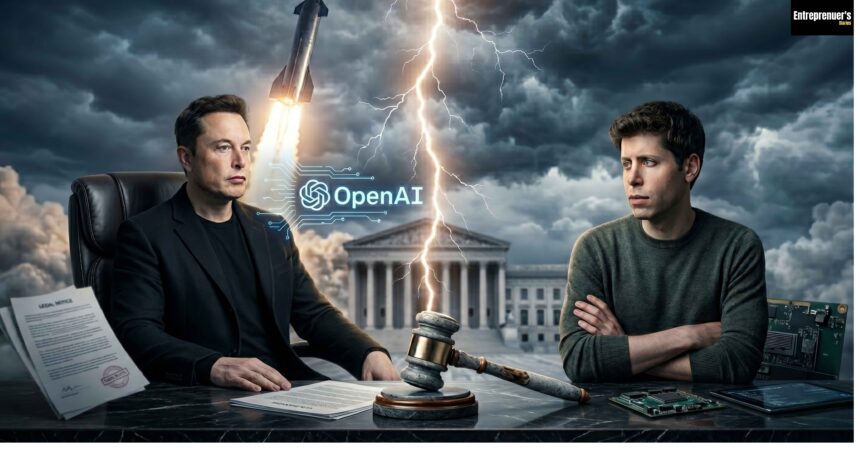
Oakland, April 28: The Musk Altman OpenAI trial is no longer a headline. It is a courtroom.
Nine jurors were seated Monday at the Robert F. Peckham Federal Building in Oakland, California. Opening arguments began Tuesday morning under Judge Yvonne Gonzalez Rogers. Every seat in the gallery was taken.
The stakes are not abstract. The Musk Altman OpenAI trial could unwind the corporate structure of an $852 billion company, remove the CEO who built it, block one of the most anticipated IPOs in market history, and set legal precedent governing how AI nonprofits across America convert themselves into for-profit enterprises.
That is not hyperbole. That is what Judge Gonzalez Rogers is being asked to decide.
The Founding Agreement That Both Sides Now Dispute
The Musk Altman OpenAI trial traces its roots to a single shared belief: that artificial general intelligence, built without profit motive and open to the world, gave humanity its best shot at a safe technological future.
Elon Musk and Sam Altman co-founded OpenAI in 2015 on exactly that premise. Musk provided approximately $44 million in early seed funding. The organization was structured as a nonprofit, explicitly bound by charitable trust obligations.
It was not a startup. It was, on paper, a research institution.
Musk left the board in 2018 after a power struggle. According to OpenAI’s own published account, he had attempted to merge the company with Tesla and separately sought to become its CEO. He was denied both. He walked.
A year later, OpenAI created a for-profit subsidiary to attract the compute capital its research demanded. By 2025, the company had converted further into a public benefit corporation. The nonprofit retained a 26 percent stake plus warrants tied to valuation milestones.
That sequence is the heart of the Musk Altman OpenAI trial.
Musk claims the conversion violated the charitable trust under which his contributions were made. His legal team described the conduct in court filings as a “long con” carried out with betrayal “of Shakespearean proportions,” as covered by NPR.
OpenAI’s response is equally pointed. The company has called the Musk Altman OpenAI trial a “baseless and jealous bid to derail a competitor,” as covered by CNBC, arguing that Musk participated in early discussions about a for-profit structure and filed suit only after launching his own rival AI company.
What the Musk Altman OpenAI Trial Actually Argues, After 26 Claims Became 2
When Musk first filed in 2024, his complaint carried 26 separate claims. Only two survived to reach the courtroom: unjust enrichment and breach of charitable trust. A fraud allegation was dismissed as recently as last Friday.
That narrowing matters. Neither remaining claim requires proving intentional deception. Both require showing that insiders, specifically Altman and OpenAI president Greg Brockman, financially benefited from a corporate conversion that violated the nonprofit’s founding obligations.
As covered by The Next Web, the underlying facts are largely undisputed. OpenAI was incorporated as a nonprofit. It created a for-profit entity. Its leaders now hold equity in that entity.
The Musk Altman OpenAI trial, at its legal core, is a dispute about whether that documented sequence constitutes a violation of law. Not whether anyone intended it to be.
Musk is no longer seeking the $134 billion in damages for himself personally. He has asked the court to redirect any financial remedy back into the OpenAI charitable foundation, as covered by CNBC. He is also seeking the removal of Altman and Brockman from their executive and board positions, and has asked Gonzalez Rogers to consider unwinding OpenAI’s entire restructuring.
The judge has split proceedings into two phases. The nine jurors advise on liability. Gonzalez Rogers decides remedies herself. Deliberations begin no later than May 12. If liability is found, a remedies hearing follows on May 18.
The Witnesses: A Who’s Who of Silicon Valley Under Oath
The witness list in the Musk Altman OpenAI trial reads like the attendee roster of a Davos plenary.
Musk himself could take the stand as early as Tuesday, as covered by CNBC. Altman was present in the courtroom for jury selection. Brockman is scheduled to testify. Microsoft CEO Satya Nadella is listed as a witness, as is Shivon Zilis, a former OpenAI board member and mother of some of Musk’s children, as covered by CNN.
Microsoft’s inclusion in the Musk Altman OpenAI trial is not incidental. The company holds approximately 27 percent of OpenAI’s restructured entity and was named as a co-defendant, accused of aiding and abetting the breach of charitable trust. Microsoft has denied any collusion, maintaining that it partnered with OpenAI only after Musk had left the board, as covered by Fox Business.
The evidence pile is both vast and personal.
Hundreds of pages of emails, texts, call logs, and diary entries have been entered as exhibits. As covered by The Japan Times, a central piece of evidence is a diary entry by Brockman from the fall of 2017: “This is the only chance we have to get out from Elon.”
That sentence alone is expected to receive extended cross-examination.
In a separate 2023 email covered by CNN, Altman told Musk he was his “hero” but expressed hurt over public attacks on OpenAI. Musk’s response: “The fate of civilization is at stake.”
As legal analysts quoted by CNN noted, the winning side in the Musk Altman OpenAI trial will almost certainly be the one that weaves those documents into the clearest human story. Document volume does not win trials. Narrative does.
The Financial Stakes: An $852 Billion Company and Two Competing IPOs
The commercial subtext of the Musk Altman OpenAI trial is impossible to ignore.
OpenAI closed a $122 billion funding round at an $852 billion valuation, as covered by CNBC. The company is targeting a potential IPO in the fourth quarter of 2026, with a possible public market valuation approaching $1 trillion, as covered by Fox Business.
OpenAI has already flagged the Musk Altman OpenAI trial as a material risk to its business in documents shared with prospective IPO investors, as covered by CNBC. Then, hours after day one of the trial concluded, the Wall Street Journal reported that OpenAI is falling short of internal revenue and user growth goals as it eyes that public offering.
The timing could not be worse for a company pitching itself to public markets.
On the other side, Musk has merged xAI with SpaceX in an all-stock transaction valued at $1.25 trillion, as covered by CNBC. SpaceX is itself preparing for what could become the largest IPO in history.
Every month the Musk Altman OpenAI trial clouds OpenAI’s governance narrative is a month xAI uses to close the gap in enterprise AI, compute partnerships, and investor attention.
Wedbush analyst Dan Ives put it directly. “This is a tech soap opera that all investors will be watching as Musk vs. Altman enters the MMA ring,” Ives said, as covered by CNN. He added that Musk has made the Musk Altman OpenAI trial personal, “and that is not a good thing for anyone involved.”
The timing of Musk’s legal escalation, as covered by The Next Web, tracks his own commercial calendar with uncomfortable precision. xAI fundraising rounds in late 2024 and mid-2025 landed alongside amended complaints and accelerated discovery requests targeting OpenAI.
Judge Gonzalez Rogers noted in prior proceedings that “this country likes competition.” Few observers missed what that remark was pointing at.
What Governance Scholars Are Actually Watching
Beneath the billionaire theatre, the Musk Altman OpenAI trial raises a legal question with consequences far beyond OpenAI.
Rose Chan Loui, director of the UCLA School of Law’s philanthropy and nonprofit program, told MIT Technology Review that Musk must demonstrate specifically what deficiencies exist in OpenAI’s deal with the attorneys general of California and Delaware. Both states approved the restructuring with conditions, including an independent safety committee overseeing the for-profit subsidiary.
That regulatory approval is OpenAI’s strongest procedural shield in the Musk Altman OpenAI trial.
Most charitable trust scholars, as covered by spacedaily.com, predict the most likely outcome is a ruling that Musk simply lacks legal standing. He was a peripheral early donor who left the board years before the restructuring he now challenges. If standing is denied, the case ends without reaching the merits, OpenAI’s structure survives, and the IPO timeline holds.
If standing survives, the precedent set by the Musk Altman OpenAI trial reaches every research foundation and safety-focused AI lab in the country.
As covered by crypto.news, Musk’s legal team argued in court filings that the case could determine whether AI safety commitments made during nonprofit fundraising can be legally abandoned once commercial capital has been secured. That matters to every institution currently raising money on a mission-driven promise.
Still, the irony is not lost on anyone in the courtroom. The man making that argument leads the world’s richest for-profit AI competitor.
Nine Jurors, One Judge, and What Comes Next
The nine jurors seated Monday include nurses, city workers, and retirees from across the greater Bay Area, as covered by Fox Business.
Many expressed unfavorable views of Musk during voir dire, driven primarily by his $250 million contribution to Donald Trump’s 2024 presidential campaign and his chaotic tenure heading the Department of Government Efficiency, as covered by CNN and ABC7.
One prospective juror reportedly described Musk in their pre-trial questionnaire as “greedy” and a “piece of garbage,” as covered by CNN. Musk’s legal team struck that candidate. Those ultimately seated were largely individuals who said they held neutral views of both Musk and AI.
Their role in the Musk Altman OpenAI trial is advisory. They deliver a liability finding. Judge Gonzalez Rogers is not bound by it. She retains full authority over any remedies.
That structure places the real outcome of the Musk Altman OpenAI trial in the hands of a single federal judge who has managed this case for years without being hurried by the profiles of the billionaires before her.
As covered by ABC7, UC Berkeley professor Andrew Reddie, who studies AI security and safety, described Musk’s legal argument as a claim of “bait and switch: philanthropic intent turning into for-profit activity.”
That framing may be the simplest summary of what the Musk Altman OpenAI trial is ultimately about.
Musk posted on X as jury selection wrapped: “Scam Altman and Greg Stockman stole a charity. Full stop.”
OpenAI responded on its own account: “We can’t wait to make our case in court where both the truth and the law are on our side.”
Both statements are exactly what you would expect. The Musk Altman OpenAI trial itself will be considerably less predictable.
Connect With Us On Social Media [ Facebook | Instagram | Twitter | LinkedIn ] To Get Real-Time Updates On The Market. Entrepreneurs’ Diaries Is Now Available On Telegram. Join Our Telegram Channel To Get Instant Updates.

Tobias is a Berlin-based startup scout and event reporter who explores global tools, tech events, and founder-friendly platforms.