

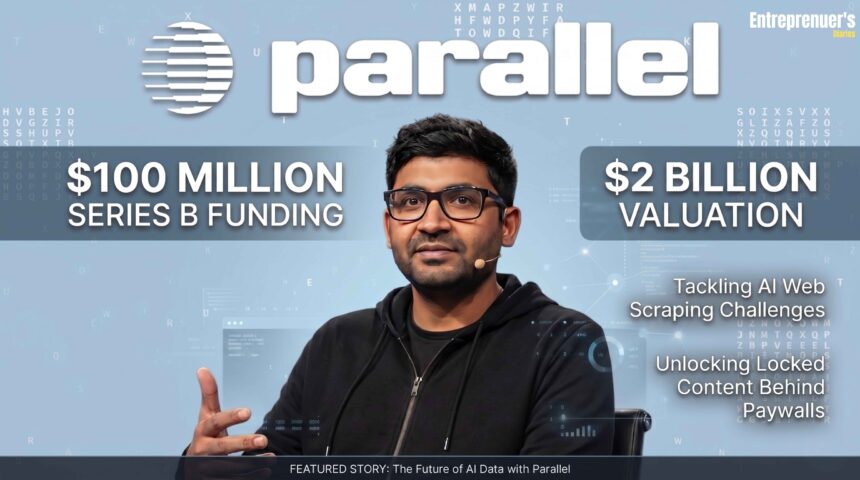
Palo Alto, April 29: Parag Agrawal AI startup Parallel Web Systems has just pulled off one of the most striking valuation jumps in Silicon Valley this year. The Palo Alto-based company raised $100 million in a Series B funding round led by Sequoia Capital, taking its valuation to $2 billion, according to The Wall Street Journal. Existing investors Kleiner Perkins, Index Ventures, and Khosla Ventures all returned for the round. In less than 27 months, this Parag Agrawal AI startup has gone from a $30 million seed round to one of the most closely watched infrastructure bets in the technology industry. That kind of trajectory does not happen by accident.
Three and a half years ago, Agrawal was escorted out of Twitter’s San Francisco headquarters on the same evening Elon Musk arrived with a kitchen sink prop and a smirk. The symbolism was brutal and deliberate. A $44 billion acquisition, a theatrical entrance, and a CEO shown the door before the ink was dry. Most people in that position retreat. Some write a book. Agrawal did neither.
He built a company. And now that Parag Agrawal AI startup is worth $2 billion.
The company has now raised approximately $230 million in total, according to The Wall Street Journal. Its previous $100 million Series A round in November had valued the Parag Agrawal AI startup at $740 million, as reported by Reuters. The valuation has nearly tripled in a single funding cycle. That does not happen because a founder once ran a social media company. It happens because the bet underneath the company is the right one, placed at exactly the right time.
The Infrastructure Nobody Noticed Was Missing
To understand what this Parag Agrawal AI startup actually does, start with a simple question that Agrawal himself has put to audiences. According to Reuters, he framed it plainly: “How many jobs are there where we could turn off web access and ask you to do the same job fully?” The answer, of course, is almost none. Lawyers need case precedent. Insurance underwriters need current claims data. Software engineers need documentation, repositories, and real-time error references.
Now consider that those same professionals are increasingly delegating large portions of their research workload to autonomous AI agents, software systems that operate without a human clicking a button for every step. Those agents need the web too. But the existing web was not built with machines as the primary reader in mind. Google Search delivers ranked links designed for human eyeballs to scan and click. That model is fundamentally incompatible with how an AI agent operates and what it requires.
That gap is precisely what the Parag Agrawal AI startup Parallel Web Systems was built to fill.
The company builds a programmatic web infrastructure based on a suite of specialized application programming interfaces for searching the internet, performing tasks online, extracting information from websites, and monitoring the web, as reported by SiliconAngle. Its APIs use a proprietary web index optimized for what the company calls machine retrieval, meaning the output is not a list of blue links but tokenized, structured content fed directly into an AI model’s context window. The practical result, the company says, is improved accuracy, fewer hallucinations, and lower operational costs for enterprise customers deploying AI agents at scale.
That framing matters. The Parag Agrawal AI startup is not competing with Google for human attention. It is building the plumbing for a web no human will directly see.
A Founder Forged in the Right Crucible
Agrawal spent eleven years at Twitter, first as an engineer, then as Chief Technology Officer, then as CEO from November 2021 until his firing in October 2022. His tenure at the top was short and turbulent, dominated by the chaos of Musk’s acquisition process, a prolonged legal standoff, and a culture war inside the company about its direction. None of that makes for a straightforward founder story.
But it does make for an unusually well-calibrated one. Enterprise customers use the Parag Agrawal AI startup to power agents that write software code, analyze customer data for sales teams, and assess risk for insurance underwriting, areas where high-quality web data alongside internal systems is critical, Agrawal told Reuters. The problems he spent a decade solving at Twitter, including spam detection, bot classification, and content integrity at scale, are precisely the kinds of problems that define building reliable infrastructure for AI agents interacting with a messy, dynamic, paywalled internet.
The Parag Agrawal AI startup was co-founded by Agrawal and Travers Nisbet, according to Tracxn. The company first launched its products in August 2025, as reported by Reuters. Since its founding in early 2024, Parallel Web Systems has amassed a user base of more than 100,000 developers, including many from AI-native startups and large enterprises, Agrawal told The Wall Street Journal. That developer base is not an accident of marketing. It is a product of infrastructure that works reliably at scale, which is the only metric that matters in this category.
The Sequoia Stamp and What It Signals
When Sequoia Capital leads a round, the market pays attention. The firm has backed Apple, Google, Oracle, Airbnb, and Stripe, among others. It does not deploy capital at a $2 billion valuation because a founder once had a high-profile job. It deploys capital because it believes the infrastructure layer being built is genuinely foundational. That is the lens through which the Parag Agrawal AI startup’s latest raise must be read.
Sequoia partner Andrew Reed spelled out the thesis with precision, as reported by SiliconAngle. He said Parallel Web Systems is providing the core infrastructure needed to support long-running AI agents that can operate continuously in the background, maintain context across extended periods, and execute multi-step research tasks without a human in the loop. “One of the things that is a core shared function amongst all of these long-horizon agents is the ability to use the web,” Reed said, according to SiliconAngle.
That observation is not incidental. It is the central market argument behind a $2 billion valuation for a Parag Agrawal AI startup that launched its products less than a year ago.
One of the first companies to adopt the tools built by this Parag Agrawal AI startup is the legal platform Harvey AI, which has developed autonomous agents designed to perform research-heavy tasks on behalf of lawyers, according to SiliconAngle. Harvey co-founder and President Gabe Pereyra told The Wall Street Journal that it is not enough for agents to simply be given access to Google Search. The granularity, structure, and freshness of data that an autonomous legal research agent requires cannot be reliably sourced from a general-purpose search engine. That feedback from an early enterprise customer is exactly the kind of product validation that serious investors track before committing nine figures.
Agrawal said the Parag Agrawal AI startup plans to develop what he described as an open market mechanism, a new economic model to incentivize publishers to keep content accessible to AI systems, according to Reuters. As more website owners restrict access to prevent AI scraping, the quality and coverage of machine-readable web content degrades. Solving that problem is not a technical task alone. It is a policy and economic architecture challenge, and Agrawal is signaling that Parallel intends to take it seriously.
A Market That Has Not Even Hit Its Stride
The broader context makes the Parag Agrawal AI startup raise look less like exuberance and more like strategic positioning ahead of a structural shift. According to MarketsandMarkets, the global AI agents market is projected to grow from $7.84 billion in 2025 to $52.62 billion by 2030, a compound annual growth rate of 46.3%. Grand View Research projects even more aggressive expansion, estimating the market could reach $182.97 billion by 2033 at a CAGR of 49.6%.
Those numbers are for the application layer: the agents themselves. The infrastructure layer that enables agents to reliably access, process, and act on web data is less frequently headlined, but arguably more defensible as a business. Infrastructure companies tend to scale with usage across an entire ecosystem rather than competing on a product-by-product basis. That is why Sequoia’s thesis on this Parag Agrawal AI startup frames Parallel Web Systems as a shared function rather than a single-use tool.
According to IDC data reported by Salesmate, by 2026 AI copilots are expected to be embedded in nearly 80% of enterprise workplace applications, reshaping how teams work, decide, and execute. Approximately 35% of organizations already report broad usage of AI agents, with another 27% experimenting or deploying them in limited ways, per the same research. Every single one of those agents will need to interact with the live web. The question is which infrastructure layer they will trust to do it reliably. Right now, the Parag Agrawal AI startup is positioning itself as the answer to that question for enterprise customers who cannot afford to be wrong.
Parallel’s current enterprise use cases span several high-stakes verticals. Each shares a defining characteristic: the cost of incorrect or outdated information is high, which means the premium on accurate, verifiable, real-time web data is significant. That commercial logic is clean. It is the kind that scales.
The Competitor Landscape and the Road Ahead
The Parag Agrawal AI startup is not alone in this space. Rival companies Tavily and Exa Labs are building similar infrastructure for AI agent web access, as noted by SiliconAngle. Both have attracted venture backing and developer communities of their own. The space is young enough that there is no definitive market leader, which explains why Sequoia moved when it did. In infrastructure markets, the company that establishes deep integration with the largest enterprise accounts and the most widely adopted developer tooling tends to compound its advantage over time. First-mover depth, not first-mover timing, is what creates durable moats in this category.
An April 2026 partnership with Genpact and integration with Vercel’s AI Gateway and SDK signal enterprise traction and broader distribution for the Parag Agrawal AI startup, according to BuiltIn. SOC 2 Type II certification, also noted by BuiltIn, signals seriousness about compliance, a prerequisite for regulated enterprise verticals including financial services, insurance, and legal services.
Agrawal said the fresh capital from the Series B will go toward expanding sales and marketing teams and continuing investment in research and development, according to The Wall Street Journal. The enterprise go-to-market push is the next phase for a Parag Agrawal AI startup that has spent its first two years primarily building and proving the technology with developers and early enterprise adopters.
Still, the numbers are striking on their own terms. This Parag Agrawal AI startup has moved from a $30 million seed round in January 2024 to a $2 billion Series B valuation in April 2026, a period of roughly 27 months. The company launched its products publicly in August 2025 and was already counted among the top-ranked infrastructure players in its competitive set within months of that launch, according to Tracxn.
“Every few weeks, we solve one bottleneck and hit another somewhere,” Agrawal told The Wall Street Journal. “We’re building some things I’m really excited about. I wouldn’t work here if I wasn’t.”
That last sentence carries more weight than a press release. According to executive compensation research firm Equilar, as reported by Fortune, Agrawal was entitled to a severance payout worth $57.4 million following his departure from Twitter. That sum could have funded a very comfortable professional exit. Board seats, advisory retainers, conference circuit appearances: all of it was on the table for the former CEO of a platform that once shaped global public conversation.
He chose a 50-person infrastructure startup instead. And that Parag Agrawal AI startup has now been validated at $2 billion by four of the most credible venture firms on the planet.
Sequoia, Kleiner Perkins, Index Ventures, and Khosla Ventures have all committed nine figures to back this bet. The market is paying close attention. The question now is whether Parallel Web Systems can convert its infrastructure advantage into the kind of enterprise lock-in that turns a valuation milestone into a durable, generational business.
Based on the architecture of the bet and the caliber of the capital behind it, the odds are not unfavorable.
Connect With Us On Social Media [ Facebook | Instagram | Twitter | LinkedIn ] To Get Real-Time Updates On The Market. Entrepreneurs’ Diaries Is Now Available On Telegram. Join Our Telegram Channel To Get Instant Updates.

Ethan is a Lisbon-based leadership strategist who helps remote-first startups scale through systems, team clarity, and async culture.