

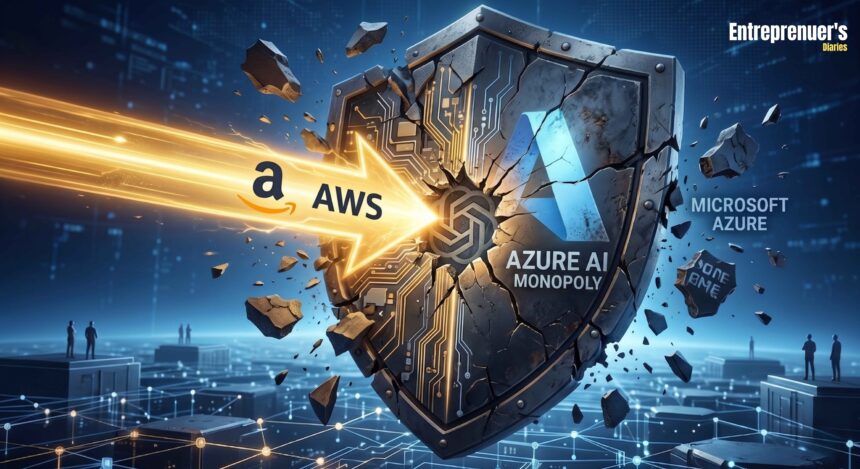
San Francisco, April 29: The OpenAI Amazon cloud relationship is now official, operational, and already reshaping how enterprises think about artificial intelligence infrastructure. For years, the industry operated on a simple premise: if you wanted access to the world’s leading AI models, you went through Microsoft. That arrangement is now history, and the implications for cloud competition, enterprise technology, and the future of AI infrastructure are profound.
On April 27, 2026, Microsoft and OpenAI announced a reworked partnership that strips the software giant of its exclusive access to the ChatGPT maker’s technology. Within 24 hours, Amazon Web Services confirmed that the OpenAI Amazon cloud partnership had moved from negotiation to live deployment, embedding the company’s most powerful models directly into AWS infrastructure and formally ending the Azure-only era of enterprise AI.
The speed of it was deliberate. The consequences will be felt across Silicon Valley and in boardrooms worldwide for years.
The End of the Microsoft Monopoly
Under the revised terms, Microsoft will continue to hold a license to OpenAI’s intellectual property for models and products through 2032, but that license is now non-exclusive. Microsoft will also no longer pay a revenue share, while payments flowing in the other direction, from OpenAI to Microsoft, continue through 2030 subject to a total cap.
That last clause matters. In exchange for surrendering exclusivity, which had helped boost Azure’s cloud sales in the early years of the AI boom, Microsoft walks away from a revenue share on products it resells on its platform. Both sides traded something significant. One gives up a structural monopoly; the other gives up a revenue stream. That is precisely the kind of mutually uncomfortable compromise that tends to hold.
The revised agreement also kills what insiders called the AGI trigger, a clause that hinged Microsoft’s intellectual property rights on a declaration that artificial general intelligence had been achieved. Both companies found the clause too vague. In a moment when OpenAI is actively preparing for a public offering and building out an enterprise business, the last thing it needed was an existential definitional argument holding deals hostage.
Barclays analysts called the move a positive for both sides, noting that Microsoft no longer needs to build out all the data center capacity OpenAI requires, freeing up capital for Copilot and other cloud needs. There is also a regulatory dimension. Ending the exclusivity pact may help Microsoft manage antitrust scrutiny in the UK, the US, and Europe over whether its arrangement gave it an unfair advantage in cloud and enterprise AI markets.
OpenAI Amazon Cloud Goes Live on Bedrock
The day after the Microsoft announcement, OpenAI CEO Sam Altman appeared by video at an AWS event in San Francisco. AWS CEO Matt Garman confirmed that the OpenAI Amazon cloud integration was live, with frontier models including GPT-5.4 immediately available in preview on Amazon Bedrock and GPT-5.5 arriving within weeks.
This is not a soft entry. The OpenAI Amazon cloud deployment on Bedrock gives developers genuine flexibility in how they build, from new AI applications to intelligence embedded in existing products to agentic workflows capable of reasoning and taking action across complex business processes. For enterprises, it means a single path from experimentation to production, with frontier AI capabilities now available inside the AWS environments where their most critical workloads already run.
Three specific products are landing on Bedrock simultaneously. Frontier models are accessible through the same APIs and controls customers already use. Codex, the company’s coding agent, is now on Bedrock for enterprise software development at scale. And Bedrock Managed Agents, powered by OpenAI’s frontier models, provides an optimized environment for building production-ready agentic applications on AWS.
The Codex figures alone make a statement. More than 4 million people use the tool every week, according to company disclosures, and AWS confirmed it will be available through the Codex CLI, desktop app, and Visual Studio Code extension. Eligible customers can also apply usage toward existing AWS cloud commitments. That detail is not a footnote. Reducing procurement friction for large enterprises is one of the fastest ways to accelerate adoption, and both sides know it.
The $50 Billion Bet Behind the OpenAI Amazon Cloud Deal
The OpenAI Amazon cloud partnership is backed by a financial commitment that reflects the scale of what is being attempted. The AI lab signed a deal committing $38 billion in cloud capacity from AWS, its first major contract with the leader in cloud infrastructure, as reported by CNBC. That was only the infrastructure side.
Amazon also announced plans to invest up to $50 billion in the company, comprised of a $15 billion initial investment and another $35 billion contingent on certain conditions being met, with AWS serving as the exclusive third-party cloud distribution provider for the Frontier enterprise agent platform.
Under the infrastructure agreement, OpenAI is accessing AWS compute comprising hundreds of thousands of state-of-the-art Nvidia GPUs, including GB200 and GB300 processors via Amazon EC2 UltraServers, with the ability to expand to tens of millions of CPUs to rapidly scale agentic workloads. AWS has built clusters topping 500,000 chips, per Amazon’s own disclosures.
That hardware commitment tells you something about the scale of ambition involved. This is not a startup hedging its bets. This is a company preparing for a trajectory of compute demand that most organizations cannot fathom. Still, the financial weight is real. Analysts are calling this the rising capital intensity of AI: only hyperscale cloud providers have the resources to build and manage the supercomputing infrastructure that frontier development requires. The bet on enterprise revenue justifying these commitments has not yet been proven.
What the OpenAI Amazon Cloud Shift Means for Enterprise Customers
The practical impact for corporate technology buyers is significant and immediate. For years, companies building on AWS faced a structural problem: they wanted access to the industry’s leading models, but those models were formally tied to Azure. The security, governance, and procurement frameworks of AWS were simply incompatible with how OpenAI distributed its products.
Amazon has argued consistently that enterprises want to build agents and AI-augmented tools with frontier models but have been stopped by security policy, data privacy, and sovereignty concerns. The OpenAI Amazon cloud integration on Bedrock sidesteps many of those concerns directly.
The models on Bedrock inherit the full set of enterprise controls customers already depend on: IAM-based access management, AWS PrivateLink connectivity, guardrails, encryption at rest and in transit, comprehensive logging through AWS CloudTrail, and integration with existing compliance frameworks. There is no additional infrastructure to configure and no new security model to learn, per Amazon’s official disclosures.
For procurement teams, the math simplifies considerably. Usage can now be applied toward existing AWS cloud commitments, consolidating AI spend alongside broader workloads. One invoice. One vendor relationship. One compliance review. That simplicity is worth more than any benchmark comparison.
Where Microsoft Stands After Losing OpenAI Exclusivity
None of this means Microsoft has been pushed aside. The two companies are still calling Azure the primary cloud partner, and the bulk of OpenAI infrastructure will likely continue to run there for the six years this deal covers. The company has also reaffirmed its Azure commitment, reportedly agreeing to purchase substantial additional capacity going forward.
That framing is accurate, but it undersells the competitive damage done to Azure’s positioning. The platform built years of enterprise momentum on the premise that the industry’s leading models would only run there. The OpenAI Amazon cloud arrangement changes that permanently.
AWS and Google Cloud enterprise customers had been limited in their ability to integrate these products because of the exclusive relationship and will now be more likely to consider them alongside competing models, according to Gil Luria, analyst at D.A. Davidson, speaking to Reuters. That shift has real implications for Azure’s AI-driven cloud growth story.
Turns out the arrangement that made Microsoft one of the great beneficiaries of the AI boom may now be the same arrangement that defined its ceiling. The company’s share price dipped modestly on the news before recovering, a quiet signal that investors are still working out what exclusivity was truly worth.
The Google Variable
One thread deserves close watching: Google Cloud. According to sources cited by Axios, Google is studying the revised deal terms to assess what partnership might now be possible. If OpenAI secures distribution rights on a third major cloud platform, the enterprise footprint expands further and the model marketplace becomes genuinely competitive across all three hyperscalers.
The strategic logic is straightforward. Enterprise customers want to use the best models inside the cloud infrastructure they already trust and pay for. The OpenAI Amazon cloud deal has proven that this model works. A Google Cloud agreement would complete the picture and push the multi-cloud ambition to its logical conclusion.
The OpenAI Amazon Cloud Partnership and the IPO Calculus
By diversifying infrastructure partners and locking in long-term capacity across providers, OpenAI is signaling both independence and operational maturity. CEO Sam Altman has acknowledged publicly that an IPO is the most likely path forward given capital needs. CFO Sarah Friar has echoed that sentiment, framing the recent corporate restructuring as a necessary step toward going public, as reported by CNBC.
The OpenAI Amazon cloud expansion fits squarely into that IPO narrative. Distribution across AWS, Azure, and potentially Google Cloud demonstrates to future public market investors that the business is not a single-vendor dependency. It signals revenue diversification, operational scale, and the kind of enterprise credibility that institutional investors demand before committing capital.
For Amazon, the partnership strengthens Bedrock as a one-stop destination for enterprise builders and reduces its reliance on Anthropic as the marquee AI supplier inside AWS. It also puts new pressure on rivals, because the fight is now over distribution power, not product hype.
That is the clearest-eyed summary of where the AI infrastructure wars stand today. The era of betting on a single model maker or a single cloud provider is finished. The companies shaping the next decade of enterprise AI are those that understand one fundamental truth: the platform that makes identity, billing, security, and deployment easiest will win, regardless of which model produces the strongest benchmark number.
The Microsoft partnership defined the first act. The OpenAI Amazon cloud era now beginning will define what comes next.
Connect With Us On Social Media [ Facebook | Instagram | Twitter | LinkedIn ] To Get Real-Time Updates On The Market. Entrepreneurs Diaries Is Now Available On Telegram. Join Our Telegram Channel To Get Instant Updates.

Ethan is a Lisbon-based leadership strategist who helps remote-first startups scale through systems, team clarity, and async culture.