

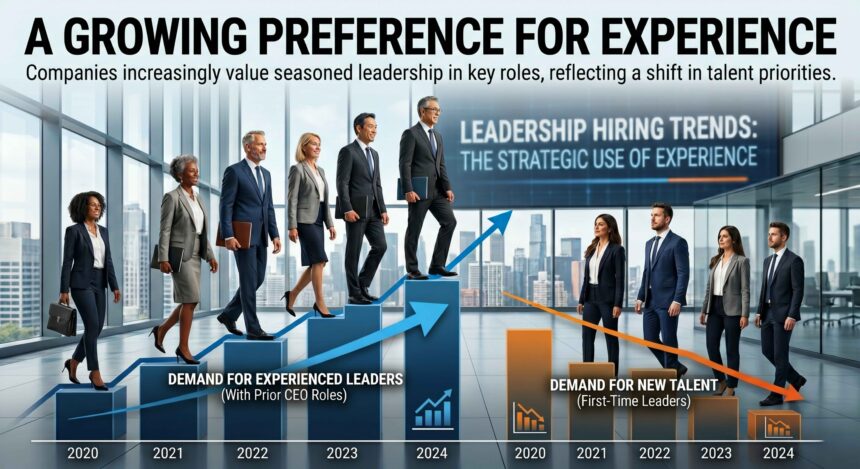
New York, April 29: Experienced CEO demand is rewriting the rules of corporate succession. Forty-one percent of the 22 incoming CEOs in the S&P 500 this quarter had prior experience running public companies, up from 25 percent in the same period last year, according to data published today by Fortune, citing Russell Reynolds Associates’ latest Global CEO Turnover Index. In a climate defined by tariff volatility, activist investor pressure, and sustained economic uncertainty, boards are no longer content betting on potential. They want proof.
- Why the Experienced CEO Is Now the Safest Board Bet
- A Record Wave of Departures Forcing Boards to Act
- How Activist Investors Are Shortening Experienced CEO Runways
- The Consumer Sector: Ground Zero for Experienced CEO Demand
- The COO Pipeline and the Death of the Leapfrog Hire
- Disney’s 2026 Succession: A Masterclass in Deliberate Experienced CEO Selection
- What Boards Are Dangerously Getting Wrong
- The Price of a Proven Experienced CEO Is Rising Fast
The era of grooming an untested internal star and watching them grow into the job is giving way to something more transactional and, frankly, more urgent. Boards want leaders who already know where the landmines are buried.
Why the Experienced CEO Is Now the Safest Board Bet
Constantine Alexandrakis, CEO of Russell Reynolds Associates, told Fortune this morning that the appetite for proven operators reflects the pace and pressure of the current moment. “There is more urgency in the air, more speed, more change, more transformation,” Alexandrakis said. “And an experienced pair of hands at a moment like this could be more attractive.”
Boards are drawn specifically to experienced CEO candidates who previously served on the very board they are now being asked to lead. The onboarding curve is shorter. The institutional knowledge is already there. The trust is built in.
That logic is playing out in real-time succession moves. PayPal is the clearest example in 2026. When Alex Chriss stepped down as President and CEO in February, the board did not run a wide external search. It turned to Enrique Lores, an experienced CEO who had served on PayPal’s board for nearly five years and as Board Chair since July 2024.
Lores also brought more than six years as President and CEO of HP Inc., where he led the company through a strategic transformation into services and subscription models, according to SEC Form 8-K filings. PayPal’s proxy statement was direct: “The Board determined that at this juncture, PayPal requires a leader with deep operational expertise, a proven ability to drive disciplined execution, and experience leading complex global organizations through periods of transformation.”
That is not boilerplate. That is a board that has been burned and is protecting itself.
At Workday, a different but equally telling scenario unfolded. Cofounder Aneel Bhusri, who has served as experienced CEO or co-CEO at various points across 15 years, stepped back in to replace Carl Eschenbach, per reporting from Fortune. The pattern echoes Starbucks with Howard Schultz and Disney with Bob Iger: when a hand-picked successor falters, the board reaches back for someone who has already done the job at that company, in that seat.
A Record Wave of Departures Forcing Boards to Act
To understand why boards are paying such a premium for experienced CEO talent, the scale of turnover needs framing. Russell Reynolds Associates found that 234 CEOs of globally listed companies departed their roles in 2025, up 16 percent from 2024 and 21 percent above the eight-year average, per Fortune and DeviceDaily. That marked the second consecutive record-breaking year for CEO exits.
The Conference Board, working alongside Egon Zehnder, ESGAUGE, and Semler Brossy, found that S&P 500 CEO successions at firms in the top three performance quartiles jumped from 7 percent in 2024 to 12 percent in 2025. These are not struggling companies being forced to make changes. They are high performers acting proactively.
As Ariane Marchis-Mouren, Senior Researcher at The Conference Board, noted in a November 2025 press release: “Many leadership changes in 2025 reflected strategic realignment and long-term succession planning rather than immediate performance triggers.”
Boards are no longer waiting for a crisis. They are engineering transitions on their own terms.
How Activist Investors Are Shortening Experienced CEO Runways
A significant portion of these exits is being accelerated by outside pressure. Research from Barclays, cited by Russell Reynolds, found that activist campaigns reached record levels in 2025. The consequence was measurable: a record 32 CEOs resigned within one year of an activist campaign in 2025, up from 27 the previous year. In the S&P 500 alone, investors launched 141 activist campaigns in 2025, up 23 percent on 2024 levels.
Activist pressure has become a structural feature of large-company leadership, not an occasional disruption.
Pressure is also shortening tenure expectations. Fortune’s data published today shows that outgoing CEOs this quarter had been in their roles for an average of 11.9 years, compared to 8.3 years last year. The departing class stayed longer. Institutions had time to ossify under long-running leadership. Boards now want incoming experienced CEO candidates who can break patterns fast, not spend 18 months learning the business.
The Consumer Sector: Ground Zero for Experienced CEO Demand
Nowhere is this tension sharper than in consumer-facing businesses. A report published by the Harvard Law School Forum on Corporate Governance in April 2026, drawn from Russell Reynolds research, found that 54 consumer CEOs at publicly listed companies globally left their roles in 2025. That was the most since tracking began in 2018, at a turnover rate of 17 percent, the highest of any sector tracked.
Those departing executives served an average of just 6.3 years, below the 7.1-year global average. Consumer boards responded by reaching more often for experienced CEO talent, recognizing that managing digital habits, omnichannel expectations, and cost-conscious consumers simultaneously demands leaders who have navigated comparable terrain before.
What makes the sector particularly acute, according to the same report, is the state of succession planning itself. Almost half of consumer board members surveyed said they either did not have a CEO succession plan or were not sure whether they had one. Of those who did have a plan, almost half said it extended no further than three years. That gap between turnover frequency and succession depth is a governance vulnerability boards across sectors are now racing to close.
The COO Pipeline and the Death of the Leapfrog Hire
One telling consequence of this emphasis on experienced CEO readiness is a shift in who gets the top job. Spencer Stuart’s 2025 CEO Transitions Report found that COOs and company presidents accounted for 48 percent of new CEO appointments in 2025, up from 40 percent the prior year.
These are not seat-fillers. They are operators who have lived inside the machine, managed the leadership team, and understand how the company actually runs, as opposed to how it appears in the board deck.
Equally notable is what disappeared entirely. In 2021, one in five new CEOs came from below the C-suite, the leapfrog appointment. In 2025, there were no such moves among first-time CEOs at S&P 1500 companies, per Spencer Stuart data. Boards have stopped gambling on transformational outliers from the middle of the organization. In a volatile environment, operational credibility is the table stake.
Disney’s 2026 Succession: A Masterclass in Deliberate Experienced CEO Selection
If any single event crystallized the new approach, it was Disney. After years of speculation and the turbulent, brief tenure of Bob Chapek from 2020 to 2022, the board unanimously chose parks division head Josh D’Amaro to succeed Bob Iger as experienced CEO, effective March 18, 2026, according to SIGMA Assessment Systems analysis.
The succession was structured with additional deliberateness. Runner-up candidate Dana Walden was elevated to the newly created role of President and Chief Creative Officer. The board was not just naming a CEO. It was protecting itself against losing another finalist and building an orderly leadership bench at the same time.
That choreography reflects what Alexandrakis described to Fortune as a systems-level view of experienced CEO succession. “It’s not about one person,” he said. “It’s about a system of people and a leadership team that comes together and drives the change.”
What Boards Are Dangerously Getting Wrong
The rush toward proven operators carries its own risks, and governance observers are naming them. Spencer Stuart’s data noted a clear tension: CEO tenure is shrinking and scrutiny is rising, yet many boards are simultaneously moving toward internally developed leaders, many of whom lack prior board experience.
Among the 140 first-time CEOs appointed across S&P 1500 companies in 2025, two-thirds had never served on a public company board, per Spencer Stuart data cited by Fortune. They are being handed the most complex corporate job in the world without prior exposure to shareholder dynamics or public company governance.
That knowledge gap does not disappear simply because a new CEO was a COO first. Boards that mistake internal familiarity for experienced CEO readiness are likely to find themselves in this same conversation two or three years from now.
Succession planning, as the Harvard Law School analysis concluded, needs to be treated as an ongoing discipline rather than a crisis response.
The Price of a Proven Experienced CEO Is Rising Fast
The financial incentive structure is beginning to reflect the premium boards are placing on experience. Enrique Lores at PayPal was given a compensation structure explicitly designed, per the company’s proxy statement, to immediately align his interests with stockholders and incentivize execution intensity. HP CEO to PayPal CEO is not a standard transition. It required the board to price that experience accordingly.
As Fortune’s data from today confirms, it is also taking longer to fill CEO roles. Boards are conducting extended searches, keeping interim leaders in place, and using those windows to evaluate more carefully. That caution is its own market signal: the right experienced CEO, at the right moment, is worth waiting for.
The question boards should be asking is not only who can hit the ground running, but whether the ground they are running into has been properly prepared. That is a question of organizational readiness, succession discipline, and leadership systems. Experience matters enormously. But even the most accomplished experienced CEO is only as effective as the team and structure they inherit.
Connect With Us On Social Media [ Facebook | Instagram | Twitter | LinkedIn ] To Get Real-Time Updates On The Market. Entrepreneurs Diaries Is Now Available On Telegram. Join Our Telegram Channel To Get Instant Updates.

Freya is a digital nomad and writer from Sweden, curating business travel hacks and remote-work inspiration from her global adventures.