

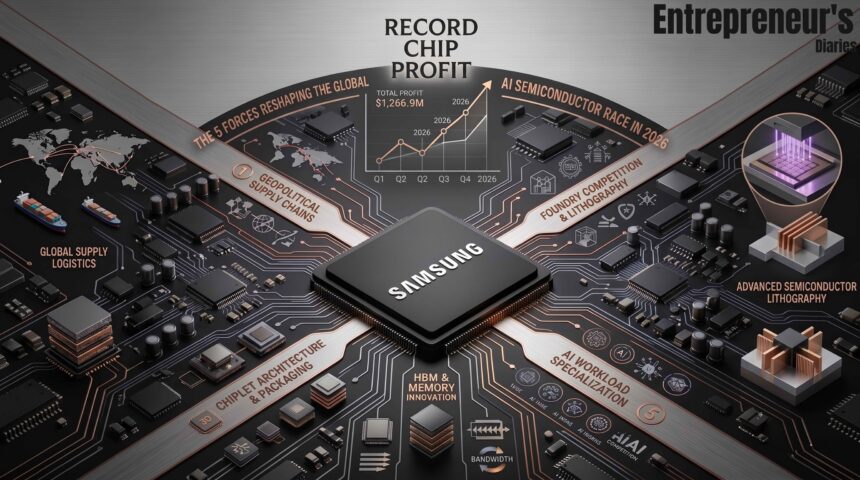
Seoul, May 1: Samsung chip profit just delivered the most extraordinary quarterly result in the company’s history. In Q1 2026, Samsung Electronics posted operating profit of 57.2 trillion Korean won, approximately $41.6 billion, a 756 percent surge year over year, according to the company’s final earnings report released on April 30.
- The HBM4 Breakthrough That Drove Samsung Chip Profit to Record Highs
- What the Record Samsung Chip Profit Numbers Actually Reveal
- The Shortage That Will Outlast the Samsung Chip Profit Cycle
- The Geopolitical Dimension Reshaping Samsung Chip Profit Outlook
- The 3 Competitive Threats Keeping Samsung Chip Profit Under Pressure
- Why Samsung Chip Profit in Q1 2026 Is a Market Signal, Not Just a Company Story
That single quarter already exceeds the company’s entire full-year earnings for 2025, which totalled 43.6 trillion won. Nothing in Samsung’s five-decade history comes close.
Revenue told the same story. Total consolidated revenue reached 133.9 trillion won, roughly $97.4 billion, up 69 percent year over year and 43 percent quarter on quarter, according to figures reported by CNBC and confirmed by Samsung’s own earnings disclosure.
Analysts at LSEG had estimated 132.69 trillion won in revenue. Samsung beat that comfortably. Operating profit estimates of 55.28 trillion won were also exceeded by a meaningful margin.
The engine behind this record performance is not consumer electronics, not smartphones, and not televisions. It is artificial intelligence, full stop.
Samsung’s Device Solutions division, which houses its memory and foundry operations, posted 81.7 trillion won in revenue and 53.7 trillion won in operating profit for the quarter, according to reporting by TechMoran and Data Center Dynamics. That single division accounted for 94 percent of total group operating profit.
For context, the same division posted just 1.1 trillion won in operating profit during Q1 2025. The 48-fold increase in one year is not a correction or a rebound. It is a structural transformation driven by a global shortage of the memory chips that AI infrastructure cannot function without.
The HBM4 Breakthrough That Drove Samsung Chip Profit to Record Highs
High-bandwidth memory has become the defining product of the current semiconductor cycle. Every NVIDIA AI accelerator, every Google Tensor Processing Unit, and every AMD MI-series GPU requires stacks of HBM to operate. Without it, the data centres running the world’s AI models simply cannot function.
For much of 2024 and early 2025, Samsung lagged behind South Korean rival SK Hynix in HBM supply, ceding the dominant supplier position to NVIDIA’s preferred partner. That dynamic shifted materially in early 2026.
According to reporting by Bloomberg in January 2026, Samsung entered the final qualification phase with NVIDIA for its HBM4 chips, having submitted initial samples in September 2025. By February 2026, the company began mass production shipments of HBM4, priced at approximately $700 per unit. That represents a 20 to 30 percent premium over its predecessor HBM3E, according to the Seoul Economic Daily.
The HBM4 ramp is directly feeding record earnings at a pace even optimistic analysts did not fully anticipate. Samsung’s memory chief Kim Jaejune told analysts during the Q1 2026 earnings call that the company is on track to more than triple HBM revenue this year versus 2025, as reported by TechPowerUp.
Most of the HBM4 production is destined for NVIDIA’s Vera Rubin AI accelerator platform, scheduled for launch in the second half of 2026. A portion is also being supplied to Google for its seventh-generation Tensor Processing Units, according to SamMobile.
Turns out, the Q1 2026 earnings disclosure contained a detail that surprised the analyst community. Conventional DRAM is currently delivering higher profit margins than HBM. The reason, as disclosed during the earnings call and reported by Tweaktown, is that conventional DRAM prices are negotiated over shorter contract cycles. This allows Samsung to capture the full benefit of the current shortage in real time, while HBM pricing locked into annual agreements flows through with a lag. Both dynamics are working simultaneously, and that combination explains the exceptional scale of the Q1 result.
What the Record Samsung Chip Profit Numbers Actually Reveal
Frankly, the headline figure flatters Samsung in one dimension and undersells it in another.
The flattering dimension: the semiconductor recovery has been turbocharged by a global DRAM shortage that any memory producer with sufficient scale would benefit from. According to Gartner analysis cited by Network World, DRAM prices are forecast to increase 47 percent in 2026 due to significant structural undersupply across both conventional and legacy memory markets.
CLSA Securities Korea analyst Sanjeev Rana told Bloomberg that DRAM average selling prices jumped more than 30 percent sequentially in Q4 2025 alone. Prices are likely to remain very strong through 2026 and possibly into the first half of 2027. When supply is this constrained and demand this urgent, operating leverage in a high-fixed-cost memory business produces exactly the kind of profit explosion the Q1 numbers reflect.
The dimension the headline undersells: the mobile division saw operating profit fall 35 percent to 2.8 trillion won in Q1 2026, according to TechPowerUp, because rising memory costs are eating directly into handset margins. The display division also saw a 20 percent decline in operating profit.
The semiconductor business is powering the group, but doing so in part at the expense of other divisions that depend on affordable memory inputs.
Samsung’s foundry division, meanwhile, continues to operate in TSMC’s shadow. CFO Soon-Cheol Park told analysts during the earnings call, as reported by Data Center Dynamics, that foundry earnings improvement will continue through 2026. That said, he cautioned that the second half of the year would bring a mixed business environment as AI-driven growth collides with rising IT costs and global trade uncertainty including tariffs.
The Shortage That Will Outlast the Samsung Chip Profit Cycle
Understanding the durability of the current profit trajectory requires understanding why the underlying shortage is so structurally entrenched. This is not a typical inventory correction playing out in reverse.
According to analysis published by tech-insider.org this week, HBM production now consumes roughly 23 percent of all DRAM wafer capacity globally. Each next-generation AI GPU requires eight HBM modules, consuming 96 individual DRAM dies per chip.
Because HBM generates three to five times higher revenue per wafer than conventional DRAM, every major memory producer has been systematically reallocating capacity toward AI-grade chips. This has left consumer and enterprise standard memory markets in a state of structural undersupply that new fab capacity cannot quickly resolve.
Samsung’s own memory chief warned analysts that supply is already well short of demand. Based on confirmed orders already in hand, the gap in 2027 is expected to be even wider than in 2026, as reported by TechPowerUp.
Samsung’s president of global marketing, Wonjin Lee, told Bloomberg in January 2026 that memory chip shortages will affect everyone in the electronics industry. “In 2026, there’s going to be issues around semiconductor supplies, and it’s going to affect everyone, not just Samsung,” Lee said. “It’s an industry-wide reality.”
That warning has a direct bearing on earnings durability. A shortage that the world’s largest memory maker itself cannot resolve is by definition a multi-year structural condition, not a temporary windfall.
The Geopolitical Dimension Reshaping Samsung Chip Profit Outlook
No analysis of Samsung’s competitive positioning is complete without reckoning with the geopolitical architecture now actively restructuring where chips get made, by whom, and for which customers.
US export controls on advanced semiconductors to China, expanded under successive policy rounds and still in force under the current Washington framework, have reshuffled the customer mix. They have also created ongoing compliance complexity in Chinese NAND and DRAM sales operations, according to the Financial Times.
The brief US-China pause on export control escalation agreed in November 2025, as reported by Sourceability, offered temporary relief. It did not, however, resolve the structural tension between Chinese manufacturing exposure and the need to maintain access to US customers and technology.
Meanwhile, the $17 billion advanced chip plant in Taylor, Texas, cleared a significant milestone in Q1 2026. According to Data Center Dynamics, Samsung confirmed it has moved equipment into Fab 1 at the Taylor site and is on track to begin operations in 2026, with mass production planned for 2027. Fab 2 remains in early review.
Back in South Korea, the company is facing internal pressure that rarely appears in earnings reports. More than 30,000 unionized workers rallied in Pyeongtaek last week, according to Data Center Dynamics. They are demanding that the chip division share 15 percent of its operating profits with employees, remove the 50 percent bonus cap, and deliver a seven percent pay increase. When a single division posts $36 billion in quarterly profit, the argument for sharing that upside with the workforce is not a fringe position.
The 3 Competitive Threats Keeping Samsung Chip Profit Under Pressure
Three competitive dynamics will determine whether the current earnings trajectory can be sustained through the remainder of 2026 and beyond.
First, SK Hynix remains structurally ahead in HBM despite Samsung’s HBM4 progress. SK Hynix had reportedly booked almost every 2026 HBM wafer allocation before mid-2025, according to analysis cited by AI CERTs News. Closing that gap further would translate directly into additional revenue that currently flows to its rival.
Second, the race for 16-Hi HBM4 is already underway and ferociously competitive. According to Tweaktown, NVIDIA has reportedly requested 16-Hi HBM memory chip deliveries from Samsung, SK Hynix, and Micron by Q4 2026. All three have begun full-scale development. The outcome of that qualification race will determine market share in the next generation of AI accelerators.
Third, the foundry business still trails TSMC in advanced logic, limiting the ability to capture the full value of the AI chip stack. TSMC continues to manufacture the most critical GPU and CPU designs for Apple, NVIDIA, and Qualcomm. Samsung Foundry is expanding its 2-nanometer customer base and claims 1.4-nanometer development is on schedule, as reported by TechPowerUp. Until that yield gap with TSMC closes at the leading edge, logic manufacturing earnings will remain disproportionately smaller than memory.
Why Samsung Chip Profit in Q1 2026 Is a Market Signal, Not Just a Company Story
What 94 percent of group profit coming from a single chip division in a single quarter actually signals reaches far beyond one company’s balance sheet. It signals that the AI hardware cycle has fully transitioned from anticipation to hard scarcity.
Memory, packaging, and power are now genuine bottlenecks in the AI buildout. Not model architectures. Not software frameworks. The physical chips themselves.
According to analysis published by editorialge.com citing industry projections, the global semiconductor market is on course to approach $1 trillion in 2026. Logic and memory growth are reinforcing each other in a more synchronized upcycle than the industry has seen in decades. Samsung chip profit at this scale is one of the clearest real-time indicators of that synchronization.
The consensus view among analysts, as reported by Bloomberg Intelligence and CLSA Securities, is that the HBM demand cycle has multiple years left to run. Every new generation of AI model requires more compute, more bandwidth, and more of the memory only three companies on earth can supply at scale.
The 2026 capital expenditure plan is set at over 110 trillion won, approximately $73.3 billion, a 128 percent increase over 2025 and a record high, according to TechPowerUp. That is not the capital allocation of a company managing a cyclical windfall. It is the capital allocation of a company that believes the structural demand shift underneath its semiconductor business is permanent.
One record quarter does not establish permanence. But a 48-fold increase in divisional operating profit, a $36 billion result that exceeds a full prior year in three months, and management warning that 2027 shortages will be worse than 2026 together make a case that is difficult to dismiss.
Samsung chip profit in Q1 2026 is not a ceiling. For the companies racing to build the AI economy, it may only be the beginning.
Connect With Us On Social Media [ Facebook | Instagram | Twitter | LinkedIn ] To Get Real-Time Updates On The Market. Entrepreneurs’ Diaries Is Now Available On Telegram. Join Our Telegram Channel To Get Instant Updates.

Isabella is a global business journalist and former McKinsey analyst from Brazil. She brings sharp insights on economic shifts, policies, and founder journeys from around the world.

Luca is a tech ethicist from Italy exploring disruptive innovation through a human lens—from AI to biotechnologies to decentralization.