
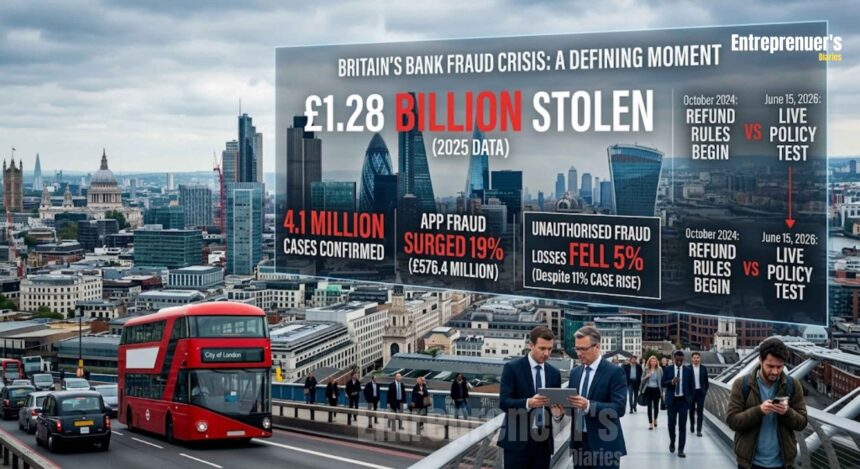
London, June 15, 2026: The rules have not changed. The refund framework is exactly what the Payment Systems Regulator switched on in October 2024. And yet Britain’s bank fraud crisis reached a defining moment on the morning of June 15, 2026, when the numbers that Reuters and UK Finance published from Britain’s latest annual fraud dataset landed with the force of a policy reckoning.
Criminals stole £1.28 billion from British consumers and businesses in 2025 a four per cent rise on 2024, and the fifth consecutive year in which total fraud losses across the UK have exceeded £1 billion. More than 4.1 million fraud cases were confirmed across authorised and unauthorised categories combined.
And at the centre of it all, authorised push payment fraud the category the new reimbursement regime was specifically designed to contain surged 19% to £576.4 million, its sharpest year on year climb since the COVID era technology scam boom.
The data, confirmed by Innovate Finance, which compiled the figures drawn from its members, arrives precisely as Frontier Economics concludes an independent review of the PSR’s reimbursement rules, with findings due in early July 2026.
The timing is not coincidence. It is a live policy test, and the results are not flattering. One positive signal is buried in the data, however and it is a significant one: unauthorised fraud losses fell five per cent to £703.4 million in 2025, despite an 11% increase in the number of unauthorised cases reported, to 3.81 million. Banks are getting better at stopping one type of fraud. The criminal ecosystem is getting better at exploiting another.
That divergence APP fraud surging while unauthorised fraud falls is the structural story inside the 2025 numbers, and it is the story that defines the entire regulatory debate now underway.
KEY FIGURES AT A GLANCE
- Total UK Fraud Losses 2025: £1.28 billion up 4% on 2024 (UK Finance / Innovate Finance)
- Total Confirmed Fraud Cases: 4.1 million across authorised and unauthorised categories (UK Finance / Innovate Finance)
- APP Fraud Losses 2025: £576.4 million up 19% year on year (UK Finance, via Reuters)
- Unauthorised Fraud Losses 2025: £703.4 million down 5% on 2024 (Finextra, citing Innovate Finance)
- Returned to APP Fraud Victims: £354.3 million equivalent to 61% of APP losses (UK Finance)
BRITAIN’S BANK FRAUD IN FULL: £1.28 BILLION, 4.1 MILLION CASES, AND WHAT THOSE NUMBERS ACTUALLY MEAN
Britain has now recorded five consecutive years of fraud losses exceeding £1 billion. The 2025 figure of £1.28 billion, confirmed by Innovate Finance drawing on member data and reported by Finextra on June 15, 2026, represents a four per cent increase on 2024’s £1.17 billion and it does so against a backdrop in which Britain’s banking sector has poured significant resource into fraud prevention technology, consumer awareness campaigns, and real time detection infrastructure.

The 4.1 million confirmed fraud cases in 2025 combining 3.81 million unauthorised cases and 248,070 APP fraud cases is a dataset that tells two fundamentally different stories about who is winning and who is losing the fraud prevention battle.
According to Finextra’s reporting of the Innovate Finance figures, unauthorised fraud cases increased 11% to 3.81 million in 2025, but losses in that category fell five per cent to £703.4 million. That means more attempts were made, but banks caught more of them. The prevention infrastructure is working at scale against unauthorised fraud specifically.
APP fraud tells the opposite story. According to Reuters’ June 15, 2026 reporting citing UK Finance data, 248,070 APP fraud cases were recorded in 2025, up seven per cent on the prior year. Losses in that category rose 19% to £576.4 million. Higher case numbers, higher individual losses, higher total damage. The PSR’s mandatory reimbursement regime has not bent that curve.
The criminals operating in the APP fraud ecosystem have adapted to it, selected for higher value targets, and are deploying increasingly sophisticated social engineering aided by AI to defeat the consumer awareness measures that constrained their operation in 2024.
As Innovate Finance noted in its commentary reported by Finextra, the rise demonstrates how fraud continues to operate on an industrial scale and represents a national security threat. That framing national security, not consumer protection is itself a signal of how seriously the industry now views what the data shows.
WHAT APP FRAUD IS AND WHY THE DISTINCTION DETERMINES WHO PAYS
Authorised push payment fraud is not hacking. It is not account takeover. It is the deliberate psychological manipulation of a victim into making a bank transfer they believe is legitimate. The victim authorises the payment. That single word authorised is the reason why, for most of British banking history, banks bore no legal liability for these losses whatsoever. The victim made the transfer. The bank processed it correctly. The loss was the victim’s to bear.
The PSR’s October 2024 reimbursement mandate changed that equation entirely. For the first time in UK banking history, a mandatory framework shifted the cost of APP fraud losses from the individual victim to the payment service providers who processed the transaction. That shift in liability created the incentive structure the PSR intended but as the 2025 data now confirms, it has not yet succeeded in reducing the frequency or severity of APP fraud itself.

According to UK Finance’s own press release accompanying its 2025 Half Year Report, two thirds of APP fraud cases in the first half of 2025 originated online, accounting for 32% of losses. Seventeen per cent of cases began via telecommunications, typically involving higher value scams and accounting for 28% of losses. The arithmetic is unambiguous: the financial sector is liable for losses that originate, at industrial scale, on platforms it does not operate and channels it does not control.
THE PSR’S OCTOBER 2024 MANDATE: WHAT THE RULES ACTUALLY SAY
On October 7, 2024, the Payment Systems Regulator implemented its mandatory reimbursement requirement for APP fraud a world first policy, as the PSR’s own publications explicitly describe it. Under its policy statement PS24/7, later consolidated into PS25/5 published in May 2025, the PSR directed all payment service providers using Faster Payments to reimburse victims of in scope APP scams up to a maximum of £85,000 per claim. The original proposed cap was £415,000. The PSR’s decision to reduce it to £85,000 was confirmed in PS24/7, following industry consultation.
The mechanism is specific. Payment service providers must issue the refund within five business days of a claim, or within 35 business days if investigation is required. The cost is split equally 50% by the sending payment service provider and 50% by the receiving payment service provider.
Firms may deduct a £100 excess per claim, but this cannot be applied to customers classified as vulnerable. Payment service providers must reimburse unless they can prove the customer acted with gross negligence and the PSR has placed the burden of that proof squarely on the firm, not the consumer.
INSIDE THE NUMBERS: INVESTMENT, PURCHASE, AND ROMANCE SCAMS ALL HIT RECORDS
The composition of the £576.4 million in 2025 APP fraud losses tells a more alarming story than the headline figure alone. According to Finextra’s June 15, 2026 reporting of the Innovate Finance data, investment fraud accounted for the highest proportion of APP losses at £221.5 million up 40% year on year with case numbers up 26% to 14,893. Romance fraud losses increased 23% to £39.2 million.

These are not marginal movements. They are the product of a criminal ecosystem that has found AI powered social engineering to be scalable, cost effective, and increasingly difficult for potential victims to detect.
Investment scams, according to UK Finance’s data and its press releases, are driven primarily by social media posts advertising lucrative returns on fictitious funds or fabricated investment schemes. The average loss in an investment scam case is more than 20 times that of a purchase scam, according to Info security Magazine’s analysis of the UK Finance Half Year 2025 data.
That ratio explains why total APP losses have risen sharply even as APP case volumes tell a more moderate story: the criminals who are getting through are not running high volume, low value operations. They are running precisely targeted, high value campaigns against a narrowing but increasingly lucrative pool of victims.
According to analysis published by Edgar, Dunn and Company, the average loss per APP fraud case jumped 23% to £2,427 in 2024, compared to £1,978 in 2023. The 2025 data confirms that trajectory has continued and accelerated.
One notable area of decline within the APP category: impersonation fraud where criminals pose as a bank, police force, or organisation and convince victims to transfer money to a “safe account” fell again in 2025, with losses down 12% and case numbers down 11%, per Finextra’s reporting of the Innovate Finance data.
Consumer awareness campaigns around this specific scam type appear to be working. The challenge is that every percentage point of progress in one category is being outpaced by deterioration in investment and romance fraud.
Key Sub Category Data (2025, Innovate Finance via Finextra):
- Investment fraud losses: £221.5 million up 40% year on year, 14,893 cases, up 26%
- Romance fraud losses: £39.2 million up 23%
- Impersonation fraud: losses down 12%, cases down 11%
- Two thirds of APP cases originated online 32% of APP losses
- 17% of APP cases began via telecommunications 28% of APP losses
THE DECLINE IN UNAUTHORISED FRAUD: THE ONE DATA POINT BANKS CAN POINT TO WITH PRIDE
Inside the £1.28 billion headline, there is a genuine success story and it deserves to be stated as clearly as the crisis. Unauthorised fraud losses fell five per cent in 2025 to £703.4 million, according to Finextra’s reporting of the Innovate Finance figures.
This decline occurred despite an 11% increase in the number of unauthorised fraud cases reported, to 3.81 million. Banks intercepted more attempts, at a higher rate, and reduced the total financial damage even as the volume of attacks increased.
The components of that success are instructive. According to Finextra’s reporting, remote banking fraud fell 27% to £104.4 million in 2025 a substantial year on year reduction that reflects the cumulative effect of multi factor authentication, behavioural biometrics, and real time anomaly detection systems that UK banks have invested in since the pandemic.
Contactless fraud rose eight per cent to £46.8 million a comparatively modest increase given the continued growth of contactless payment volumes across the UK economy.
Remote purchase fraud which has been the most persistent and fastest growing category of unauthorised fraud in recent years made up £423.5 million of the unauthorised total in 2025, per the Finextra report. While this remains a significant loss figure, the five per cent overall decline in unauthorised losses confirms that bank prevention systems are becoming more effective at the boundary between attempted and completed unauthorised fraud.
The UK Finance Half Year 2025 Report, published by UK Finance directly, had already signalled this trend: banks prevented £870 million of unauthorised fraud in H1 2025 alone, 20% more than in the same period in 2024, equivalent to stopping 70 pence of every pound of attempted unauthorised fraud. That prevention rate is the highest the UK banking sector has recorded, and it represents a genuine structural improvement in the industry’s defensive capability.
The frustration for the sector and the central argument of everyone calling for platform and telecoms accountability is that this progress is being erased in real time by APP fraud losses that originate outside the financial system entirely. Banks are getting better at stopping the fraud they can see. They cannot stop the fraud that starts on a social media platform before any bank is involved.
THE PLATFORM PROBLEM: META, $16 BILLION, AND THE ADVERTISING ECOSYSTEM THAT FUNDS IT
The most commercially significant dimension of this fraud crisis is not what is happening inside the banking sector. It is what is happening outside it on the social media and advertising platforms that serve as the primary origination point for investment scams now at their highest ever loss level in UK history.
In November 2025, Reuters published an investigation based on internal Meta documents revealing the company projected approximately 10% of its total 2024 revenue roughly $16 billion would come from running advertisements for scams and banned goods.
The Reuters investigation reported that a December 2024 internal document showed Meta was showing its users an estimated 15 billion higher risk scam advertisements per day. A separate internal document indicated that Meta earns approximately $7 billion annually from the most clearly deceptive category of scam advertising, labelled internally as higher risk.
According to Reuters’ reporting of the internal documents, Meta’s own automated systems flagged many of these advertisers as likely fraudsters but the company’s policy was to ban advertisers only when its systems predicted at least 95% certainty of fraud. Below that threshold, Meta charged suspect advertisers higher ad rates as a penalty instead of removing them. A Meta spokesperson described the 10% revenue figure as a rough and overly inclusive estimate and stated the company aggressively fights fraud and scams.
In the UK context specifically, Reuters’ June 15, 2026 reporting confirmed that Meta has repeatedly failed to stop illegal advertisements for high risk investment products on its platforms, despite making public commitments to block them.
UK Finance’s Ruth Ray told Reuters directly that most APP fraud still starts via online tech platforms or via telecoms, and that stronger, enforceable responsibilities urgently need to be placed on those sectors. Janine Hirt, chief executive of Innovate Finance, told Reuters that technology companies should help bear the cost of reimbursement and introduce stricter checks such as seller verification.
OFFICIALS ON THE RECORD
- Ruth Ray, Director of Economic Crime, UK Finance (via Reuters, June 15, 2026): “Given most APP fraud still starts via online tech platforms or via telecoms, we urgently need stronger, enforceable responsibilities to be placed on these sectors.” Ray also confirmed to Reuters that fraudsters are becoming increasingly sophisticated in their use of social engineering, aided by AI, widening the pool of potential victims.
- Janine Hirt, CEO, Innovate Finance (via Reuters, June 15, 2026): Technology companies should help bear the cost of reimbursement and introduce stricter platform checks, including seller verification, as part of any reformed framework.
- Ben Donaldson, Managing Director of Economic Crime, UK Finance: “The financial services industry works tirelessly to protect customers and prevent billions more being stolen by fraudsters, but we know that criminals are always looking for new ways to exploit victims.”
- PSR Spokesperson (via Reuters, June 15, 2026): “We have consistently called for tech firms to do more to protect their users, while banks and telecoms providers must also play their part.”
WHAT THE PSR’S OWN DATA SHOWS ABOUT THE FIRST YEAR OF REIMBURSEMENT
The PSR’s own quarterly reimbursement dashboard, as reported in its first anniversary assessment published in October 2025, showed that in the first year of the scheme from October 7, 2024 to September 30, 2025 88% of the money lost to eligible APP scams was reimbursed to victims, totalling £173 million. This compares to a 65% reimbursement rate in 2024 under the prior voluntary code. The PSR’s Q3 2025 dashboard, published in January 2026, further confirmed that 82% of claims were closed within five business days, and 98% within 35 business days.
However, the full year 2025 data reported by UK Finance and Innovate Finance puts those reimbursement gains into a sobering context. Banks reimbursed £354.3 million to APP fraud victims in 2025, equivalent to 61% of total APP losses, per Finextra’s reporting. The PSR’s in scope reimbursement scheme covered £173 million of that total at an 88% rate. The remaining returns came through other mechanisms, including voluntary recovery and negotiated settlements and the gap between what was lost and what was returned, approximately £222 million, was borne permanently by victims.
According to the Fair Banking All Party Parliamentary Group’s report “No Half Measures A Blueprint to Beat APP Fraud,” published in July 2025, the annual cost of APP fraud to the UK economy is £3.3 billion when downstream costs beyond direct banking losses are included. The APPG explicitly recommended that social media companies be required to contribute to the Mandatory Reimbursement Requirement and the Economic Crime Levy, noting that fraud is now the most prevalent crime against individuals in the UK.
A government survey cited by BioCatch’s analysis found that among fraud victims: 86% felt anger, 73% reported stress, 63% experienced anxiety, 18% suffered depression, and 3% reported suicidal thoughts. These figures are not footnotes. They are the human cost sitting behind every one of the 4.1 million confirmed cases.
THE FRONTIER ECONOMICS REVIEW AND WHAT COMES NEXT
Frontier Economics is conducting an independent review of the PSR’s October 2024 APP fraud reimbursement rules, with findings due in early July 2026, as reported by Reuters and Traders Union on June 15, 2026. The review will assess the regime’s impact on fraud prevention, the appropriateness of the £85,000 liability cap, its effect on competition across the payments sector, and the operational shortcomings identified in its first eighteen months of operation.
The stakes extend far beyond whether the cap changes. According to Traders Union’s analysis published on June 15, 2026, the review’s conclusions are likely to shape how the costs of fraud prevention and victim compensation are shared across the payments, technology, and telecommunications sectors. If technology platforms are brought inside the cost sharing framework a position advocated by UK Finance, the PSR, Innovate Finance, and the Fair Banking APPG the economics of digital advertising for major platforms operating in the UK market will change materially.
The Grant Thornton analysis of the APP fraud reimbursement scheme, published in April 2026, further noted that the scheme has increased financial and operational pressure on payment firms, particularly smaller payment service providers and fintechs operating with narrower margins.
The Frontier Economics review in July 2026 is the first formal mechanism in which the regulatory perimeter could be officially redrawn. Its findings will set the commercial and regulatory tone for UK payments for the next decade.
THE BOTTOM LINE: WHAT THIS CRISIS ACTUALLY MEANS, AND WHAT MOST COVERAGE WILL MISS
Most reporting on the UK’s £1.28 billion fraud total will frame this as a banking failure story. It is not primarily a banking failure story. The decline in unauthorised fraud five per cent down to £703.4 million despite an 11% rise in attack volumes is the clearest proof in years that the banking sector’s prevention infrastructure is working. Banks stopped more fraud, at a higher rate, than at any point since the pandemic. That is not a footnote. That is a systemic improvement that deserves to be acknowledged.
The crisis is not that banks are failing to defend the perimeter they control. The crisis is that the most dangerous and fastest growing category of fraud APP fraud at £576.4 million, up 19% originates on a perimeter they do not control, cannot monitor, and are currently required to compensate for financially without any corresponding obligation on the platforms where it begins.
That asymmetry is the defining market structure problem in UK financial crime. The banking sector has spent years building real time fraud detection, behavioural biometrics, and inter bank intelligence sharing infrastructure. It prevents £870 million of unauthorised fraud every six months. It has driven impersonation fraud losses down 12% in a single year.
And yet the 2025 total fraud figure has risen to £1.28 billion the highest since 2022 because investment scam losses on social media are rising 40% per year while the platforms hosting those advertisements bear zero financial liability for the outcomes.
The 4.1 million total confirmed fraud cases in 2025 is not merely a statistic. It is 4.1 million people who had money taken from them, or had an attempt made on their finances. It is a scale of criminal activity that dwarfs every other category of financial crime in the UK and has done so for five consecutive years.
And it is a scale that makes the current framework in which banks absorb the mandatory reimbursement liability for losses that start on social media and end in a Faster Payment increasingly untenable as a long term commercial proposition for any payment service provider that is not a systemically important institution with the balance sheet to absorb it.
The Frontier Economics findings in early July 2026 will be the first credible signal of whether the regulatory architecture is about to expand. For investors in payments, fintech, and digital advertising, that report is the event to watch not this one. This one tells you the building is on fire. The July report will tell you whether anyone has called the fire service with jurisdiction over where it started.
MARKET AND INVESTOR TAKEAWAYS
- Total UK fraud losses rose to £1.28 billion in 2025 the highest since 2022 and the fifth consecutive year above £1 billion signalling that the current multi sector framework is structurally insufficient.
- 4.1 million confirmed fraud cases in 2025 makes financial fraud the largest single category of crime against individuals in the UK by volume.
- The five per cent decline in unauthorised fraud losses to £703.4 million despite an 11% rise in cases is the banking sector’s strongest prevention performance since the pandemic and deserves recognition as a genuine systemic achievement.
- The 19% APP fraud surge to £576.4 million, combined with 40% growth in investment scam losses to £221.5 million, points directly to social media advertising platforms as the next mandatory accountability frontier.
- The Frontier Economics review, due in early July 2026, could extend cost sharing liability to technology and telecoms platforms a development with material implications for digital advertising economics and fintech competitiveness in the UK market.
- Banks reimbursed £354.3 million 61% of APP losses in 2025. The £222 million gap between what was lost and what was returned represents the permanent cost borne by victims outside the scope of the mandatory regime.
FREQUENTLY ASKED QUESTIONS
FAQ 1: What does the £1.28 billion total fraud figure actually include?
The £1.28 billion in total UK fraud losses for 2025, confirmed by Innovate Finance drawing on its member data and reported by Finextra on June 15, 2026, covers all payment fraud and scams reported by UK Finance and Innovate Finance members. This includes both authorised push payment fraud where victims are manipulated into making transfers and unauthorised fraud, where criminals access accounts or steal card details without the victim’s knowledge.
APP fraud accounted for £576.4 million of the total, while unauthorised fraud losses totalled £703.4 million. The 4.1 million case total combines 3.81 million unauthorised fraud cases and 248,070 APP fraud cases. Importantly, this figure represents only the fraud reported to and captured by UK Finance and Innovate Finance members. The Fair Banking All Party Parliamentary Group’s July 2025 report estimated the total annual cost of APP fraud alone to the UK economy at £3.3 billion when downstream costs are included.
FAQ 2: Why did unauthorised fraud losses fall even as cases rose?
Unauthorised fraud losses fell five per cent to £703.4 million in 2025, per Finextra’s reporting of the Innovate Finance data, despite an 11% increase in confirmed cases to 3.81 million. The divergence between rising case numbers and falling losses reflects the increasing effectiveness of bank fraud prevention systems. According to UK Finance’s own Half Year 2025 press release, banks prevented £870 million of unauthorised fraud in just the first six months of 2025 20% more than the same period in 2024, equivalent to stopping 70 pence of every pound targeted.
Remote banking fraud fell 27% to £104.4 million, reflecting the impact of multi factor authentication and behavioural biometric technology. More attacks were attempted, but a higher proportion were intercepted before losses crystallised. This is the clearest evidence that bank investment in prevention technology is delivering measurable results in the categories of fraud that banks can actually see and stop.
FAQ 3: Why is APP fraud rising when the reimbursement rules were supposed to prevent it?
The PSR’s October 2024 mandatory reimbursement regime was designed to create a prevention incentive by making both sending and receiving payment service providers financially liable for reimbursing victims. The PSR’s own first anniversary assessment, published in October 2025, confirmed that 88% of eligible APP scam losses were reimbursed to victims in the first year, up from 65% under the prior voluntary framework a genuine improvement in consumer protection outcomes.
However, the regime’s prevention logic depends on financial liability changing the behaviour of the parties who can actually prevent fraud. The data shows that banks are responding but the platforms and telecoms channels where most APP fraud originates are not inside the mandatory framework and bear no financial liability.
As Ruth Ray of UK Finance told Reuters on June 15, 2026, most APP fraud still starts via online tech platforms or via telecoms. Until those sectors carry a proportionate share of the cost, the prevention incentive is incomplete.
FAQ 4: What specifically is the Frontier Economics review examining?
Frontier Economics is conducting an independent review of the PSR’s October 2024 APP fraud reimbursement rules, with findings due in early July 2026, as reported by Reuters and Traders Union on June 15, 2026. The review will critically assess the regime’s impact on fraud prevention rates, the appropriateness of the £85,000 maximum reimbursement cap, its effects on competition across the payments sector, and the operational issues identified in the scheme’s first eighteen months of operation.
According to Traders Union’s analysis, the review’s conclusions are expected to shape how fraud prevention and victim compensation costs are distributed across the payments, technology, and telecoms sectors the central question that the 2025 fraud data makes impossible to defer.
FAQ 5: What does this mean for fintechs and smaller payment service providers specifically?
The 50/50 cost split reimbursement model in which both the sending and receiving payment service provider bear equal liability for APP fraud reimbursements places structurally different burdens on large incumbent banks and smaller payment firms.
Grant Thornton’s April 2026 analysis noted that while initial fears of an immediate surge in fraudulent reimbursement claims had not materialised, claim volumes have increased steadily each quarter, placing mounting financial and operational pressure on payment firms, particularly those with narrower margins.
For fintechs that have built growth models on the lower friction payment journeys that also happen to carry higher APP fraud risk, the reimbursement cost is a direct and growing line item. The Frontier Economics review’s findings on whether the £85,000 cap is adjusted, and whether tech and telecoms platforms are brought inside the cost sharing framework, will directly determine how sustainable that pressure becomes over the next regulatory cycle.
Connect With Us On Social Media [ Facebook | Instagram | Twitter | LinkedIn ] To Get Real-Time Updates On The Market. Entrepreneurs’ Diaries Is Now Available On Telegram. Join Our Telegram Channel To Get Instant Updates.

Isabella is a global business journalist and former McKinsey analyst from Brazil. She brings sharp insights on economic shifts, policies, and founder journeys from around the world.

Tokyo-based CFA translating global markets into clear insights for modern entrepreneurs.