
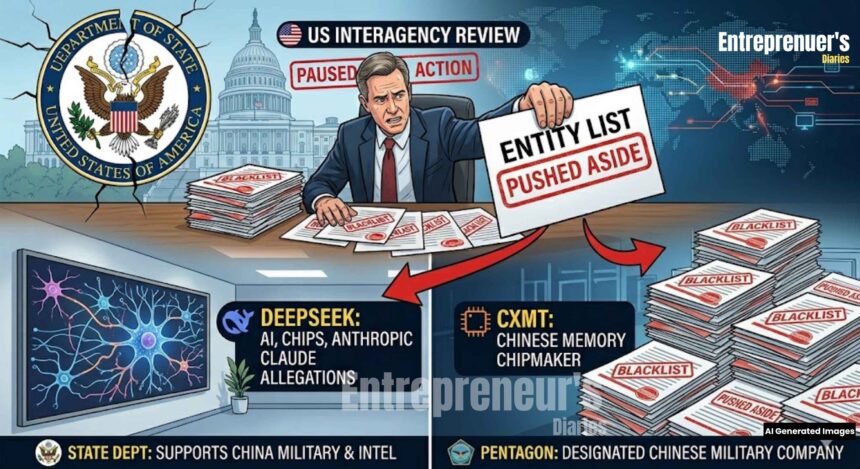
Washington, June 17, 2026: The DeepSeek blacklist that almost was. A Chinese AI startup that allegedly tried to steal from Anthropic. A memory chipmaker tagged by the Pentagon as a military company. More than 100 other firms flagged as national security risks. All of them cleared for blacklisting by a U.S. interagency committee more than a year ago. None of them have actually been blacklisted.
That gap between approval and action is now the headline story in U.S. China tech policy. Reuters reported on June 16, 2026, citing two people familiar with the matter, that Washington has held off adding DeepSeek, ChangXin Memory Technologies (CXMT), and over 100 other companies to the Commerce Department’s Entity List, even though an interagency committee approved them for listing more than a year ago.
This is not a story about a security threat nobody noticed. It is a story about a security threat everybody noticed, and a government that decided not to act on it.
THE CORE REUTERS FINDING: WHAT WAS ACTUALLY CONFIRMED
US Holds Off Blacklisting China’s DeepSeek. Every figure in this section traces to Reuters’ exclusive report, published June 16, 2026, and syndicated by outlets including CNBC, MarketScreener, Yahoo Finance, BusinessWorld, and Republic World.
According to Reuters, DeepSeek, CXMT, and more than 100 other companies were approved by an interagency committee last year for addition to the Commerce Department’s Entity List. That approval has never resulted in a published listing.
The interagency committee that makes these calls includes officials from the Departments of Commerce, Defense, Energy, State, and at times Treasury, per Reuters. Two of Reuters’ sources said the committee has approved companies for the list, but Commerce has not published them.
The reason, according to Reuters: the Trump administration is trying to avoid escalating tensions with Beijing. US Blacklist DeepSeek is the headline framing, but the substance is more specific.
That is not speculation dressed up as fact. It is the framing Reuters itself used in its lead paragraph, attributed to two people described as familiar with the matter.
THE CASE BEHIND THE DEEPSEEK BLACKLIST
The DeepSeek blacklist push did not come out of nowhere. DeepSeek is not a marginal player caught up in bureaucratic process. Its low cost AI model triggered a global technology stock selloff when it launched in January 2025, a moment that remains one of the defining shocks of the current AI investment cycle.
The specific national security case for the DeepSeek blacklist, as reported by Reuters, traces to a senior U.S. State Department official who told the news agency last year that DeepSeek has supported China’s military and intelligence operations. The same official said the startup attempted to use shell companies based in Southeast Asia to illegally access advanced U.S. chips, according to Reuters’ reporting.
That is a serious allegation from a named category of U.S. government official, even if the official is not named individually in Reuters’ report. It is also the most direct national security justification Reuters has reported for why DeepSeek was approved for the Entity List in the first place, and it remains the central rationale behind the still unpublished DeepSeek blacklist more than a year later.
WHO IS BEHIND DEEPSEEK: THE LIANG WENFENG STORY
Understanding why DeepSeek became a flashpoint requires understanding where it came from. DeepSeek’s full legal name is Hangzhou DeepSeek Artificial Intelligence Basic Technology Research Co., Ltd. It was founded on July 17, 2023, and is headquartered in Hangzhou, Zhejiang province, per the company’s own corporate registration details as documented on its Wikipedia entry and corroborated by multiple business outlets.
The company is owned by High Flyer, a Chinese hedge fund. Both DeepSeek and High Flyer are led by the same person: Liang Wenfeng, who serves as CEO of both entities.
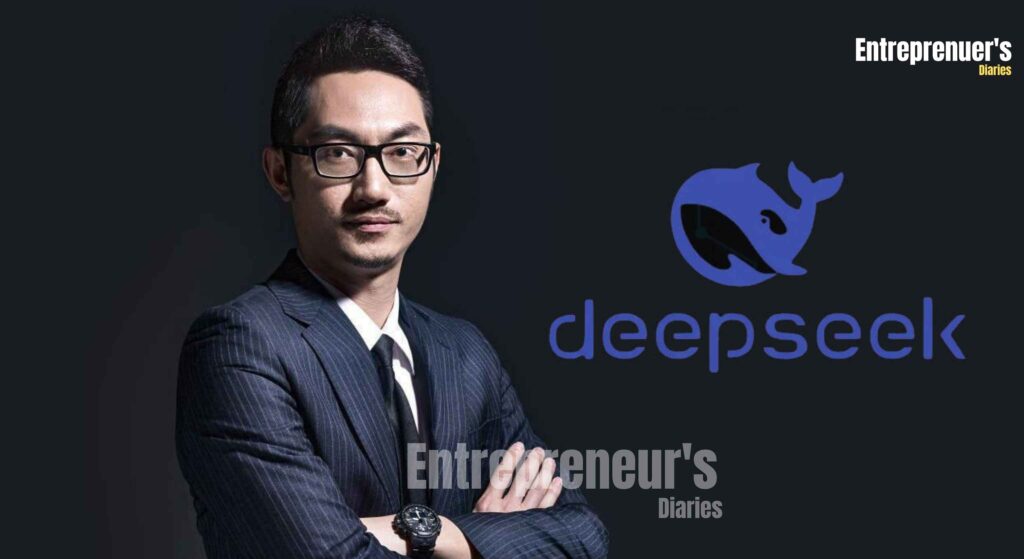
Liang was born in 1985 in Guangdong province and studied electronic information engineering and information and communication engineering at Zhejiang University, earning his bachelor’s and master’s degrees there, according to his Wikipedia profile and corroborating reporting from Entrepreneur.
He co founded High Flyer in February 2016 with two of his Zhejiang University classmates. The fund grew to manage more than 100 billion yuan, or roughly $14 billion, in assets by 2021, according to Forbes sourced reporting cited by Entrepreneur.
In 2023, as High Flyer wound down its main investment product, Liang redirected the firm’s computing infrastructure toward AI research, leading to DeepSeek’s founding that July, per Entrepreneur’s reporting on the company’s history.
That infrastructure pivot is central to the U.S. national security conversation. High Flyer had spent years building large scale computing capacity for quantitative trading. DeepSeek inherited that capacity and the chips behind it questions about how those chips were acquired are part of what U.S. officials are now scrutinizing.
THE ANTHROPIC ALLEGATIONS, IN THE COMPANY’S OWN WORDS
The Reuters report references a more recent and more specific allegation, this time from Anthropic, an American AI company. Per Anthropic’s own blog post, published on its official website, the company stated it had identified industrial scale campaigns by three AI laboratories, DeepSeek, Moonshot, and MiniMax, to illicitly extract Claude’s capabilities to improve their own models.

Anthropic’s exact language, taken from that post: these labs generated over 16 million exchanges with Claude through approximately 24,000 fraudulent accounts, in violation of the company’s terms of service and regional access restrictions.
The technique involved is called distillation, where a less capable model is trained on the outputs of a stronger one. Anthropic was careful to note that distillation is a widely used and legitimate training method, used by frontier labs to build smaller, cheaper versions of their own models. What made this different, per Anthropic, was the use of fraudulent accounts and proxy services specifically to evade detection and access restrictions that apply to users in China.
Separately, OpenAI also raised concerns to U.S. lawmakers that DeepSeek was targeting its models, according to Reuters’ June 16 report. That detail places two of the most prominent American AI labs, Anthropic and OpenAI, on record with overlapping concerns about the same Chinese company.
WHY CXMT IS A DIFFERENT KIND OF RISK
If DeepSeek’s flag is about software and intelligence operations, CXMT’s is about hardware and military classification. ChangXin Memory Technologies was designated a Chinese military company by the U.S. Defense Department under the Biden administration, according to Reuters. The Commerce Department has reportedly been considering placing CXMT on the Entity List for more than a year, per multiple Reuters reports.
CXMT is not a fringe operation. It is China’s largest DRAM (dynamic random access memory) chipmaker. According to market research firm Omdia, cited in CXMT’s own IPO prospectus filed with the Shanghai Stock Exchange, the company held a 7.67% share of the global DRAM market in the fourth quarter of 2025, ranking it fourth worldwide behind Samsung Electronics, SK Hynix, and Micron Technology.
CXMT’s client list includes Alibaba, Tencent, ByteDance, Lenovo, Xiaomi, Oppo, and Vivo, according to an IPO sponsorship letter filed by China International Capital Corporation and reported by KrASIA. The company is also expanding into high bandwidth memory, a chip category critical to AI computing infrastructure, per the same reporting.
CXMT’s first quarter 2026 financial results, disclosed in its own Shanghai Stock Exchange prospectus and reported by the South China Morning Post, showed revenue of 50.8 billion yuan (about $7.4 billion), up 719% year on year, with net profit of roughly 33 billion yuan compared with a loss in the same period a year earlier.
That is the profile of a company a U.S. Entity List action would meaningfully affect, and one whose continued access to American technology, software, and equipment carries real strategic weight.
THE OFFICIAL SILENCE FROM BIS
Reuters reported that it sought comment from both DeepSeek and CXMT but could not reach either company outside normal business hours. It also sought comment from the Commerce Department’s Bureau of Industry and Security (BIS), the agency that actually administers the Entity List. Per Reuters, BIS did not directly respond to questions about why updates to the Entity List had not been published since last year, and did not comment specifically on DeepSeek or CXMT.
What BIS did provide, according to Reuters, was a general statement: the bureau uses “many policy and enforcement tools, including the Entity List … on a daily basis to ensure we are combating bad actors.”
That is a real statement from BIS, but it is notably non specific. It defends the existence of the tool without explaining its non use in this case. For context on how BIS typically talks about the Entity List when it does act, the bureau’s own press releases offer a useful contrast.
In a separate, unrelated enforcement action announced on its official website, Under Secretary of Commerce for Industry and Security Jeffrey Kessler described the Entity List as “one of many powerful tools at our disposal to identify and cut off foreign adversaries seeking to exploit American technology for malign purposes.”
THE MAN AT THE CENTER OF THE PAUSE
That name, Jeffrey Kessler, appears again in Reuters’ reporting on the DeepSeek and CXMT delay, this time in a far less celebratory context. Per Reuters, since late 2025, Jeffrey Kessler, under secretary of commerce for industry and security, has sought to avoid listing Chinese parties for fear of escalating tensions between the U.S. and China. Reuters attributed this to its first source and other people familiar with the matter.
Kessler has held the under secretary role since March 20, 2025, appointed by President Trump with Senate confirmation, according to his official government biography as documented on Wikipedia’s entry for the position. He leads BIS, the agency within Commerce responsible for the Entity List, from its Washington headquarters.
The contrast Reuters draws is stark: the same official whose own agency publicly frames the Entity List as a tool for cutting off adversaries is, according to Reuters’ sourcing, the one who has personally steered the bureau away from using it against dozens of newly flagged Chinese firms.
THE BACKLOG NOBODY IS TALKING ABOUT
DeepSeek and CXMT are the names making headlines. They are far from the only companies caught in the freeze. Reuters reported that at least 75 Chinese entities involved in advanced semiconductor production, semiconductor manufacturing equipment production, and AI modeling have gone through the interagency committee and were slated for blacklisting, according to one of its sources.
Multiple Chinese companies were also slated for listing after supplying Russian drones that were recovered in Poland last September, per Reuters. One source told Reuters that listing these lesser known suppliers is especially important because many U.S. companies further down the supply chain may not be aware of the nature of these firms’ business.
Separately, dozens of Chinese companies were identified last year as national security risks for selling restricted Nvidia chips to Chinese universities, but were never added to the list, according to a third Reuters source. Chinese manufacturers of drones and robotic “dog” systems intended for military use were also identified as potential targets, per the same source. None of these have been published either.
THE LONGEST GAP IN A DECADE
The scale of the freeze becomes clearer with one statistic. The U.S. has not posted any additions to its Entity List since October, which Reuters describes, citing Philip Luck of the Center for Strategic and International Studies, as the longest stretch between new postings in more than a decade.
Luck, who studies global supply chains at CSIS, offered Reuters a blunt assessment of what that pause means in practice: “The Entity List is like whack a mole and you’ve got to keep whacking the moles.” He added that the lack of new listings is likely allowing American technology to reach adversaries who could use it against the United States.
Kevin Kurland, a former Commerce Department official, was equally direct in his comment to Reuters: “The fact the U.S. hasn’t put any companies on the Entity List since October demonstrates that trade policy is overshadowing the use of a critical national security tool.”
Those are two named, credentialed sources, one an academic supply chain expert, one a former insider at the agency in question, both making the same point through different lenses.
WHAT THE ENTITY LIST ACTUALLY DOES
For readers unfamiliar with the mechanism at the center of this story, the Entity List is a Commerce Department register of foreign individuals, companies, and organizations subject to specific export licensing requirements because they are deemed national security or foreign policy risks.
Per Reuters’ explanation, U.S. companies cannot ship goods, software, and technology to companies on the list without a license, and that license is likely to be denied. In practice, that means a company’s appearance on the list functions as a near total cut off from American suppliers, chipmakers, and software providers, absent a rare licensing exception. It is one of the U.S. government’s sharpest non military tools for restricting a foreign company’s access to American technology.
BIS has used the tool actively in the past against other Chinese entities. According to a BIS press release on its official website, the bureau previously added 12 entities, 11 under the destination of China and one under Taiwan, for engaging in the development of advanced AI, supercomputers, and related capabilities. That action illustrates that the tool itself is fully operational; what has changed, per Reuters, is the willingness to use it against this newest batch of approved names.
THE TENSE RIVALRY BEHIND THE DECISION
None of this is happening in a vacuum. Reuters frames the pause against what it describes as a tense rivalry between the United States and China over technology, trade, and national security.
Washington has leaned on tariffs and export controls to keep Beijing at bay, per Reuters, while China maintains a stranglehold on rare earth minerals that defense, automotive, and chipmaking firms need.
That mutual leverage helps explain the restraint Reuters describes. An Entity List action against DeepSeek and CXMT would not be a symbolic gesture. China’s control over rare earths gives it a retaliatory lever that touches nearly every advanced manufacturing sector in the American economy, and Reuters’ reporting suggests the administration is unwilling to test that lever further at this moment.
Reuters also points to a related regulatory gap that reinforces the broader picture of an agency in a holding pattern. The bureau said early last year it would replace a Biden era rule governing global access to U.S. origin AI chips. It has still not published a replacement, per Reuters, and is not enforcing the earlier rule, a lapse that may have opened a potential loophole allowing chips to be exported to Chinese companies operating outside China.
WHAT THIS MEANS FOR BUSINESSES AND INVESTORS
For companies operating anywhere near the U.S. China technology corridor, semiconductor supply chains, AI model licensing, cloud infrastructure, or export compliance, this story carries a specific and immediate signal: regulatory status and regulatory risk are no longer the same thing.
DeepSeek and CXMT are, as of today, not on the Entity List. That is the factual, current status. But Reuters’ reporting establishes that both companies have already cleared the security review process that normally precedes a listing. A change in political calculus, not a change in the underlying security assessment, is the only thing currently standing between these companies and formal blacklisting.
That distinction matters enormously for compliance teams. A company that builds DeepSeek model integrations into its products, or that sources memory chips with CXMT exposure somewhere in its supply chain, is operating in a zone the U.S. government itself has already flagged as a security concern, even though no legal restriction currently applies.
It also matters for investors tracking the semiconductor and AI sectors. CXMT’s planned Shanghai listing, its DRAM market share gains, and its profit turnaround are all real, disclosed, and verifiable corporate developments. But they are unfolding while the company sits, per Reuters, in a U.S. regulatory holding pattern that could end at any time, particularly if diplomatic conditions between Washington and Beijing shift.
THE BOTTOM LINE
The headline writes itself: the U.S. held off blacklisting DeepSeek. The more important story is what “holding off” actually means in this case. It is not inaction born of uncertainty. It is inaction despite certainty, after the security case for action had already cleared the government’s own internal review.
Reuters’ sourcing puts a name to the decision, Jeffrey Kessler, and a motive, avoiding escalation with Beijing. It puts a number to the backlog, more than 100 companies, including at least 75 tied specifically to advanced semiconductors, manufacturing equipment, and AI. And it puts a timeframe to the freeze, the longest gap in Entity List postings in more than a decade.
For DeepSeek, the practical effect is continued, unrestricted access to whatever American technology and partnerships it can still secure, even as the State Department’s own assessment links it to China’s military and intelligence operations and Anthropic accuses it of running an industrial scale scheme to copy Claude’s capabilities.
For CXMT, it means a clear runway toward its Shanghai listing and continued global market share gains in DRAM, even after the Pentagon itself classified it as a Chinese military company. The Entity List was built to close gaps like this. Right now, by the U.S. government’s own design and its own delay, the gap stays open.
FREQUENTLY ASKED QUESTIONS
Is DeepSeek currently on the U.S. Entity List or banned in the United States?
No. As of this report, DeepSeek is not on the Commerce Department’s Entity List. Per Reuters’ June 16, 2026 report, DeepSeek was approved by an interagency committee last year for addition to the list, but the Commerce Department has not published that listing.
This means DeepSeek faces no federal export restriction at this time, even though it has cleared the government’s internal national security review process. Separately, several U.S. states, including New York, Texas, and Virginia, have moved to restrict DeepSeek from state government systems and devices, a state level action distinct from any federal Entity List decision.
Why is the U.S. delaying action against DeepSeek and CXMT specifically?
Per Reuters’ sourcing, two people familiar with the matter said the Trump administration is trying to avoid escalating tensions with Beijing. Reuters further reported that Jeffrey Kessler, the under secretary of commerce for industry and security who leads BIS, has since late 2025 sought to avoid listing Chinese parties for this same reason, according to its first source and others familiar with the matter.
The broader context, per Reuters, is a tense rivalry in which Washington uses tariffs and export controls against Beijing while China holds significant leverage through its control of rare earth minerals needed by U.S. defense, auto, and chipmaking industries.
What specifically did DeepSeek allegedly do to warrant national security concern?
According to a senior U.S. State Department official who spoke to Reuters last year, DeepSeek has supported China’s military and intelligence operations and attempted to use shell companies in Southeast Asia to illegally access advanced U.S. chips.
Separately, Anthropic stated in an official blog post on its website that it identified an industrial scale campaign by DeepSeek and two other Chinese AI labs, Moonshot and MiniMax, involving over 16 million exchanges with its Claude model through roughly 24,000 fraudulent accounts, aimed at illicitly extracting Claude’s capabilities. OpenAI separately told U.S. lawmakers that DeepSeek was also targeting its models, per Reuters.
What is the Entity List and what happens to a company once it is added?
The Entity List is a Commerce Department register, maintained by the Bureau of Industry and Security, of foreign parties subject to specific export licensing requirements due to national security or foreign policy concerns. Per Reuters, once a company is added, U.S. firms cannot ship it goods, software, or technology without a license, and that license is likely to be denied.
In effect, listing cuts a company off from most legal access to American technology and components. Decisions to add a company are made by an interagency committee including officials from the Departments of Commerce, Defense, Energy, State, and at times Treasury, per Reuters.
How big a company is CXMT, and why does its potential blacklisting matter for the global chip market?
CXMT, ChangXin Memory Technologies, is China’s largest DRAM memory chipmaker. According to Omdia data cited in the company’s own IPO prospectus filed with the Shanghai Stock Exchange, CXMT held a 7.67% share of the global DRAM market in the fourth quarter of 2025, ranking fourth worldwide behind Samsung Electronics, SK Hynix, and Micron Technology. The company’s clients reportedly include Alibaba, Tencent, ByteDance, Lenovo, Xiaomi, Oppo, and Vivo, per an IPO sponsorship letter reported by KrASIA.
The U.S. Defense Department designated CXMT a Chinese military company under the Biden administration, according to Reuters, and the Commerce Department has reportedly weighed adding it to the Entity List for more than a year. Because CXMT supplies memory chips used across consumer electronics, AI servers, and computing infrastructure, any future U.S. export restriction on the company would have ripple effects across global hardware supply chains.
Connect With Us On Social Media [ Facebook | Instagram | Twitter | LinkedIn ] To Get Real-Time Updates On The Market. Entrepreneurs’ Diaries Is Now Available On Telegram. Join Our Telegram Channel To Get Instant Updates.

Isabella is a global business journalist and former McKinsey analyst from Brazil. She brings sharp insights on economic shifts, policies, and founder journeys from around the world.

Tokyo-based CFA translating global markets into clear insights for modern entrepreneurs.