
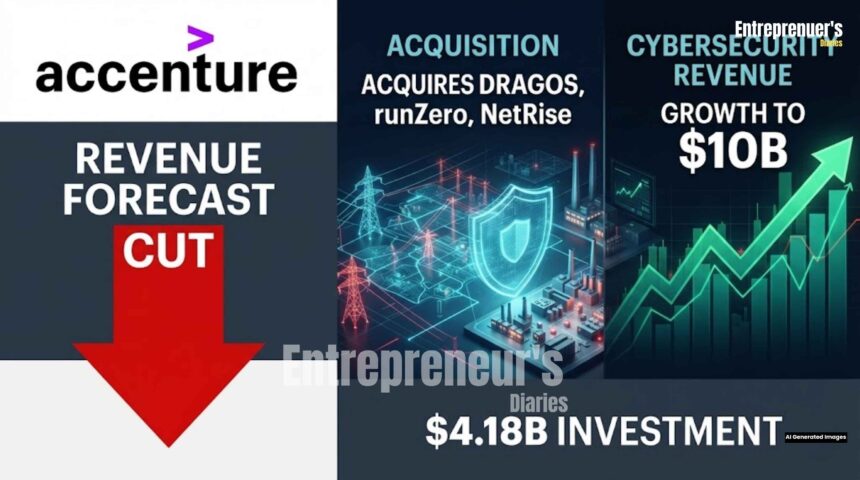
New York, June 18, 2026: A $10 billion cybersecurity business. A new $4.18 billion bet on protecting power grids and factories from AI driven attacks. And an Accenture share fall that hit double digits within hours of both announcements. That is the contradiction sitting at the center of Accenture’s Thursday.
The consulting giant beat Wall Street’s earnings estimates, unveiled its largest cybersecurity acquisition push to date, and still watched its shares get hammered in premarket trading. This is not a story about a failed quarter. It is a story about a forecast cut that mattered more to investors than a deal that, on paper, should have been the headline.
THE CORE FINDING: WHAT THE ACCENTURE SHARE FALL ACTUALLY REVEALED
Every figure in this section traces to Reuters’ report published June 18, 2026, and Accenture’s own official statements released the same day. According to Reuters, Accenture said on Thursday it would take a majority stake in industrial cybersecurity firm Dragos and fully acquire two smaller companies, asset intelligence firm runZero and device security specialist NetRise, in a combined deal valued at $4.18 billion. The Accenture cybersecurity deal marks the company’s largest single push into industrial security to date.

Accenture’s own newsroom statement frames the deal differently in emphasis but identically in substance. Per the company’s official release, the acquisitions are designed to deliver “end to end operational technology (OT) security” for critical infrastructure and industrial operations, including power grids, pipelines, manufacturing plants, distribution facilities, and data centers.
Reuters reported that Accenture shares fell over 11% in premarket trading. The Globe and Mail’s syndication of the same Reuters wire confirmed the identical figure. Separately, Reuters coverage carried by MarketScreener and Yahoo Finance cited a premarket decline of roughly 5%, while Seeking Alpha’s market commentary put the drop at 13%. The selloff coincided directly with Accenture revenue cuts to its full-year growth forecast, announced in the same release.
That range is not a contradiction to paper over. It reflects how fast premarket prices move as new information lands, and different snapshots in time produced different numbers. What is consistent across every outlet is the direction and the cause: a forecast cut, not the acquisition itself, drove the selloff.
WHY ACCENTURE IS BUYING DRAGOS, RUNZERO, AND NETRISE
The strategic logic, according to Accenture’s own statement, centers on a security gap the company says has gone “previously unaddressed at scale.” Reuters reported that the acquisitions will expand Accenture’s cybersecurity business into software for protecting industrial operations and critical infrastructure, against a backdrop of rising AI driven cyber threats and geopolitical tensions.
Accenture’s release goes further. It states that the Dragos Platform will expand to cover the extended environment that controls physical processes, while Accenture’s OT security expertise, industrial datasets, and decades of relationships with critical infrastructure operators will be layered on top.

Robert M. Lee, co founder and CEO of Dragos, is quoted directly in Accenture’s official statement: “Our energy and water systems, manufacturing plants, data centers and other operational environments need cybersecurity built from the ground up for xOT and designed to keep pace as threats evolve. The consequences of getting it wrong become societal threats.”
Lee added, per the same statement, that organizations need “solutions, not a patchwork of software and services,” and that adding runZero and NetRise would let the Dragos Platform become “a unique end to end platform for global defense.”
JULIE SWEET’S OWN WORDS ON THE DEAL
Accenture Chair and CEO Julie Sweet put her name directly behind the strategic rationale in the company’s official statement. “In an age when AI driven cyber threats and geopolitical risk are evolving at a rapid pace, our cybersecurity practice is growing by double digits and has a strong track record of leveraging inorganic opportunity to fuel organic growth,” Sweet said, per Accenture’s newsroom release.

She continued: “Our clients across industries and regions are asking us how to be more proactive and integrated in their approach to cybersecurity. The addition of Dragos, complemented by runZero and NetRise, fills this important need.”
Sweet also addressed the deal in Accenture’s separate earnings statement, distributed through Business Wire alongside fiscal third quarter results. There, she called the acquisition “the type of move that defines our strategy,” adding it is “expanding our addressable market, creating a new platform led growth opportunity, and is positioning Accenture at the center of one of the most critical cybersecurity challenges our clients face.”
Two CEO level quotes, issued the same day, in two separate official company statements, are rare. It signals how central this acquisition is to Accenture’s near term narrative, regardless of how the stock reacted.
THE DEAL’S FINANCIAL ARCHITECTURE
Per Accenture’s official newsroom disclosure, the transaction details are specific and verifiable. The combined enterprise value across all three companies sits at approximately $4.175 billion, subject to customary purchase price adjustments. Dragos, runZero, and NetRise are together estimated to generate approximately $208 million in annual recurring revenue as of June 2026.
That $208 million figure carries a growth rate attached to it. Accenture’s statement specifies it represents 53% year over year growth, a detail that signals the underlying businesses Accenture is buying are scaling fast independent of the deal itself.
The release also addresses earnings impact directly. Accenture said the acquisitions “deliver strong gross margins” and, while initially dilutive, are “expected to be accretive to earnings per share and free cash flow over time.” On timing, Accenture’s statement is precise: the transactions are expected to close in August or September 2026, subject to customary closing conditions, including required regulatory approvals.
WHO RUNS WHAT AFTER THE DEAL CLOSES
The leadership structure, as disclosed in Accenture’s official release, keeps Dragos as the operating umbrella. Dragos, headquartered in Hanover, Maryland, currently has 580 employees, per the company statement. runZero, based in Austin, Texas, has 66 employees. NetRise, also based in Austin, has 57 employees.
Three executives are named for expanded roles. HD Moore, CEO of runZero, and Thomas Pace, CEO of NetRise, will become key Dragos executives, according to Accenture’s statement. Michael Scott, Chief Technology Officer and Chief Scientist at NetRise, joins them in that expanded leadership group.
Dragos will continue to operate as an independent business under Robert M. Lee’s leadership, per Accenture’s release, even as it absorbs the two smaller companies underneath it.
A DECADE OF BUILDING TOWARD THIS MOMENT
Accenture frames Thursday’s announcement as the latest chapter in a much longer cybersecurity buildout, not a standalone bet. According to the company’s official statement, Accenture has grown its overall cybersecurity business to $10 billion in revenue in fiscal year 2025, up from $700 million in revenue in 2016. That works out to a 35% compound annual growth rate, which Accenture says is four times the rate of its overall corporate CAGR.
The statement also places Thursday’s deal inside a specific lineage of OT focused acquisitions stretching back more than a decade, including Cimation in 2015 and Revolutionary Security in 2020. That history matters for how analysts and clients interpret the Dragos deal. It is not Accenture testing a new category. It is Accenture doubling down on a category it has already spent ten years and roughly $9.3 billion in organic revenue growth building.
THE EARNINGS NUMBERS THAT ACTUALLY MOVED THE STOCK
The acquisition was not announced in isolation. It landed alongside Accenture’s fiscal third quarter 2026 results, distributed officially via Business Wire, and it is those numbers that explain the share price reaction.
Per Accenture’s official earnings statement, third quarter revenues came in at $18.7 billion, an increase of $1.0 billion, representing 6% growth in U.S. dollars but only 3% growth in local currency year over year. Reuters reported, through its wire syndicated by The Globe and Mail, that this figure landed slightly below the analyst consensus estimate of $18.78 billion, as cited in Investing.com’s coverage of the print.
Adjusted earnings per share told a different story. Accenture posted $3.80 per share, beating the analyst consensus estimate of $3.72, according to Investing.com’s reporting on the release. New bookings, however, slipped. Accenture’s statement put quarterly bookings at $19.3 billion, down from $19.7 billion in the same quarter a year earlier. Operating margin expanded 20 basis points to 17.0%, per the same official release.
THE GUIDANCE CUT THAT TRIGGERED THE SELLOFF
If one number explains Thursday’s stock reaction more than any other, it is this one. Reuters reported that Accenture cut the top end of its annual revenue growth forecast range. The company now expects full year revenue growth of 3% to 4% in local currency, down from its previous guidance range of 3% to 5%, according to Reuters’ wire coverage carried by MarketScreener.
Investing.com’s reporting added a layer of nuance Accenture itself provided: stripping out an estimated 1% drag from the company’s U.S. federal government business, Accenture said it expects underlying growth of 4% to 5%. That carve out, per Investing.com’s analysis, did little to calm a market already pricing in structural pressure on traditional IT consulting demand. Reuters characterized the guidance cut in stark terms, reporting it signals that businesses, wary of an uncertain economy, are curtailing spending on discretionary IT consulting projects.
On the earnings per share side, the picture was more positive. Accenture’s official statement said the company is guiding to full year adjusted EPS of $13.78 to $13.90, representing 7% to 8% growth, while continuing to expect free cash flow of $10.8 billion to $11.5 billion for the year.
A MARKET ALREADY BRACED FOR BAD NEWS
Thursday’s reaction did not happen in a vacuum. Accenture walked into its earnings report already carrying analyst skepticism that had been building for weeks. According to Investing.com’s reporting, Truist Securities had downgraded Accenture to a Hold rating ahead of the print, citing ongoing client budget pressures, heightened competition from AI pure play companies, and the potential for AI driven revenue cannibalization of traditional service models.
That downgrade has a specific date and a specific analyst attached to it. Per Investing.com’s separate coverage of the rating action, Truist Securities downgraded Accenture from Buy to Hold on June 1, 2026, cutting its price target from $260 to $210. Analyst Arvind Ramnani’s note, as cited in that coverage, flagged concerns about Accenture’s growth trajectory and the risk of AI eroding the company’s traditional, personnel based pricing models.
Investing.com also reported that Morgan Stanley issued its own downgrade as recently as June 15, 2026, meaning Accenture’s earnings beat had to overcome a wall of pre existing negative analyst positioning before markets even opened Thursday.
THE CONTAGION ACROSS EUROPEAN IT SERVICES
Accenture’s guidance cut did not stay contained to one stock. Investing.com reported that the selloff spread quickly across the Atlantic, with Capgemini falling 8.4% to €89.4 in sympathy trading as investors reassessed demand trends across the broader IT services sector.
That sector wide reaction matters. When one company’s guidance cut moves a direct competitor’s stock on a different exchange within the same session, it signals that professionals tracking business news US and European markets see the underlying concern, softening enterprise IT budgets, as systemic rather than company specific.
WHAT ACCENTURE SAYS IS STILL GROWING
Even inside a cautious earnings statement, Accenture’s own release pointed to specific areas of resilience, particularly around artificial intelligence transformation work. Per the company’s official results statement, demand for large scale reinvention remains strong, with 104 quarterly client bookings of $100 million or more year to date, up 13%. The company also said it is seeing more large scale AI transformation programs land with clients.
Julie Sweet’s statement accompanying the earnings release tied these numbers together directly: “Accenture delivered a strong third quarter, with broad based revenue growth, a 9% increase in EPS, and $8.2 billion returned to shareholders year to date.”
That $8.2 billion shareholder return figure, disclosed in the same official statement, is a detail easy to lose inside a guidance cut headline, but it is a verified number directly from Accenture’s own release, not an analyst estimate.
ACCENTURE AT A GLANCE: THE CORPORATE PROFILE BEHIND THE HEADLINES
Accenture plc is incorporated in Dublin, Ireland, and trades on the New York Stock Exchange under the ticker ACN, operating as a global management consulting, technology services, and outsourcing firm.
According to data reported by MarketScreener, Accenture’s net sales split nearly evenly between consulting services, representing 50.4% of revenue, and outsourcing services, representing 49.6%. The same data breaks down its client base by sector: automotive, distribution, travel, and transport account for 30.1% of net sales; health and public services represent 21.2%; financial services make up 18.3%; communications, media, and high technology contribute 16.4%; with the remaining 14% spread across other sectors.
WHY THIS MATTERS FOR BUSINESSES AND INVESTORS
For professionals tracking business news US and global enterprise technology spending, Thursday’s events carry a signal beyond one company’s stock price.
The first signal is about budget discipline. Accenture’s narrowed guidance, paired with Reuters’ framing of cautious client spending, suggests AI era demand has not fully offset broader caution around discretionary IT consulting projects, an implication for anyone selling into enterprise technology budgets.
The second signal is about where the growth pockets actually are. Accenture is not retreating from cybersecurity while pulling back elsewhere. It is committing $4.18 billion to operational technology security specifically because, per its own statement, clients are asking for more proactive, integrated protection for critical infrastructure, a directional bet worth watching for anyone in industrial software, utilities, or manufacturing technology.
The third signal is about how markets price acquisitions inside earnings season. A $4.18 billion deal, paired with named CEO quotes from both companies, would ordinarily dominate a day’s headlines on its own. Instead, it became secondary to a guidance cut measured in a single percentage point, a reminder that forward guidance, more than deal making, remains the dominant lever moving large cap consulting stocks in 2026.
THE BOTTOM LINE
Accenture did not have a bad quarter by most conventional measures. It beat earnings per share estimates, raised its EPS guidance range, returned $8.2 billion to shareholders year to date, per its own disclosure, and closed one of the largest cybersecurity acquisitions of the year, with both CEOs issuing confident, on record statements about the strategic fit.
None of that stopped the stock from falling sharply in premarket trading. The reason, consistently across Reuters, Investing.com, and Seeking Alpha’s reporting, traces back to one number: a narrowed revenue growth forecast that investors read as confirmation of a broader slowdown in enterprise consulting demand, not as a rounding error.
The Dragos, runZero, and NetRise deal will close, per Accenture’s own timeline, in August or September 2026. Whether it becomes the growth engine Sweet and Lee described in their statements, or simply a bright spot inside a slower growing company, is the question that will define how this story is remembered.
FREQUENTLY ASKED QUESTIONS
What exactly did Accenture announce on June 18, 2026?
Accenture announced two separate but related pieces of news on the same day. First, per the company’s official statement, it agreed to acquire a majority stake in industrial cybersecurity firm Dragos and fully acquire two smaller companies, runZero and NetRise, in a combined deal with an enterprise value of approximately $4.175 billion. Second, alongside its fiscal third quarter 2026 earnings release, Accenture narrowed its full year revenue growth guidance, cutting the top end of its forecast range from 5% to 4%, according to Reuters.
Why did Accenture’s stock fall if it beat earnings estimates?
Accenture beat on adjusted earnings per share, posting $3.80 against a consensus estimate of $3.72, per Investing.com’s reporting. However, Reuters reported that Accenture cut the top end of its annual revenue growth forecast, now guiding to 3% to 4% growth in local currency versus a prior range of 3% to 5%. Reuters characterized this as a signal that businesses are curtailing discretionary IT consulting spending amid economic uncertainty, and that guidance cut, rather than the earnings beat, drove the premarket share decline.
How much is Accenture paying for Dragos, runZero, and NetRise?
According to Accenture’s official newsroom statement, the combined enterprise value across all three companies is approximately $4.175 billion, subject to customary purchase price adjustments. Accenture is acquiring a majority stake in Dragos and 100% of both runZero and NetRise.
What do Dragos, runZero, and NetRise actually do?
Dragos is an industrial cybersecurity firm focused on operational technology (OT) threat detection for critical infrastructure, according to Accenture’s official statement. runZero is described in Accenture’s release as an asset intelligence company, while NetRise is described as a device security specialist. Together, per Accenture’s disclosure, the three companies are estimated to generate approximately $208 million in annual recurring revenue as of June 2026, representing 53% year over year growth.
When will the Accenture Dragos deal close?
Per Accenture’s official statement, the transactions are expected to close in August or September 2026, subject to customary closing conditions, including the receipt of required regulatory approvals.
Is this Accenture’s first move into industrial cybersecurity?
No. According to Accenture’s official release, the company has invested in operational technology cybersecurity for more than a decade, including its acquisitions of Cimation in 2015 and Revolutionary Security in 2020. Accenture’s statement also discloses that its overall cybersecurity business grew from $700 million in revenue in 2016 to $10 billion in fiscal year 2025, a 35% compound annual growth rate.
Did other IT services stocks fall alongside Accenture?
Yes. According to Investing.com’s reporting, French IT consulting firm Capgemini fell 8.4% to €89.4 in the same trading session, as investors reassessed demand trends across the broader IT services sector following Accenture’s guidance cut.
Was Accenture’s stock already under pressure before this earnings report?
Yes. Per Investing.com’s reporting, Truist Securities downgraded Accenture from Buy to Hold on June 1, 2026, cutting its price target from $260 to $210 and citing client budget pressures and competition from AI pure play companies. Investing.com also reported that Morgan Stanley issued a separate downgrade on June 15, 2026, just days before the earnings release.
What did Accenture’s CEO Julie Sweet say about the deal?
In Accenture’s official statement, Julie Sweet said the addition of Dragos, runZero, and NetRise “fills this important need” as clients ask for more proactive cybersecurity. In a separate official earnings statement, she described the acquisitions as “the type of move that defines our strategy,” calling it an expansion of Accenture’s addressable market and a new platform led growth opportunity.
Connect With Us On Social Media [ Facebook | Instagram | Twitter | LinkedIn ] To Get Real-Time Updates On The Market. Entrepreneurs’ Diaries Is Now Available On Telegram. Join Our Telegram Channel To Get Instant Updates.

Isabella is a global business journalist and former McKinsey analyst from Brazil. She brings sharp insights on economic shifts, policies, and founder journeys from around the world.

Tokyo-based CFA translating global markets into clear insights for modern entrepreneurs.