

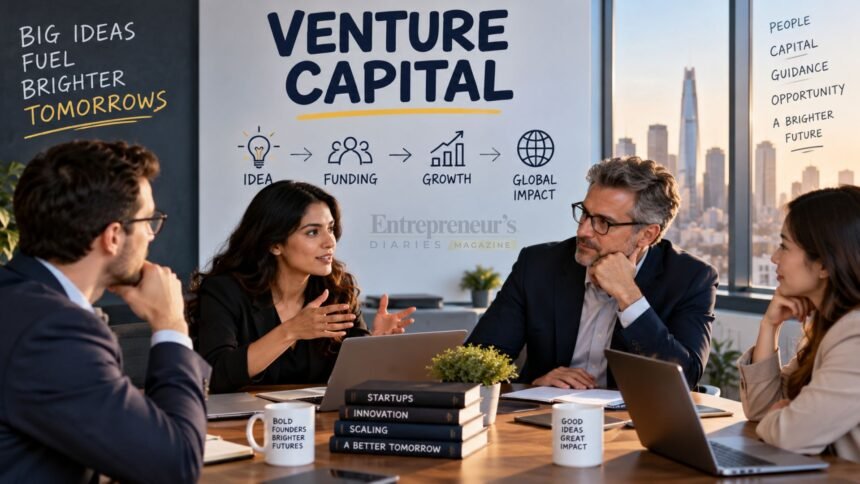
Venture capital is money invested in businesses that investors believe could grow very quickly and become much more valuable in the future.
Imagine you have created a new company.
You have a good product. Customers like it. You can see a much bigger market ahead. But there is one problem: growing the company requires far more money than you currently have.
You may need to hire 50 people, develop better technology, enter new countries, advertise your product or build factories and infrastructure.
You could try to grow slowly using the money the business earns. You could borrow money. Or you could find investors willing to put money into the company in exchange for owning part of it.
That third option is where venture capital enters the picture.
The basic idea behind venture capital is simple. An investor gives a promising company money today because the investor hopes their ownership in that company will become significantly more valuable tomorrow.
But there is much more to understand before a founder decides that venture capital is the right path.
What Is Venture Capital?
Venture capital, often shortened to VC, is a form of private investment commonly used to finance companies with significant growth potential.
Instead of simply lending money to the company, a venture capital investor normally receives equity, meaning ownership in the business.
The U.S. Securities and Exchange Commission explains that venture capital funds typically invest in rapidly growing businesses. These investments generally have a long time horizon, with investors hoping eventually to earn a return through a liquidity event such as an acquisition or an initial public offering.
Here is a very simple example.
Suppose Maya creates a technology company.
Her company is currently worth $4 million.
A venture capital firm believes the company could eventually become worth hundreds of millions of dollars. It agrees to invest $1 million.
In exchange, the investor receives an agreed percentage of Maya’s company.
Maya now has capital to grow the business.
The investor now owns part of a company that it hopes will become considerably more valuable.
Both sides are taking a risk.
Maya is giving away some ownership.
The investor could lose some or even all of its investment if the company fails.
That combination of high risk and potentially high growth sits at the heart of venture capital.
Why Does Venture Capital Exist?
Many businesses can grow without outside investors.
A neighbourhood restaurant, accounting practice or small online store might use savings, profits or loans to expand.
Some startups face a very different situation.
Imagine a company developing a new artificial intelligence platform.
It might need engineers, computing infrastructure, cybersecurity specialists, salespeople and several years of product development before becoming highly profitable.
Waiting ten years to grow using only profits could allow competitors to take the market first.
Venture capital can provide the money required to accelerate that journey.
The U.S. Small Business Administration describes venture capital as funding generally directed towards high-growth companies in exchange for equity rather than being structured like a traditional loan. It also notes that investors accept greater risk in pursuit of potentially greater returns.
This distinction is important.
Venture capital is not free money.
And it is generally not a normal business loan.
When a bank lends you money, you usually have to repay the loan with interest.
When a venture capital investor invests in your company, the investor normally receives ownership. If the company becomes extremely valuable, that ownership could eventually be worth much more than the original investment.
How Does Venture Capital Work?
Understanding venture capital becomes easier when you see it as a cycle.
Step 1: Investors Put Money Into a VC Fund
A venture capital firm usually manages money contributed by investors.
Those investors can include institutions and other capital providers.
The venture capital firm then looks for promising companies in which to invest that capital.
Step 2: The VC Firm Finds Startups
Venture capital firms evaluate many businesses.
They might focus on particular sectors such as:
- artificial intelligence;
- financial technology;
- healthcare;
- software;
- biotechnology;
- climate technology;
- cybersecurity; or
- consumer products.
Some investors specialise in very young businesses. Others prefer companies that have already demonstrated significant growth.
Step 3: The Startup Is Evaluated
Receiving venture capital normally involves far more than presenting an exciting idea.
Investors want to understand the company.
They may examine its product, customers, founders, market, financial performance, technology, competition, legal structure and growth potential.
This investigation is commonly called due diligence.
A simple question sits behind much of this analysis:
If we invest in this company, can it become substantially more valuable?
Step 4: Terms Are Negotiated
If the investor is interested, the parties negotiate the investment.
They need to determine issues such as:
- how much money will be invested;
- what the company is worth;
- how much equity the investor receives;
- what rights the investor receives;
- whether the investor gets a board seat; and
- what protections apply to the investment.
This is where startup valuation becomes particularly important.
Step 5: The Company Uses the Capital to Grow
Once the investment closes, the startup can use the money according to its growth strategy.
That could mean hiring people, improving the product, entering markets, acquiring customers or expanding infrastructure.
Venture capital investors can also contribute more than money.
The SEC notes that traditional VC investors may provide strategic guidance, customer and investor introductions, operational support and help recruiting important employees.
That is why founders sometimes describe the best investors as partners rather than simply sources of capital.
What Are the Main Venture Capital Funding Stages?
Startup funding is often divided into rounds.
The exact terminology varies, but understanding the basic stages makes the venture capital world much easier to follow.
Pre-Seed
This is usually one of the earliest stages.
A founder may still be turning an idea into a real product.
Funding can come from the founders themselves, friends and family, accelerators or early investors.
The central goal is often proving that the idea can become a business.
Seed Funding
At the seed stage, the company usually needs capital to develop its product, test the market, recruit its early team or win initial customers.
Think of it literally as planting a seed.
Investors are providing resources that could allow a small company to grow into something much larger.
Series A
By Series A, investors generally expect more evidence.
The startup may have customers, revenue, meaningful usage or another indication that people genuinely want its product.
Capital may be used to strengthen the business model and accelerate growth.
Series B
A Series B company is usually further along.
It may have already shown that its model works and now needs substantial resources to expand.
The money could support more employees, additional markets, greater sales capacity or stronger technology.
Series C and Beyond
Later funding rounds can involve companies that are already substantial businesses.
They may raise capital for international expansion, acquisitions, new products or preparations for an eventual exit.
The SEC notes that venture funds can invest across a company’s growth cycle and often participate again when portfolio companies raise later rounds.
The important point is that venture capital is not one single cheque at one single moment.
A successful startup can raise several rounds as it develops.
Why Would a Founder Want Venture Capital?
The most obvious answer is money.
But that is only part of the story.
Faster Growth
Imagine two companies competing in the same market.
Company A can invest $100,000 into growth.
Company B has raised $10 million.
If both businesses are equally well managed, Company B has significantly more resources to hire employees, develop products, advertise and enter markets.
Capital can therefore create speed.
Access to Experienced People
A strong venture capital firm may have worked with dozens or hundreds of companies.
Its team may recognise problems a first-time founder has never encountered.
That experience can be valuable.
Connections
Business growth often depends on access.
A well-connected investor may be able to introduce a startup to potential executives, customers, advisers, future investors or strategic partners.
Credibility
Funding from a respected investor can sometimes act as a signal.
Customers, employees and future investors may take greater interest because a professional investor has already examined the company and decided to back it.
But founders should not confuse fundraising with business success.
Raising venture capital is an input. Building a valuable company is the outcome that actually matters.
What Does Venture Capital Cost the Founder?
This is where founders need to pay close attention.
The biggest cost is usually ownership.
Suppose you own 100% of your startup.
You raise venture capital and issue new shares to investors.
You might now own 80%.
After another funding round, perhaps your ownership falls further.
This process is called dilution.
Dilution is not automatically bad.
Owning 20% of a company worth $500 million is financially more valuable than owning 100% of a company worth $1 million.
The problem arises when founders give away too much ownership without creating enough additional value.
There can also be a cost in control.
The SBA notes that venture capital commonly comes with an active investor role and that founders should expect to surrender some ownership and control in exchange for funding.
That means founders should evaluate the terms of an investment, not merely celebrate the amount being offered.
How Do Venture Capital Investors Make Money?
This part is surprisingly simple.
They want the companies they invest in to become more valuable.
Imagine a VC invests $2 million and receives 10% of a startup.
If that company eventually becomes worth $200 million, that ownership could theoretically be worth $20 million before considering later dilution, transaction terms and other complexities.
But not every investment succeeds.
Some startups grow slowly.
Some are sold for disappointing amounts.
Others fail completely.
Venture capital therefore relies on the possibility that successful investments can generate very large returns.
VC funds also have long investment horizons. The SEC explains that venture funds are typically structured to last at least ten years, with investments often remaining locked up until an event such as an acquisition or public offering creates liquidity.
That helps explain why venture investors care so much about scale.
They are generally not looking merely for a healthy company.
They are searching for companies capable of becoming very large companies.
What Do Venture Capitalists Look for in a Startup?
Every investor is different, but several questions appear repeatedly.
Is the Market Big Enough?
A brilliant business serving an extremely small market may never become large enough to generate the returns a venture fund requires.
Investors therefore examine the size of the opportunity.
Is There Real Demand?
Founders naturally love their own ideas.
Customers are a better test.
Investors want evidence that real people or companies need the solution.
Can the Business Scale?
Scalability means the company can become much larger without its costs increasing at exactly the same rate.
Software businesses are a classic example.
Creating the original software can be expensive. But serving an additional customer may cost relatively little.
Is the Founding Team Strong?
An idea can change.
A market can change.
The team has to deal with both.
Investors therefore examine whether founders can execute, learn, recruit talent and make difficult decisions.
Does the Company Have an Advantage?
If competitors can copy the business tomorrow, growth may be difficult to defend.
An advantage might come from technology, intellectual property, data, distribution, brand, network effects or specialised knowledge.
Is There a Possible Exit?
Investors eventually need a way to turn ownership into a financial return.
That can happen when another company acquires the startup, existing shares are sold in a secondary transaction, or the business enters public markets.
Venture Capital Is Huge — But the Headlines Can Mislead
The modern venture capital market is enormous, but founders should understand where the money is actually going.
According to the National Venture Capital Association’s 2026 Yearbook, U.S. venture investors deployed approximately $320 billion across 15,352 deals during 2025. Artificial intelligence represented 65.4% of deal value.
The picture became even more dramatic in 2026.
PitchBook and NVCA reported that U.S. startups raised more than $400 billion during the first half of 2026, already exceeding the investment total for all of 2025. But the organisations also warn that the recovery is uneven because a very large share of capital is concentrated in AI companies and mega-rounds of $100 million or more.
That distinction matters to founders.
Reading that hundreds of billions of dollars are entering venture capital does not mean every startup suddenly has easy access to funding.
Capital can be abundant overall while remaining extremely difficult to obtain for an individual company.
Venture Capital vs a Business Loan
These two funding methods are fundamentally different.
With a traditional business loan, you borrow money and are expected to repay it, normally with interest.
With venture capital, investors generally receive equity.
A lender is primarily concerned about whether you can repay the debt.
A venture capitalist is primarily concerned about whether the value of the company can grow enough to produce an attractive return.
A loan can allow founders to preserve more ownership but creates repayment obligations.
Venture capital can remove those normal loan repayments but requires founders to share ownership and potentially control.
Neither is automatically better.
The right choice depends on the business.
Does Every Startup Need Venture Capital?
No.
This may be the most important lesson in the entire discussion.
A startup does not need venture capital simply because other startups are raising it.
Some excellent companies are built through bootstrapping, meaning founders use their own money and revenue generated by the business.
Bootstrapping can allow founders to retain greater ownership and control.
The SBA points out that self-funding allows an entrepreneur to maintain control, although the founder also carries the financial risk personally.
Venture capital makes more sense when a company has the potential and need to grow rapidly and requires significant outside capital to pursue that opportunity.
For example, a biotechnology company developing a new treatment may require enormous investment before generating meaningful revenue.
A profitable consulting company might not.
The question should therefore never be:
“How do I get VC funding because successful founders raise money?”
A better question is:
“What type of capital gives this particular business the best chance of succeeding?”
That small change in thinking can prevent expensive mistakes.
Questions Founders Should Ask Before Raising Venture Capital
Before approaching investors, founders should be able to answer several basic questions.
How much money do we actually need?
What exactly will we do with it?
What measurable progress should that capital create?
How much ownership are we prepared to give away?
What kind of investor do we want?
How quickly can this company realistically grow?
Can we build the business without venture capital?
What happens if our next funding round takes longer than expected?
And perhaps most importantly:
Are we building a company that fits the venture capital model at all?
A founder who cannot answer these questions probably needs more preparation before fundraising.
The Simple Way to Think About Venture Capital
Forget the complicated terminology for a moment.
Venture capital can be understood through one basic exchange:
The startup receives money and support to pursue rapid growth.
The investor receives ownership and the possibility of a large future return.
If the company succeeds, both sides may benefit enormously.
If it fails, the investor can lose its money and the founder can lose years of work.
That is why venture capital combines ambition with risk.
For the right business, it can help transform a small startup into a global company.
For the wrong business, taking venture capital can create unnecessary pressure, dilution and expectations.
Founders should therefore stop treating fundraising as a trophy.
The amount of venture capital a startup raises does not tell you how successful the business ultimately becomes.
Customers matter.
Revenue matters.
A useful product matters.
Sustainable economics matter.
Execution matters.
Capital simply gives the company additional resources with which to pursue those things.
The smartest founders understand that distinction.
They do not ask how much money they can raise.
They ask how much capital the business genuinely needs, what that capital can accomplish and whether the value created will justify the ownership they give away.
That is the real meaning of venture capital—and understanding it before signing an investment agreement can be just as valuable as the funding itself.
Useful External Resources
- For founders who want to explore the subject further, the U.S. Securities and Exchange Commission’s guide to early-stage investors explains the differences between common startup investors and how venture funds operate.
- The U.S. Small Business Administration’s business funding guide provides a beginner-friendly comparison of self-funding, investors and other financing routes.
- For current industry statistics and venture-market trends, founders can consult the NVCA 2026 Yearbook and the PitchBook-NVCA Venture Monitor.
Connect With Us On Social Media [ Facebook | Instagram | Twitter | LinkedIn ] To Get Real-Time Updates On The Market. Entrepreneurs’ Diaries Is Now Available On Telegram. Join Our Telegram Channel To Get Instant Updates.

Rajeev is a Silicon Valley startup finance coach helping early-stage founders navigate funding, valuation, and scaling with confidence.