
There is a specific kind of quiet panic that sets in on Wall Street when a massive shift happens, and you realize you are drastically underinvested. That was the exact mood in late March and early May when two very different semiconductor companies dropped their quarterly numbers.
According to market data aggregated and reported by Bloomberg, the official financial guidance coming out of Micron Technology and Qualcomm didn’t just move their own stocks it triggered a staggering AI chip stock rally that added roughly $400 billion in market capitalization to the Philadelphia Semiconductor Index almost overnight.
When you see a $400 billion number flash across a screen, it’s easy to assume it’s just algorithmic momentum or speculative froth. But when you actually sit down and read the dry, legally binding language of official corporate earnings releases, you realize the market was reacting to something far more concrete.
The artificial intelligence story had finally escaped the confines of the data center GPU. As a journalist who has covered these cycles for years, I can tell you that the transition from “hype” to “hardware reality” is the most dangerous, and most profitable, phase of any tech boom.
Micron and Qualcomm didn’t just report good quarters. They provided official, auditable proof that AI is forcibly rewiring the entire global semiconductor supply chain. Here is exactly what these executives said, the official numbers they cited, and why those specific figures ignited a fire under the US equity markets.
The Anatomy of the $400 Billion AI Chip Stock Rally
To truly understand the anatomy of this AI chip stock rally, you have to look past the surface level headlines and examine how AI semiconductor stocks actually trade. The Philadelphia Semiconductor Index known universally as the SOX is essentially the heartbeat of global tech infrastructure.
When Bloomberg reported that this specific index surged by $400 billion in market value almost immediately following these earnings releases, specifically fueled by Micron and Qualcomm forecasts, it wasn’t just a victory lap for tech bulls. It was a violent, structural repricing of the future.
For months, a nagging doubt had lingered over Wall Street regarding AI investment. Sure, the dominant GPU makers were selling massive AI accelerators. But was the rest of the supply chain actually seeing the cash? Were the memory companies benefiting? Were consumer chipmakers seeing a real bump?
Or was this just a highly concentrated bubble sitting at the very top of the AI pyramid? In the span of just a few weeks, the hard, official disclosures from Micron and Qualcomm dissected those doubts with a resounding yes.
Micron proved that massive data centers require an entirely new, highly lucrative type of memory architecture just to function. Qualcomm proved that the everyday consumer is actually preparing to buy new hardware to run these models locally. Once institutional money realized both ends of the pipeline were officially congested with verified demand, the mechanics of the AI chip stock rally took over, and the capital flooded in.
Micron’s Confession: The Data Center is Starving for Memory
The first shoe dropped on a Wednesday morning in late March when Micron released its official Q2 Fiscal Year 2024 results. If you just glanced at the headline revenue of $5.82 billion, you might have thought, “Okay, decent bounce back.”
According to the official Micron earnings release, that top line number represented a 57.7% increase from the prior year. GAAP net income swung to a positive $793 million, or $0.71 per diluted share, officially reversing a net loss of $231 million from the year prior.
But the real story wasn’t in the past. It was in the forward guidance. Micron officially told Wall Street to expect Q3 FY2024 revenue of $6.6 billion, give or take $200 million. To put that in perspective, the consensus estimate at the time was sitting around $6.02 billion.
Micron didn’t just beat the estimate; they completely blew past it by roughly $600 million. When a company of Micron’s size guides half a billion dollars above what the street is modeling, it means the orders are coming in so fast that internal forecasting models are struggling to keep up.
The “Sold Out” Bombshell
During the official earnings conference call, CEO Sanjay Mehrotra stepped up to the microphone and delivered the exact phrase that broke the dam. He officially stated: “We are in the very early stages of a multi year AI driven growth cycle, driven by the deployment of AI in the cloud and the emergence of AI enabled edge devices.”

That sounds like standard CEO optimism. But then he got incredibly specific about a product called High Bandwidth Memory, or HBM. HBM is the specialized memory required to keep massive AI processors from starving for data. It is incredibly difficult to manufacture.
And right there, on the official call transcript, Mehrotra said: “Our HBM supply is sold out for calendar year 2024 and calendar year 2025.” Let that sink in for a moment. In an industry known for brutal boom and bust cycles, a CEO just officially locked in two full years of demand for their most lucrative product.
He didn’t stop there. He explicitly noted on the call that “the pricing for HBM is significantly more favorable than traditional DRAM.” In the official press release, the company quantified this, stating they now expect HBM revenue to exceed several hundred million dollars in FY2024. They also officially noted this forecast was more than double what they had projected just three months prior.
This wasn’t hype. This was a legally binding corporate disclosure telling investors that the pricing power in the memory market had fundamentally shifted.
Breaking Down Micron’s Official Numbers
When you pull back the curtain on the official Micron earnings release, the imbalance of this AI wave becomes glaringly obvious. Micron breaks its business down into specific units. The Compute and Networking Business Unit (CNBU) is the division that sells directly to the AI server builders.
According to the official release, CNBU revenue hit $3.85 billion. That is a 67% jump from the previous quarter, and a staggering 112% increase year over year. It is an absolute rocket ship trajectory. Now, contrast that with their other divisions. The official release shows the Mobile Business Unit brought in $1.32 billion.
The Storage Business Unit did $536 million. The Embedded Business Unit reported $1.04 billion. Those units are growing, sure. But they are growing at a normal, pedestrian pace compared to the data center division. What these official numbers tell professional investors is that AI isn’t just a rising tide lifting all boats.
It is a Category 5 hurricane slamming directly into the data center infrastructure market, leaving the traditional consumer markets relatively untouched. You have to position your portfolio accordingly.
The Consumer Edge: Enter Qualcomm
If Micron proved the cloud was hungry, the market still needed proof that regular consumers would participate in this AI upgrade cycle. That proof arrived on May 1, 2024, when Qualcomm published its official Q2 Fiscal Year 2024 earnings release.
Qualcomm is the undisputed king of smartphone chips. But smartphones are a mature, slightly boring market right now. The official headline revenue for the quarter was $9.39 billion, representing a modest 1% year over year increase.
GAAP diluted earnings per share came in at $1.97. Again, on the surface, this looks like a company treading water. But the forward guidance told a completely different story. According to the official press release, Qualcomm guided for Q3 FY2024 revenue of $8.8 billion to $9.6 billion.
The midpoint of that range $9.2 billion was firmly above the Wall Street consensus of $9.07 billion. The market immediately recognized that Qualcomm was about to launch something that would break the sluggish smartphone malaise.
Cristiano Amon’s AI PC Pivot
During the official Q2 FY2024 earnings call, CEO Cristiano Amon essentially declared that the personal computer is about to go through its biggest identity crisis since the invention of the internet.
He officially stated: “We are now at the inflection point of AI, with on device AI set to fundamentally reshape the PC industry, similar to the transition to smartphones.” This is a bold claim. But Amon backed it up with hardware specifics on the official call.
He detailed the upcoming launch of the Snapdragon X Elite processor. According to Qualcomm’s official product specifications referenced during the call, this chip features a dedicated Neural Processing Unit (NPU) capable of 45 TOPS (Trillions of Operations Per Second).
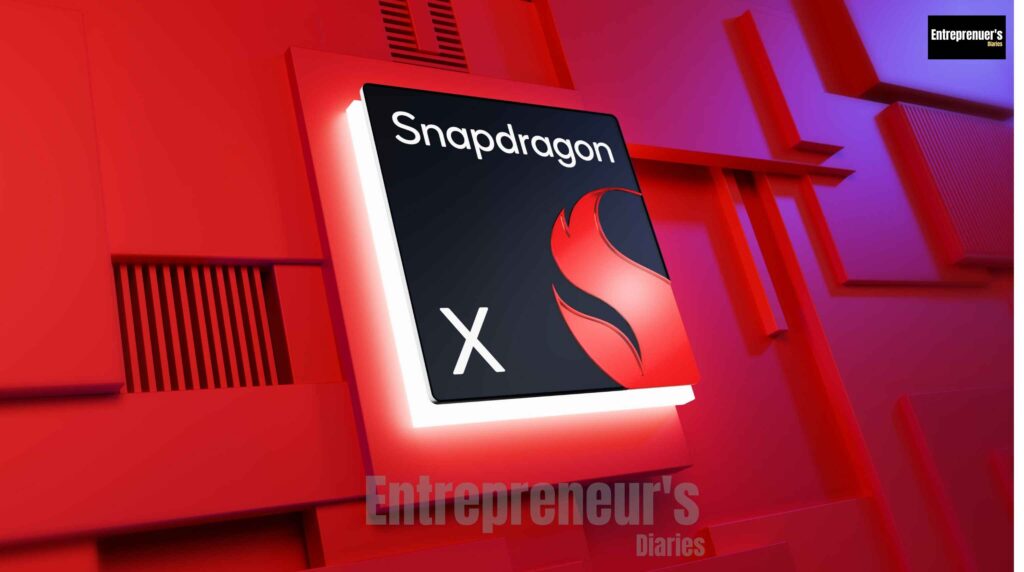
For the non engineers reading this, that means the laptop itself has a specialized brain specifically built to run AI tasks without draining the battery or relying on a cloud connection. Amon officially confirmed the commercial timeline on the call, stating: “We are on track to see multiple OEMs launch Snapdragon X Elite based Copilot+ PCs in the coming weeks, marking the beginning of a new era for Windows.”
This official confirmation was the green light for the market. It meant that Microsoft’s new AI features weren’t just software fantasies. They were being bundled into physical silicon, and Qualcomm held the patent heavy keys to the kingdom.
Decoding Qualcomm’s Segment Data
To really understand Qualcomm’s resilience, you have to look at how they officially categorize their money. They report through two main buckets: QCT (chips) and QTL (patent licensing). According to the official Q2 FY2024 release, the QCT chip division brought in $8.03 billion, up 4% year over year.
Inside that, the Handset division officially did $6.17 billion, up 8%. Management noted on the call that this strength was driven by premium Android devices specifically phones using their high end Snapdragon 8 Gen 3 chip.
Even in a sluggish global phone market, people are apparently willing to pay up for AI capable premium devices. But the hidden gem in the official release was the Automotive division. Automotive revenue officially hit $606 million. That is a 35% year over year surge.
On the call, management officially guided for Automotive revenues to exceed $4 billion for the full fiscal year. As cars essentially become computers on wheels, Qualcomm is quietly locking down the silicon inside your dashboard. Meanwhile, their patent licensing arm (QTL) officially pulled in $1.33 billion.
When you piece together this official data, you see a company that isn’t just surviving a tough consumer cycle. They are strategically shifting their massive engineering resources toward high margin AI PCs and automobiles, exactly when those markets are ready to pop.
Why These Two Reports Broke the Market
You might be asking yourself why these two specific reports resulted in a $400 billion sector wide rally. Why didn’t Micron’s good news just lift Micron? Why did it lift everyone? It comes down to how semiconductor supply chains actually work in the real world.
AI requires an unprecedented synchronization of hardware. If you build a massive AI GPU, it is useless without Micron’s HBM memory stacked right on top of it. The fact that Micron officially stated their HBM is sold out means the GPU makers are moving product as fast as humanly possible.
Conversely, if you build AI software for consumers, it is useless if the consumer’s laptop is too weak to run it. Qualcomm officially confirming the imminent launch of 45 TOPS AI PCs means the software developers now have a massive installed base to sell into.
When Bloomberg reported that $400 billion was added to the semiconductor index, it was because institutional money managers finally saw the complete puzzle. The cloud infrastructure demand was officially verified by Micron.
The consumer edge demand was officially verified by Qualcomm. Therefore, the companies that package these chips, the companies that test them, and the companies that manufacture the equipment to build them all of them had to be repriced upward.
The Macro Economics: Dirt, Concrete, and CHIPS
There is a deeper macroeconomic story here that often gets lost in the daily stock gyrations. When CEOs officially guide for billions in unexpected revenue, it translates into real world, physical economic activity.
According to prior official corporate disclosures from Micron, the company is currently in the middle of a massive capital expenditure cycle. They are actively building highly advanced fabrication plants in Idaho and New York.
These projects are heavily subsidized by the US government through the CHIPS and Science Act, a piece of macroeconomic legislation designed to bring semiconductor manufacturing back to American soil. Skeptics worried that these government subsidized plants would result in massive overcapacity building factories that would just sit empty.
Micron’s official Q2 earnings release completely destroyed that narrative. You do not officially guide for sold out HBM supply through 2025 if you are worried about overcapacity. You are scrambling to ramp up production in your Taiwan facilities while simultaneously pouring concrete in Idaho.
For those of us tracking market and economic business news in the US, this is the ultimate validation of industrial policy. Federal subsidies met a genuine, massive market demand. The result is a highly skilled workforce being deployed, advanced manufacturing equipment being utilized, and billions of dollars flowing through the US economy.
This is why the equity market reacted so violently to the upside. It wasn’t just a tech story anymore. It was a broad US economic growth story.
The Death of the Commodity Cycle
Perhaps the most important takeaway for professional investors is the death of the traditional semiconductor commodity cycle. Historically, memory chips like DRAM and NAND were brutal commodities. Companies like Micron would ramp up production, supply would outpace demand, prices would collapse, and margins would vanish.
It was a bloodbath that happened every three to four years. But listen to how Sanjay Mehrotra officially described the pricing environment on the Q2 earnings call. He explicitly stated that “industry supply and demand dynamics are favorable” and officially guided for sequential increases in ASPs (Average Selling Prices) for both DRAM and NAND.
More importantly, he made it crystal clear that HBM ASPs are multiples higher than standard memory. When you have a product that is technically difficult to manufacture, officially sold out for two years, and commands premium pricing, you are no longer selling a commodity.
You are selling a highly engineered, irreplaceable component. Qualcomm is attempting to pull off the exact same maneuver with the AI PC. By integrating a dedicated NPU into their Snapdragon X Elite, they are forcing the consumer market out of the commodity PC race.
You aren’t buying a laptop to run Excel anymore. You are buying an AI device. And as Cristiano Amon officially noted, AI devices command a premium mix, driving up Qualcomm’s average selling prices. This structural shift in pricing power is the exact mathematical formula that institutional investors use to justify higher valuation multiples.
When a sector transitions from low margin commodities to high margin, AI driven products, the entire valuation matrix must be rewritten. That rewriting process is exactly what added $400 billion to the market cap of the semiconductor index.
The Analytical Closing: What You Do Next
Let’s strip away the noise and look at the hard reality of where we stand. The $400 billion rally sparked by Micron and Qualcomm wasn’t a fluke. It wasn’t a meme stock squeeze. It was the brutal, efficient US equity market digesting official corporate data and pricing in a new reality.
Micron’s official earnings release and CEO Mehrotra’s exact quotes on the earnings call proved that AI data centers are swallowing every ounce of high bandwidth memory they can get their hands on, and they will keep doing so through 2025.
Qualcomm’s official earnings release and CEO Amon’s exact quotes proved that the consumer hardware upgrade cycle is no longer a theoretical future event. It is hitting store shelves in a matter of weeks.
If you are an entrepreneur, this means you need to stop building software that relies purely on the cloud. The edge is where the market is going, and the silicon to power it is officially here. If you are an investor, the strategic playbook is no longer to just buy the obvious AI giants.
You have to look at the memory bottlenecks. You have to look at the advanced packaging supply chain. You have to look at the companies that hold the patents for on device AI processing. We have officially crossed the threshold where AI demand is dictating the financial guidance of the largest chipmakers on earth. Bookmark this moment.
The next time the market experiences a pullback, do not panic. Look back at the official, legally binding guidance provided by these two companies. As long as HBM remains sold out and AI PCs are hitting the market, any dip in semiconductor stocks is an institutional buying opportunity, not a reason to sell.
The macroeconomic winds of the US tech sector have permanently shifted. The money is officially flowing from the cloud to the edge, and the companies that build the plumbing are going to make fortunes doing it.
Frequently Asked Questions (FAQs)
Why did AI chip stocks suddenly surge by $400 billion?
According to market data reported by Bloomberg, a massive $400 billion rally was triggered in the semiconductor index because Micron and Qualcomm released official quarterly earnings guidance that drastically exceeded Wall Street expectations. Their official numbers proved that AI spending was no longer just benefiting a few GPU makers, but was flooding into memory chips and consumer devices, forcing institutional investors to reprice the entire sector.
What exactly is HBM memory and why is it such a big deal right now?
HBM stands for High Bandwidth Memory. It is a highly complex, stacked memory chip essential for running massive AI models because it moves data much faster than traditional memory. According to the official Micron Q2 FY2024 earnings release and CEO Sanjay Mehrotra’s statements on the earnings call, Micron’s HBM is completely sold out for both 2024 and 2025, guaranteeing massive, high margin revenue that broke historical commodity pricing cycles.
What is the Qualcomm AI PC and when will people actually be able to buy one?
The Qualcomm AI PC refers to a new generation of computers powered by Qualcomm’s Snapdragon X Elite processor. According to official statements made by CEO Cristiano Amon on the Q2 FY2024 earnings call, these computers feature a specialized 45 TOPS Neural Processing Unit (NPU) to run AI directly on the device. Amon officially confirmed that major manufacturers will launch these Copilot+ PCs to consumers in the coming weeks.
How do we know this isn’t just another tech bubble driven by hype?
The difference between a hype driven bubble and a fundamental re-rating lies in official corporate disclosures. The surge wasn’t based on rumors; it was based on official SEC filed earnings releases. Micron officially guided for $6.6 billion in revenue (crushing estimates) and officially doubled its HBM revenue forecast. Qualcomm officially beat expectations and provided concrete timelines for hardware launches. This is hard financial data, not speculation.
How does the automotive market fit into Qualcomm’s AI growth?
While AI PCs get the headlines, the automotive sector is quietly becoming a massive growth engine for Qualcomm. According to the official Qualcomm Q2 FY2024 earnings release, the company’s Automotive division revenue surged 35% year over year to $606 million. Management officially guided for full year automotive revenue to exceed $4 billion, proving that as cars become “computers on wheels,” Qualcomm is securing a highly profitable, long term foothold in that market.
Connect With Us On Social Media [ Facebook | Instagram | Twitter | LinkedIn ] To Get Real-Time Updates On The Market. Entrepreneurs’ Diaries Is Now Available On Telegram. Join Our Telegram Channel To Get Instant Updates.

Isabella is a global business journalist and former McKinsey analyst from Brazil. She brings sharp insights on economic shifts, policies, and founder journeys from around the world.

Tokyo-based CFA translating global markets into clear insights for modern entrepreneurs.