
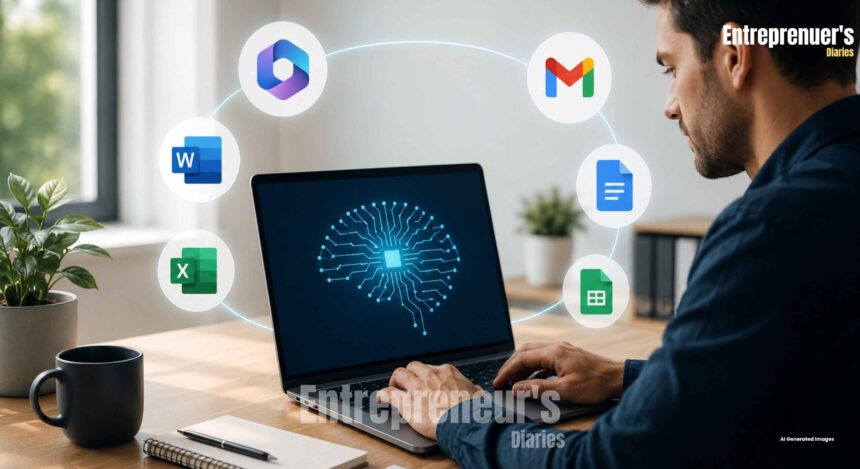
New Delhi, India, June 26, 2026: Running a small business usually means you are constantly running out of something. Time. Cash. Patience. For the last few years, AI for Small Business felt like just another thing many entrepreneurs were running out of. Artificial intelligence seemed like a luxury locked behind the closed doors of Fortune 500 tech departments.
That reality has shifted faster than most people realize. Major tech companies have completely torn up their old pricing playbooks. They are now explicitly targeting small business owners with highly capable, surprisingly affordable AI tools.
For founders and investors trying to figure out where the actual value is in this AI cycle, the answer isn’t in the sprawling data centers. It’s in the quiet revolution happening at small accounting firms, local marketing agencies, and regional supply companies.
This is the story of how small businesses are actually using these tools today, based entirely on official product releases, verified academic data, and federal regulatory frameworks. No hype. No guessing. Just the operational reality.
Why AI for Small Business Was Once Out of Reach
To understand why AI for Small Business is gaining momentum today, it’s important to look at why it remained inaccessible for so long. For years, enterprise AI was built for large organizations with deep budgets and dedicated technical teams.
If a major bank or global corporation wanted AI, it hired data scientists, built proprietary models, and invested millions of dollars in computing infrastructure. According to historical documentation of enterprise software deployments, these projects often took years to complete and required significant capital investment.
For a ten person marketing agency or a regional manufacturer, that level of investment was simply unrealistic. The upfront costs alone could consume an entire year’s profit.
Even after open source AI models became available, deploying them required specialized technical expertise to install, maintain and secure them against vulnerabilities. Most small businesses do not employ chief technology officers or AI engineers. Instead, owners and operations managers often juggle multiple responsibilities every day. That gap created a major opportunity for technology companies.
Instead of expecting businesses to build their own AI systems, companies like Microsoft and Google shifted toward subscription based AI services that small businesses could adopt without complex infrastructure or enterprise contracts. That transition fundamentally changed how AI for Small Business could be deployed, making advanced AI capabilities far more accessible to founders and growing businesses.
Microsoft Bets Big on the $20 User
Microsoft has been the most aggressive player in rewriting the rules for small business AI. According to the official Microsoft Newsroom, the company initially rolled out Microsoft 365 Copilot with a strict enterprise focus.
The official Microsoft pricing pages show that the enterprise tier costs $30 per user, per month. More importantly, it required a minimum commitment of 300 users. For a small business with twenty employees, that threshold was a brick wall.
Microsoft recognized this disconnect. According to the Microsoft Newsroom, the company officially launched Copilot Pro to bridge this exact gap. Copilot Pro is priced at $20 per user, per month. There is no massive enterprise contract required. You just buy it and plug it in.
What does that actually look like for a small business?
According to Microsoft’s official product documentation, Copilot Pro weaves directly into the apps people already stare at all day. In Word, it doesn’t just write text. Microsoft states it can take a rough, messy outline drafted by a stressed manager and generate a polished, formatted first draft in seconds.
It can summarize a twenty page industry report into three bullet points. In Excel, the capabilities get even more interesting for a small business trying to manage tight margins. Microsoft officially states that Copilot can analyze raw data sets, identify formatting issues, and generate complex visual charts.
It does this without the user needing to write a single formula. For a small business that can’t afford a dedicated data analyst, this is a massive shift. And Microsoft didn’t stop at basic document editing.
According to the official Microsoft website, the company also released Copilot Studio. This is a platform where small businesses can build custom AI agents tailored to their specific, niche workflows. Microsoft states these agents can be connected to internal company databases using pre-built connectors, allowing the AI to pull up specific inventory numbers or client histories without any coding required.
Google’s Parallel Push for the Little Guy
Google clearly saw what Microsoft was doing and matched the playbook. According to the official Google Workspace Blog, Google officially introduced Gemini Business. This was explicitly designed to bring advanced AI capabilities to organizations of all sizes, completely stripping away the enterprise level prerequisites.
According to Google’s official pricing documentation, Gemini Business also lands at that critical $20 per user, per month mark. Think about a typical Monday morning for a small business owner. The inbox is flooded. There are customer complaints, vendor questions, and internal updates all tangled together.
According to Google’s official product pages, Gemini integrates directly into Gmail to cut through that noise. Google states the AI can scan a long, confusing email thread and generate a concise summary of what was actually decided.
It can draft replies that match the tone of previous emails you’ve sent. In Google Docs, the official documentation notes that Gemini acts as a collaborative partner. It can take a basic prompt like “write a proposal for a local bakery to supply our cafe” and generate a structured, professional document.
In Google Sheets, Google officially states that Gemini can take a natural language command like “organize this list of Q3 expenses by category” and execute the task instantly. But Google knew that small businesses would be terrified of feeding their private financial data into an AI engine.
According to the official Google Workspace security page, Google explicitly guarantees that business data entered into Gemini Business is not used to train Google’s foundational AI models. Your data stays in your tenant. That single guarantee is what makes a $20 tool actually usable for a small business.
When AI Gets Specific: Intuit and the Cash Flow Problem
General tools like Word and Gmail are great. But small businesses live and die in specialized software. Intuit, the company behind QuickBooks, understood this dynamic perfectly. According to an official press release from the Intuit Newsroom, the company launched Intuit Assist.
This is a generative AI assistant, but it doesn’t live in a separate window. It lives directly inside QuickBooks, Mailchimp, and TurboTax. According to Intuit’s official product documentation, the primary goal is to automate the financial tasks that keep small business owners working until midnight. Let’s look at accounts receivable.
Chasing down unpaid invoices is a miserable, time consuming task. Intuit officially states that Intuit Assist can automatically generate customized invoice templates based on simple conversational prompts. It can also automatically categorize messy bank transactions, saving hours of manual data entry every week.
The most critical feature, however, involves cash flow. According to the Intuit Newsroom, Intuit Assist uses a small business’s historical accounting data to forecast future cash flow. It doesn’t just show you what happened last month. It projects what your bank account will look like next month.
For a small business operating on razor thin margins, that foresight is the difference between making payroll and taking out a high interest loan. Intuit also officially noted that Intuit Assist bridges the gap between accounting and marketing.
It connects QuickBooks data directly to Mailchimp. The AI can automatically generate targeted email marketing campaigns based on a customer’s recent purchase history. It handles the data sync automatically. No manual exporting and importing spreadsheets.
The Sales Floor: Salesforce and HubSpot Join In
Customer acquisition is another area where small businesses bleed time and money. You can’t afford a massive sales development team. You need your three sales reps to be incredibly efficient. According to the official Salesforce Newsroom, the company rolled out Einstein Copilot to address this exact pressure point.
Salesforce designed this AI to act as a conversational assistant that lives natively inside the CRM. According to Salesforce’s official product documentation, Einstein Copilot doesn’t just find information; it takes action.
Before a small business owner gets on a discovery call, the AI can automatically research the prospect’s company. It can pull up every single past interaction that company has had with your business. And the moment the call ends, Salesforce states that Einstein Copilot can draft a highly personalized follow up email summarizing the next steps.
These are tasks that used to take a sales rep thirty minutes of clicking around a dashboard. Now it takes seconds. HubSpot, which dominates the small business CRM market, has integrated AI just as aggressively.
According to HubSpot’s official product updates, the company embedded AI across its marketing, sales, and service hubs. HubSpot officially states that its AI tools can generate blog posts, create social media captions, and rewrite website copy to optimize for search engines. For a small business that cannot justify the retainer of a full service marketing agency, this is a lifeline.
HubSpot also officially introduced ChatSpot. According to the HubSpot website, this tool lets users talk to their CRM like it’s a human employee. You can type, “Show me all leads from last week that are over $5,000,” and the AI pulls the list instantly. It completely removes the need for small business owners to learn complex database query languages.
The Hard Data: Does This Actually Boost Productivity?
It’s easy to be cynical about tech company press releases. They are designed to sell software. But independent, institutional researchers have been watching this rollout very closely. And the data they are publishing is striking. The National Bureau of Economic Research (NBER) released a detailed working paper that should be required reading for every small business investor.
According to the official NBER publication, researchers conducted a rigorous study of 5,179 customer support agents. These agents worked at a large, unnamed software company. The researchers split the agents into two groups. One group got access to a generative AI assistant. The control group did not.
According to the NBER study, the agents using the AI resolved 14% more customer issues per hour. That is a massive, measurable increase in operational output. How did it achieve this? According to the study, the AI essentially acted as a senior mentor sitting next to a junior worker.
When a customer asked a complex question, the AI instantly suggested the best answer based on the company’s massive internal documentation. The agent didn’t have to go digging for the answer. But the most important finding in the NBER paper has nothing to do with the top performers.
According to the official findings, the AI had almost zero impact on the productivity of the company’s highly skilled, veteran workers. The veterans already knew the answers. The AI caused a massive 34% increase in productivity for novice and lower skilled workers. Read that again. A 34% productivity jump for junior staff.
This is the exact reason small businesses should be paying attention. Small businesses rarely have the budget to poach top tier industry veterans. They hire hungry, smart people who need time to learn the ropes. This NBER data proves that affordable AI tools fundamentally compress that learning curve. They allow a small business to deliver veteran level service with a team of junior employees.
The Regulatory Hangover: You Are Still on the Hook
Here is the part of the AI story that most small business cheerleaders conveniently ignore. Adopting these tools is not just a tech upgrade. It is a legal liability. The United States government has made it very clear that they are watching how businesses use AI.
According to the official White House website, President Biden signed the Executive Order on the Safe, Secure, and Trustworthy Development and Use of Artificial Intelligence in October 2023. While a lot of the order focuses on massive tech companies building foundational models, it sets a regulatory tone that trickles all the way down to a ten person shop.
To back up this executive order, the U.S. Department of Commerce relies on the National Institute of Standards and Technology (NIST). According to the official NIST website, the AI Risk Management Framework (AI RMF) is the definitive standard for how businesses should handle AI.
Small businesses cannot just blindly trust an AI tool and walk away. NIST breaks AI risk management down into four distinct functions. If you are a founder, you need to understand these. The first is “Govern.” According to NIST, this means someone in the small business has to take ultimate responsibility for how the AI is used. You can’t just let employees do whatever they want.
The second is “Map.” NIST states that a business must document exactly what context the AI is being used in. What data goes in? What comes out? The third is “Measure.” According to NIST, you have to actively test the AI’s output. If you use AI to write financial reports for clients, you are legally responsible for ensuring the math is correct.
The fourth is “Manage.” NIST states that businesses must have a plan for when the AI fails. And AI does fail. It “hallucinates.” It makes things up with absolute, terrifying confidence. If a small business uses a $20 AI tool to draft a legal contract for a client, and the AI completely invents a non existent legal clause, the small business is liable for that contract. Not the tech company. The small business.
The Silent Danger of Data Leakage
This regulatory reality leads directly to the biggest operational risk small businesses face right now: data privacy. When an employee is rushing to meet a deadline, the easiest thing to do is copy a client’s sensitive financial data and paste it into a generic, free AI chatbot to get a quick summary.
That is a massive breach waiting to happen. When you put data into a consumer grade AI tool, that data is often absorbed by the system to train future versions of the model. According to OpenAI’s official data privacy policies, this is exactly what happens with the free, consumer versions of ChatGPT. Your conversations can be used for model training.
If a competitor eventually queries that same AI model, there is a risk however small that your proprietary data could surface in their results. This is why small businesses must absolutely refuse to use consumer AI tiers for work. According to OpenAI’s official policies, users of ChatGPT Team, ChatGPT Enterprise, and the API have their data explicitly opted out of model training.
Microsoft and Google offer the exact same guarantees for their business tiers. According to the official Microsoft privacy statement, data entered into Microsoft 365 Copilot is strictly bound by tenant boundaries. Your data is not shared with other businesses, and it is not used to train the base models.
According to the official Google Workspace security documentation, Google provides this identical data isolation guarantee for Gemini Business. For a small business, the “affordable” part of AI instantly vanishes if you suffer a data breach. Paying $20 a month for a secure business tier is the only mathematically defensible choice.
How a Small Business Actually Pulls This Off
So, how does a founder actually execute this without wasting money?
You don’t just buy subscriptions for everyone on Monday morning and hope for the best. Based on the official capabilities of these tools and the NIST risk framework, there is a logical way to do this. First, do an internal audit. Find the tasks that take up the most time but require the least amount of complex human judgment.
Based on the NBER study, customer support emails and drafting standard proposals are your lowest hanging fruit. Second, choose your tools based on security, not just features. Opt for embedded tools like Intuit Assist or HubSpot AI.
Because the AI lives inside the software you already trust, you drastically reduce the risk of data leaking out to a random third party startup. Third, run a controlled pilot. Do not roll this out company wide. Pick two or three of your least experienced employees.
The NBER data proves that is where you will see the highest ROI. Give them the AI tools and measure their output for 30 days against their historical baselines. Fourth, build a human review step into your standard operating procedures.
No AI-generated email goes to a client without a human reading it first. No AI-generated financial forecast is acted upon without a manager checking the logic. This satisfies the NIST “Measure” and “Manage” requirements. Fifth, once you have proven the productivity gains and established the safety guardrails, scale the subscriptions to the rest of the team.
What Comes Next, According to the Roadmaps
The tools available today are powerful, but they are essentially just very fast text predictors. The next generation is already officially on the way. And it will require small businesses to be even more vigilant.
According to the official Microsoft product roadmaps, the company is aggressively moving toward what they call “Agentic AI.” Microsoft officially states that future versions of Copilot won’t just answer your questions.
They will be able to execute multi step workflows on their own. You won’t ask it to draft an email. You will tell it, “Review last month’s expenses, find the software subscriptions we aren’t using, and draft cancellation emails for the vendors.”
The AI will do all of it. Google is moving in a similar, albeit more sensory, direction. According to Google’s official announcements regarding Project Astra, the company is building AI with “multimodal understanding.” This means future AI tools won’t just read text. They will process live video and audio in real time.
Imagine a small plumbing company using a smartphone camera to show an AI a broken pipe. The AI cross references the official manufacturer schematics, identifies the exact part, and orders it from the supplier automatically.
These are not science fiction concepts. They are officially confirmed developments currently in the pipeline at Microsoft and Google. Small businesses that spend the next year building strict data governance and workflow integration will be the ones capable of adopting these advanced tools the moment they drop.
The Bottom Line for Founders and Investors
The adoption of affordable AI by small businesses is not a temporary trend. It is a fundamental restructuring of how operational leverage works. For decades, the only way a small business could grow was by adding headcount.
More headcount meant more payroll taxes, more management overhead, more office space, and more operational risk. The introduction of rigorously tested, $20 per month AI tools from Microsoft, Google, Intuit, and Salesforce breaks that cycle. The NBER data doesn’t just suggest these tools work. It proves they can drive a 14% increase in productivity. More importantly, it proves they can turn junior employees into highly effective operators almost overnight.
But this new leverage comes with a strict, non negotiable price tag. The White House Executive Order and the NIST AI Risk Management Framework make it crystal clear that the government will not accept “the AI made a mistake” as an excuse.
If a small business uses AI to cut costs, they must simultaneously invest the time to map, measure, and manage the output of that AI. The small businesses that win over the next decade won’t be the ones that buy the most AI subscriptions. They will be the ones that meticulously integrate secure, embedded AI into their existing workflows.
They will use it to strip out the mindless, low value administrative work that drains their team’s energy. And they will redirect that saved time toward the only things that actually grow a business: building better products and talking to real customers. Bookmark this framework.
As AI moves from simply drafting emails to autonomously executing complex business operations, the gap between the small businesses that prepared for this shift and the ones that just played with the free chatbots will become an unbridgeable chasm.
Frequently Asked Questions
What is the most affordable AI tool for small businesses right now?
According to the official pricing pages of Microsoft and Google, the most affordable entry points for secure, business grade AI are Microsoft Copilot Pro and Google Gemini Business. Both are officially priced at $20 per user, per month. These tiers are built for small businesses and do not require the massive enterprise licensing commitments of their premium counterparts.
Is there actual proof that AI tools cut costs for small businesses?
Yes. According to an official working paper published by the National Bureau of Economic Research (NBER), generative AI increased worker productivity by 14% in customer support tasks. For a small business, this means the exact same amount of work can be completed with significantly fewer labor hours, directly reducing variable operational costs.
Is it safe to put my company’s private data into AI tools?
It depends entirely on which version of the tool you use. According to the official data privacy policies of OpenAI, consumer versions of ChatGPT may use your data to train their models. However, OpenAI, Microsoft, and Google all officially state that data entered into their business specific subscriptions like ChatGPT Team, Microsoft 365 Copilot, and Gemini Business is completely isolated and is not used for model training.
Do small businesses actually have to worry about government AI regulations?
Yes. According to the official White House Executive Order on Artificial Intelligence and the National Institute of Standards and Technology (NIST) AI Risk Management Framework, businesses utilizing AI are expected to actively manage the risks of its output. If a small business uses AI to generate a faulty contract or inaccurate financial advice, the small business is legally liable, not the AI provider.
Which AI tool makes the most sense for a small business handling its own accounting?
According to the official Intuit Newsroom and product documentation, Intuit Assist is the leading embedded AI tool for small business finance. It is built natively into QuickBooks to automate invoice generation, categorize bank transactions, and forecast cash flow, allowing the business to leverage AI without exporting sensitive financial data to a third party application.
Connect With Us On Social Media [ Facebook | Instagram | Twitter | LinkedIn ] To Get Real-Time Updates On The Market. Entrepreneurs’ Diaries Is Now Available On Telegram. Join Our Telegram Channel To Get Instant Updates.

Isabella is a global business journalist and former McKinsey analyst from Brazil. She brings sharp insights on economic shifts, policies, and founder journeys from around the world.

Tokyo-based CFA translating global markets into clear insights for modern entrepreneurs.