
Philadelphia, Pennsylvania, June 29, 2026: Thirteen percent isn’t a rounding error. It isn’t the kind of move a stock makes on a routine earnings beat or a minor buyback announcement. When a company’s shares jump that much in premarket trading on a single Monday, the market is telling you something it had been quietly thinking for years.
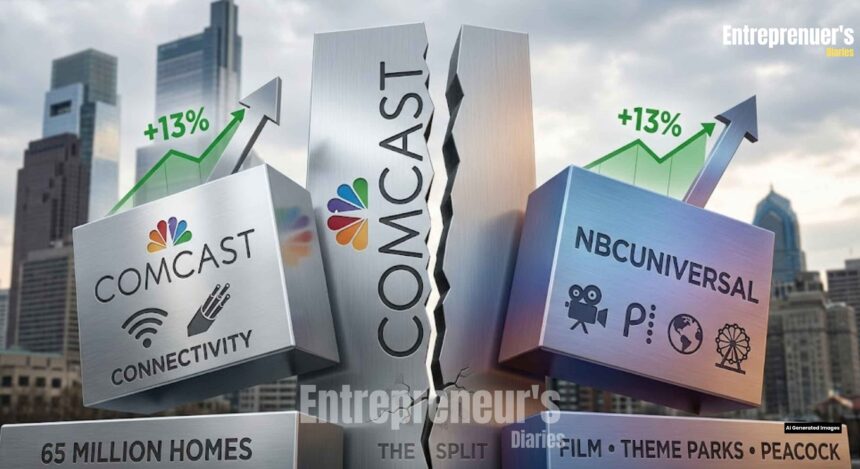
That’s exactly what happened to Comcast. Shares surged 13% before the bell after the company confirmed it would break itself in two, separating NBCUniversal and Sky from the broadband and wireless business that built the company, according to Investing.com.
Comcast NBCUniversal Spinoff: Unpacking the Plan Behind the Split
Let’s get the structure straight first, because the headline number obscures the mechanics. Comcast intends to spin off NBCUniversal and Sky into a new, independent public company through a tax free distribution, according to Comcast Corporation.
The transaction is expected to close in roughly one year, Investing.com reported. Once it does, Comcast shareholders will hold stock in both companies.
The new NBCUniversal will carry the theme parks division, Universal’s film and television studios, the NBC and Telemundo networks, Peacock, Bravo, and the European Sky business, per Investing.com.
The remaining Comcast keeps broadband, wireless, and entertainment platforms, operating a network that reaches more than 65 million homes and businesses, according to Investing.com.
Comcast also plans to hold a stake of up to 19.9% in NBCUniversal for as long as a year after the split, monetizing it later in a tax efficient way, Investing.com reported. NBCUniversal will keep the same dual class share structure Comcast uses today, and both companies intend to carry investment grade balance sheets.
In its own statement on the deal, Comcast described the goal as building “two focused industry leaders,” each with its own scale and strategic mandate, the Hollywood Reporter reported.
That phrase is doing a lot of work. It’s an admission, dressed up in corporate language, that one company could no longer be both things at once.
The Cultural Reversal: From Empire Building to Strategic Shrinking
To understand why this is strategically significant, you have to understand what Comcast has spent the last two decades doing: getting bigger. The company built its media empire by acquiring NBCUniversal from General Electric in stages, finally buying out GE’s remaining 49% stake for roughly $16.7 billion in 2013, according to a Comcast press release filed with the Securities and Exchange Commission.
For years, the logic was scale. More content, more distribution, more leverage over advertisers and affiliates. Bigger was simply better.
That logic started cracking in 2024. Comcast announced it would spin off most of NBCUniversal’s cable networks USA Network, CNBC, MSNBC, Oxygen, E!, Syfy, and Golf Channel into a separate company, Variety reported.
That entity eventually became Versant Media Group, which completed its separation on January 2, 2026, and began trading on Nasdaq under the ticker VSNT, according to a Comcast press release filed with the SEC.
Speaking before that first split, Chairman and CEO Brian Roberts described a “drum beat” pushing entertainment and sports toward streaming, arguing the cable brands placed into Versant weren’t feeding Peacock the way NBCUniversal needed, the Hollywood Reporter reported.

He also noted that a leaner NBCUniversal, with close to $40 billion in revenue at the time, would have enough scale to stand on its own as a strong, independent company.
Notably, Roberts said the original Versant separation wasn’t even his idea. It came from Comcast president Mike Cavanagh, the Hollywood Reporter reported.
That detail reframes Monday’s announcement. This isn’t a single defensive reaction. It’s the continuation of a strategy one executive has been quietly driving for nearly two years, through two separate transactions.
The Plumbing Problem: Why One Balance Sheet Can’t Serve Two Businesses
Here’s the part that doesn’t show up in the press release language. Broadband and media are not just different products. They are different financial machines, and forcing them to share one balance sheet creates a structural drag that compounds over time.
Broadband and wireless infrastructure generates steady, subscription based cash flow. It rewards efficient, predictable capital spending on network upgrades, and it appeals to a specific kind of investor: income focused, dividend driven, allergic to volatility.
Media is the opposite animal. Theme parks, film studios, and streaming services run on content investment cycles, advertising market swings, and box office hits and misses. That profile appeals to growth investors who want exposure to upside, not steady income.
When you bolt those two businesses together, neither investor gets exactly what they want. The connectivity investor gets diluted by media volatility. The growth investor gets diluted by infrastructure’s lower ceiling.
This is, in essence, a plumbing problem. You can have an excellent media business and an excellent connectivity business, but if the capital allocation pipes connecting them are mismatched, both businesses underperform what they could be worth standing alone.
Comcast’s first quarter 2026 results hinted at how leadership is now framing the connectivity side specifically. “2026 is an important year of execution,” Roberts and Cavanagh said jointly as co CEOs, pointing to broadband subscriber losses improving by more than 100,000 year over year and record wireless line additions, according to a Comcast earnings release filed with the SEC.
That is a narrower, infrastructure focused story. It is far easier to tell when a theme park or streaming business isn’t sitting in the same earnings report, competing for the same capital and the same investor attention.
The Two Company Gambit
So what is Comcast actually betting on? Not just separation for its own sake, but two pure play companies that the market can finally price correctly, each on its own terms.
The standalone Comcast becomes a connectivity company, full stop. Broadband, wireless, business services, reaching more than 65 million homes and businesses, according to Investing.com.
The standalone NBCUniversal becomes a global media and entertainment company anchored by its growing theme parks division, Universal’s studios, NBC, Telemundo, Peacock, Bravo, and Sky, the Hollywood Reporter reported.
Mike Cavanagh, who will run the new NBCUniversal as CEO, said he was “thrilled to continue leading NBCUniversal into the future,” citing the company’s brands, theme parks, franchises, and creative talent as the foundation for long term value creation, per the Hollywood Reporter.
There’s a subtler advantage buried in this structure too. A standalone NBCUniversal gets its own publicly traded stock, and equity is the currency of media mergers and acquisitions.
A division inside a larger conglomerate doesn’t have that currency. An independent company does.
That detail is exactly why several Wall Street analysts had already been speculating, well before Monday’s announcement, about NBCUniversal’s potential role in the broader media consolidation wave underway across the industry, including hypothetical combinations involving Warner Bros. Discovery, CNBC reported.
Those scenarios remain speculative. But a separately listed NBCUniversal removes one of the structural obstacles that made them difficult to execute when NBCUniversal was just a division.
Building the New Architecture: Leadership and the One Year Clock
A strategy this size doesn’t run on paper alone. It needs people already in position before the announcement goes out, and Comcast’s leadership plan reveals just how long this had been in the works.
Brian Roberts stays actively involved with both companies going forward, working alongside their respective CEOs, Investing.com reported.
Mike Cavanagh moves from steering Comcast’s overall strategy into the CEO seat at NBCUniversal, the business he has been credited with reshaping since first pitching the Versant separation.
Michael Angelakis, Comcast’s chief financial officer from 2007 to 2015, returns to lead the slimmed down Comcast as CEO once the separation closes. He joins in the interim as a strategic advisor, per Investing.com.
Angelakis previously left Comcast to launch an investment vehicle backed by the company, a detail that matters here. He brings an insider’s knowledge of Comcast’s connectivity operations and an outsider’s experience running an independent enterprise.
When Cavanagh was first named co CEO alongside Roberts in September 2025, Roberts called him “a trusted and collaborative leader” who had proven himself over a decade at the company, according to a Comcast press release filed with the SEC.
Comcast didn’t improvise this leadership bench in the weeks before Monday’s announcement. It had been assembling two credible CEO tracks for well over a year.
There’s also a quieter signal sitting in Comcast’s recent debt activity. In June 2026, the company priced cash tender offers to repurchase billions of dollars of its own outstanding senior notes, according to a Comcast press release filed with the SEC.
That kind of balance sheet housekeeping typically precedes a transaction that requires two separately investment grade companies to stand on their own.
The Tax and Regulatory Minefield
No transaction this size clears without risk, and Comcast’s own securities filings are unusually direct about it. A tax free spin off depends on satisfying specific IRS conditions, and Comcast’s filings explicitly warn that failing to meet those conditions in a comparable separation would create “significant tax liability.”
Sky adds another layer of complexity. Its footprint across the United Kingdom and continental Europe means the deal needs regulatory clearance on both sides of the Atlantic, not just from U.S. authorities.
That cross border review is exactly the kind of process that can stretch a “roughly one year” timeline into something longer. Multinational separations rarely move faster than their slowest regulator.
Looking Over Their Shoulder: How Rivals Are Positioned
Once separated, each new company faces a sharper, more legible set of competitors. The connectivity only Comcast goes head to head with Charter Communications, Verizon, and T Mobile in broadband and wireless, based on peer comparisons compiled by Yahoo Finance.
NBCUniversal, meanwhile, steps into a media landscape already being reshaped by consolidation on every side. Warner Bros. Discovery has been pursuing its own planned separation into two public entities while fielding acquisition interest, including from Paramount Skydance, CNBC reported.
Disney remains the most direct rival across theme parks, film studios, and streaming. Netflix continues to set the pace in direct to consumer video economics.
For NBCUniversal, the bet is that a pure play media and experiences company, no longer sharing capital with a telecom business, can move faster and compete harder for content, rights, and deals on its own terms.
Why This Bet Could Still Fail
It’s tempting to treat a transaction this size as a guaranteed win. It isn’t, and the execution risks deserve the same scrutiny as the upside.
First, there’s organizational risk. When Versant separated from NBCUniversal, MSNBC had to build its own standalone news gathering operation from scratch, the Hollywood Reporter reported.
Untangling shared advertising sales teams, distribution agreements, and back office systems across NBCUniversal and Sky spanning theme parks, two continents, and multiple broadcast and streaming brands is a far larger version of that same problem.
Second, there’s the valuation question itself. Wall Street has been asking for some version of this split for years, and not everyone was convinced it would fix things.
Activist investor Trian Partners took a stake in Comcast back in 2020, with the firm arguing the stock was undervalued, the Philadelphia Inquirer reported at the time. The underlying complaint was structural: investors couldn’t cleanly value a company combining a cash generative connectivity business with a media division carrying very different growth and risk characteristics.
That argument resurfaced more pointedly in 2025. Craig Moffett of MoffettNathanson noted that Comcast’s cable business had performed well while NBCUniversal and Sky struggled, and said he was unsure “what it will take for the valuation gap to close” short of separating the businesses, CNBC reported.
Monday’s announcement is, in effect, the market test of that exact thesis. If a cleaner separation doesn’t close the valuation gap analysts have been pointing to, the structural argument for conglomerates may have been wrong all along and Comcast will have spent two transactions finding that out the hard way.
The Founder’s Playbook: What You Can Actually Learn
You’re probably not running a media and telecom conglomerate worth tens of billions of dollars. But the strategic mechanics behind this split scale down further than you’d expect.
Separate what no longer shares a growth curve.
When two parts of your business have fundamentally different capital needs, growth rates, or risk profiles, bolting them together doesn’t create synergy. It creates a valuation discount. If a division’s success metrics look nothing like your core business’s, ask whether it belongs under the same roof at all.
Sequence big bets instead of forcing them all at once.
Comcast didn’t try to solve its entire structural problem in one move. It separated the most clearly mismatched assets first, the declining cable networks, and only later took on the much larger question of whether media and connectivity belonged together at all. Smaller, sequenced bets reduce the risk of any single one sinking you.
Build your leadership bench before you announce the change.
Cavanagh’s elevation to co CEO and Angelakis’s return as a strategic advisor weren’t last minute appointments. They were quiet preparation for a structural bet leadership had been building toward for well over a year. Don’t announce a transformation before you have the people to execute it.
Let the market price your parts, not your average.
If outside investors keep telling you your stock trades at a discount to its component parts, that feedback is worth taking seriously long before an activist investor forces the conversation. Sometimes the most valuable thing you can do for shareholders is stop asking them to value a hybrid.
The Analytical Closing: Betting on Focus Over Scale
For decades, the prevailing logic in media and telecom was that bigger meant safer. More verticals meant more leverage, more cross promotion, more insulation from any single business cycle. Comcast’s own history, from buying out NBCUniversal piece by piece to acquiring Sky, was built entirely on that premise.
What Monday’s announcement signals is that the premise has quietly stopped holding. Streaming broke the economics that once made cable networks valuable.
Broadband became a utility business that no longer needs a content arm to justify its existence. And investors, for years, kept telling Comcast exactly that, through an undervalued stock price that no buyback program could fully fix.
The lesson here isn’t that conglomerates are inherently doomed, or that every diversified company should rush to split itself apart. It’s narrower and more useful than that: when the parts of your business stop sharing a growth curve, a capital structure, or an investor base, holding them together stops being a source of strength and starts being a tax on both of them.
Comcast tested that idea once, with Versant, before committing to it at full scale. That sequencing is itself a lesson in corporate discipline that’s easy to overlook amid the bigger headline.
The real measure of this bet won’t show up in Monday’s 13% stock pop. It will show up over the next several years, in whether a connectivity only Comcast and a media only NBCUniversal are each worth more than the sum they used to be and in whether other conglomerates, watching closely, decide it’s time to ask the same question about their own balance sheets.
Frequently Asked Questions
Why is Comcast splitting into two companies?
Comcast said the separation creates two focused companies, one centered on connectivity and one on media and entertainment, each with its own scale, financial profile, and strategic priorities, according to the Hollywood Reporter and Investing.com.
What will happen to NBCUniversal after the Comcast spinoff?
NBCUniversal will become an independent public company holding the theme parks division, Universal’s film and television studios, NBC, Telemundo, Peacock, and Bravo, with Mike Cavanagh as CEO, according to Investing.com and the Hollywood Reporter.
Will Sky be part of Comcast or NBCUniversal after the split?
Sky moves into the new NBCUniversal entity as part of its European media portfolio, according to Investing.com and the Hollywood Reporter.
Who will run Comcast and NBCUniversal after the separation?
Michael Angelakis, Comcast’s former chief financial officer, will become CEO of the remaining Comcast once the separation closes, while Mike Cavanagh becomes CEO of NBCUniversal. Brian Roberts stays actively involved with both, according to Investing.com.
When will the Comcast NBCUniversal spinoff be completed?
Comcast expects the tax free separation to close in approximately one year from the June 2026 announcement, according to Investing.com.
Connect With Us On Social Media [ Facebook | Instagram | Twitter | LinkedIn ] To Get Real-Time Updates On The Market. Entrepreneurs’ Diaries Is Now Available On Telegram. Join Our Telegram Channel To Get Instant Updates.

Isabella is a global business journalist and former McKinsey analyst from Brazil. She brings sharp insights on economic shifts, policies, and founder journeys from around the world.

Freya is a digital nomad and writer from Sweden, curating business travel hacks and remote-work inspiration from her global adventures.