

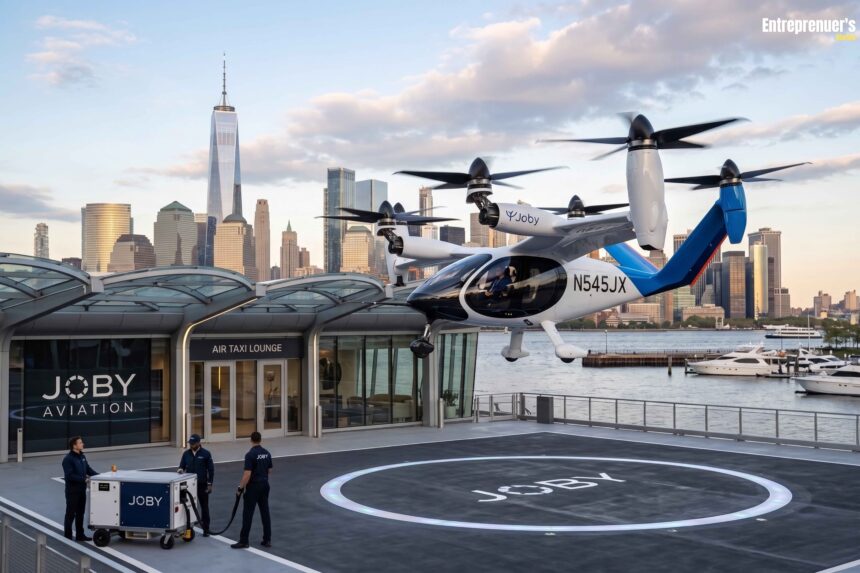
New York, April 30: Getting from Midtown Manhattan to JFK on a Tuesday afternoon takes about as long as flying from New York to Boston. That math has not changed in decades. Joby Aviation thinks it finally can.
The Santa Cruz-based company has spent sixteen years building toward a single, audacious goal: a commercially certified, all-electric aircraft that takes off and lands vertically, moves at 150 miles per hour, and carries passengers across city corridors in minutes rather than hours. That aircraft is now real. It has flown more than 1,000 times, according to company records. And New York City, the most punishing urban transit environment in the United States, is squarely in its crosshairs.
This is not a concept. It is not a PowerPoint. According to reporting from Bloomberg and The Wall Street Journal, Joby Aviation has identified New York as the anchor market for its commercial launch, with service initially targeting the Manhattan-to-airport run that has frustrated business travelers and daily commuters alike for the better part of fifty years. The company is not dabbling. It is building.
What Joby Aviation’s Air Taxi Service Actually Means for New York Commuters
Put the numbers on the table. A car ride from downtown Manhattan to JFK during peak hours averages 59 minutes, per data from the New York City Department of Transportation. The subway and AirTrain combination runs closer to 70 minutes on a good day, longer when the A train decides otherwise. Joby Aviation’s five-seat eVTOL aircraft, based on the company’s own published flight performance data, would cover the same distance in roughly seven minutes of air time.
Seven minutes. That figure deserves a moment.
For a business traveler catching a 7 a.m. international departure, that kind of time compression is not a convenience. It is a structural change in how they plan their entire morning. For a consultant flying to Chicago three times a week, it reframes the economics of maintaining a New York base. The use case practically writes itself, and that is precisely what has drawn institutional money, airline partnerships, and federal contracts into Joby Aviation’s orbit.
On pricing, company executives have consistently described the target range as comparable to a premium black-car service, not helicopter charter territory. That framing is deliberate. Blade, the Manhattan helicopter shuttle operator, has spent years trying to crack mainstream adoption without success, largely because the price point kept the addressable market thin. Joby Aviation’s unit economics, if the company hits its manufacturing and certification targets, would open the air taxi category to a far wider slice of New York’s professional class.
The Delta Airlines Partnership: A Strategic Infrastructure Play for Joby Aviation
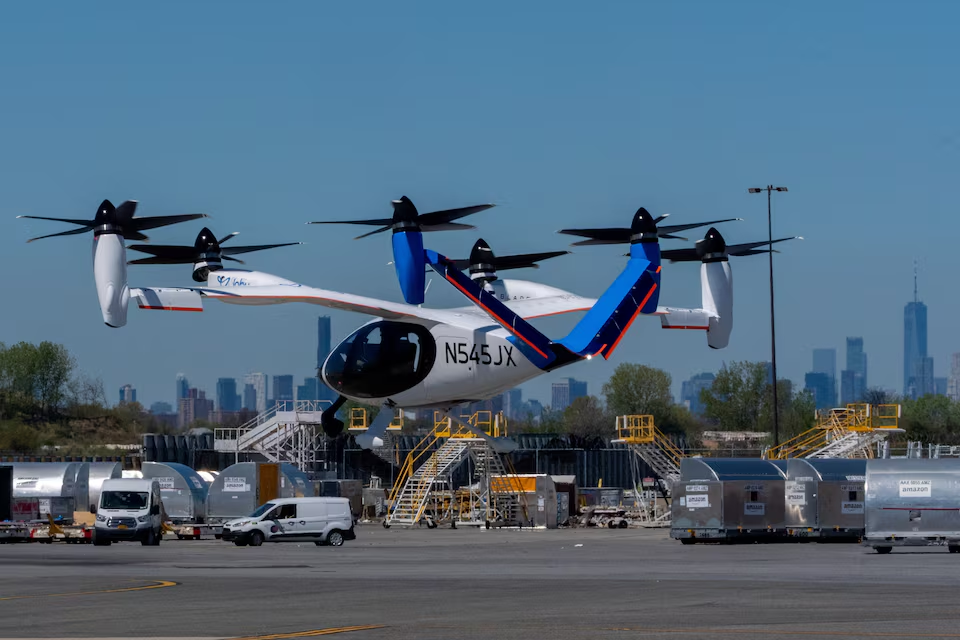
Few commercial agreements in the eVTOL sector have carried as much strategic weight as the one Joby Aviation struck with Delta Air Lines. Under the arrangement, Delta committed equity capital and agreed to a framework for weaving Joby Aviation’s service into the broader Delta passenger experience at JFK and LaGuardia, according to Reuters and the Financial Times.
Read that again slowly, because the implications run deep. Delta is not slapping its logo on a press release. The airline is positioning itself to sell Joby air taxi connections at the point of flight booking, which means a passenger reserving a Delta seat from London to New York could theoretically purchase a Joby leg into Manhattan in the same checkout window. That kind of distribution access is something no eVTOL startup could build on its own, regardless of how good the aircraft is.
There is a ground-side dimension here that matters just as much. Delta’s existing relationships with the Port Authority of New York and New Jersey have given Joby Aviation a path to vertiport placement at JFK that would otherwise require years of independent negotiation with one of the most bureaucratically dense infrastructure bodies in the country. The two companies have been actively working on JFK vertiport development, according to Port Authority officials cited by The New York Times.
Frankly, this is the part of the urban air mobility story where most companies have quietly fallen apart. Real estate in New York does not yield to good intentions. Zoning does not bend for compelling engineering. The decision to anchor the ground infrastructure strategy through an established airline partner rather than fight for standalone rooftop or waterfront sites from scratch is one of the smarter operational choices in Joby Aviation’s history.
FAA Certification: The Regulatory Milestone That Unlocks Joby Aviation’s Air Taxi Launch
There is one gate between Joby Aviation and paying passengers, and it sits inside a federal building in Washington. The FAA type certificate is the instrument that converts a sophisticated aircraft into a legal commercial carrier. Without it, the entire business model exists on paper.
Joby Aviation is further along this process than any other eVTOL company operating in the United States, according to Aviation Week and AIN Online. The company has cleared the FAA’s Stage 4 conformity inspections on its production-representative aircraft, a threshold that most competitors have not yet reached. More than 1,000 test flights are on record, per company statements cited by CNBC, covering a significant portion of the certification flight test matrix the FAA requires.
The broader regulatory picture has shifted somewhat in Joby Aviation’s favor. Congress has applied pressure on the FAA to modernize its approach to novel aircraft categories, wary of ceding ground to European regulators who have moved faster on eVTOL certification timelines. The agency has responded by refining its eVTOL pathway, though it has not abandoned the rigorous safety standards that define Part 135 air carrier certification. That final certificate is what Joby Aviation needs to operate scheduled passenger service, and it remains the critical dependency in every launch timeline the company has put forward.
The honest caveat: nobody, including Joby Aviation, can tell you exactly when that certificate arrives. The FAA does not publish guarantees. Aviation certification history is filled with schedules that slipped by months and years. The company’s commercial launch window is real, but it remains conditional.
Joby Aviation’s Funding Position and the Path to Profitability
North of $2.2 billion raised. That figure, drawn from PitchBook data and company disclosures, represents one of the largest capital accumulations in the eVTOL sector globally. Two investors stand out above the rest.
Toyota has put $394 million into Joby Aviation, and the relationship goes well beyond a check. According to Nikkei Asia and the Financial Times, Toyota engineers have worked directly inside Joby Aviation’s manufacturing operation, applying the automaker’s legendary production discipline to an aircraft factory context. That is a genuinely unusual arrangement. Most strategic investors in aerospace startups provide capital and a logo. Toyota has provided people, process knowledge, and supply chain access, the kind of operational depth that cannot be purchased at any valuation.
The United States Air Force represents the second pillar. Federal contracts with the military branch have given Joby Aviation access to operational testing environments that civilian-only companies rarely see before commercial launch. Flying in complex, contested airspace with demanding logistics requirements builds a kind of institutional confidence that no investor demo day can replicate.
The balance sheet reality is what it is. The company went public through a SPAC merger in 2021 and trades on the New York Stock Exchange. It is pre-revenue, cash-consuming, and dependent on continued investor confidence through a certification process that has no guaranteed end date. According to its most recent public financial disclosures, the company holds sufficient runway to carry operations through the anticipated launch period, but the margin for timeline slippage is not unlimited.
The Competition: Why Joby Aviation Holds the Strongest Air Taxi Position
Archer Aviation is the name that comes up most consistently in the same breath as Joby Aviation, and for good reason. The San Jose-based competitor is pursuing its own FAA certification and has a commercial agreement with United Airlines that mirrors the structural logic of the Joby-Delta arrangement. Archer’s Midnight aircraft uses a different engineering configuration, and the two companies have made different bets on propulsion architecture and manufacturing approach. Both are real. Both are serious. The race is not over.
What is over, however, is Lilium. The German eVTOL pioneer that once commanded some of the highest valuations in the sector filed for insolvency in late 2024, according to extensive reporting by the Financial Times and Reuters. The collapse was a useful corrective for an industry that had spent several years inflating expectations. Lilium had aircraft. It had investors. What it did not have was a credible path from prototype to certified commercial operations within a capital structure that could survive the wait. The lesson was absorbed unevenly across the sector.
Joby Aviation absorbed it better than most. The combination of military contracts providing operational credibility, a Tier 1 automotive manufacturer providing manufacturing discipline, a major airline providing distribution infrastructure, and an FAA certification process more advanced than any domestic peer adds up to a competitive position that is structurally different from where Lilium stood. The risks are still real. The advantage is also real.
What New York City’s Infrastructure Actually Requires for Joby Aviation’s Air Taxi Operations
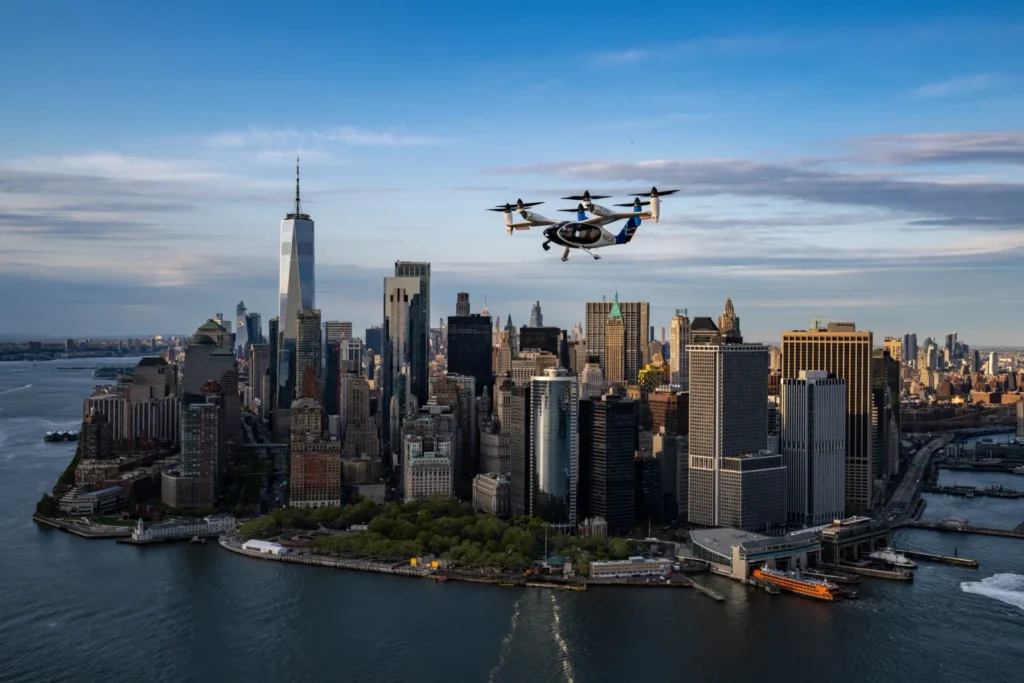
One vertiport at JFK is a start. It is not a network. A city the size and complexity of New York ultimately needs departure and arrival points across Manhattan, the outer boroughs, and the major airport terminals before an air taxi service becomes genuinely useful to a broad population rather than a novelty for the few.
The FAA and NASA have spent several years developing Urban Air Mobility traffic management frameworks, according to publicly available NASA technical documents and FAA advisory circulars. The work is substantive. It establishes how eVTOL aircraft would be tracked, separated, and routed through dense urban airspace. What it does not yet provide is a fully operational system deployed in a real city environment, because no city has one yet.
New York’s airspace sits in a category of its own. JFK, LaGuardia, Newark, and Teterboro all operate in close geographic proximity, with commercial jets, regional aircraft, private planes, and helicopter corridors layered across the same sky. Inserting a new class of electric aircraft into that picture requires not just FAA approval for the aircraft itself, but coordinated airspace redesign and real-time traffic management infrastructure that is still being built at the national level.
Joby Aviation has acknowledged the phased reality openly. The initial New York service will cover specific, high-demand point-to-point routes rather than a citywide grid. That is the right posture. Overselling network density in year one is how urban mobility companies have historically burned goodwill before they had product to back it up.
The Bigger Picture for Founders and Investors Watching Joby Aviation
JoeBen Bevirt founded Joby Aviation in 2009. That was three years before the iPhone 5 existed. The company that Bevirt started in a Santa Cruz workshop has been in development longer than most of the people downloading its coverage on social media have been paying attention to the startup world.
That timeline is not a criticism. It is the nature of the category. Aviation does not compress for venture capitalists. The FAA does not accelerate for impatient limited partners. The physics of certification, manufacturing scale-up, and airspace integration operate on schedules that bear no resemblance to software release cycles. Companies that entered the eVTOL space with consumer app assumptions and eighteen-month runway expectations largely did not survive the encounter with reality.
Joby Aviation survived because it was built, from the beginning, with an understanding that this was a decade-plus undertaking. The capital strategy, the military partnerships, the Toyota manufacturing relationship, and the airline distribution deal all reflect a founder and leadership team that understood what they were actually building. That institutional patience is one of the rarest assets in the startup ecosystem, and in aerospace, it is the only kind that matters.
New York City has been promised better transportation more times than anyone still counting. The Second Avenue subway took seventy years from proposal to first train. The hyperloop never moved beyond renderings. Cross-Hudson rail improvements remain perpetually five years away. The city’s relationship with infrastructure ambition is, to put it generously, complicated.
Against that history, a certified Joby Aviation air taxi service connecting Manhattan to its airports in under ten minutes would be the most tangible leap in New York’s transit options since the AirTrain opened in 2003. It would not solve the subway. It would not replace the taxi. But for the slice of the city that moves on business time, it would change the calculus of every airport morning in ways that are difficult to fully imagine until the first flight actually happens.
That flight has not happened yet. The certificate has not been issued. The vertiports are still being permitted. But Joby Aviation has assembled, piece by piece, a more credible set of building blocks toward commercial reality than this sector has ever placed in front of a major American city. The sky above New York is not yet shared with electric air taxis. It is getting there.
Connect With Us On Social Media [ Facebook | Instagram | Twitter | LinkedIn ] To Get Real-Time Updates On The Market. Entrepreneurs’ Diaries Is Now Available On Telegram. Join Our Telegram Channel To Get Instant Updates.

Tobias is a Berlin-based startup scout and event reporter who explores global tools, tech events, and founder-friendly platforms.