
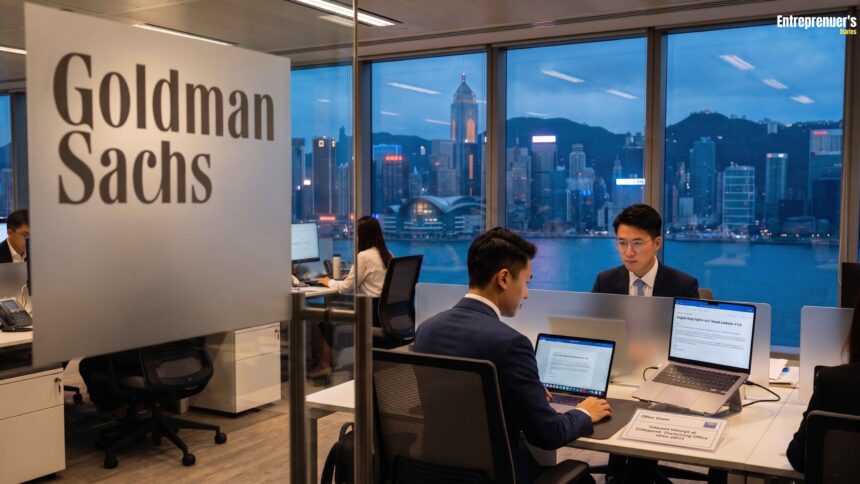
Hong Kong, April 30: Somewhere between a signed enterprise agreement and a compliance officer’s desk, things broke down. Goldman Sachs has confirmed that its Hong Kong-based staff can no longer access Anthropic’s AI models, a restriction that followed an internal review of the bank’s contract with the San Francisco company. No dramatic fallout. No public accusation. Just a quiet line drawn through a city where the regulatory ground shifted long before any AI vendor arrived to build a business on it.
This is not a story about distrust. Goldman Sachs has not walked away from Anthropic’s technology globally, and nobody on either side has suggested the relationship is irreparable. What has happened is more instructive than a breakup: a global bank ran its contractual fine print against the specific legal reality of operating in Hong Kong, and the numbers did not add up.
Goldman Sachs and Anthropic: The Enterprise Relationship That Hit a Wall
Goldman Sachs came to Anthropic’s table early. The bank, alongside a handful of other large financial institutions, entered enterprise agreements with Anthropic as its Claude series of large language models proved genuinely capable on the tasks that matter in finance: reading dense legal filings, extracting structured data from unstructured documents, drafting and reviewing correspondence under deadline pressure. Anthropic’s pitch was not just performance. It was the safety-first positioning, the Constitutional AI framework, the sense that this was a company building something you could defend in front of a regulator without breaking into a sweat.
That pitch held, more or less, until a jurisdiction-specific review said otherwise.
According to reporting confirmed by the bank, the Hong Kong restriction followed an examination of how Anthropic’s contractual terms mapped against Goldman Sachs’ compliance obligations in that specific market. The bank has not disclosed which provisions fell short, but the outcome is unambiguous: staff in Hong Kong are locked out, pending resolution. Goldman Sachs did not name a timeline. Anthropic has not made a public statement addressing the specifics.
Why Hong Kong Is a Different Animal for AI Contracts
Anyone who has worked in financial services across Asia-Pacific knows that Hong Kong is not simply a satellite office of New York or London. It is a jurisdiction with its own regulators, its own legal character, and since 2020, a political overlay that has made every multinational operating there reassess what it means to store, process, and expose client data on systems governed by foreign infrastructure.
The “one country, two systems” arrangement still technically governs Hong Kong’s legal framework, but the National Security Law passed in June 2020 introduced obligations and ambiguities that financial compliance teams have been working through ever since. For a global bank, the practical question is specific and uncomfortable: if a regulator or law enforcement authority in Hong Kong demands access to data processed through a US-based AI vendor’s infrastructure, what does the contract say about cooperation? And does that answer satisfy both sides of the regulatory exposure?
The Hong Kong Monetary Authority has issued detailed guidance under its Supervisory Policy Manual on technology risk management, third-party vendor oversight, and cloud computing. The Securities and Futures Commission holds its own expectations for systems used in regulated activities. Together, they create an obligation for financial institutions to demonstrate, not merely assert, that their technology vendors meet the required standard. A vendor contract written to satisfy US enterprise procurement standards does not automatically satisfy what Hong Kong’s regulators require.
Anthropic’s models, like those of every other frontier AI company, run primarily on cloud infrastructure based in the United States. Cross-border data flows, jurisdiction of processing, and the chain of subprocessors handling that data are matters that banks operating in Hong Kong cannot afford to leave vague. Goldman Sachs appears to have looked closely, found vagueness, and acted accordingly.
Wall Street Is Conducting the Same Review. Quietly.
Goldman Sachs is not the first institution to pull this thread, and it will not be the last. Across the industry, compliance and technology risk teams have spent the past eighteen months working backward through AI vendor agreements signed in a more optimistic moment, checking whether the contracts actually hold up against the regulatory environments in which the tools are being used.
The SEC has been explicit: broker-dealers and investment advisers must supervise AI systems used in regulated activities with the same rigour applied to any other technology. The Office of the Comptroller of the Currency and the Federal Reserve have both updated third-party risk management guidance in ways that reach directly into AI vendor relationships.
In Europe, the AI Act brings high-risk AI systems in financial services under full enforcement in August 2026, a development Entrepreneur’s Diaries covered in its April 2026 issue. In Hong Kong, the HKMA’s Supervisory Policy Manual and its circulars on cloud computing and third-party risk create a compliance obligation that banks must demonstrably satisfy.
None of this regulatory pressure is theoretical anymore. It lands on specific contracts with specific vendors in specific jurisdictions.
Anthropic has not been standing still. The company has grown its enterprise compliance infrastructure, added transparency documentation, and worked bilaterally with clients to address jurisdiction-specific requirements. Its Trust and Safety function has expanded considerably as the enterprise client base has widened.
But there is a structural tension in building compliance infrastructure at the pace that enterprise AI has been adopted. Global contracts are, by necessity, written for the common case. Hong Kong is rarely the common case.
The pattern shows up elsewhere. JPMorgan Chase operates internal approved-vendor frameworks that differentiate AI access by function and geography, a structure born from exactly the kind of compliance reasoning Goldman Sachs is now acting on publicly.
Morgan Stanley has invested in proprietary AI infrastructure partly because tight data governance is easier to guarantee when you own the stack. Citigroup’s internal AI use policies treat jurisdiction-specific regulatory obligations as first-order constraints, not items to be addressed after the rollout.
None of these institutions are retreating from AI. They are being precise about where it can legally operate and on whose terms.
The hard part of enterprise AI was never convincing staff to use the tools. It was producing contracts that could survive a serious legal review eighteen months after they were signed.
Anthropic’s Valuation Is High. The Reputational Stakes Are Higher.
Anthropic sits at approximately $61.5 billion in valuation, according to Bloomberg’s reporting on the company’s most recent funding round. Google and Amazon are both investors with significant deployment commitments.
The enterprise narrative that has driven that valuation rests substantially on the idea that Anthropic is the AI company that serious institutions can trust: rigorous, transparent, safety-oriented, built for environments where the cost of getting it wrong is measured in regulatory action rather than bad press.
A contractual restriction at Goldman Sachs Hong Kong does not crater that narrative on its own. This is a single jurisdiction, a single contract review, and neither party has characterised it as a broader breakdown. The path to resolution, a supplemented or renegotiated agreement that addresses Hong Kong’s specific requirements, is standard enterprise software procedure.
But the reputational arithmetic still matters. Goldman Sachs is not a minor customer. It is a signal.
When Goldman Sachs restricts a vendor’s access, other institutions notice. Compliance officers at banks currently reviewing their own AI vendor agreements in Hong Kong, Singapore, Tokyo, and Frankfurt will be reading this story and opening their own contract files.
For Anthropic, the question this episode raises is less about Goldman Sachs specifically and more about the speed at which its enterprise compliance infrastructure can close gaps that sophisticated clients are now actively finding.
The 5 Contract Provisions That Most Likely Broke Down

Without the Goldman Sachs-Anthropic contract in hand, precise attribution is not possible. But five categories of provision consistently surface when regulated financial institutions review AI vendor agreements against demanding jurisdictions, and any one of them is sufficient to produce exactly the outcome Goldman Sachs has now implemented.
Data residency and processing location is the first and most fundamental. AI enterprise contracts written for global deployment frequently permit data to be processed wherever the vendor’s cloud infrastructure sits, which for US-based companies means American data centres as a default. For Goldman Sachs Hong Kong, that default creates direct tension with regulatory expectations around where client and operational data may reside and under whose legal jurisdiction it sits.
Audit and inspection rights come second. Hong Kong’s financial regulators expect banks to demonstrate substantive oversight of their technology vendors, not just attest to it. That means contractual rights to audit, inspect, and test vendor security practices.
AI companies operating at frontier scale have not uniformly built the audit access architecture that satisfies financial regulators in demanding markets. A clause that looks adequate for a US enterprise customer can fall short of what an HKMA-supervised institution needs.
Subprocessor disclosure is third. AI models do not run on AI company infrastructure alone. They run on hyperscale cloud platforms, with further subprocessors beneath.
Regulated entities in Hong Kong must ensure that every link in that chain satisfies their obligations. Contracts that do not clearly identify and constrain the subprocessor chain leave banks exposed in ways that compliance teams cannot accept and regulators will not excuse.
Model change notification sits fourth. A financial institution using an AI model in any process that touches clients or regulated decisions needs to know when that model changes, before it changes.
The pace of AI model development makes this more than a procedural concern. A model update can alter outputs, introduce new behaviours, or change the risk profile of a workflow in ways that require internal review before going live. Contracts without adequate change notification provisions make that review impossible to conduct.
Regulatory cooperation rounds out the five. Financial institutions need contractual certainty that if a regulator comes to them with questions about a technology system, their vendor will cooperate fully and promptly.
In Hong Kong’s regulatory environment, where the powers of relevant authorities are broad and cooperation with foreign regulators can create legal complications under the National Security Law, the precise language of a regulatory cooperation clause is not a formality. It is a core risk management question with no acceptable ambiguity.
Goldman Sachs ran the review. One or more of these provisions did not pass.
The Cost Nobody Is Counting
There is a dimension to this story that tends to get lost in the contract language. Goldman Sachs employees in Hong Kong who had built working habits around Anthropic’s models, who had developed prompting approaches and integrated Claude into research workflows, used it to compress document review time or accelerate first drafts, are now locked out with no announced timeline for resolution.
Productivity built on AI tools is not instantly portable. Different models carry different strengths, different response tendencies, and different performance profiles on specific task types. The institutional knowledge that staff develop around a particular model’s capabilities does not transfer to a replacement without a learning curve. That operational cost is real, and it does not show up in any contract review. It shows up in the work, and in the people doing it.
What Goldman Sachs Just Told the Entire Enterprise AI Market
Step back from the specifics, and what Goldman Sachs has done in Hong Kong is point at something the enterprise AI market has been reluctant to examine directly. The first generation of AI adoption in financial services moved fast because the tools were impressive and the contracts were permissive. That era is closing.
The second generation is being defined by institutions willing to accept short-term operational disruption in exchange for contractual frameworks that will hold up when a regulator asks hard questions.
That trade is uncomfortable, especially for AI vendors that have built enterprise growth strategies around frictionless deployment. But it is the trade that regulated industries have always made with technology, and there is no reason to believe AI will remain permanently exempt.
For AI companies, the message is structural: compliance infrastructure is not a feature to be added after product-market fit. In financial services, it is a prerequisite for staying in the market at all. Vendors that treat a Goldman Sachs compliance review as a sales obstacle to manage are going to find themselves on the wrong side of a growing number of restricted-access decisions in cities that are not New York and contracts that were not written with them in mind.
For financial institutions watching, the Goldman Sachs situation in Hong Kong is less a warning than a checklist item. The question is not whether your AI vendor contracts will face this kind of scrutiny. The question is whether you find the gaps before a regulator does.
Goldman Sachs found them first. In the unsexy world of enterprise technology governance, that is exactly the right answer.
Connect With Us On Social Media [ Facebook | Instagram | Twitter | LinkedIn ] To Get Real-Time Updates On The Market. Entrepreneurs’ Diaries Is Now Available On Telegram. Join Our Telegram Channel To Get Instant Updates.

Tobias is a Berlin-based startup scout and event reporter who explores global tools, tech events, and founder-friendly platforms.