
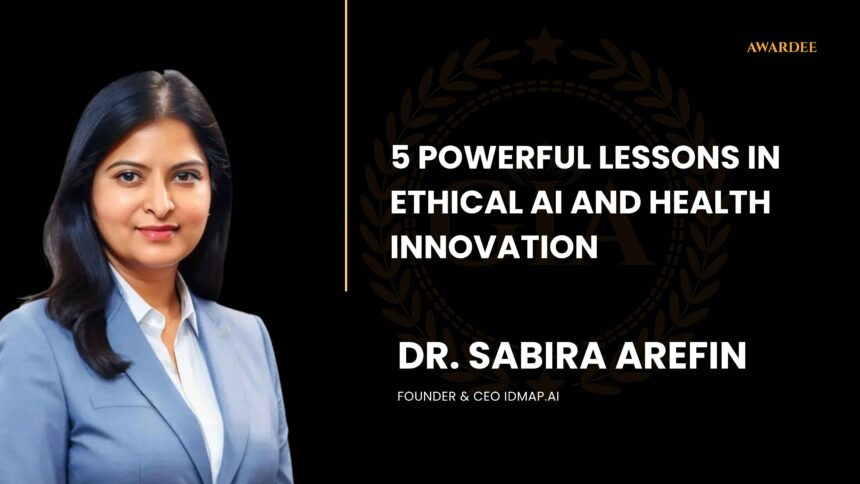
New York, March 20: When Dr. Sabira Arefin speaks about artificial intelligence, she does not reach for optimism as a default. She reaches for accountability first. That distinction, subtle but consequential, defines a career that most professionals in her field would struggle to replicate.
Her work cuts across AI systems, public health infrastructure, and ethical data governance with a consistency that is rare. In most sectors, pivoting toward whatever earns the next funding round has become routine. Arefin has not pivoted. She has deepened.
Dr. Sabira Arefin is the Founder and Chief Evangelist of the Global Health Alliance and the Chief Executive Officer of IdMap.ai. The company is built around a premise most organizations treat as secondary: ethical governance must be embedded from the foundation, not bolted on after the architecture is already set.
Her academic foundation is substantial. She holds an MBA from Duke University and completed the Global Healthcare Leadership Program at Harvard. She earned a Doctor of Business Administration, an Honorary Doctorate in Leadership and Innovation, and has pursued advanced doctoral research in AI-driven healthcare data security.
Each credential adds operational depth to a central question Dr. Sabira Arefin has carried across every role: how do systems remain human-centered when efficiency becomes the default value?
That question was not formed in a seminar room. It was forged during years spent in analytics and technology, watching decisions encoded in algorithms ripple outward into human lives. The machinery moved fast. The consequences moved slower. Most of the people building those systems were not pausing long enough to track the distance between the two.
Dr. Sabira Arefin and the Case for Preventive Health Infrastructure
The Global Health Alliance reflects what Dr. Sabira Arefin built from that reckoning. The framework is deliberately practical, centered on health literacy, community intelligence, and AI-supported insights designed to lower barriers before crises emerge.
Prevention, in her framing, is not merely a cost-saving strategy for overwhelmed healthcare systems. It is a philosophical commitment. The belief that systems should support people before they break, not only after they have already collapsed.
In the United States, the case for preventive care infrastructure is well-documented and largely unrealized. According to the Centers for Disease Control and Prevention, chronic diseases account for roughly 90 percent of the nation’s annual $4.5 trillion in healthcare expenditures.
Yet the preponderance of funding, institutional attention, and clinical infrastructure continues to flow toward acute and reactive care. Dr. Sabira Arefin is not the first to point this out. But she is one of the few who has tried to architect a working alternative rather than simply critique the existing model.
The Global Health Alliance positions community intelligence as a foundational resource, not a supplement. Health literacy is treated as infrastructure in the same way that roads and hospital beds are treated as infrastructure: something the system must build and maintain rather than assume.
The AI-supported insights layered onto this foundation are designed to reduce barriers of access and understanding. Not to replace the human judgment and community relationships that make preventive care actually reach people.
How Dr. Sabira Arefin Is Solving the Governance Problem in AI Healthcare
IdMap.ai addresses a problem that has grown significantly more urgent as healthcare systems globally have moved to digitize patient records, deploy predictive models, and integrate automated decision-support tools. Data is abundant. Trust is fragile. The two conditions have not moved in the same direction.
According to a 2024 report by the Pew Research Center, roughly 67 percent of Americans say they are not comfortable with their doctor relying on AI to make medical diagnoses or recommend treatments, even when accuracy is acknowledged.
The discomfort is not irrational. High-profile cases of bias in algorithmic health tools have made the risks concrete. Pulse oximeters that performed poorly on patients with darker skin tones. Sepsis prediction models flagging incorrect risk levels in certain populations. The distance between a well-intentioned AI deployment and a harmful one is often much shorter than developers anticipated.
IdMap.ai delivers what Dr. Sabira Arefin describes as privacy-conscious identity and trust infrastructure, built for institutions navigating exactly this environment. The platform ensures that organizations have the governance tools in place before a failure forces the question.
Her leadership approach at IdMap.ai is defined by restraint. Growth is pursued, but never at the expense of accountability. That framing carries weight in an industry where the two are frequently positioned as competing priorities.
Frankly, the market has no shortage of platforms promising to clean up data governance after the fact. What distinguishes Dr. Sabira Arefin’s approach is the insistence that governance is not remediation. It is architecture. You do not retrofit conscience into a system built without it. You design it in from the first line.
Dr. Sabira Arefin on Writing, Ethics, and Scaling Accountability
Arefin’s intellectual engagement with these questions extends beyond organizational leadership. In Longevity: Lessons from Life, Dr. Sabira Arefin translates complex scholarship into grounded reflection on how leaders sustain principled decision-making over time.
The forthcoming Ethical Intelligence: Built-In Governance for AI Systems takes the argument further. It interrogates how ethics functions at scale and how leaders remain accountable when consequences are delayed and diffuse.
That last phrase deserves attention. A bias embedded in a hiring algorithm does not produce a single, identifiable moment of harm. It produces a pattern, distributed across thousands of rejected applications, visible only in aggregate and often only years after the model was deployed.
By the time the pattern is legible, the accountability chain has grown cold.
The books are not thought leadership exercises in the conventional sense. They are attempts by Dr. Sabira Arefin to close the distance between scholarship and practice, giving working executives and policymakers a framework for asking harder questions before systems are deployed, rather than after the damage surfaces.
That sequencing matters more than it is usually credited for.
Global Recognition: Dr. Sabira Arefin at the Bali Leadership Summit
In February 2026, Dr. Sabira Arefin was among the global leaders who convened at the inaugural Global Impact Summit and Awards, held at Harper Kuta Bali. The gathering, organized by Entrepreneur’s Diaries, was invitation-only and jury-led, designed around demonstrated professional impact rather than ticket sales.
Arefin appeared as a featured voice on stage alongside executives, founders, and social impact practitioners from across multiple continents.
The summit reflected a broader shift in how professional recognition is being structured globally. Traditional conference formats have ceded ground to smaller, more deliberately assembled gatherings where the quality of conversation is treated as a design priority. According to the Entrepreneur’s Diaries editorial board, curated recognition backed by editorial credibility is more durable than mass visibility.
For Dr. Sabira Arefin, the recognition was consistent with a career that has never prioritized visibility as an end in itself. Her trajectory is marked by a preference for frameworks over profiles, for institutional infrastructure over personal platform, for systems that outlast their founders rather than remain dependent on them.
What Dr. Sabira Arefin Is Building Next
Her focus for the coming years is expansive but disciplined. The Global Health Alliance is being developed into a broader health intelligence network, extending its preventive care framework across a wider range of communities and health systems.
IdMap.ai’s ethical governance infrastructure is being deepened and scaled. The goal is to position the company as a foundational layer for institutions serious about navigating the accountability demands of an AI-integrated world.
Neither ambition is pitched as disruption. That choice is itself a signal. In a sector where disruption has become the default vocabulary of ambition, describing one’s work in terms of governance, infrastructure, and sustained accountability is a deliberate departure.
Disruption generates attention quickly. Infrastructure generates trust slowly. Dr. Sabira Arefin has built her career around the premise that the second kind of progress is the only kind that endures.
The question she started with, how systems remain human-centered when efficiency becomes the default value, does not have a final answer. But the body of work she has assembled across the Global Health Alliance, IdMap.ai, and her published scholarship represents one of the more serious ongoing attempts to operationalize that answer in real institutions, with real data, and real consequences attached.
In a landscape that rewards volume over value, that is worth noting carefully.
Connect With Us On Social Media [ Facebook | Instagram | Twitter | LinkedIn ] To Get Real-Time Updates On The Market. Entrepreneurs’ Diaries Is Now Available On Telegram. Join Our Telegram Channel To Get Instant Updates.

Isabella is a global business journalist and former McKinsey analyst from Brazil. She brings sharp insights on economic shifts, policies, and founder journeys from around the world.