
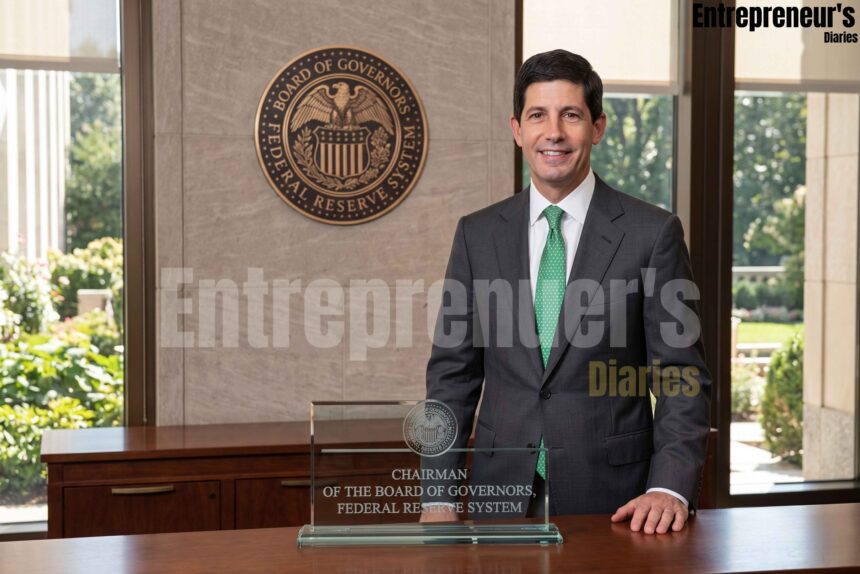
Washington D.C., April 30: The Senate confirmed Kevin Warsh as the next chair of the Federal Reserve this week, ending one of the most closely watched nomination battles in recent memory. Markets had been watching the process for months. So had central bank officials in Frankfurt, London, and Tokyo. The moment the gavel came down, one era of American monetary policy closed and another, more uncertain and more deliberate one, opened.
Kevin Warsh, now officially the new Fed chairman, does not arrive at the Marriner S. Eccles Building carrying a theorist’s blueprint. He carries something rarer: direct memory of crisis. He was inside the room in 2008 when the global financial system came within hours of total collapse. That experience, more than any speech or op-ed he has since delivered, explains how he will govern the most consequential financial institution on earth.
Who Is Kevin Warsh and Why Does This Appointment Matter

Before Kevin Warsh became the new Fed chairman, he was many things. A Harvard Law graduate. A Morgan Stanley mergers and acquisitions attorney. A Fed governor appointed at just 35 years old, making him one of the youngest to ever hold that seat. He served on the Federal Reserve Board from 2006 to 2011, a stretch that covered the housing bubble’s final inflation, its catastrophic collapse, and the desperate improvisation that followed.
He watched Ben Bernanke make calls that had no historical precedent. He was part of the emergency deliberations, the all-night sessions, the decisions made with incomplete information and enormous consequence. What Kevin Warsh took from those years was not a love of intervention. It was a deep suspicion of it.
According to reporting by The Wall Street Journal, Warsh spent the years after his Fed tenure arguing persistently that quantitative easing, while necessary as a crisis tool, had been extended far beyond its mandate. The Fed’s balance sheet, he wrote in multiple Journal op-eds, had become a market distortion engine, suppressing yields, inflating asset prices, and creating a false sense of financial stability that would eventually demand a reckoning.
That argument, dismissed by some as ideologically rigid, looks considerably more credible in 2026 than it did in 2013. And it is now the argument held by the new Fed chairman with full institutional authority to act on it.
At 56, Kevin Warsh brings a quality that recent Fed chairs, brilliant as they were, largely lacked: practitioner instincts. He does not read capital markets through econometric models. He reads them the way a trader does, through price signals, credit spreads, and the behavior of money under pressure. That orientation will shape everything from his FOMC votes to his press conference answers.
The Trump Connection and the Political Backdrop
The relationship between President Donald Trump and Kevin Warsh predates this nomination by years. Trump had made his irritation with Jerome Powell a recurring theme throughout 2025, publicly and repeatedly pressing for faster rate cuts while Powell held firm on data dependency. According to reporting by Politico, confirmed by NBC News, the White House began substantive outreach to Warsh in late 2025, well before Powell’s term formally expired in May 2026.
The nomination landed in February and cleared the Senate Banking Committee on a largely party-line vote, with two Democratic senators crossing the aisle, according to Reuters. The full Senate confirmation followed this week with similar margins. The new Fed chairman now holds his position with a clear, if politically complicated, mandate.
That political backdrop deserves honest examination. The Federal Reserve’s independence is structural, not absolute. Every Fed chair serves at the intersection of law, economics, and politics, and Kevin Warsh is no different. What is different is the degree to which this appointment reflects a White House with specific, stated preferences about monetary direction. Trump wanted a Fed less inclined to activist intervention. He got one.
Whether Kevin Warsh will honor that preference or chart his own course once confirmed is something only the FOMC minutes will reveal. People who have worked closely with him describe someone who is fiercely protective of the Fed’s institutional credibility and unlikely to subordinate it to political convenience. Still, the perception of alignment with the executive branch is itself a variable the new Fed chairman will need to manage carefully, particularly in communications with international partners who watch Fed independence as a proxy for US financial system reliability.
What the New Fed Chairman Means for Interest Rates

The practical question every CFO, founder, and portfolio manager is asking right now is simple: what does Kevin Warsh mean for the cost of money? The answer, based on his public record and the analysis of people who know him well, is this: rates will not fall as fast or as far as markets were pricing before his confirmation.
The federal funds rate has been declining gradually since the 2023 tightening peak. Kevin Warsh has signaled, in remarks cited by the Financial Times, that he views the current rate environment as insufficiently responsive to embedded inflation in services and labor markets. That is not a hawkish alarm. It is a cautionary flag against complacency.
Goldman Sachs economists, in a research note covered by Bloomberg, pushed back their Fed rate cut forecast by approximately one quarter following the confirmation. That single adjustment, modest as it sounds, has downstream effects across every rate-sensitive asset class and financing structure in the market.
For founders managing venture debt, for CFOs refinancing corporate credit, for private equity sponsors modeling exit timelines, the Kevin Warsh era means one thing above all others: the cheap money window is not reopening on the timeline you had planned. Adjust accordingly.
5 Powerful Shifts Incoming Under Kevin Warsh’s Federal Reserve
First, the balance sheet will shrink faster than most expect. Kevin Warsh has never been subtle about his view that the Fed’s approximately $7 trillion balance sheet is an ongoing distortion of market pricing. The Peterson Institute for International Economics has noted that an accelerated quantitative tightening program would push long-term Treasury yields higher and reduce the implicit subsidy the Fed has been providing to asset markets for years. That process, uncomfortable as it will be for leveraged investors, is likely to begin in earnest under the new Fed chairman.
Second, the way the Fed talks to the world is about to change. Kevin Warsh is direct in a way that recent chairs were not. Former colleagues cited by the Wall Street Journal describe him as allergic to deliberate vagueness, the kind of carefully hedged language designed to offend no one and commit to nothing. The new Fed chairman is expected to bring a more disciplined, less ambiguous communication approach. That clarity will be welcome to some market participants and unsettling to those who have profited from interpreting Fed ambiguity.
Third, shadow banking is about to face more scrutiny. Kevin Warsh has consistently flagged the non-bank financial sector as a source of systemic risk that the Fed has been too slow to address. Private credit markets, which have expanded dramatically since 2020 according to data cited by the Bank for International Settlements, are likely to receive closer attention under the new Fed chairman’s regulatory posture. This is not a crackdown. It is an overdue reckoning with where the next crisis is most likely to originate.
Fourth, the inflation targeting framework is up for review. The average inflation targeting approach adopted in 2020 was sold as a correction for years of undershooting. What it delivered, critics argue, was an institutional reluctance to tighten in 2021 that cost the economy dearly. Kevin Warsh has questioned this framework publicly and repeatedly. Sources familiar with his thinking, as reported by the Financial Times, confirm that a formal review is being discussed internally. Whether it results in a framework change or a clarification of the existing one, the signal is clear: the new Fed chairman does not consider current doctrine settled.
Fifth, forward guidance as a primary tool is finished. This is perhaps the most significant shift of the five. Kevin Warsh has argued for years that by committing to future rate paths, the Fed has gradually surrendered its ability to respond to new information without triggering market disruption. The new Fed chairman is expected to return the institution to a genuinely meeting-by-meeting, data-driven posture. For traders who have built careers around interpreting dot plots, that is a fundamental change in how the game is played.
Market Reaction: Measured, Not Panicked
Markets absorbed the confirmation of Kevin Warsh as the new Fed chairman with the kind of measured calm that comes from weeks of preparation. The vote was not a surprise. Futures had priced it in. The 10-year Treasury yield edged higher, the dollar strengthened slightly, and equity indices dipped before recovering, according to Reuters market coverage. Nothing dramatic. Nothing that suggested the financial system was caught off guard.
The real test, as multiple fixed-income strategists told Bloomberg, will arrive at Kevin Warsh’s first FOMC meeting in June. His opening press conference will be studied sentence by sentence. His tone, his framing of the economic outlook, and critically his language around the balance sheet will either confirm or complicate the market’s current assumptions.
For equity investors, the new Fed chairman represents a modest but real headwind for long-duration growth assets. A slower easing path means higher discount rates for longer. For value-oriented investors and businesses generating real cash flow today, the Warsh era may prove more hospitable than the past decade of zero-rate policy ever was.
The Global Implications of a New Fed Chairman

Kevin Warsh steps into the new Fed chairman role at a moment when the dollar’s centrality to global finance is both an enormous power and an enormous responsibility. Every rate decision he makes is felt in Jakarta, Nairobi, Buenos Aires, and Warsaw before the US morning session has closed. That reach demands a level of global awareness that not every Fed chair has brought to the role.
The European Central Bank and the Bank of England are both managing their own delicate easing cycles. A Fed that holds rates higher for longer under Kevin Warsh creates a gravitational pull on global capital toward dollar assets, complicating the policy calculus for every other major central bank. The ECB in particular, navigating a fragile recovery in Southern Europe, cannot afford a sharp euro depreciation driven by Fed hawkishness.
For emerging markets carrying dollar-denominated sovereign debt, the stakes are even higher. The Institute of International Finance, in a member note covered by Bloomberg, identified several frontier economies where current debt-service ratios are already dangerously stretched. A prolonged period of elevated US rates under the new Fed chairman could push some of those economies toward restructuring conversations that nobody wants to have.
What Founders and Business Leaders Should Do Now
Kevin Warsh becoming the new Fed chairman is not a reason to panic. It is a reason to plan with greater precision than most businesses have been applying to their financial assumptions.
The cost of capital is not returning to the post-2008 floor. That era ended in 2022 and Kevin Warsh has made clear, in everything he has said and written over the past decade, that he has no interest in recreating it. The new normal, under the new Fed chairman, is a world where money has a real price again. Businesses built for that world will be fine. Businesses built on the assumption of perpetual cheap financing will face a reckoning that has nothing to do with their product or their team and everything to do with their capital structure.
Specifically: variable-rate debt facilities need hedging reviews today. Capital raise timelines need to be stress-tested against rates 40 to 50 basis points higher than current levels. Debt financing strategies that depend on a sharply lower rate environment within the next 12 months should be revised.
That said, Kevin Warsh inherits an economy that is not broken. Consumer spending remains solid, the labor market is near full employment, and corporate balance sheets, broadly speaking, have held up through a genuinely difficult few years. The new Fed chairman is not walking into a crisis. He is walking into a critical transition, from the emergency monetary posture of the pandemic decade toward something more sustainable, more honest, and more demanding of the businesses that have to operate within it.
That transition will be uncomfortable in places. It will reward discipline and punish complacency. And it will be shaped, for better or worse, by the judgment, instincts, and convictions of Kevin Warsh, the new Fed chairman, for years to come.
Connect With Us On Social Media [ Facebook | Instagram | Twitter | LinkedIn ] To Get Real-Time Updates On The Market. Entrepreneurs’ Diaries Is Now Available On Telegram. Join Our Telegram Channel To Get Instant Updates.

Freya is a digital nomad and writer from Sweden, curating business travel hacks and remote-work inspiration from her global adventures.