
Washington, D.C., May 5: The Federal Reserve rate cut that Wall Street spent the first quarter of 2026 desperately pricing in is now, by nearly every credible measure, off the table for the near term.
That is the clearest takeaway from a week that delivered the Fed’s most divided policy vote since 1992, a GDP print loaded with inflation danger, and a leadership handoff at the most powerful central bank on earth.
Friday, May 8 brings the April jobs report. That number is now the only data point capable of shifting the Federal Reserve interest rates 2026 conversation in any meaningful direction.
The Federal Reserve Holds. The Dissent Reveals Everything.
On April 29, the Federal Open Market Committee voted 8-4 to hold its benchmark federal funds rate at 3.5 to 3.75 percent, according to sources. The hold itself surprised nobody.
The four-way dissent did.
Governor Stephen Miran dissented in favor of an immediate Federal Reserve rate cut, according to sources. Going the other direction entirely, Minneapolis Fed President Neel Kashkari, Cleveland Fed President Beth Hammack, and Dallas Fed President Lorie Logan each voted against retaining the statement’s easing language, according to sources.
Kashkari published an essay titled “Why I Dissented” on May 1. He wrote that given recent economic and geopolitical developments and the higher level of uncertainty about the outlook, forward guidance signaling future cuts is not appropriate at this time, according to sources. He went further: if the Strait of Hormuz stays closed for long, the Federal Reserve may need to raise rates, not cut them.
That is not a framing any market had priced. Rate hike language is now officially back inside the Federal Reserve, and that alone reframes the entire Federal Reserve interest rates 2026 debate.
This marks the third consecutive meeting where the Federal Reserve kept rates on hold, following three cuts in the latter part of 2025, according to sources. The easing cycle is, for now, finished.
The Inflation Problem Is Bigger Than the Headline
The Federal Reserve rate cut calculus in 2026 runs directly through one number: PCE inflation.
The Bureau of Economic Analysis released Q1 2026 GDP on April 30. The headline growth figure of 2.0 percent annualized looked decent, according to sources. But the PCE price index, the Federal Reserve’s preferred inflation gauge, surged to a 4.5 percent annualized rate in Q1, up from 2.9 percent in Q4 2025, according to sources.
Core PCE, which strips out food and energy, came in at 4.3 percent annualized, according to sources. That is more than double the Federal Reserve’s 2 percent target.
The Consumer Price Index for March hit 3.3 percent on an annual basis, the highest level since May 2024, according to sources. Economists told sources they expect April’s reading to come in hotter still. Some forecasters project PCE could hit 4 percent by year-end, according to sources.
The Iran war is the core driver. The conflict, now in its ninth week, has effectively closed the Strait of Hormuz to normal oil traffic. As of this week, Brent crude was trading at $105 a barrel, up 44 percent since before the war began, according to sources.
Federal Reserve Bank of Dallas research quantified the damage: if the Strait closure lasts one quarter, headline PCE inflation could rise by 1.7 percentage points at an annualized rate, with elevated readings persisting through Q3 2026, according to sources.
Mark Zandi, chief economist at Moody’s Analytics, told sources the damage has already been done. Oil prices are not returning to pre-war levels quickly regardless of when the conflict ends.
Fitch Ratings’ head of U.S. economics Olu Sonola told sources: the longer the Iran conflict drags on, the greater the risk that higher energy prices continue to push inflation up and ultimately dampen growth.
Billionaire investor Ray Dalio, founder of Bridgewater Associates, told sources this week that the U.S. economy has devolved into stagflation. That one word captures the Federal Reserve’s exact dilemma in 2026: inflation too high to cut rates, growth too fragile to raise them.
Powell Out. Warsh In. The Federal Reserve’s Balance of Power Shifts.
Jerome Powell chairs his last FOMC meeting. His term as Fed chair expires May 15.
The Senate Banking Committee voted 13-11 on April 29 to advance Kevin Warsh’s nomination, according to sources. The full Senate is expected to confirm him the week of May 11. Warsh will almost certainly chair the next FOMC meeting on June 16-17.
Powell told reporters he plans to remain on the Board of Governors and keep a low profile, according to sources. His term as governor runs through early 2028. He stays in the room. He still votes.
Markets have been pricing Warsh as a Federal Reserve rate cut catalyst. That assumption may be badly wrong.
According to sources at 24/7 Wall Street, Warsh’s actual record suggests he cares more about defeating inflation than delivering quick relief to markets. During his Senate confirmation hearings, Warsh emphasized central bank independence and called inflation a long-term economic threat, according to sources.
Natixis CIB chief U.S. economist Christopher Hodge told sources that Warsh is in the unfortunate position of probably being the least influential Federal Reserve chair in a long time. He will have a hard time convincing other FOMC members to cut Federal Reserve interest rates quickly.
The reason is structural, not personal. Fed chairs lead by consensus. Three voting members have now publicly signaled openness to rate hikes. Warsh cannot override that by decree.
According to sources at Charles Schwab, the addition of Kevin Warsh to the FOMC will not swing the balance between doves and hawks, as Warsh takes Stephen Miran’s seat and Powell’s board seat remains open only to Powell himself.
The Federal Reserve rate cut that the White House wants is not available on the current committee’s terms.
Traders Have Already Moved. The Cuts Are Priced Out.
Markets have largely settled on a verdict for the Federal Reserve interest rates 2026 outlook.
According to sources, CME FedWatch placed the probability of no rate change at the June 17 meeting at 93.3 percent. Futures traders assign just 6.7 percent odds to a Federal Reserve rate cut at that meeting.
Polymarket priced the no-change outcome at 96 percent as of May 3, with roughly $16.48 million in total trading volume on the question, according to sources.
According to sources at StreetStats, as of May 1, futures markets are pricing a mostly steady path around the current 3.64 percent effective rate through early 2027. That pricing implies no meaningful Federal Reserve rate cut arrives in the next 12 months under baseline conditions.
Treasury markets confirmed the shift after April 29. The 10-year yield rose to 4.42 percent, its highest level in a month. The two-year yield climbed to 3.94 percent, according to sources.
J.P. Morgan Global Research sees the Federal Reserve holding rates steady for the rest of 2026, with any next move more likely being a 25 basis point hike in Q3 2027, not a Federal Reserve rate cut, according to sources.
Fidelity’s analysis noted that the bar to cut is now just as high as the bar to hike, because of the stickiness in inflation, with the realistic expectation being: on hold, according to sources.
The May 8 Print: What It Would Take to Shift the Federal Reserve
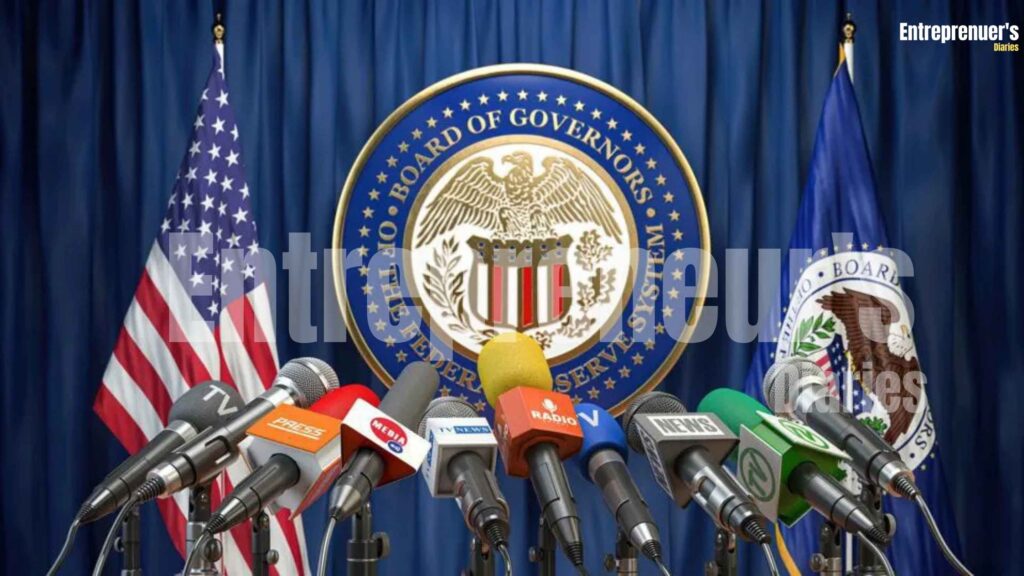
The April jobs report, due May 8 at 8:30 a.m. Eastern Time, is the first major data point arriving after the Federal Reserve rate decision and ahead of Warsh’s first meeting as chair.
The last official reading was March’s 178,000 nonfarm payrolls, which beat the Dow Jones consensus estimate of 59,000, according to sources. Healthcare led, driven by strike-returning workers at Kaiser Permanente. Strip that out and the underlying trend looks considerably softer.
Wages in March rose just 0.2 percent month-over-month and 3.5 percent year-over-year, the lowest annual gain since May 2021, according to sources.
For April, FactSet consensus estimates project just 50,000 jobs added, according to sources. Far below March. The unemployment rate is expected to hold at 4.3 percent, according to sources.
That deceleration, if confirmed, reflects the converging pressure of tariff uncertainty, federal workforce reductions, and the economic weight of war-driven energy costs.
A print near 50,000 with stable unemployment changes almost nothing for June. The 93 percent probability of no Federal Reserve rate cut is not moving on modest data.
What would actually shift the Federal Reserve interest rates 2026 outlook is a figure that shocks to the downside: payrolls well below 50,000, unemployment rising meaningfully, and wage data that signals demand destruction rather than supply constraint.
In that scenario, even a hawkish committee might reconsider. Warsh’s new leadership could provide the institutional cover for a pivot. But that scenario requires the labor market to crack in ways it has not yet cracked.
The Federal Reserve and a Frozen Labor Market
Staffing Industry Analysts described the current labor market as a frozen environment, with its speed limit lowered by dramatically slowed labor force growth, according to sources.
The two-month average of job gains across February and March runs to just 22,500 per month, according to sources. That is the structural reality beneath the volatile monthly swings.
The labor force participation rate stood at 61.9 percent in March, barely moved in a year, according to sources. Long-term unemployment, joblessness lasting 27 weeks or more, stood at 1.8 million in March, up 322,000 over the prior year, according to sources.
Federal government employment continued declining for months, according to sources.
This is not a labor market in collapse. It is a market in suspension. That distinction matters for how the Federal Reserve reads the May 8 data.
For every founder, CFO, and operator making decisions right now, the message is blunt. The Federal Reserve rate cut that many businesses had budgeted for in H1 2026 is not coming. Federal Reserve interest rates 2026 remain elevated, sticky, and politically complicated in ways they have not been in years.
Any easing, under realistic scenarios, arrives late and arrives small. Plan around that. The April jobs report on May 8 either confirms the holding pattern or cracks it open.
Until it does, the Federal Reserve holds, the market waits, and the cost of capital stays exactly where it is.
Connect With Us On Social Media [ Facebook | Instagram | Twitter | LinkedIn ] To Get Real-Time Updates On The Market. Entrepreneurs’ Diaries Is Now Available On Telegram. Join Our Telegram Channel To Get Instant Updates.

Isabella is a global business journalist and former McKinsey analyst from Brazil. She brings sharp insights on economic shifts, policies, and founder journeys from around the world.