New York, June 16, 2026: The BOJ rate hike just changed everything. Tuesday, June 16, 2026 is already being called one of the most consequential trading days in recent memory and for good reason.
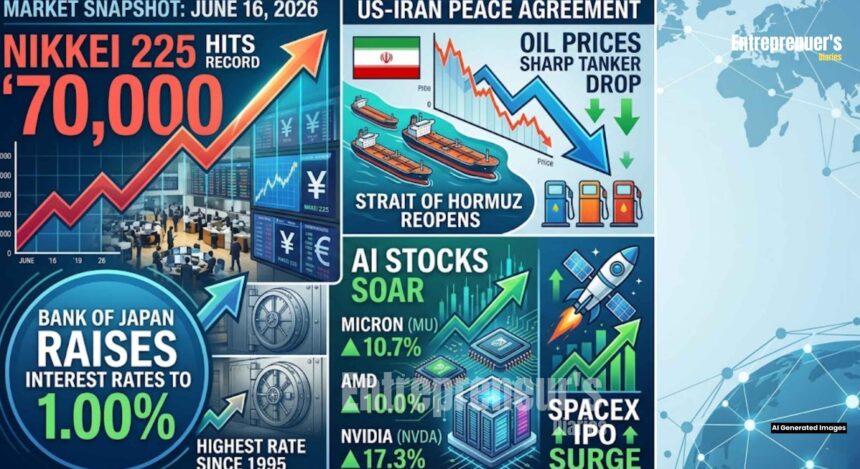
Three major market events collided on a single morning: Japan’s benchmark Nikkei 225 crossed the 70,000 mark for the very first time in its history, the Bank of Japan raised interest rates to their highest level since 1995 with a landmark BOJ rate hike to 1.00%, and Asian equity markets broadly climbed on the back of a US–Iran peace agreement that sent oil prices sharply lower on Monday.
Add to that the continuing explosion in AI linked stocks on Wall Street Micron up 10.8%, AMD up 7%, Nvidia posting the biggest single contribution to S&P 500 gains, as reported by the Associated Press and SpaceX surging nearly 20% in its second day of trading after completing what is widely described as the largest IPO in history, and you have a day that demands a serious, carefully sourced breakdown.
Every figure, every quote, and every claim in this article is sourced and attributed by name. Nothing is included that could not be verified through a credible, named publication. If you read only one piece on today’s markets, make it this one.
A MOMENT MARKETS WILL REMEMBER
There are days that move markets. And then there are days that move history. Tuesday, June 16, 2026, was the second kind. Japan’s benchmark Nikkei 225 crossed 70,000 points for the very first time a threshold no screen had ever shown before. Simultaneously, the Bank of Japan raised its key interest rate to 1.00%, the highest level since September 1995.
Halfway around the world, Wall Street had just recorded all time highs on the back of a landmark US–Iran peace deal that sent oil prices sharply lower. And AI stocks continued their relentless march upward.
Each of these events would dominate a news cycle on its own. Together, on a single Tuesday, they represent a genuine inflection point in global market economics one with direct consequences for investors, entrepreneurs, businesses, and policymakers across every major economy.
WHERE THE MARKETS STOOD ON TUESDAY
By early afternoon Tokyo time, here is exactly where the major Asian indices were trading, according to the Associated Press and ABC News. Japan’s Nikkei 225 was up 0.6% at 69,713.05, having briefly crossed 70,000 for the very first time before trimming gains.
South Korea’s Kospi surged 2.1% to 8,721.64, pushing further into all time record territory. China’s Shanghai Composite was up less than 0.1% at 4,100.53. Taiwan’s Taiex gained 0.6%. India’s Sensex rose 0.5%. On the downside, Australia’s S&P/ASX 200 fell 0.3% to 8,892.10, and Hong Kong’s Hang Seng slipped 1.3% to 24,533.35, per the Associated Press.
The spread of gains across Japan, South Korea, Taiwan, and India tells a consistent story. Global risk appetite is improving. The Asia Pacific region is absorbing two simultaneous tailwinds: easing energy prices following the US–Iran deal, and sustained momentum in the AI technology trade.
THE BANK OF JAPAN DECISION: THREE DECADES IN THE MAKING
The centrepiece of Tuesday’s action was the Bank of Japan’s decision to raise its benchmark policy rate by 25 basis points to 1.00%. According to Trading Economics, which sources data directly from the Bank of Japan, the decision passed by a 7 to 1 vote of the Policy Board. It marks the highest level of Japanese interest rates since September 1995 more than thirty years.
The purpose, as stated in the BOJ’s official policy statement reported by Trading Economics and FXStreet, was to prevent the Iran war driven energy shock from fuelling broader inflation across the Japanese economy. This is the BOJ’s first rate hike since December 2025. Before today’s move, the rate stood at 0.75%.
Additionally, the BOJ voted 8 to 1 to pause its reduction in Japanese government bond purchases from April 2027, per FXStreet. No forward guidance on future rate timing was included in the official policy statement.
The June meeting was notable for a significant absence. Governor Kazuo Ueda was hospitalised prior to the meeting for a two week treatment of an infected liver cyst, per Reuters. The session was therefore chaired by Deputy Governor Ryozo Himino, with Deputy Governor Shinichi Uchida conducting the post decision press conference, per Reuters and FXStreet.
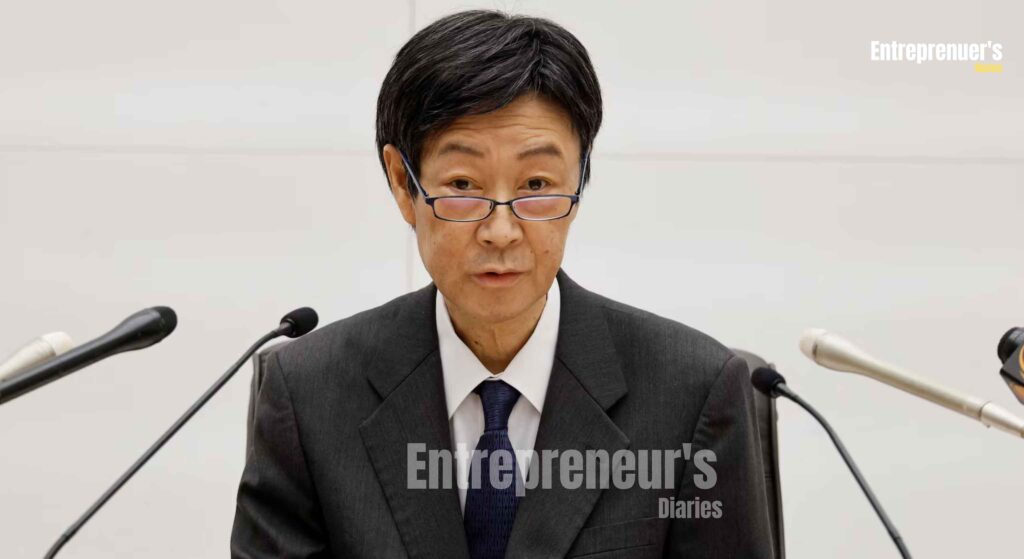
Trading Economics confirmed this was the first regular BOJ policy meeting held without the governor in attendance. One board member voted against the hike. Board member Asada Toichiro dissented, citing greater downside risks to production and employment than upside risks to prices, according to Trading Economics and FXStreet, both sourcing the official BOJ policy statement.
In its official policy statement, reported by FXStreet and Trading Economics, the BOJ stated that underlying inflation could accelerate above the 2% target amid rising energy costs. The board also said financial conditions would stay accommodative despite the rate hike, continuing to support economic activity. Policymakers confirmed they will continue raising rates as warranted by economic, price, and financial developments, while closely monitoring the Middle East conflict’s impact on the economy.
WHAT THE OFFICIALS ACTUALLY SAID
Speaking before a parliamentary committee on Tuesday, Deputy Governor Himino addressed future rate policy directly. According to Trading Economics, sourcing official BOJ statements, Himino said Japan’s real interest rates remain “at extremely low levels” and pledged that the Bank of Japan will “continue to raise the policy rate and adjust the degree of monetary accommodation in accordance with economic, price, and financial developments.”
Himino deliberately avoided providing any timeline for the next increase. He said policymakers are closely monitoring the economic and price impact of ongoing Middle East tensions, and stated the central bank aims to maintain market credibility through the stable achievement of its inflation target. All of this was reported by Trading Economics on June 16, 2026.
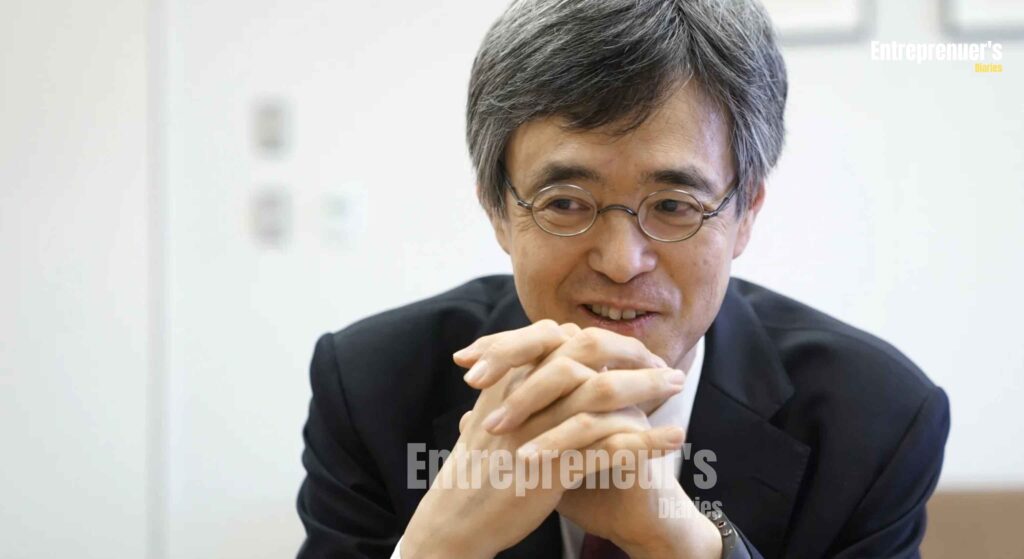
FXStreet, reporting directly from the BOJ’s official policy statement, added a crucial detail: the BOJ stated that the pass through of rising oil prices “has been progressing at a relatively faster pace, which could spread to increase in consumer prices across a wide range of items.” The board also noted there is a risk of underlying CPI inflation “deviating upward to a level above the price target.”
These are not minor caveats. They are the BOJ putting on record that inflation risk not just the energy shock is the primary driver of its decision. That framing matters enormously for what comes next.
Saisuke Sakai, senior economist at Mizuho Research Institute, told Reuters: “Ueda’s absence won’t affect the BOJ’s institutional decision to focus on mounting inflation risks rather than risks to growth from the Middle East conflict.”
WHAT THE NIKKEI 70,000 MILESTONE ACTUALLY REPRESENTS
When a major index crosses a round number for the first time, the media reports the number. The professional investor asks what it means. The Nikkei 225 touching 70,000 is the visible result of a multi year structural story.
Japanese equities spent the 1990s and much of the 2000s in recovery from the collapse of the asset bubble. The index only reclaimed its previous all time high in 2024. The rally since has been driven by three forces: corporate governance reforms that improved returns on equity, the return of inflation after decades of deflation, and a significant wave of foreign investor interest in Japan as an alternative to Chinese equities.
As reported by the Associated Press and ABC News, the index retreated from 70,000 to 69,713.05, up 0.6%, by early afternoon. The pullback at round numbers is institutional. Fund managers take profits at milestones. It does not diminish what crossing the threshold represents. South Korea’s Kospi surging 2.1% to 8,721.64 into record territory is the standout performer of the session.
Seoul’s outperformance reflects strong semiconductor demand tied to global AI infrastructure investment, as well as a policy environment that is comparatively more predictable than Tokyo’s at this moment.
THE US–IRAN DEAL: THE EVENT THAT TRIGGERED TUESDAY
To understand why Asia was broadly higher on Tuesday, you need to understand Monday evening in New York. On June 15, 2026, US stock markets staged one of their strongest single sessions of the year. According to CBS News and Reuters, the Dow Jones Industrial Average gained 469 points, or 0.9%, to close at 51,671 a brand new all time record high.
The S&P 500 jumped 1.7% to 7,554.29. The Nasdaq Composite surged 3.1% to 26,683.94, its best single day since March 31, per CNBC. All three figures are confirmed by CBS News, Reuters, CNBC, and Kiplinger.
The trigger: President Trump announced a preliminary deal with Iran to reopen the Strait of Hormuz, the maritime chokepoint through which roughly one fifth of the world’s oil and liquefied natural gas normally flows, confirmed by both the Associated Press and Al Jazeera.
Brent crude fell 4.8% to $83.17 a barrel, per CBS News. West Texas Intermediate, the US standard, dropped to $81.46, per CBS News. By early Tuesday trading, Brent had slipped further to $82.93 and US crude was at $80.66, per the Associated Press.
For context: Brent was trading above $100 a barrel just weeks before this deal. Before the war began in February 2026, it was near $70. Even at $82–$83, these prices remain elevated but the direction of travel has fundamentally shifted.
The Associated Press also noted that even after Hormuz reopens on Friday as expected, it will likely take months for the energy industry to get back to full speed.
THE HUMAN STORY BEHIND THE NUMBERS
Any credible account of this Hormuz deal must include what was actually happening at the strait itself. According to Al Jazeera, sourcing data from the International Chamber of Shipping, approximately 500 ships were waiting to pass through the Strait of Hormuz as of June 15. Some 20,000 seafarers were stranded in the Persian Gulf crew members trapped in the middle of an active war for months.
International Chamber of Shipping Secretary General Thomas Kazakos said in a statement provided directly to Al Jazeera: “Their safe departure from the region must be a top priority but will take time.” The International Maritime Organization recorded 46 known attacks on international shipping lines during the conflict, killing at least 14 seafarers, per IMO data cited by Al Jazeera.
IMO Secretary General Arsenio Dominguez stated that the evacuation of stranded seafarers will take time to “ensure that all necessary safety and security guarantees are in place,” per Al Jazeera. President Trump stated the strait will be “completely open” by Friday.
But analysts at political risk consultancy Eurasia Group warned, per CBS News, that it may take several weeks before tanker traffic reaches even 50% of pre war levels. Iran has also laid sea mines in the strait that have yet to be cleared, per Al Jazeera. Gas prices may ease in coming weeks but are unlikely to return to pre war levels anytime soon, experts told CBS News.
AI STOCKS: THE OTHER STORY RUNNING IN PARALLEL
Even as geopolitical events dominated headlines, the artificial intelligence trade continued to drive markets on Monday. According to the Associated Press, as syndicated by ABC News, Micron Technology rallied 10.8%. Advanced Micro Devices rose 7.0%. Nvidia climbed 3.5% and the Associated Press specifically noted that Nvidia’s gain was the single strongest force pushing the S&P 500 upward, given its position as Wall Street’s most valuable company.
SpaceX, Elon Musk’s rocket and AI company trading under the ticker SPCX, rose 19.6% on its second day of trading, per the Associated Press and ABC News. The company made its market debut on June 12, 2026, in what is widely described as the largest IPO in stock market history. The Nasdaq Composite closed at 26,683.94 on Monday its best single session since March 31, per CNBC.
Brian Mulberry, chief market strategist at Zacks Investment Management, told CNBC on June 15: “It seems to be much more orderly than what I expected, and that’s not a bad thing people are adding it and holding it in their portfolio, not trying to turn it over.”
These are not isolated moves. They represent the continuing re-rating of companies at the centre of the global AI buildout. Micron supplies the memory chips AI data centres require. AMD and Nvidia compete for dominance in the AI chip market. SpaceX is building the orbital and AI infrastructure that defines the next generation of the technology economy.
BONDS AND CURRENCY: THE SIGNALS PROFESSIONALS WATCH
In the US bond market, the yield on the 10 year Treasury note slipped to 4.47% from 4.48% late Friday, per the Associated Press. Lower oil prices reduce inflationary pressure, which eases the urgency for central banks to tighten, which flows through into lower Treasury yields.
In currency markets, the dollar was nearly unchanged at 160.33 Japanese yen. The euro traded at $1.1580, down slightly from $1.1592, per the Associated Press. The yen barely moved after the BOJ rate hike, with USD/JPY holding above 160.00 in the wake of the decision, per FXStreet and InvestingLive.
Even at 1.00%, Japan’s real interest rates remain deeply negative a point Himino himself put on record. The yen carry trade is not being unwound sharply. It is adjusting gradually. Goldman Sachs cut its Q4 2026 Brent crude forecast to $80 per barrel from $90, and its 2027 average to $75 from $80, per InvestingLive reporting on June 16, 2026 signalling that analysts expect sustained relief from energy price pressure in the months ahead.
THE CLOSING ANALYSIS: WHAT THIS DAY ACTUALLY MEANS
Investors who read only the headlines on June 16, 2026 will take away a simple story. Nikkei 70,000. BOJ hikes. Iran deal. Markets up. The investor who reads more carefully will take away something more important.
Japan has now raised interest rates to 1.00% for the first time in thirty years. That is not a technicality. It is the formal close of an era. The era of near zero and negative rates in Japan which shaped the global carry trade, suppressed the yen, and indirectly funded risk assets worldwide is ending. Not overnight. Not violently. But definitively.
A Reuters poll from June 10 projects the rate will reach 1.25% by year end. A Bloomberg survey of 51 economists confirmed the same direction. The BOJ’s own policy statement, per FXStreet, says policymakers “will continue raising rates as warranted.” And Goldman Sachs is already cutting its Brent crude forecasts for 2026 and 2027, per InvestingLive. This is a trend, not a one off.
At the same time, the Hormuz deal is real but incomplete. Some 500 ships are waiting. Sea mines remain. Eurasia Group says 50% traffic normalisation takes weeks. Gas prices will stay elevated for consumers and businesses well into the coming months.
And AI continues to compound. Micron up 10.8%. AMD up 7%. Nvidia the single most powerful force in the S&P 500. SpaceX up 19.6%. These are not speculative moves. They reflect real institutional conviction that the AI infrastructure buildout is the defining multi year investment cycle of this decade.
What Tuesday, June 16, 2026 represents is not resolution. It is the beginning of a more complex, more structured phase of global market economics where energy normalises slowly, monetary policy tightens gradually, and technology continues to compound aggressively.
The markets that understand all three realities simultaneously will make the most of what the next twelve months will bring. The investors who wait for certainty will almost certainly wait too long.
FREQUENTLY ASKED QUESTIONS
Q1. Why did the Bank of Japan raise rates to 1% right now?
According to Trading Economics, sourcing the Bank of Japan’s official policy statement, the decision was aimed at preventing Iran war driven energy costs from embedding broader inflationary pressure into the Japanese economy.
The BOJ’s policy statement, reported by FXStreet, noted that the pass through of rising oil prices “has been progressing at a relatively faster pace, which could spread to increase in consumer prices across a wide range of items.” The board also flagged the risk of underlying CPI inflation “deviating upward to a level above the price target.” That is the official justification on record an inflation concern, not just an energy concern.
Q2. Will the BOJ raise rates again in 2026?
Yes, further hikes are broadly expected. A Reuters poll published June 10, 2026, reported by FXStreet and US News, projected the Bank of Japan will raise its policy rate to 1.25% in the fourth quarter of 2026 implying one more hike this year. A Bloomberg survey of 51 economists, published June 9, 2026, showed 49 of 51 respondents expecting the rate to reach 1.25% by year end. About 71% of economists in the Bloomberg survey expected the BOJ to hike roughly once every six months, per Bloomberg reporting syndicated by The Edge Malaysia.
Q3. Is the Strait of Hormuz actually open for ships right now?
Not fully. According to Al Jazeera, sourcing International Chamber of Shipping data from June 15, 2026, approximately 500 ships remain waiting to pass through the strait, with some 20,000 crew members stranded in the Persian Gulf. Iran has also laid sea mines in the strait that have yet to be cleared by minesweepers, per Al Jazeera.
Political risk consultancy Eurasia Group warned, per CBS News, that it may take several weeks before tanker traffic reaches even 50% of pre war levels. The Associated Press reported that even after Hormuz reopens on Friday as expected, it will likely take months for the energy industry to return to full speed.
Q4. What is the yen carry trade and why does it matter to global investors?
The yen carry trade is a strategy where investors borrow cheaply in Japanese yen made possible by Japan’s decades of ultra low rates and invest that capital into higher yielding assets in other countries, including US equities, bonds, and emerging markets. When the BOJ raises rates, borrowing in yen becomes more expensive, reducing the incentive to hold these positions.
A sharp carry trade unwind can trigger sudden global market volatility. The key signal from Tuesday: even after the hike, USD/JPY held above 160.00 with the yen barely moving, per FXStreet and InvestingLive confirming markets are not pricing an accelerated tightening path. At 1.00%, with real rates still deeply negative as Himino confirmed, the unwinding remains gradual, not sudden.
Q5. How do falling oil prices affect businesses and consumers in the real economy?
Lower oil prices reduce the cost of energy, transportation, manufacturing, and logistics across the entire economy. For consumers, this means gradual relief at the petrol pump and lower utility bills over time. For businesses, it means lower input costs, improved margins in freight and aviation, and reduced inflationary pressure on supply chains. For central banks, lower oil prices reduce headline inflation, easing the urgency to raise or hold rates high.
Goldman Sachs cut its Q4 2026 Brent forecast to $80 per barrel from $90, and its 2027 average to $75 from $80, per InvestingLive signalling sustained relief ahead. However, CBS News reported that gas prices are unlikely to return to pre war levels anytime soon, which will continue to put some financial pressure on households and businesses in the near term.
Connect With Us On Social Media [ Facebook | Instagram | Twitter | LinkedIn ] To Get Real-Time Updates On The Market. Entrepreneurs’ Diaries Is Now Available On Telegram. Join Our Telegram Channel To Get Instant Updates.

Isabella is a global business journalist and former McKinsey analyst from Brazil. She brings sharp insights on economic shifts, policies, and founder journeys from around the world.

Tokyo-based CFA translating global markets into clear insights for modern entrepreneurs.