
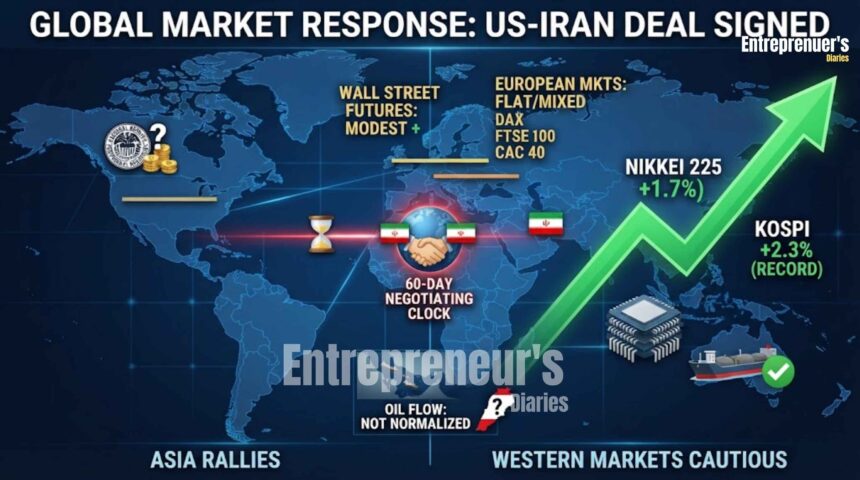
BANGKOK, Thursday, June 18, 2026: The global market response to US-Iran deal was a split verdict on Thursday. This came hours after the United States and Iran signed an initial agreement to end their war. Japanese and South Korean stock benchmarks surged to fresh record highs. European markets stayed flat or slightly negative. Wall Street futures pointed only modestly higher.
The divergence tells a bigger story. Investors are weighing geopolitical relief against renewed concern over US interest rates. For business leaders, traders, and entrepreneurs tracking global risk, this is a moment worth understanding in detail. This report breaks down exactly what was agreed, how markets reacted region by region, and what is verified by named sources versus what remains unconfirmed.
Global Market Response to US-Iran Deal: What Was Actually Signed
According to the Associated Press, leaders from the US and Iran signed a deal on a permanent end to hostilities. The agreement starts a 60 day negotiating clock. That window is meant to produce a final deal on the future of Iran’s nuclear program. In the meantime, Tehran is required to dilute its stockpile of highly enriched uranium, the AP reported.
A major concession came from Washington. The AP reported that the deal waives US backed sanctions on Iran. This immediately allows Iran to sell its oil freely on global markets, according to details released by both governments. CBS News separately confirmed that the United States and Iran signed a memorandum of understanding meant to end the Middle East war. Fighting was halted on all fronts, including in Lebanon, CBS reported.
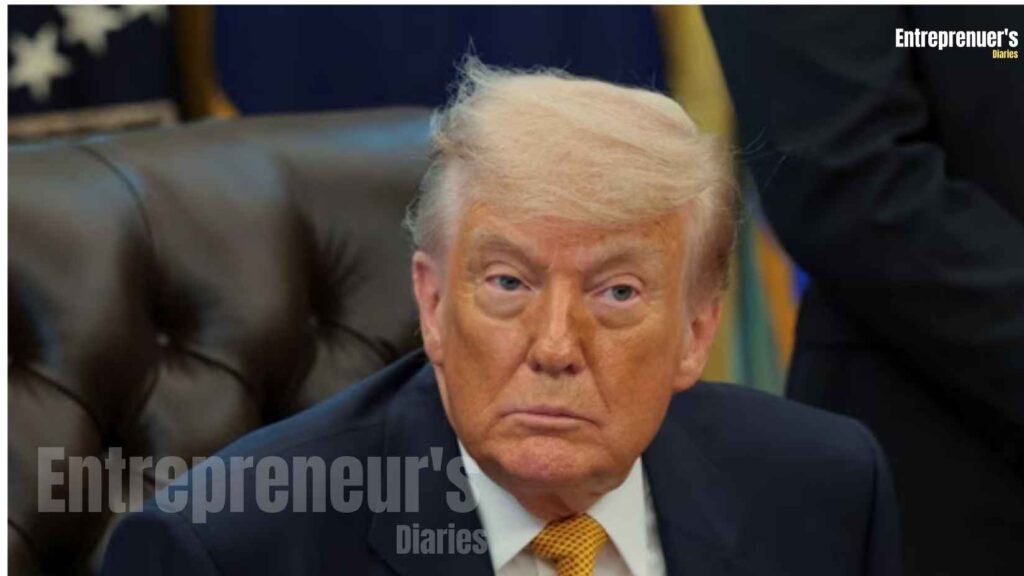
President Trump addressed the conditional nature of the truce directly. CBS News quoted him saying that if a wider deal could not be reached within the 60 day window, “We go back to bombing.” He added that the US would not “let them have a nuclear weapon,” according to the same CBS News report.
The Signing Location and Timeline, According to Switzerland’s Government
Some confusion exists around exact dates across outlets, so it is worth being precise here using official statements. Switzerland’s Federal Department of Foreign Affairs confirmed the memorandum of understanding signing was scheduled for Friday, June 19, 2026, at the Bürgenstock resort near Lucerne, Switzerland, according to a sourced timeline citing the Swiss ministry.
Bloomberg reported on June 17 that Switzerland’s government confirmed representatives of Pakistan and Qatar would also attend the signing. Bloomberg added that the US and Iran plan to sign a 14 point memorandum of understanding at the Bürgenstock hotel complex.
Swiss public broadcaster SWI swissinfo.ch, citing Pakistani Prime Minister Shehbaz Sharif, reported the same June 19 date for the official ceremony in Switzerland. CNBC reported that Sharif announced on social media platform X that “the Peace Deal between the United States of America and Islamic Republic of Iran has been REACHED.” CNBC quoted Sharif saying, “The official signing ceremony will be on Friday, 19 June in Switzerland.” President Trump confirmed the agreement separately. CNBC reported that Trump wrote on Truth Social, “The deal with the Islamic Republic of Iran is now complete.”

CNN reported that Trump and Vice President JD Vance had already virtually signed an earlier stage agreement on June 15, 2026 to end the US blockade of Iranian ports, reopen the Strait of Hormuz, and begin the 60 days of nuclear negotiations, according to a senior US official cited by CNN.
This explains the AP’s reference to an “initial agreement” already signed by Wednesday, June 17, ahead of the larger formal ceremony in Switzerland on Friday, June 19.
Asia Leads the Rally
The most dramatic market reaction came from Asia. The Associated Press, reporting from Bangkok, said world shares were mixed on Thursday, June 18, 2026. Benchmarks in Japan and South Korea set fresh records after the US and Iran signed their initial agreement ending the war, AP said.
Japan’s Nikkei 225 gained 1.7%, closing at a new record high of 71,053.49, according to the AP. The index topped 70,000 for the first time, driven by hopes for an end to the war combined with continued buying of high tech shares tied to the artificial intelligence boom, AP reported.
Neil Newman, head of strategy at Astris Advisory Japan, was quoted by the AP describing the rally as broad based. “This is very broad based rally, I believe it’s actually showing some confidence that the Japanese economy is going to recover further from the end of the war, and presumably the oil prices in the near future,” Newman said.
South Korea’s Kospi also reached record territory. The AP reported the index gained 2.3% to close at 9,063.84. The Kospi has roughly tripled over the past year, the AP noted. This was helped substantially by gains in semiconductor makers Samsung Electronics and SK Hynix. Samsung’s shares rose 4.6% and SK Hynix gained 6.5%, according to the AP.
Elsewhere in the region, Taiwan’s Taiex jumped 1.3%, the AP reported. Hong Kong’s Hang Seng moved in the opposite direction, losing 2.1% to close at 23,792.35. Mainland China’s Shanghai Composite edged 0.4% lower to 4,090.48, AP reported. Australia’s S&P/ASX 200 slipped 0.6% to 8,911.10.
The contrast within Asia itself is notable. Markets most tied to semiconductor exports and energy import costs, namely Japan, South Korea, and Taiwan, rallied hardest. Markets in Hong Kong and mainland China showed more caution.
Europe and Wall Street: A More Restrained Tone
The optimism softened considerably moving west. The AP reported that in early European trading on Thursday, June 18, Germany’s DAX edged just 0.2% higher to 24,987.35. The CAC 40 in Paris dipped 0.1% to 8,424.47. Britain’s FTSE 100 shed 0.8%, falling to 10,422.40.
US futures pointed only modestly higher ahead of the open. The AP reported the S&P 500 future was up 0.9%, while the Dow Jones Industrial Average future gained 0.6%.
That restraint follows a rougher session a day earlier on Wall Street, on Wednesday, June 17. The AP reported that the Asian rally followed a Wall Street retreat that day, driven by speculation that the Federal Reserve may raise interest rates this year to curb inflation.
The Fed had released projections showing nearly half its policymakers foresee at least one rate increase in 2026, according to the AP. On that Wednesday session, the S&P 500 slumped 1.2%, the Dow dropped 1%, and the Nasdaq composite sank 1.3%, the AP reported. CBS News added detail on individual stock moves that day. SpaceX fell 4.9%, marking its first loss since its stock market debut the prior week, CBS reported.
Microsoft dropped 3.8%, Amazon fell 3.5%, and Nvidia slipped 1.3%, CBS News reported, describing these three as among the heaviest weights dragging on the S&P 500 that session.
The Federal Reserve Factor
Markets are not reacting to the Iran deal in isolation. A separate domestic story is shaping investor sentiment in Western markets: a new Federal Reserve chair settling into the role. The Globe and Mail, citing AP reporting, noted that Kevin Warsh held his first news conference as head of the US central bank this week.
Warsh did not offer a forecast for where the federal funds rate may end 2026, according to the report. He said he was considering a revamp of how the Fed communicates with markets and households. One of his first moves, the report said, was ending the practice of including hints in Fed statements about future rate direction.
On the economic data front, the same report noted a separate reading showing retail revenue grew at a faster pace in May than economists had expected. This combination, a more guarded Fed communication style alongside hotter than expected retail data, is part of why Wall Street futures stayed measured even as Asian peers surged on war related optimism.
Oil and Currency Moves
Energy markets reflected the de escalation directly, though gains were measured rather than dramatic by Thursday morning. The AP reported that Brent crude fell 1.9% to $78.05 a barrel early Thursday, June 18. US benchmark crude slipped 2.1% to $74.43 a barrel.
Brent remains above its roughly $70 pre war level, the AP noted, but well below the $100 plus levels seen a few weeks earlier during the height of the conflict. In currencies, the AP reported the dollar slipped slightly to 160.63 yen from 160.65 yen. The euro firmed modestly to $1.1510 from $1.1501.
It is worth noting the scale of the earlier move. NBC News reported that when the tentative deal was first announced on Sunday, June 14, oil prices fell more than $4 a barrel in a single session, with futures for the S&P 500 up 1.2% and Dow futures up 1% at that time. President Trump celebrated that initial drop in oil prices on social media. NBC News quoted his Truth Social post: “Ships of the World, start your engines. Let the oil flow!”
Strait of Hormuz: Still Not Back to Normal
A critical detail for energy markets and shipping dependent businesses is that physical oil flows have not yet normalized, despite the diplomatic breakthrough. CBS News reported that commercial traffic through the Strait of Hormuz remained low as of its Wednesday, June 17 report. The number of vessels transiting the waterway was in the single digits, compared to a historic average of around 135 vessels per day, CBS reported.
This matters enormously for global trade. NPR reported that Iran has effectively controlled the Strait of Hormuz since shortly after the war began on February 28, 2026, virtually shutting down the passage for around 20% of the world’s oil.
The US responded by blockading Iranian ports, according to NPR. The US also says Iran laid mines in the strait, NPR reported. Trump said the strait would be opened for mine removal after the deal’s formal signing, NPR reported, citing the president’s comments made on Sunday, June 14.
Even before the Friday ceremony, the world’s largest international shipping association issued a caution. NBC News reported that the Baltic and International Maritime Council said it remains risky for vessels to transit through the Strait of Hormuz, despite the agreement having been announced.
For entrepreneurs in shipping, logistics, energy trading, and import export businesses, this is the single most important operational detail in the entire story. A signed political agreement and a functioning trade route are not the same thing, and the gap between them is currently still wide.
The Lebanon Complication
One unresolved thread runs through nearly every report on this deal: Lebanon. NPR reported that Iran made an end to fighting between Israel and Hezbollah in Lebanon a condition for its deal with the US. However, Israeli Defense Minister Israel Katz said the country would keep troops in southern Lebanon indefinitely, according to NPR.
Al Jazeera reported a similar split. Most nations applauded the agreement as a step toward peace, but Israel said it would not withdraw from Lebanon, according to Al Jazeera’s reporting.
Swiss broadcaster SWI swissinfo.ch reported that Iranian Foreign Minister Abbas Araghchi said an end to the war would entail an end to Israeli occupation of territories in Lebanon. Araghchi said Iran would regard any new Israeli attacks on Lebanon, or continued occupation of those territories, as a breach of the agreement, according to the same report. This is a live fault line. If Israel does not align its position with the broader ceasefire framework, it introduces a real risk of renewed escalation that markets have not fully priced in.
International Reactions
Diplomatic reaction to the deal was broadly positive, according to Al Jazeera’s reporting. Iran’s deputy foreign minister, Kazem Gharibabadi, indicated that a broader deal covering sanctions relief for Iran would be worked out during the 60 day ceasefire window, Al Jazeera reported. Separately, NPR reported that Gharibabadi, quoted by Iranian state media, said Iran sees the deal as a victory.
Pakistan, which mediated the talks alongside Qatar, had the accord set for signing in Switzerland. Al Jazeera described it as a major breakthrough after months of fighting that killed thousands of people and sent global energy prices soaring. Kuwait expressed what Al Jazeera described as a “warm welcome” for the memorandum of understanding. Kuwait also commended the mediating roles played by Pakistan and Qatar, according to Al Jazeera.
China commended the agreement while expressing appreciation for Pakistan’s mediation efforts, a Chinese foreign ministry spokesperson said, according to Al Jazeera. Turkish President Recep Tayyip Erdogan posted on social media platform X that he welcomed the agreement “with satisfaction” as an important development for peace in the region, Al Jazeera reported.
British Prime Minister Keir Starmer also weighed in, according to NBC News. Starmer called the agreement “very significant” and said he had discussed it directly with Trump. NBC News quoted Starmer saying: “Obviously, nothing is guaranteed, but it is, I think, a significant breakthrough, a very significant breakthrough. Hopefully, something which as we work together we can turn into that enduring peace that we all want to see.”
Casualty Toll From the Conflict
To understand why markets reacted as strongly as they did in Asia, it helps to understand the scale of what this deal is meant to end. CBS News reported that Lebanon said Israel’s campaign of airstrikes and ground invasion has so far killed more than 3,800 people. On the Israeli side, CBS News reported 31 soldiers and one civilian contractor killed since the conflict’s expansion into Lebanon on March 2, 2026.
This was a four month regional war, running from late February 2026 through mid June 2026, with direct consequences for global oil supply, shipping routes, and inflation. That context is essential to why a 60 day negotiating clock and a partial sanctions waiver moved Asian markets so sharply.
What Remains Unverified or in Dispute
In the interest of strict factual accuracy, several widely circulated claims about deal terms could not be confirmed from named official or first tier news sources at the time of this report. Specific terms beyond what is detailed above, such as the complete dismantlement of Iran’s nuclear program or the full removal of all nuclear material from the country, appear in secondary aggregator reporting but have not been independently confirmed in the primary reporting reviewed for this report. Readers should treat such specifics as unconfirmed pending the official text of the memorandum of understanding, which the AP noted has not yet been shared publicly by either side.
Similarly, claims about a potential US proposal to redirect frozen Iranian assets toward Gulf state reconstruction costs remain at the level of reported negotiation chatter rather than confirmed agreement terms.
This report deliberately excludes such unverified figures and will be updated as official documentation becomes available following Friday’s signing ceremony at the Bürgenstock resort in Switzerland.
Why This Matters for Entrepreneurs and Investors
For professional readers, three things stand out beyond the daily index moves. First, the regional divergence is itself the signal. Asian markets tied to semiconductor exports and energy import costs are pricing in durable de-escalation. Western markets remain anchored to a separate, more immediate concern: US monetary policy under a new Fed chair who has deliberately reduced forward guidance.
Second, the 60 day countdown is a real, dated catalyst. It runs from the June 19 Bürgenstock signing through approximately mid August 2026. Trump’s own framing, “we go back to bombing” if a final deal isn’t reached, means markets will likely revisit this story with renewed volatility as that deadline approaches.
Third, the gap between political agreement and physical trade normalization is the detail most likely to be missed by casual readers but most relevant to operators. Single digit vessel transits through the Strait of Hormuz, against a historic average of roughly 135 per day, means freight costs, insurance premiums, and delivery timelines in oil dependent supply chains will likely stay elevated for weeks even after Friday’s ceremony.
The businesses that benefit fastest from this deal will not necessarily be the ones celebrating the headline. They will be the ones tracking Strait of Hormuz traffic data, the Fed’s next communications under Warsh, and whether Israel’s position on Lebanon shifts before the 60 day window closes in mid August. Those three data points, more than Thursday’s index closes, will determine whether this week’s rally holds or reverses.
Frequently Asked Questions
1. Has the US Iran war officially ended?
An initial agreement to end hostilities was signed by Wednesday, June 17, 2026, with fighting halted on all fronts including Lebanon, according to CBS News and the Associated Press. The full memorandum of understanding is scheduled for formal signing at the Bürgenstock resort in Switzerland on Friday, June 19, 2026, according to Switzerland’s Federal Department of Foreign Affairs and Pakistani Prime Minister Shehbaz Sharif. A final, comprehensive peace deal still depends on a 60 day nuclear negotiation period succeeding.
2. Why did Asian stock markets hit record highs on June 18 while US and European markets stayed flat?
Asian markets, particularly Japan’s Nikkei 225 and South Korea’s Kospi, are more directly exposed to oil import costs and semiconductor demand, both of which benefit from war de-escalation, according to the Associated Press reporting from Bangkok. US and European markets are simultaneously weighing a separate concern: the Federal Reserve’s interest rate outlook under new chair Kevin Warsh, following a Wall Street retreat on Wednesday, June 17, reported by the AP.
3. What happens to oil prices and the Strait of Hormuz after the deal?
Brent crude fell to $78.05 a barrel and US benchmark crude slipped to $74.43 a barrel on June 18, according to the AP. However, CBS News reported that actual vessel traffic through the Strait of Hormuz remained in the single digits as of June 17, far below the historic daily average of around 135 vessels, meaning physical oil flows have not yet returned to normal.
4. What happens if the US and Iran fail to reach a final nuclear deal within 60 days?
President Trump stated that if a wider deal could not be reached within the 60 day negotiation period starting from the Bürgenstock signing, “We go back to bombing,” according to CBS News. He added the US would not allow Iran to obtain a nuclear weapon.
5. Is the Lebanon conflict also covered by this deal?
Iran made an end to Israel Hezbollah fighting in Lebanon a condition of its agreement with the US, according to NPR. However, Israeli Defense Minister Israel Katz said Israel would keep troops in southern Lebanon indefinitely, according to the same report, leaving this part of the ceasefire framework unresolved and a key risk factor for markets going forward.
Connect With Us On Social Media [ Facebook | Instagram | Twitter | LinkedIn ] To Get Real-Time Updates On The Market. Entrepreneurs’ Diaries Is Now Available On Telegram. Join Our Telegram Channel To Get Instant Updates.

Isabella is a global business journalist and former McKinsey analyst from Brazil. She brings sharp insights on economic shifts, policies, and founder journeys from around the world.

Tokyo-based CFA translating global markets into clear insights for modern entrepreneurs.