
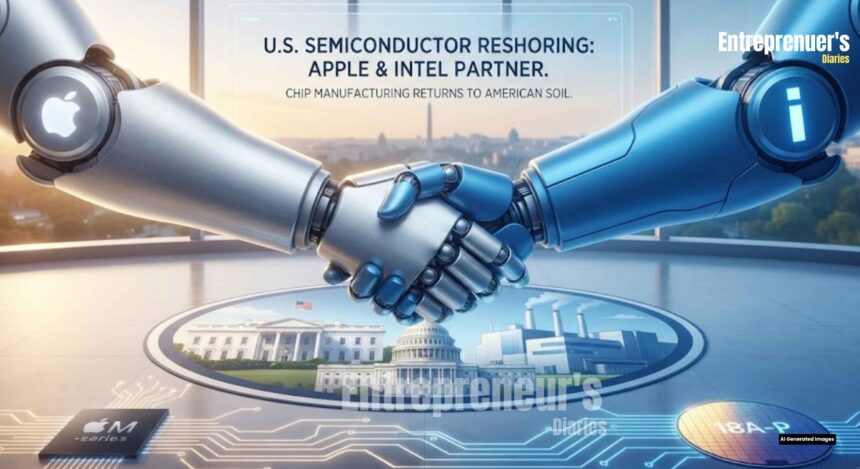
Washington, June 18, 2026: The Apple Intel chip deal just moved from speculation to confirmation. In the early hours of Thursday, President Donald Trump announced on Truth Social that Apple has agreed to work with Intel to design and manufacture its chips inside the United States.
This is not a rumor anymore. It is the first time a sitting US president has personally announced a chip manufacturing agreement between two of the country’s largest technology companies, and it caps more than a year of private negotiation between Apple and Intel.
For founders, investors, and operators tracking the broader tech trend US story in 2026, this is the clearest sign yet that semiconductor reshoring has moved from policy talk to commercial fact.
What Trump Actually Announced About the Apple Intel Chip Deal
The announcement came directly from the president, not through a press briefing or a corporate statement. Trump wrote in a Truth Social post that Apple has agreed to work with Intel to design and manufacture its chips in the United States, according to Reuters.
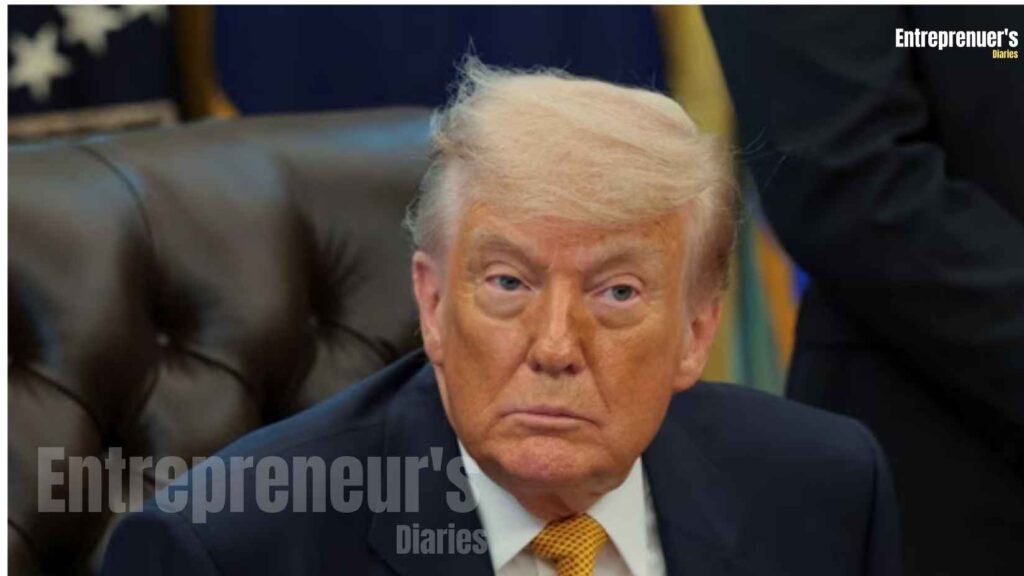
The post did more than confirm a deal. It folded the announcement into a broader argument Trump has been making about American manufacturing.
“The Technology the World relies on was invented in America,” Trump wrote, in a portion of the post reported by the Washington Examiner. “We all remember ‘Intel Inside.’ Stupid Presidents took our Economy for granted, and let Taiwan and others steal our Semiconductor Factories.”
He continued, tying the Apple announcement to his own time in office. “When I won my Second Term (Third, actually!), it was clear America needed its Semiconductor Industry to come back to the U.S.A.,” Trump wrote, per the same Washington Examiner report.
Trump also used the post to revisit the government’s existing financial relationship with Intel, a detail that matters for understanding why this deal carries political as well as commercial weight.
Trump statement on Intel stock made his view of the relationship explicit. “We decided to help Intel in exchange for 10% of their shares,” Trump wrote, according to the Washington Examiner. “They were worth around 100 Billion Dollars when we made our offer. Now they are worth over 600 BILLION DOLLARS! Nine months, and they’ve increased in value over HALF A TRILLION DOLLARS. America’s stake is now over 60 Billion Dollars.”
Neither Apple nor Intel had responded to requests for comment at the time Reuters first published its report, since the post went up outside normal business hours.
The Deal’s Backstory: Eighteen Months in the Making
This announcement did not appear out of nowhere. The Wall Street Journal first reported in May 2026 that Intel had reached a preliminary agreement to manufacture some chips for Apple, following discussions that had been running for more than a year, a timeline Reuters confirmed again in its coverage of Thursday’s announcement.
That preliminary May agreement already pointed to specific products. Reporting cited by Apple Insider indicated the arrangement was expected to involve Intel manufacturing chips for devices including the iPad Pro and entry level MacBook Air, helping Apple reduce its dependence on Taiwan Semiconductor Manufacturing Company for at least part of its product line up.
What changed on June 18 is the level of confirmation. A reported preliminary agreement, sourced to unnamed people familiar with the matter, became a presidential announcement naming both companies directly and describing the partnership as a done deal.
Why Apple Needed a Second Chipmaker
Apple’s motivation, according to Reuters’ reporting, is straightforward capacity math. The company relies heavily on TSMC, whose advanced production lines are in high demand from AI chipmakers such as Nvidia and AMD.
That demand crunch has had visible effects on Apple’s own products. Recent reporting from AppleInsider noted that a boom in Mac mini and Mac Studio popularity has made both products increasingly difficult to buy, a supply constraint directly tied to Apple’s single supplier dependence on TSMC’s advanced nodes.
Diversifying into a second domestic foundry partner solves two problems at once. It gives Apple additional manufacturing capacity it currently cannot get from TSMC alone, and it reduces geographic concentration risk tied to Taiwan, a detail Reuters’ reporting flagged as a key reason an Intel partnership appeals to Apple’s supply chain strategy.
It is also worth being precise about scale. This is not Apple walking away from TSMC. It is Apple building, for the first time, a multi foundry model at the advanced node level, something the company has never operated before.
Intel’s Government Stake and the Numbers Behind It
The Apple agreement does not exist in a vacuum. It sits inside a broader industrial policy relationship between Washington and Intel that began in 2025.
According to CNBC’s reporting, the US government took a 10% stake in Intel last year through an $8.9 billion investment, funded by converting CHIPS Act grants that had not yet been paid out, along with awards from the Defense Department’s Secure Enclave semiconductor program.
That stake has produced a significant paper gain. Yahoo Finance reported that the Treasury’s position, originally valued at $8.9 billion for roughly 433.3 million shares purchased at $20.47 each, had grown to an estimated $56.5 billion, an unrealized gain of about $47.6 billion within eight months of the original investment.
Trump’s own framing of that gain, in the same Truth Social post reported by the Washington Examiner, put the current value of the government’s stake at over $60 billion, a figure consistent with Intel’s continued share price appreciation through the second quarter of 2026.
It is worth noting, as Yahoo Finance’s reporting did, that this remains an unrealized gain on paper. Whether or when the government converts any of that position into a realized profit depends on market conditions and, separately, on political appetite for the administration to book a return on what was originally framed as industrial policy rather than an investment trade.
The arrangement has also drawn scrutiny in Washington. Yahoo Finance’s reporting noted that the equity for grants structure has drawn Senate scrutiny over what critics have described as policy driven windfalls for a single company.
Intel’s Manufacturing Turnaround, in Its Own Words
The Apple deal lands at a moment when Intel’s own manufacturing technology has reached a new milestone. According to Stocktwits’ reporting, Intel said this week that its 18A-P process, a follow on to its existing 18A node, has entered risk production, a low volume manufacturing phase used to gather data on defect rates, performance, and variability before full scale output begins.
Intel has described the 18A-P process as delivering up to 9% higher performance, 18% lower power consumption, and meaningfully improved thermal characteristics compared with the original 18A node, per Stocktwits’ coverage of the company’s technical announcement.
Intel’s financial results back up the operational story. The company reported first quarter 2026 revenue of $13.6 billion, up 7% year over year and beating Wall Street estimates by roughly 9%, according to figures reported by Yahoo Finance. Intel’s Data Center and AI segment grew 22% to $5.05 billion in the same quarter, while Intel Foundry, the division most directly relevant to any Apple manufacturing arrangement, narrowed its operating loss by $72 million quarter over quarter.
Intel CEO Lip-Bu Tan, who took over the company last year, has described the shift in tone around Intel’s prospects in blunt terms. “A year ago the conversation around Intel was about whether we could survive. Today it’s about how quickly we can add manufacturing capacity,” Tan said on Intel’s most recent earnings call, as quoted by Yahoo Finance.

Tan has also spoken specifically about Intel’s role in the broader domestic manufacturing push the Apple deal represents. “As the only semiconductor company that does leading edge logic R&D and manufacturing in the U.S., Intel is deeply committed to ensuring the world’s most advanced technologies are American made,” Tan said in remarks reported by the Washington Examiner. He added that the administration’s focus on US chip manufacturing is “driving historic investments in a vital industry that is integral to the country’s economic and national security,” and said Intel is “grateful for the confidence the President and the Administration have placed in Intel.”
How the Market Reacted
Investors moved within hours of Trump’s post. Intel shares jumped 5.7% in overnight trading ahead of Thursday’s session, according to Stocktwits’ reporting, which also noted that Intel’s stock is up 228% year to date heading into this announcement.
That overnight move builds on a much larger rally that began with the original May reports of preliminary Apple Intel talks. TradingKey reported that Intel shares surged more than 13% intraday and closed up 13.96% on the day those preliminary talks were first confirmed, pushing the company’s market capitalization to $627.8 billion at that time.
Wall Street’s price targets have moved in step with the stock. According to a compilation of analyst notes by Stocks To Trade, Melius Research raised its Intel price target from $100 to $150 while reiterating a buy rating, and Citi moved its target from $95 to $130, with both firms citing Intel’s foundry roadmap and rising demand for CPUs in AI driven workloads as supporting factors.
Evercore ISI analyst Amit Daryanani, commenting on the Apple Intel relationship before Thursday’s confirmation, described the potential benefit to Apple in terms of resilience rather than cost savings. The arrangement would provide Apple “long term supply chain resilience, more foundry choices, and greater flexibility during future device production ramps,” Daryanani said, as reported by TradingKey.
What Officials and Executives Have Said
Beyond Trump’s own post, the deal has been shaped by months of behind the scenes engagement from senior administration officials. According to TradingKey’s reporting, US Commerce Secretary Howard Lutnick met multiple times over the past year with Apple CEO Tim Cook, Nvidia CEO Jensen Huang, and SpaceX chief Elon Musk specifically to encourage business partnerships with Intel.
That same reporting indicates Trump personally raised Intel directly with Cook during a meeting at the White House, a detail that underscores how directly the administration has been involved in steering commercial decisions at the country’s largest technology companies.
Apple’s own public statements on the relationship have been notably restrained by comparison. In February 2026, Apple’s head of global procurement, David Tom, was asked directly in an interview whether the company was moving forward with Intel manufactured chips. His response, as reported by TradingKey, was limited to confirming ongoing dialogue: “We are always in communication with Intel,” Tom said, without disclosing further details of the negotiations underway at the time.
The Wider Tech Trend US Pattern
Apple is not the only major technology company Intel has brought on as a manufacturing partner over the past year. According to TradingKey’s reporting, Intel has used the period of active government mediation to establish partnerships with Nvidia and with ventures connected to Elon Musk, in addition to the new Apple agreement.
Nvidia’s relationship with Intel began with a $5 billion investment in September 2025, structured around Intel building custom data center CPUs for Nvidia, according to Yahoo Finance’s reporting. Intel has also joined the Terafab consortium, a manufacturing initiative involving SpaceX, xAI, and Tesla, per the same reporting.
Taken together, these partnerships describe a consistent pattern rather than an isolated transaction. The federal government’s equity stake in Intel, combined with direct outreach from cabinet officials and the president himself, has functioned as a coordinating mechanism that has steered multiple major US technology companies toward the same domestic foundry partner within roughly a twelve month window.
The Analytical Close: Why This Changes the Calculus for Every Chipmaker
Here is the part of this story that matters most for anyone running a business that depends on semiconductor supply, and it is the part that headline coverage of Trump’s post will likely skip past.
Until Thursday, every report connecting Apple and Intel carried a qualifier. It was a preliminary agreement. It was based on people familiar with the matter. It was something both companies declined to confirm. Trump’s announcement removed that qualifier, not through a joint corporate press release, but through a presidential statement that treats the deal as settled before either company has issued its own confirmation.
That sequencing is itself a signal worth sitting with. In every previous instance of this administration’s engagement with Intel, dating back to the original 2025 equity stake, the public announcement of progress has come from the White House first and from the companies involved second, if at all. The Apple deal follows that same script. Trump confirmed it. Apple and Intel had not, as of this report, issued matching statements of their own.
For operators building anything adjacent to hardware, components, or device manufacturing in the United States, the practical lesson is that federal industrial policy is now operating as an active deal making force inside the semiconductor sector, not a passive incentive structure sitting in the background. A government holding a 10% equity stake in a chipmaker has a direct financial interest in that company landing customers like Apple, and the past year of reporting shows that interest translating into cabinet level outreach to the CEOs of Nvidia, SpaceX, and Apple specifically.
For investors, the read through extends beyond Intel’s stock price. A model where the federal government’s own balance sheet gains when a private semiconductor company wins major commercial contracts is a structurally different incentive environment than anything the US chip sector has operated under before. Whether that model accelerates Intel’s foundry turnaround or simply front loads political credit for a recovery already underway is a distinction worth tracking separately from the stock’s near term performance.
For Apple specifically, the deal marks the first time in the company’s history that it has operated a genuine multi foundry strategy at the advanced node level. That shift did not happen because TSMC failed Apple. It happened because TSMC succeeded too completely, with demand from AI chipmakers consuming enough of its advanced capacity that even Apple, with its purchasing power, could not guarantee unconstrained supply. The Apple Intel deal is less a story about Intel’s comeback than it is a story about a capacity ceiling at the world’s most important contract chipmaker, one large enough that even Apple needed a second option.
The structural shift, in short, is this: a presidential Truth Social post has become a recognized channel for confirming major US corporate manufacturing agreements before the companies themselves do. That is a new pattern in how technology deals get disclosed, and it deserves attention well beyond the chip industry it was announced for.
What to Watch Next
Three signals will determine how much Thursday’s announcement actually changes in practice. The first is official confirmation. Apple and Intel have not yet issued matching public statements describing the scope, products, or timeline of the agreement Trump described, and that confirmation, when it comes, will likely contain the operational detail his post did not.
The second is product scope. Earlier reporting pointed to entry level MacBook Air and iPad Pro chips as the most likely candidates for Intel manufacturing, a far smaller slice of Apple’s silicon needs than its iPhone lineup, which remains tied to TSMC’s most advanced nodes. Whether Trump’s announcement reflects an expansion of that scope or simply a presidential confirmation of the same preliminary agreement reported in May is not yet clear.
The third is Intel’s 18A-P yield performance. With the process now in risk production, the gap between Intel’s announced manufacturing capability and its proven ability to deliver Apple grade yields at volume remains the single largest variable standing between Thursday’s announcement and chips that actually ship inside Apple devices.
Watch all three over the coming quarters. Together, they will determine whether June 18, 2026, marks the start of a genuinely diversified US semiconductor supply chain for Apple, or simply the moment a year long negotiation became a headline.
Frequently Asked Questions
1. Did Trump confirm an Apple Intel chip manufacturing deal, or is this still a rumor?
Trump confirmed it directly. In a Truth Social post published in the early hours of June 18, 2026, the president stated that Apple has agreed to work with Intel to design and manufacture its chips in the United States, according to Reuters. As of this report, Apple and Intel have not issued their own joint statement confirming the specific terms.
2. Which Apple products will Intel actually manufacture?
Neither company has confirmed final product details. Earlier reporting from the Wall Street Journal, relayed by AppleInsider, indicated the preliminary agreement reached in May 2026 was expected to involve Intel manufacturing chips for products including the iPad Pro and entry level MacBook Air, helping reduce Apple’s reliance on TSMC for those specific devices.
3. How much does the US government currently own of Intel, and why?
The US government holds roughly a 10% equity stake in Intel, acquired in 2025 through an $8.9 billion investment that converted unpaid CHIPS Act grants and Defense Department Secure Enclave funding into Intel shares, according to CNBC. Trump stated in his June 18 post that the stake’s value has since grown to over $60 billion, a figure he tied to Intel’s broader share price appreciation over the prior nine months.
4. Why is Apple moving away from relying solely on TSMC?
According to Reuters, Apple’s move is driven by capacity constraints, since TSMC’s advanced production lines are in high demand from AI chipmakers including Nvidia and AMD, alongside Apple’s own products. Reporting from AppleInsider has also tied recent supply shortages of Mac products directly to this single supplier capacity bottleneck.
5. What is Intel’s 18A-P process, and how does it relate to this deal?
Intel’s 18A-P process is an advanced version of its 18A manufacturing node and entered what the company calls risk production this week, according to Stocktwits, a low volume stage used to test defect rates and performance before full scale manufacturing begins. Intel has said 18A-P delivers up to 9% higher performance and 18% lower power consumption than the standard 18A process, positioning it as the manufacturing technology most likely to be used for any Apple chips produced under the new agreement.
Connect With Us On Social Media [ Facebook | Instagram | Twitter | LinkedIn ] To Get Real-Time Updates On The Market. Entrepreneurs’ Diaries Is Now Available On Telegram. Join Our Telegram Channel To Get Instant Updates.

Isabella is a global business journalist and former McKinsey analyst from Brazil. She brings sharp insights on economic shifts, policies, and founder journeys from around the world.

Luca is a tech ethicist from Italy exploring disruptive innovation through a human lens—from AI to biotechnologies to decentralization.