
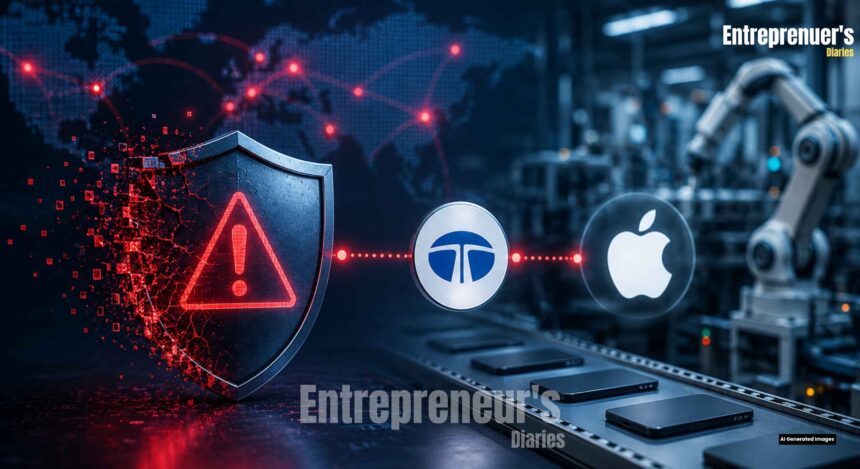
NEW DELHI, June 26, 2026: The Tata Electronics data breach has triggered a specific kind of quiet panic in cybersecurity circles because the company is a major Apple supplier. It is not the loud, chaotic panic of a downed website or a ransomware screen flashing on a hospital network. Instead, it is the slow realization that the fundamental rules of enterprise security may be shifting once again. That is exactly what happened when Tata Electronics confirmed a data breach.
According to the company’s official statement, later reported by Reuters, Tata Electronics acknowledged a security incident involving some employee data. The company said its core IT infrastructure, manufacturing operations, and customer data remained secure and entirely uncompromised.
Apple, when asked about the incident by Bloomberg, said it was looking into the situation while reiterating that it takes supplier security seriously. No specific financial figures were released. No exact headcount of affected employees was disclosed. No technical details about how the attackers gained access were shared.
That lack of detail is precisely what makes this incident significant for the wider technology industry. Viewed simply as an isolated security incident, it appears to be a supplier responding to a breach. But at a broader level, it highlights how the digital supply chain has become a critical focus of modern enterprise cybersecurity.
This is not just a story about one company’s network. It reflects how supply chain security has become an increasingly important part of protecting enterprise technology ecosystems.
How the Tata Electronics Data Breach Exposed the Castle Security Model
For decades, enterprise security was built around a simple idea: protect the network perimeter and everything inside would remain safe. The Tata Electronics data breach has once again highlighted why that traditional “castle and moat” approach is no longer enough for modern businesses.
Under this model, organizations relied on firewalls, intrusion prevention systems and endpoint protection to keep attackers outside the network. The assumption was that once the perimeter was secure, internal systems could largely be trusted.
However, today’s technology ecosystem operates very differently. Enterprises depend on suppliers, cloud providers, manufacturing partners and third party vendors that exchange data and systems every day. A weakness in any trusted partner can create risk across the wider business ecosystem.
As the article explains, agencies such as CISA have repeatedly warned that attackers increasingly target trusted suppliers instead of attempting to breach heavily protected enterprises directly. The incident involving Tata Electronics illustrates why vendor security has become an essential part of enterprise cybersecurity.
Rather than viewing cybersecurity as a single company’s responsibility, organizations are increasingly treating the entire supply chain as part of their security perimeter. The traditional castle model is giving way to an approach where every connection must be continuously verified instead of automatically trusted.
When the Factory Floor Became a Software Problem
To understand why a hardware manufacturer like Tata Electronics is such a fascinating and terrifying target, you have to look at how factories have changed. There used to be a hard line between two worlds. On one side, you had Information Technology. That was the domain of emails, databases, and HR systems.
On the other side, you had Operational Technology. That was the heavy machinery, the robotic arms, the assembly lines. OT systems were often “air gapped.” They weren’t connected to the internet. They were safe by virtue of being completely disconnected.
Well, that world is gone. What we have now is IT/OT convergence, often bundled under the buzzword “Industry 4.0.” Modern smart factories run on cloud connectivity. They use thousands of IoT sensors. They rely on real time data analytics to squeeze out every ounce of manufacturing efficiency.
This is a technological marvel, but it is also a security nightmare. Because now, the network that handles the employee HR portal the network that was reportedly breached at Tata Electronics is physically and logically connected to the systems that monitor the assembly of physical components.
While Tata stated their manufacturing operations were not impacted, you can see the structural danger clear as day. A breach in the “boring” IT side of the house can serve as a beachhead. Attackers get in through an HR phishing scam or a misconfigured server, and then they start crawling laterally, looking for a bridge to cross over into the operational technology side.
If they ever manage to cross that bridge, they don’t just steal data. They can physically halt the production of components, causing massive global supply chain shortages. The IT/OT convergence trend is rewriting the rules of physical security, and most supply chains are still struggling to catch up.
The Death of the Annual Security Audit
In the wake of the Tata incident, the company announced it was “tightening internal controls.” It sounds like corporate boilerplate, but it actually points to a massive shift in how enterprises manage vendor risk. For years, the gold standard for supply chain security was the annual audit.
A company like Apple would send a massive spreadsheet to a supplier. The supplier would check a bunch of boxes. Maybe they would let a third party auditor run a penetration test over a weekend. If they passed, they were granted access. Often, that meant they were given a persistent VPN connection straight into the primary enterprise network.

They were trusted. And once they were trusted, nobody really checked on them again for twelve months. It was security theater. And the cybersecurity industry is finally admitting it. The future is defined by a concept called Zero Trust. The National Institute of Standards and Technology NIST lays this out in their Special Publication 800-207.
The core philosophy is exactly what it sounds like: never trust, always verify. In a Zero Trust world, a supplier checking a box on an audit means absolutely nothing. Every single time a supplier’s system reaches out to access an enterprise resource, it has to prove its identity. It has to prove its security posture. And it only gets access to the specific data it needs for that exact transaction.
This requires a technology called micro segmentation. Instead of putting a supplier inside your network and hoping they behave, you put them in a tightly controlled, isolated box. If that supplier gets breached like Tata did the attacker finds themselves trapped in a tiny segmented slice of the network. They cannot move laterally. They cannot see the broader enterprise.
This is the kind of heavy lifting that “tightening internal controls” actually requires today. It is a total architectural overhaul.
Protecting the Data, Not Just the Door
There is another layer to this that often gets overlooked in the rush to buy new firewall software. It is the realization that you have to assume the bad guys are already inside. If you operate under the assumption that a breach is inevitable which is the only realistic assumption in 2024 then stopping them at the perimeter is no longer the goal.
The goal is to make the data useless to them once they get it. This is where data governance comes in. And it is a mess in most global supply chains. Data tends to sprawl. It gets copied to random servers. It gets stored in unencrypted databases.
When a company like Tata Electronics overhauls its internal controls, a massive part of that is figuring out exactly what data they have, classifying it, and locking it down. They have to implement Data Loss Prevention (DLP) systems.
They have to ensure that sensitive intellectual property is encrypted not just when it crosses the internet, but when it is just sitting on a hard drive in a factory in India. Some enterprises are even moving toward tokenization. They take sensitive data and replace it with non sensitive placeholders.
If a hacker exfiltrates a tokenized database, they do not get Apple’s proprietary manufacturing specs. They get a mountain of unreadable gibberish. The Tata breach is a loud reminder that protecting the network is only half the battle. You have to protect the data layer itself, because the network will eventually bleed.
The Ghosts of Breaches Past
It is tempting to view the Tata incident in a vacuum. But seasoned cybersecurity professionals do not do that. They see it as the latest verse in a very long, very expensive song. The technology industry really woke up to the supply chain threat in late 2020 with the SolarWinds disaster.
If you read the official post mortems from CISA and the FBI, the details are chilling. Russian state sponsored actors did not hack the Pentagon or Fortune 500 companies directly. They hacked a software vendor in Texas. They compromised the software build environment.
Then, they inserted a malicious backdoor into a legitimate software update. When thousands of enterprise customers downloaded that update trusting the vendor completely they inadvertently let the attackers straight past their perimeter defenses.
We saw a different flavor of this in 2023 with the MOVEit transfer vulnerability. Again, extensively documented by CISA, attackers found a zero day flaw in a piece of third party file transfer software.
By hitting that one obscure piece of software, they managed to compromise thousands of downstream organizations globally. The Tata Electronics incident is the hardware manufacturing equivalent of this exact same playbook.
It reinforces a grim reality that tech leaders can no longer ignore. Your security posture is only as strong as the most poorly secured vendor in your supply chain. Every time one of these incidents happens, the baseline for what is considered “acceptable security” gets raised.
Fighting Machines with Machines
So, how do you actually defend a digital supply chain that is this complex, this distributed, and this heavily targeted? You cannot do it with human eyes. The sheer volume of network traffic, API calls, and data transfers between a primary manufacturer and its suppliers is staggering.
A really important trend we are seeing right now is the forced adoption of Artificial Intelligence and Machine Learning in security operations. Traditional security tools are dumb. They rely on known signatures. If an attacker uses a brand new piece of malware, or if they steal legitimate employee credentials and log in perfectly normally, traditional tools just wave them through.
AI-driven security platforms work differently. They are designed to learn the rhythm of a network. They establish a baseline of normal behavior for every single user, device, and vendor connection.
If a supplier employee in Bangalore suddenly tries to download a massive CAD file at 3:00 AM or if data starts trickling out to an unknown server in tiny, encrypted packets that bypass standard filters the AI flags it instantly.
It does not wait for a human to notice. It isolates the endpoint automatically. When Tata Electronics talks about engaging cybersecurity experts and tightening controls, you can bet that deploying this kind of continuous, AI-driven behavioral analytics is at the top of the list. You cannot fight state sponsored hackers and sophisticated syndicates with humans reading log files. You have to fight machines with machines.
The Boardroom and the Balance Sheet
There is a final piece to this puzzle that often gets ignored by the technical crowd. Money. For a long time, cybersecurity was viewed as the IT department’s problem. It was a cost center. A necessary evil. Investors and board members did not care about firewalls or Zero Trust architecture. They cared about revenue growth and profit margins.
That mindset is dead. Read the financial analysis from outlets like the Financial Times or the Wall Street Journal, and you will see a distinct shift. Investors are waking up to the fact that a supply chain breach is a massive, unpriced risk on the balance sheet.
If a key supplier gets breached and physical production halts, the primary company misses product launch dates. If proprietary intellectual property is stolen, it can wipe out billions of dollars in R&D investment overnight. Institutional investors are now actively pressuring companies to disclose their supply chain cybersecurity risks during due diligence.
Companies that can prove they have robust, Zero Trust aligned supply chain security are starting to be viewed as safer harbors for capital. Conversely, enterprises that rely on opaque, poorly secured vendor networks are carrying hidden tail risks that could crater their stock price in a matter of hours.
And it is not just investors. Regulators are kicking down the door, too. Look at the European Union. They have passed the Digital Operational Resilience Act known as DORA and the updated NIS2 Directive. These are not suggestions. They are strict legal mandates that explicitly require enterprises to manage and report on supply chain cyber risks.
CISOs are no longer just tech managers. They are risk executives sitting in boardrooms, answering to lawyers and shareholders about the security posture of vendors they do not even employ.
The Indelible Shift in How We Trust
If you step back from the technical weeds, what does the Tata Electronics breach actually mean for the future of technology? It means the concept of “trust” in the digital age has fundamentally changed. We used to grant trust implicitly.
You signed a contract with a supplier, you plugged their network into yours, and you trusted that they would not burn the house down. The Tata breach is another nail in the coffin of implicit trust. The future of enterprise technology is defined by explicit, continuous, cryptographically verified trust.
It is a world where a vendor’s security posture is monitored in real time, every single second of the day. It is a world where network access is treated as a temporary privilege, not a permanent right. It is a world where data is encrypted and tokenized because we accept that the network perimeter will eventually be breached.
The specifics of the Tata incident will fade from the headlines. The tech news cycle moves fast. But the architectural shockwaves it sends through global supply chains will be felt for a decade. It will accelerate the death of the legacy VPN. It will force the adoption of AI-driven network monitoring. It will turn data governance from a compliance annoyance into a survival imperative. Enterprise security is no longer about building a wall around yourself. It is about surviving in an ecosystem where your network is inextricably linked to everyone else’s, and where the weakest link is always the one that gets hit first.
Frequently Asked Questions (FAQs)
What is a digital supply chain cyber attack?
A digital supply chain cyber attack happens when hackers target a third party vendor or supplier to get to a larger, more secure company. Instead of attacking a tech giant directly, attackers compromise the software, hardware, or network connections of the giant’s partners to bypass their main defenses. This is a primary focus of official warnings from agencies like CISA.
What is Zero Trust Architecture in cybersecurity?
Zero Trust is a security framework, officially detailed by NIST, that operates on a simple rule: never trust, always verify. It assumes that threats exist both outside and inside the network. It requires strict identity checks, micro segmentation, and continuous monitoring for every user and device trying to access resources, completely doing away with the idea of a trusted internal network.
Why are hardware manufacturing suppliers targeted by hackers?
Modern hardware manufacturing relies on IT/OT convergence. Factories are now “smart,” connected to the cloud, and rely on real time data. Hackers target suppliers because they often have access to highly sensitive intellectual property, product blueprints, and operational networks, making them a softer entry point into a primary enterprise’s ecosystem.
How does a breach at a supplier affect the primary company?
Even if the primary company’s core network is not breached, a supplier incident can cause massive fallout. It can lead to the theft of shared intellectual property, disrupt physical manufacturing lines, halt product shipments, and trigger severe regulatory fines under new laws that hold companies accountable for their vendors’ security failures.
What does “tightening internal controls” actually mean after a breach?
In modern cybersecurity, tightening internal controls goes far beyond resetting passwords. It means implementing strict Identity and Access Management (IAM), deploying Data Loss Prevention (DLP) tools to stop data from leaving the network, encrypting data at rest, and utilizing AI to monitor for abnormal user behavior to stop attackers from moving around the network.
Connect With Us On Social Media [ Facebook | Instagram | Twitter | LinkedIn ] To Get Real-Time Updates On The Market. Entrepreneurs’ Diaries Is Now Available On Telegram. Join Our Telegram Channel To Get Instant Updates.

Isabella is a global business journalist and former McKinsey analyst from Brazil. She brings sharp insights on economic shifts, policies, and founder journeys from around the world.

Luca is a tech ethicist from Italy exploring disruptive innovation through a human lens—from AI to biotechnologies to decentralization.