
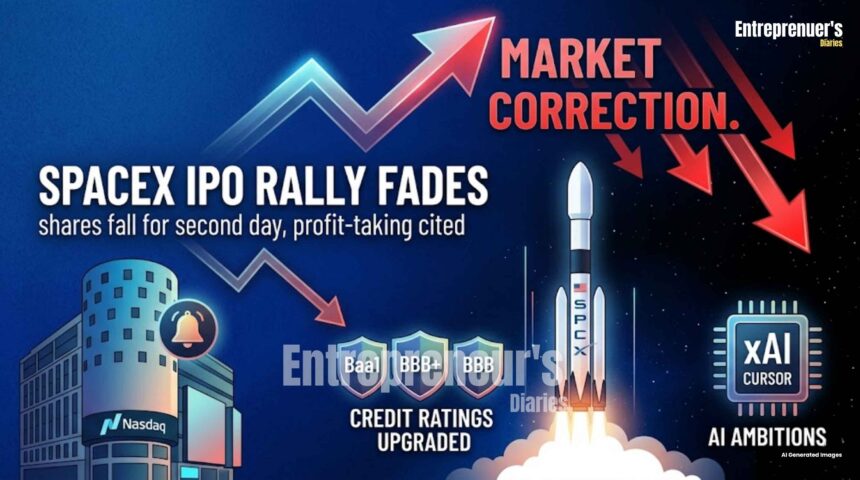
NEW YORK, Friday, June 19, 2026: Shares of SpaceX fell for a second straight session this week, as the explosive rally that followed Wall Street’s largest ever public offering showed its first real signs of fatigue. The stock briefly slipped out of the world’s top five most valuable companies list before paring some of that decline.
The pullback arrived in the same 24 hour window as a separate, more flattering headline: SpaceX picked up investment grade credit ratings from all three major ratings agencies. That contrast, a balance sheet win paired with a stock price loss, is the central tension running through this week’s trading and a useful lens for understanding what professional investors are actually pricing in.
This report lays out exactly what moved, how much, and according to which named source, while separating confirmed market data from figures that remain inconsistent across trackers.
SpaceX Shares Fall: What Happened on Thursday, by the Numbers
According to Reuters, SpaceX stock dropped more than 6% on Thursday, June 18, 2026, extending a decline of nearly 5% from the prior session. At its lowest point that day, shares traded around $178.50, Reuters reported.
A separate Reuters dispatch, published after the closing bell the same day, described the stock finishing down closer to 4% on Thursday and slipping a further 1.1% in after hours trading. Both figures come from Reuters and likely reflect different points in an unusually volatile session.
Even with the decline, SpaceX shares remained more than 30% above their $135 IPO price, according to Reuters. If losses had held at their session worst, Reuters calculated that SpaceX’s roughly $2.52 trillion market value stood to shrink by more than $150 billion in a single day.
The drop briefly knocked SpaceX out of the world’s five most valuable public companies, a position Reuters said it had held only days earlier following its debut.
IPOX Schuster analyst Kat Liu told Reuters that the size of the offering and the strength of its initial run made “some degree of profit taking is not surprising.” Liu also described the period since listing as an unusually eventful, holiday compressed trading week for the largest IPO on record.
From a $1.77 Trillion Debut to a Reality Check
To understand the scale of this pullback, it helps to revisit how extraordinary the debut itself was. SpaceX priced its IPO at $135 per share on June 11, 2026, selling roughly 555.6 million shares to raise about $75 billion, according to CNBC’s reporting on the company’s SEC filing.
That made it the largest IPO on record, surpassing Saudi Aramco’s $29 billion listing in 2019, CNBC reported. At the offer price, SpaceX was valued at approximately $1.77 trillion, instantly making it more valuable than Tesla, according to CNBC.
Investor demand for the deal was extraordinary even by mega IPO standards. Order books topped $250 billion, more than four times the size of the offering, according to data reported by StockTitan, with roughly 30% of shares allocated to retail buyers.
SpaceX began trading on Nasdaq on June 12 under the ticker SPCX. Shares opened at $150, an 11% jump from the offer price, before closing the first session up 19.2% at $160.95, according to Yahoo Finance.
Elon Musk and SpaceX President and COO Gwynne Shotwell rang the Nasdaq opening bell to mark the moment, CNBC reported. Trading volume that day topped 500 million shares, a level CNBC compared to Facebook’s 2012 Nasdaq debut.

Musk struck a notably candid tone before trading opened. “I gave SpaceX a less than 10% chance of succeeding at all,” he said, according to NBC News, reflecting on the company’s early survival odds before it became a public markets giant.
The rally did not stop after day one. According to Trading View market data, SPCX the SpaceX price on Nasdaq went on to hit an all time high of $225.64 on June 16, before the slide that defined this week began. NBC News reported that the debut made Musk the world’s first trillionaire.
Why the Rally Is Cooling: The AI Spending Question
Reuters reported that investors are now weighing whether SpaceX’s valuation can be justified once the IPO afterglow fades, specifically questioning whether the company’s costly artificial intelligence buildout will pay off.
That question did not exist in a vacuum a year ago. SpaceX’s AI unit traces back to its 2026 integration of xAI, and the company’s profile now describes a vertically integrated AI platform spanning the Grok large language model, the X platform, and AI computing infrastructure, according to Yahoo Finance’s company overview.
TradingView’s market commentary on the stock noted that some analysts believe SPCX’s current valuation reflects investor confidence in Musk personally as much as it reflects a clearly proven AI business case, and flagged open questions about the plausibility of the company’s longer range revenue targets.
That skepticism exists alongside genuine bullishness. New Street Research initiated coverage with a $165 price target and described SpaceX’s xAI linked business as a roughly $575 billion opportunity in its own right, relative to expectations for OpenAI and Anthropic, according to CNBC.
Altimeter founder and CEO Brad Gerstner, who participated in the IPO, voiced confidence in the team’s execution ability during CNBC’s live coverage of the listing, framing SpaceX’s leadership as well positioned to compete in AI infrastructure.
Wedbush analyst Dan Ives also framed the listing in broader industry terms. SpaceX’s debut was “an important moment for the broader tech sector,” Ives wrote in a note cited by Yahoo Finance, tying the listing to the wider AI investment cycle.
According to 7 analysts tracked by stockanalysis.com, the average rating on SPCX stock is “Buy,” with a 12-month price target of roughly $187.80 as of this week.
The $60 Billion Anysphere Deal Behind the AI Pivot
The clearest evidence of SpaceX’s AI ambitions arrived on Tuesday, June 16, when the company confirmed it would acquire Anysphere, the parent of the popular AI coding tool Cursor, in an all stock transaction valued at $60 billion, according to a regulatory filing reported by Reuters and CNBC.
The deal structure matters for the stock price debate. Under the agreement, Cursor will merge into a SpaceX subsidiary, and Cursor shareholders will receive SpaceX Class A stock based on an implied $60 billion equity value, according to terms reported by Reuters.
CNBC reported that the transaction is expected to close in the third quarter of 2026, pending regulatory approval, and that it follows an option SpaceX had secured back in April 2026 to either acquire Cursor outright or fund a smaller $10 billion partnership.
Cursor has scaled quickly since its 2023 launch, generating roughly $2.6 billion in annualized revenue, according to Reuters reporting cited by Yahoo Finance. Microsoft had previously examined acquiring the startup but declined to make a formal bid, CNBC reported, and OpenAI’s separate approaches were rebuffed.
Bret Greenstein, Chief AI Officer at consulting firm West Monroe, told Yahoo Finance that SpaceX appears to be following a vertical integration playbook similar to Tesla’s. “AI also requires the infrastructure to support it,” Greenstein said, pointing to energy, data centers, and connectivity as pieces of SpaceX’s broader strategy.
The acquisition puts SpaceX in more direct competition with Anthropic and OpenAI in enterprise AI coding tools, an area Yahoo Finance described as one of the fastest growing corners of the AI market.
Investment Grade Ratings Land the Same Day as the Slide
In a twist that underscores how mixed this week’s signals were, SpaceX also landed investment grade credit ratings from all three major agencies on the same Thursday its stock fell, according to Reuters.
Moody’s assigned a “Baa1” rating, Fitch a “BBB+,” and S&P Global Ratings a “BBB,” all with a stable outlook, Reuters reported. Each designation signals that SpaceX’s debt is considered investment grade, generally indicating moderate credit risk and sufficient capacity to meet financial obligations.
S&P’s published rationale, reported by Investing.com, said the agency expects elevated capital spending to drive negative free cash flow through 2029, with leverage peaking around 1.2x in 2028 before improving as connectivity revenue grows and AI monetization begins. S&P added it could lower the rating if SpaceX fails to hit growth targets while continuing heavy, cash flow negative investment.
Moody’s, for its part, praised what it called SpaceX’s “exceptional franchise strength” as the world’s leading orbital launch provider, according to a rating summary covered by Stocktwits, citing Starlink specifically as the company’s primary cash flow engine.
Fitch’s outlook noted pro forma liquidity exceeding $90 billion and expected EBITDA growth that should keep leverage within management’s target range, according to the same Stocktwits report. All three agencies flagged similar risk factors: concentrated governance under Musk, Starship execution risk, and the still unproven economics of the AI segment.
The agencies’ confidence in SpaceX’s underlying credit profile, arriving the same day equity investors were selling the stock, illustrates a split market view: bondholders are comfortable with the company’s ability to service debt, while equity investors remain less certain about how to price its AI driven growth story.
The Bond Sale Wall Street Is Watching Next
That credit rating news is directly tied to SpaceX’s next major financing step. Reuters reported that the company’s bankers are preparing to meet bond investors as early as next week to discuss a debt offering of at least $20 billion, intended to help fund SpaceX’s AI expansion.
The timing is notable. SpaceX is moving to tap public debt markets within roughly a week of its record stock listing, a sequencing that suggests the company is treating its IPO proceeds and a forthcoming bond raise as complementary, rather than substitute, sources of AI related capital.
S&P’s own analysis, reported by Investing.com, anticipated this need directly, noting that SpaceX will likely require additional capital through both debt and equity markets to cover funding gaps, even after accounting for IPO proceeds.
Sector Wide Ripple Effects Across Space Stocks
SpaceX’s slide did not happen in isolation. Reuters reported that other publicly traded space companies fell in sympathy on Thursday: Rocket Lab and Planet Labs each dropped roughly 3%, AST SpaceMobile declined about 7%, and Intuitive Machines slipped around 3%.
That pattern echoes an earlier moment in the same week. CBS News reported that on Wednesday, June 17, amid a broader Wall Street pullback tied to Federal Reserve rate speculation, SpaceX fell 4.9%, marking its first daily loss since its market debut. CBS News added that Microsoft, Amazon, and Nvidia also dropped that session, among the heaviest drags on the S&P 500.
The cross sector move suggests Thursday’s decline reflects more than company specific news. It points to a broader repricing of richly valued, AI linked growth stocks across the market, not a verdict on SpaceX’s rockets and satellites business alone.
The Lock Up Calendar: What Comes Next for SPCX
Beyond this week’s headlines, the next scheduled catalyst for SPCX isn’t an earnings report. It’s a series of insider lock up releases built directly into SpaceX’s IPO terms.
Most IPOs use a single 180 day lock up that bars insiders from selling all at once. SpaceX instead adopted a staggered, multi tranche schedule, according to reporting by CNBC and the Motley Fool on the company’s registration statement.
Under that structure, early investors may sell up to 20% of their holdings shortly after SpaceX’s second quarter earnings report, according to Yahoo Finance’s review of the filing. An additional 10% can unlock early if the stock trades at least 30% above its IPO price for five of any ten consecutive trading days following that report.
Further 7% tranches are scheduled to release at set intervals between roughly 70 and 135 days after the IPO, the Motley Fool reported, with a larger roughly 28% tranche tied to third quarter earnings. The remaining shares free up at the standard 180 day mark.
Elon Musk’s own position sits outside that schedule entirely. Musk and select major backers agreed to a full 366 day lock up with no early release provisions, according to CNBC’s reporting on the filing terms, meaning his stake remains restricted until roughly June 2027.
SpaceX insiders collectively own more than 20% of Class A shares, the Motley Fool reported, meaning a meaningful supply of stock could reach the market in stages between three and twelve months after the IPO, even before the full 180 day lock up expires in December 2026.
Historical precedent makes this calendar worth watching closely. The Motley Fool’s sister analysis at Trefis pointed to past lock up expirations at Palantir, Rivian, and Uber, each of which saw double digit single day declines when restrictions lifted, as a reason markets tend to grow cautious in the weeks before similar dates arrive.
Institutional Winners, Retail Risk
The composition of SpaceX’s shareholder base helps explain why this week’s drop affects different investors very differently. Reporting from financial markets outlet Crypto Briefing found that institutional investors who bought at the $135 IPO price were still sitting on roughly 32% gains even at Thursday’s low.
BlackRock alone is reported to have committed approximately $5 billion to the offering, according to the same Crypto Briefing analysis. That scale of institutional commitment has provided a buying base that has so far cushioned the stock’s decline relative to its all time high.
Retail and later arriving buyers have fared less well. With the volume weighted average post IPO trading price hovering just under $180, Crypto Briefing reported, the average buyer who purchased shares after the debut was roughly breakeven to slightly underwater by midweek, despite the stock still sitting well above its original offer price.
What Remains Unverified or Inconsistent
In the interest of strict accuracy, a few data points circulating this week could not be fully reconciled across sources at the time of this report. The precise magnitude of Thursday’s decline varied between Reuters dispatches filed at different points in the trading day, ranging from roughly 4% to 6.5%, likely reflecting intraday swings rather than a factual error in either report.
Separately, real time stock trackers showed slightly different intraday price ranges for Thursday’s session. Robinhood’s market data listed a day range of $172.11 to $192.00 with a $177.94 close, while Investing.com’s snapshot for the same date showed some figures that appear to reflect a different time stamp. This report relies on the figures explicitly attributed to Reuters above rather than averaging across trackers.
Claims occasionally seen in secondary commentary about SpaceX’s specific 2030 revenue targets, beyond the general skepticism flagged by TradingView’s market commentary, were not independently confirmed in company statements reviewed for this report and have therefore been excluded.
Why This Matters for Entrepreneurs and Investors
Strip away the daily price swings, and three threads matter more than Thursday’s close. The first is that bond markets and stock markets are telling different stories about the same company right now. Three rating agencies just told the world SpaceX can comfortably service new debt. Equity investors, on the same day, said they are no longer willing to pay any price for growth. That gap, not the headline percentage drop, is the real story of this week.
The second is that SpaceX’s $60 billion move into Cursor has changed what kind of company the market is being asked to value. A reusable rocket and satellite broadband business with a predictable cash flow story, Starlink, is now bundled with an unproven, capital intensive AI bet that competes directly with Anthropic and OpenAI. Investors who bought the IPO for the space business are now underwriting a software acquisition they did not explicitly price in at $135 a share.
The third is the calendar most casual readers will miss entirely: SpaceX’s staggered lock up schedule means meaningful new share supply could hit the market well before the headline 180 day date in December, starting as early as this summer’s second quarter earnings report. Combined with a pending $20 billion plus bond sale designed to fund the very AI buildout investors are now questioning, the next eight to ten weeks carry far more real catalysts than this week’s two day dip.
The businesses and investors who come out ahead here will not be the ones reacting to Thursday’s close. They will be the ones tracking three specific dates: SpaceX’s second quarter earnings report and the early lock up tranche it triggers, the formal bond roadshow expected as soon as next week, and the Anysphere deal’s targeted third quarter close. Those three events, far more than any single trading session, will determine whether SpaceX’s valuation stabilizes or faces another round of the volatility this week previewed.
Frequently Asked Questions
1. Why did SpaceX stock fall after its IPO?
SpaceX shares fell more than 4% to 6.5% on Thursday, June 18, 2026, as investors reassessed whether the company’s valuation could be justified by its costly AI expansion, according to Reuters. The decline followed a roughly 5% drop the previous session and came after the stock had earlier surged to an all time high of $225.64, per Trading View data, making some profit taking likely after such a sharp run.
2. What was SpaceX’s IPO price and how big was the offering?
SpaceX priced its IPO at $135 per share, selling about 555.6 million shares to raise roughly $75 billion, according to CNBC’s reporting on the company’s SEC filing. That made it the largest IPO on record, valuing the company at approximately $1.77 trillion at the offer price.
3. What is the SpaceX and Anysphere (Cursor) deal?
SpaceX agreed to acquire Anysphere, the parent company of the AI coding tool Cursor, in an all stock transaction valued at $60 billion, according to a regulatory filing reported by Reuters and CNBC. The deal is expected to close in the third quarter of 2026, pending regulatory approval, and is aimed at expanding SpaceX’s position in the enterprise AI tools market.
4. When does SpaceX’s IPO lock up period expire?
SpaceX uses a staggered, multi tranche lock up rather than a single date, according to reporting by CNBC and the Motley Fool on the company’s IPO filing. Early investors can sell up to 20% of holdings shortly after the company’s second quarter earnings report, with additional tranches releasing through roughly the 135 day mark and the remaining shares unlocking at the standard 180 day point; Elon Musk’s own shares are locked for a full 366 days with no early release.
5. Did SpaceX get a credit rating after its IPO?
Yes. SpaceX received investment grade credit ratings from all three major agencies on June 18, 2026: a “Baa1” from Moody’s, a “BBB+” from Fitch, and a “BBB” from S&P Global Ratings, each with a stable outlook, according to Reuters. The ratings reflect confidence in SpaceX’s financial stability even as the agencies flagged risks tied to its capital intensive AI expansion.
Connect With Us On Social Media [ Facebook | Instagram | Twitter | LinkedIn ] To Get Real-Time Updates On The Market. Entrepreneurs’ Diaries Is Now Available On Telegram. Join Our Telegram Channel To Get Instant Updates.

Isabella is a global business journalist and former McKinsey analyst from Brazil. She brings sharp insights on economic shifts, policies, and founder journeys from around the world.

Tokyo-based CFA translating global markets into clear insights for modern entrepreneurs.