
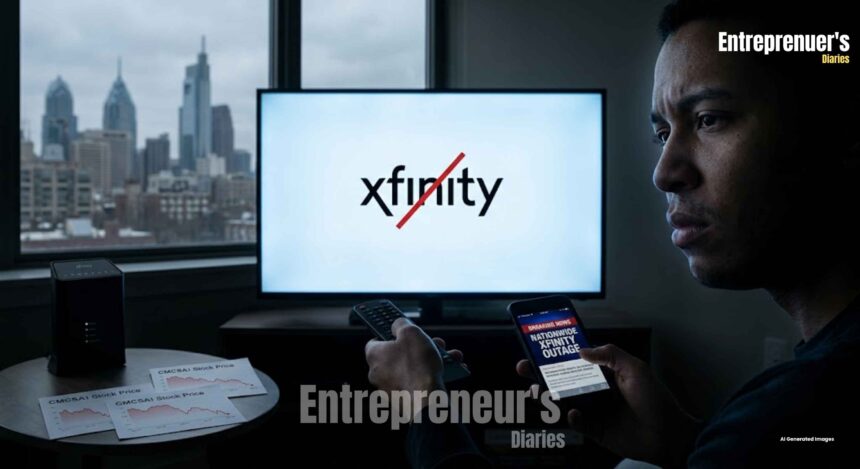
PHILADELPHIA, Monday, June 22, 2026: Somewhere between the afternoon news cycle and the evening’s World Cup kickoffs, a good chunk of Comcast’s TV screens just went dark. A nationwide Xfinity outage knocked out television, internet, and phone service in cities from coast to coast on Monday, and the timing could hardly have been worse.
Comcast’s stock is already sitting near its lowest point in roughly 13 years, according to Yahoo Finance. The broadband business has been losing customers to fiber and fixed wireless rivals for a while now, quarter after quarter, and this outage lands right in the middle of that story. Here’s what actually happened Monday, what Comcast has said about it on the record, and why it matters for anyone watching this stock or running a business on Comcast’s network.
The Xfinity outage by the numbers
The Xfinity outage started building shortly before 4 p.m. ET, at least according to Nexstar Media Group affiliates including WGNTV, FOX59 and KDVR, which tracked the first wave of complaints hitting Downdetector. The East Coast lit up fastest.
By the time the Xfinity outage peaked, Downdetector had logged 26,278 user submitted reports that’s the figure Nexstar’s affiliates settled on. actionnewsnow.com got a slightly different number from a Comcast representative directly: “more than 25,000,” with the first complaints rolling in around 12:30 p.m. PDT. Close enough to the same event, different snapshot.
King5 in Seattle had its own count, too: more than 24,000 Downdetector reports by 4:15 p.m. ET. None of these numbers are wrong, exactly. They’re just measuring a moving target at slightly different moments during a fast developing Xfinity outage, which is worth keeping in mind before anyone treats any single figure as gospel.

What’s consistent across all of it is which service took the worst hit. actionnewsnow.com, citing that same Comcast representative, put 80% of the complaints on TV service, 10% on broadband internet, and 8% on streaming. King5’s own Downdetector read was close but not identical 77% TV, 13% internet, 8% streaming. Either way, the cable boxes were the problem.
Inside the disruption: cities, timeline, and services affected
This wasn’t a regional glitch. The Desk, a telecom trade outlet that’s been covering Comcast closely for years, reported that the outage hit both home and business customers in San Francisco, Chicago, Austin, Boston, Baltimore, Philadelphia, Sacramento, Denver, Detroit, Seattle, and Miami. That’s a lot of ground to cover in one afternoon.
Xfinity TV, Xfinity Internet, and Xfinity Voice all went down around 4 p.m. ET, or 1 p.m. on the West Coast, per The Desk’s reporting. And in a detail that feels almost cruelly fitting, the Xfinity outage map the page customers are supposed to check before calling in stopped working too, according to both ABC27 and The Desk.

Xfinity Mobile rides on Verizon’s network rather than Comcast’s own pipes, so it kept working through all of this, The Desk noted. Customers could still make calls. They just couldn’t pay their mobile bill or touch their account, since those functions loop back through Comcast’s own systems.
There’s a sports angle here that’s hard to ignore. King5 reported that a France Iraq World Cup match was set to kick off at 5 p.m. ET that day, with Norway Senegal following at 8 p.m. Both fell right in or just after the outage window not exactly the moment you want your TV provider going dark.
Services came back online by 6 p.m. ET, around 3 p.m. on the West Coast, Comcast told The Desk in an email. That tracks with actionnewsnow.com’s separate reporting, which had things resolved by roughly 3 p.m. PDT.
What Comcast said: the official response
Comcast’s statement was short and, to its credit, didn’t try to spin much. A spokesperson told Nexstar Monday evening that customers were experiencing “a very brief interruption to their services due to a system update,” and apologized for the trouble.
The Desk got essentially the same line by email a system update, not an attack, not a third party, not a fiber cut somewhere. Nobody at Comcast has said what the update was actually trying to fix or upgrade, which is the kind of detail companies usually skip unless someone makes them answer for it.
Over on X, Comcast’s support account handled the flood of cable complaints the way these things usually go: asking people to DM their name and service address so a human could look into it. WGNTV caught that exchange. Nexstar also noted that Comcast didn’t get back to them with anything further when asked.
No postmortem has shown up on Comcast’s own site as of this writing. Companies don’t always publish one for outages this size, but it’s worth flagging that the explanation so far amounts to four words: a system update.
Not the first time: Comcast’s recent outage history
This isn’t the first time Comcast customers have lost service en masse this year or even this past year, really. The Desk reported that Monday marked the second large outage to hit a significant chunk of Comcast’s customer base within roughly twelve months.
The first one was different in almost every way. Back in September, a car crash physically tore up infrastructure and knocked out broadband and TV across parts of Northern California Sacramento, Elk Grove, Clovis, Fresno, Lodi, Los Banos, Madera, Mendota, per The Desk.
So one outage was an accident involving a vehicle and some cable lines. The other was a company pushing a software update that apparently didn’t go as planned. Different causes, same end result for the customer staring at a frozen screen.
The bigger picture: CMCSA stock near a 13 year low
This all happened while Comcast’s stock was already struggling, which is the part investors will care about more than the outage itself. Yahoo Finance flagged CMCSA as trading near a “nearly 13 year low,” pointing to rising competition and shifting consumer habits as the reasons why.
Google Finance had shares around $22.40, inside a 52 week range running from $22.13 up to $34.34 a pretty wide swing for a company this size. That puts Comcast’s market cap near $80 billion, with a trailing P/E ratio of about 4.4, according to the same data.
CNN Markets caught a recent close at $22.43, down roughly 1.15% from the session before. The quarterly dividend, per Google Finance, sits at $0.33 a share.
Comcast hasn’t been sitting still, to be fair. Yahoo Finance noted the company is leaning into cybersecurity products, repackaged broadband bundles, and same day WiFi equipment delivery that last one rolled out across 20 markets in mid June, according to Comcast’s own CNBC stock page.
Will a two hour outage move the needle on a stock this size? Probably not by itself. But it’s one more public, dated, easily searchable data point in a reliability story that analysts were already telling about this company before Monday afternoon.
Inside Comcast’s Q1 2026 earnings: why investors are nervous
To really understand the stock price, you have to go back to the first quarter numbers Comcast put out in April. Revenue came in at $31.46 billion for the quarter ending March 31, up 5.3% from a year earlier solid growth, at least on the top line, according to CNBC and Yahoo Finance’s coverage of the release.
Below that line, things got uglier. Net income attributable to Comcast dropped 35.6% to $2.17 billion. Adjusted EBITDA fell 16.8% to $7.93 billion. Adjusted EPS landed at $0.79, which technically beat the $0.73 Wall Street was expecting, per CNBC, but beating a lowered bar isn’t the same as growing.
The connectivity unit Xfinity broadband, cable, mobile, all of it is where the real tension lives. Domestic broadband net losses improved to 65,000 for the quarter, way down from 183,000 the year before, Fierce Network reported from the earnings call.
Co CEO Mike Cavanagh called it “the first year over year improvement since the fourth quarter of 2020,” which is a genuinely notable line for a company that’s been bleeding broadband subscribers for years. He also wasn’t shy about the headwinds: fiber overbuild and aggressive fixed wireless marketing aren’t letting up anywhere in Comcast’s footprint, he told analysts, per Fierce Network.
Cable TV losses eased too, down to 322,000 from 427,000 a year earlier, CNBC reported. On the brighter side, Comcast added a record 435,000 wireless lines in the quarter, pushing its domestic wireless base to 9.7 million lines, according to TIKR’s read on the call.
Peacock, meanwhile, hit 46 million paid subscribers with revenue up more than 70% year over year, per thedesk.net but the streaming arm still lost $432 million on an EBITDA basis, worse than the $215 million loss a year prior, mostly because of sports rights costs piling up. Comcast still found room to return $2.5 billion to shareholders that quarter: $1.25 billion in buybacks, about $1.2 billion in dividends, according to TIKR.
The competitive squeeze: fiber, fixed wireless, and customer satisfaction
None of Comcast’s broadband troubles are happening in isolation. Every rival chasing its customers is putting actual numbers behind the chase, in their own earnings reports, on their own quarterly calls.
T Mobile added more than half a million net broadband customers in Q1 2026 alone, making it the fastest growing internet provider in the country by Cord Cutters News’ count. The same report had a blunter way of putting it: Comcast and Spectrum lost internet customers during that exact window.
Verizon picked up 341,000 broadband net adds in the same quarter 214,000 fixed wireless, 127,000 fiber bringing its total to roughly 16.8 million connections, according to thedesk.net’s earnings coverage. CEO Dan Schulman told analysts the company is on pace for “more than 32 million fiber passings by the end of this year,” which is the kind of number that should worry anyone still selling cable.
AT&T isn’t sitting out either. It closed its Lumen Technologies acquisition ahead of schedule this quarter, picking up 1.1 million fiber customers and over 4 million newly passed fiber locations, Fierce Network reported from CEO John Stankey’s comments.
Then there’s the satisfaction data, which doesn’t flatter Comcast much. SpeedTestHQ’s most recent update, from April 2026, has Xfinity at a JD Power score of 60 and an ACSI score of 67 both trailing fiber providers like Google Fiber, which scored 88 and 82 on the same scales.
A separate ACSI report from Telecompetitor, out in May, found Comcast’s fiber product specifically Xfinity Fiber scoring much better at 77. Fiber just tends to beat cable on these surveys, full stop. ACSI’s Forrest Morgeson, quoted in that piece, said the industry overall has gotten better: “outages are less frequent,” in his words, even with competition heating up everywhere.
Which makes Monday a little awkward, timing wise. A national outage that knocked out service for hours, right as the industry’s own research is touting fewer outages, isn’t a great look. It doesn’t erase the broader trend, but it’s not nothing either.
Regulatory backdrop: what the FCC requires when networks go down
There’s a regulatory layer to all this that mostly stays invisible until something like Monday happens. The FCC’s own site explains that it set up outage reporting rules back in 2004, specifically to get fast, accurate information when communications networks go down in a big way.
Under the Network Outage Reporting System, or NORS, cable, wireline, satellite, wireless and VoIP providers have to report outages that last 30 minutes or longer and clear certain severity thresholds that’s straight from the FCC’s own description of the program. Providers get 120 minutes to file an initial notice once they’ve determined an outage qualifies, then 30 days for the final report.
One catch: NORS data is presumed confidential. That’s the FCC’s own framing, and it’s a big part of why outside observers rarely see the actual filings, even though the agency uses the aggregated data to spot industry wide reliability trends.
Did Monday’s outage clear the bar for a mandatory filing? Nobody’s said, at least not publicly. Comcast hasn’t confirmed whether it filed anything with the FCC over this, and there’s no requirement that it tell the public either way.
What remains unverified or inconsistent
A few things in this story didn’t line up perfectly across outlets, and it felt more honest to flag them than to pretend they did.
Start times don’t quite match. Nexstar’s affiliates said reports began “shortly before 4 p.m. ET.” actionnewsnow.com, quoting Comcast, put it around 12:30 p.m. PDT, which works out to roughly 3:30 p.m. ET. The Desk said 4 p.m. ET on the nose. These are close enough that they’re probably just different people checking Downdetector at slightly different minutes during a fast moving event, not a real contradiction.
Same story with the peak report count: 26,278 from Nexstar’s affiliates, “more than 25,000” from actionnewsnow.com, and “more than 24,000… by 4:15 p.m. ET” from King5. Downdetector’s numbers shift by the minute during something like this, so three outlets checking at three different times getting three different totals isn’t suspicious. It’s just how the data works.
The service breakdown has the same wrinkle 80/10/8 from Comcast via actionnewsnow.com, versus 77/13/8 from King5 pulling straight off Downdetector. Both are cited here by name rather than mashed into one made up average number, because that average wouldn’t actually represent anything real.
And one more: Comcast’s exact closing share price for the trading session that overlapped with the outage wasn’t independently confirmed as of this writing. The stock figures above come from the most recent data Google Finance and CNN Markets had available, and anyone making a trading decision off them should pull a live quote first.
What this means for entrepreneurs and business leaders
Pull back from the minute by minute Downdetector numbers, and two things matter more than anything that happened Monday afternoon specifically.
First: Comcast’s reliability problem, whether it’s fair or not, is landing at the worst possible time. This is a company that just told investors, with some pride, that it finally posted its first year over year improvement in broadband losses since 2020 and then it goes dark nationwide during a World Cup match, in front of exactly the kind of price sensitive households that fiber and fixed wireless competitors are circling. That’s not a great look, no matter how brief the outage actually was.
Second: the pressure on Comcast isn’t theoretical anymore, it’s showing up in the numbers every single quarter. T Mobile, Verizon, and AT&T are each adding hundreds of thousands of broadband customers through fiber and fixed wireless, the exact categories that keep winning customer satisfaction surveys, while Comcast’s cable product sits closer to the bottom of those same rankings.
If your business has a commercial contract with Comcast, this is a decent moment to actually read your service level agreement and see what it says about compensation when a “system update” takes your connection down during business hours. If you’re watching this as an investor, the outage itself isn’t really the story what matters is whether broadband losses keep shrinking past that 65,000 mark from Q1, whether Peacock and wireless can close their profitability gaps, and whether the network holds up the next time tens of millions of people tune into one event at the same time.
The people who get the most out of a story like this won’t be the ones glued to Monday’s Xfinity outage map. They’ll be the ones checking back in a quarter or two to see whether the broadband numbers kept improving, whether another outage of this size shows up, and whether CMCSA can actually find a floor while this price war keeps grinding through the rest of 2026.
Frequently asked questions
1. What caused the Comcast Xfinity outage on June 22, 2026?
Comcast says it was an internal system update not a cyberattack, not weather, not a physical infrastructure failure. That’s the explanation the company gave both Nexstar and The Desk. What the update was actually for hasn’t been disclosed.
2. How many people were affected by the Xfinity outage?
It depends which outlet’s snapshot you’re looking at. Nexstar’s affiliates cited a Downdetector peak of 26,278 reports. actionnewsnow.com, via a Comcast representative, said more than 25,000. King5 had it at more than 24,000 by 4:15 p.m. ET. All three are probably describing the same event at slightly different moments.
3. Is Comcast’s stock down because of the Xfinity outage?
Not as far as anyone has confirmed. CMCSA was already trading near a “nearly 13 year low” before Monday, per Yahoo Finance, and that’s tied to broader competitive pressure from fiber and fixed wireless providers that’s been building for a long time, not to this one incident.
4. How long did the Comcast Xfinity outage last?
Roughly two hours, based on what Comcast told The Desk and actionnewsnow.com starting around 4 p.m. ET and wrapping up by about 6 p.m. ET (1 p.m. to 3 p.m. on the West Coast) on June 22, 2026.
5. Why is Comcast losing broadband customers to other providers?
Comcast’s own Q1 2026 numbers, covered by Fierce Network and CNBC, point to fiber expansion and aggressive fixed wireless marketing from rivals as the main pressure. T Mobile, Verizon, and AT&T each added hundreds of thousands of broadband customers that same quarter, per Cord Cutters News, thedesk.net, and Fierce Network respectively, while Comcast and Spectrum were both losing customers.
Connect With Us On Social Media [ Facebook | Instagram | Twitter | LinkedIn ] To Get Real-Time Updates On The Market. Entrepreneurs’ Diaries Is Now Available On Telegram. Join Our Telegram Channel To Get Instant Updates.

Isabella is a global business journalist and former McKinsey analyst from Brazil. She brings sharp insights on economic shifts, policies, and founder journeys from around the world.

Tokyo-based CFA translating global markets into clear insights for modern entrepreneurs.