
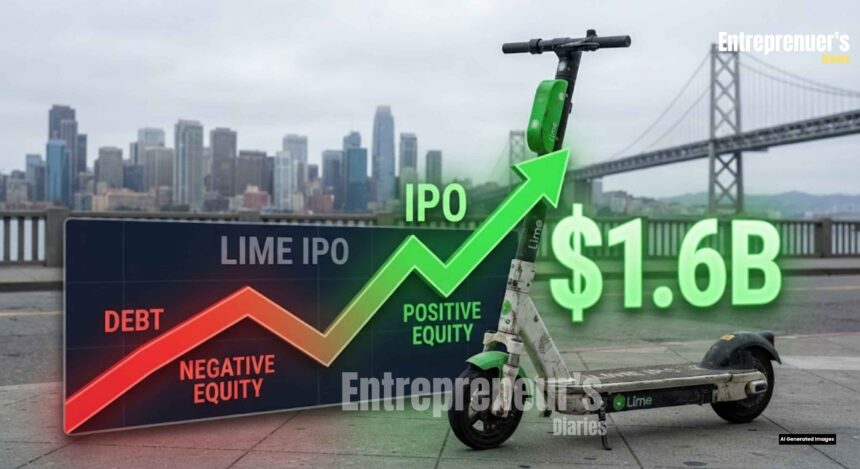
San Francisco, June 22: You’ve seen them scattered on city sidewalks. Bright green electric scooters, resting against fire hydrants or parked near subway entrances, looking battered after a life spent being ridden hard and left in the rain.
For years, these scooters were the ultimate symbol of the venture capital boom. They represented a fast, reckless, and heavily funded bet on urban transportation. Billions of dollars were thrown at the idea that people would abandon their cars for a two dollar ride on a battery powered kickstand.
But behind the flashy hardware and the convenient smartphone apps lies the true test of the Lime IPO. It is a reality defined by massive losses, crushing debt, and a relentless, exhausting fight for survival.
Now, the industry is facing its most significant public test. Lime, legally known as Neutron Holdings, Inc., has officially filed its amended prospectus with the U.S. Securities and Exchange Commission.
This filing pulls back the curtain on a business that has burned through unimaginable amounts of capital over the better part of a decade. It reveals a company that has fundamentally restructured its balance sheet pulling off a piece of financial engineering just to make it to the public markets.
This isn’t just a story about an initial public offering. It’s a story about the painful maturation of an industry, the shifting expectations of public market investors, and the raw, unfiltered economics of moving human beings through crowded modern cities.
The Real Numbers Behind The Headlines
When a highly anticipated company files to go public, the media cycle is usually dominated by one single, shiny metric. The valuation.
In the weeks leading up to Lime’s amended S-1 filing, several reports suggested the company was targeting a massive number. According to Reuters and The Information, the Uber Lime partnership helped Lime float a valuation of roughly $1.8 billion in quiet, backroom conversations with prospective investors.
The official paperwork, however, tells a slightly different story.
According to the U.S. Securities and Exchange Commission filing, Lime set an official price range of $24.00 to $26.00 per share. The math behind this valuation is entirely transparent, which is rare. Lime disclosed that it will have exactly 64,025,936 shares of common stock outstanding immediately after the offering.
If you multiply that exact share count by the $26.00 top of the price range, you get a market capitalization of roughly $1.66 billion.
If you use the $24.00 floor, the valuation drops to about $1.54 billion. At the $25.00 midpoint the number the company uses for its own illustrative calculations the implied valuation lands near $1.6 billion.
If the underwriters exercise their full option to purchase an additional 1,043,478 shares, the total share count climbs to 65,069,414. This nudges the top end valuation slightly higher, but it still falls conspicuously short of that initial $1.8 billion whisper number.
In the world of public markets, a downward revision from informal whispers to official paperwork is a subtle but incredibly important detail. It shows that the bankers and the company had to calibrate their expectations, bringing them back down to earth based on actual, hard feedback from institutional investors.
How The Capital Raise Actually Works
To really understand this IPO, you have to look at exactly who is selling shares and where the money is actually going. According to the U.S. Securities and Exchange Commission filing, Lime is selling 6,679,791 shares directly to the public.
Existing stockholders, including early venture capital backers and longtime employees, are separately offering 276,731 shares. Combined, the base offering totals 6,956,522 shares.
Don’t overlook this part: Lime will not receive a single penny from the shares sold by those existing stockholders. That money goes directly into the pockets of the early investors who are cashing out.
Lime will only collect money from the primary shares it issues itself. At the $25.00 midpoint, Lime expects to generate net proceeds of approximately $141.6 million.If the underwriters fully exercise their option for additional shares, that figure rises to roughly $165.8 million.
By the standards of technology initial public offerings, this is a remarkably modest capital raise. Lime isn’t using this event to fund a massive global expansion or take over the world. Instead, the money is being allocated with intense, almost mundane specificity.
The filing states that $115.0 million will be used immediately to fully repay the company’s outstanding Senior Secured Term Loan. Another $4.8 million is earmarked for tax withholding tied to a restricted stock unit settlement triggered by the listing itself. A further $2.8 million covers additional restricted stock units that will net settle in connection with the offering.
Whatever tiny fraction of cash remains is designated for general corporate purposes. This includes working capital, operating expenses, and capital spending on Lime’s vehicle fleet.
The company also notes it might use some proceeds to acquire or license complementary technology, though that reads like a standard legal catch all rather than an immediate strategic priority.
The Banking Syndicate And The Credit Line
The list of banks backing this deal highlights exactly how Wall Street views the company right now.
Goldman Sachs and J.P. Morgan are listed as the lead underwriters. They are joined by a tier of other financial institutions. This includes Jefferies, Evercore ISI, Citizens Capital Markets, KeyBanc Capital Markets, Needham and Company, and William Blair.

Having major Wall Street banks anchor the deal signals a certain level of institutional confidence. It means the underwriters genuinely believe they can sell this story to skeptical mutual funds and pension managers.
But the true financial cushion for Lime extends well beyond the $141 million raise.
According to the prospectus, Lime intends to enter a new $200.0 million syndicated revolving credit facility. JPMorgan Chase Bank is named as the administrative agent for this facility.
This credit line is conditioned on the IPO successfully closing. It provides Lime with a massive liquidity backstop, ensuring the company has ample cash to weather seasonal downturns or unexpected operational hurdles without having to beg shareholders for more equity.
The Uber Myth Versus The Uber Reality
In the days leading up to the amended filing, the tech press was obsessed with one specific, dramatic narrative. The story went like this: Uber, Lime’s long time strategic partner, was stepping in as a massive anchor investor to save the deal.
A report by Reuters published just before the amended S 1 dropped stated that Uber was expected to be named on the cover of the prospectus. The report claimed Uber would invest a “meaningful” amount. The same report noted that Uber had guaranteed a $115 million Lime loan that was due in September.
The hype machine was in full swing. Then the official prospectus hit the wire, published by the U.S. Securities and Exchange Commission the very next day. It put a hard, actual figure on Uber’s order.
Entities affiliated with Uber have indicated interest in purchasing up to an aggregate of $20.0 million in shares. This is a critical distinction for public market investors to understand. An indication of interest is not a legally binding commitment. It’s a handshake, not a contract.
The filing is brutally explicit about this. It states that Uber “may determine to purchase more, fewer, or no shares” in the final offering. Twenty million dollars is certainly real money. However, in the context of a roughly $150 million plus primary raise, it is a relatively small fraction. It is a far cry from the white knight narrative that dominated the early news cycle.
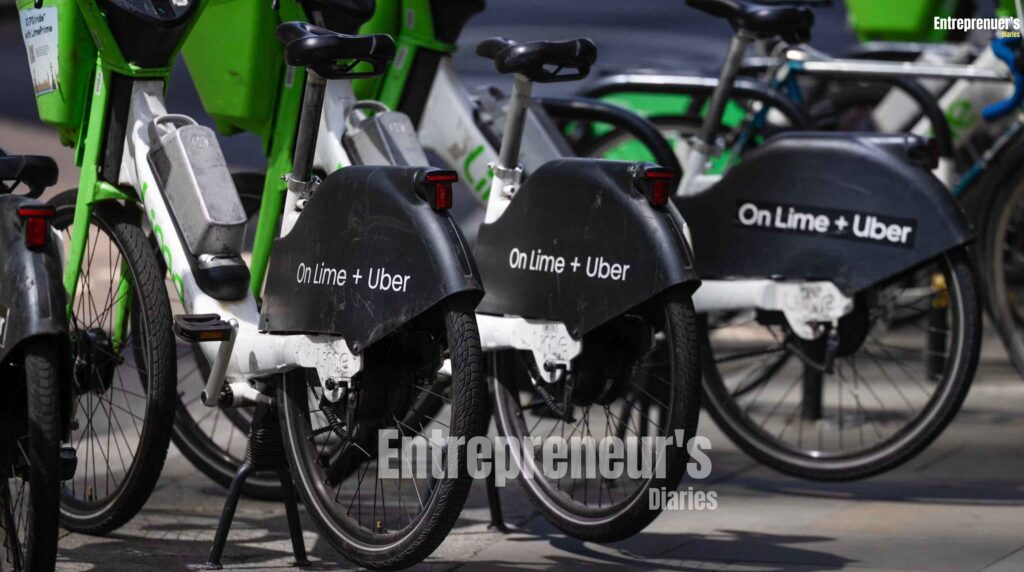
The real value of the Uber relationship has absolutely nothing to do with a one time stock purchase. It is rooted in operational integration. Lime and Uber operate under what the filing describes as a mutually exclusive partnership. Under this agreement, Lime vehicles appear as a ride option directly inside the Uber app in nearly all of Lime’s shared markets.
This integration is a massive, essentially free customer acquisition channel for Lime. According to the company’s own disclosures, revenue from this Uber partnership made up 14.1% of Lime’s total revenue in 2023. It grew to 15.8% in 2024, dipped slightly to 14.3% in 2025, and sat at 14.0% in the first quarter of 2026.
The history between the two companies is also deeply intertwined.
According to the capitalization history in the filing, Lime commanded a massive $2.4 billion private valuation in 2019. This was the absolute peak of the pre pandemic scooter mania.
When urban travel evaporated during the COVID-19 lockdowns in 2020, that valuation collapsed. Uber stepped in to lead a $170 million rescue round at a drastically reduced valuation of roughly $510 million.

The filing also reveals a side letter called the “Uber Lock Up,” originally signed in October 2023 and amended just prior to the public filing.
Under this agreement, Uber promised not to sell its existing Lime shares for a staggered period of up to two years after the IPO. Interestingly, this lock up agreement contains an exception. It does not apply to any new shares Uber decides to buy directly in the IPO offering itself.
The Hidden Financial Magic Trick
If you only read the headlines about the valuation and the Uber investment, you will completely miss the most important part of this entire filing. The real story is hidden deep in the financial statements. It lives in a section that casual readers almost always skip.
To understand it, you have to look at Lime’s balance sheet as of March 31, 2026. On an actual, pre transaction basis, Lime reported total stockholders’ equity of negative $565.7 million. The company also reported a working capital deficit of $529.0 million as of that exact same date.
How does a company going public with a $1.6 billion valuation have a balance sheet that is half a billion dollars in the hole?
The answer lies in two massive convertible debt instruments. Lime was carrying $209.6 million in so called 2020 Notes and a staggering $682.9 million in 2021 Notes. Because of the impending IPO, both of these were classified as current liabilities.
This is where the IPO becomes a financial engineering marvel. The public listing does not just raise a little bit of cash. It acts as a mechanical trigger. It forces the automatic conversion of nearly all of that debt into common stock.
The filing details three separate conversions tied to the completion of the offering. First, the $85.0 million 2020 Uber Note, plus roughly $85.0 million of other 2020 Investor Notes, convert into 12,556,013 shares of common stock.
Second, the $417.6 million in 2021 Notes convert into approximately 26,800,164 shares. This calculation is based on the $25.00 midpoint assumption. Third, all outstanding convertible preferred stock converts into 6,916,489 shares of common stock.
When you run the math, roughly $900 million in debt and preferred equity simply vanishes from the liabilities side of the balance sheet. It reappears instantly on the equity side as common stock.
And this happens completely independent of whatever cash public investors are putting into the company during the raise. The effect on Lime’s financial health is dramatic, almost overnight. The company’s own “as adjusted” figures show total stockholders’ equity flipping from negative $565.7 million to a positive $436.2 million.
After applying the net proceeds from the actual IPO cash raise, that positive equity figure climbs further to $577.0 million. In plain English, this IPO is doing two entirely separate jobs at the same time.
It is selling a small slice of new equity to the public to raise working capital. Simultaneously, it is using the mere fact of becoming a public company to scrub nearly a billion dollars of toxic, high interest debt off its books. There is one more technical housekeeping note buried in the filing that illustrates this financial reset.
Lime executed a massive 672 to one reverse stock split. This was executed in two stages in May and June. All historical share counts in the prospectus have been restated to reflect this split. They essentially had to do this to get the share price out of the pennies and into the $20+ range required by the Nasdaq.
The Core Business: Real Growth, But Still No Profit
When you look past the balance sheet mechanics, you have to ask the fundamental question. Is the actual scooter business working? The answer is decidedly mixed. Lime’s underlying operational metrics have genuinely improved over the last three years.
According to the consolidated financial statements published in the SEC filing, revenue reached $522.0 million in 2023. It jumped to $686.6 million in 2024. And it hit $886.7 million in 2025. That represents a 29.1% growth rate in 2025, which is nothing to sneeze at. The first quarter of 2026 kept that momentum going, hitting $170.2 million.
More importantly, the company proved it could actually generate cash. Lime reported positive free cash flow of $1.1 million in 2023. It jumped to $47.3 million in 2024. And it crossed the $100 million mark in 2025, hitting $103.8 million. Profitability on a net income basis, however, remains a distant dream.
Lime posted a net loss of $122.4 million in 2023. The company has incurred a net loss every single year since it was founded in January 2017. The filing explicitly states that Lime “may not be able to achieve or maintain profitability in the future.”
The losses did narrow sharply to $33.9 million in 2024, giving investors hope. But they widened again to $59.3 million in 2025. The bleeding continued into the first quarter of 2026, with a net loss of $61.3 million.
To make the financials look more attractive to growth investors, Lime leans heavily on non GAAP metrics.
Adjusted EBITDA, which strips out interest, taxes, depreciation, and other costs, is the favored metric here. The company reported an Adjusted EBITDA of $99.8 million in 2023. It grew to $153.4 million in 2024. And it hit $218.1 million in 2025.
The difference between a $59 million net loss and a $218 million adjusted EBITDA profit is entirely driven by the massive depreciation of their vehicle fleet. It is also driven by the heavy interest payments on that $900 million in debt we just discussed.
Gross margins have been slowly climbing as Lime improves the hardware durability of its scooters and e bikes. In 2023, gross margin was 32.4%. It climbed to 40.9% in 2024, before dipping slightly to 39.0% in 2025. Adjusted gross margin, which removes the depreciation hit, held remarkably steady at roughly 53% to 54%.
The Structural Reality Of Seasonality
Investors also have to wrap their heads around the extreme seasonality of this business. Lime makes almost all of its money when the weather is warm. Rider demand peaks aggressively in the second and third quarters.
Conversely, the first quarter of the year is a consistent financial bloodbath. People are simply not riding scooters in the snow or the pouring rain. But the company still has to pay its permanent staff, its insurance, and its administrative costs.
The quarterly free cash flow numbers highlight this perfectly. Lime posted negative free cash flow of $79.2 million in the first quarter of 2026. This was actually slightly worse than the negative $72.2 million logged in the first quarter of 2025.
Furthermore, a majority of fleet capital spending happens in the fourth quarter. This is when Lime buys new hardware to prepare for the next year’s riding season. So cash flows out the door right when revenue is dipping.
The company tries to explain this away in the filing as a known factor. But for public market investors who judge companies on a strict quarterly basis, these wild, predictable swings are incredibly difficult to stomach.
The Competitive Landscape And Market Share
Lime is not the only company trying to make micro mobility work. But it is arguably the one left standing in the strongest position. The filing describes Lime as the largest global shared business. The operational data provided in the prospectus mostly backs this claim up.
As of December 31, 2025, Lime operated in approximately 230 cities across 29 countries. Over the course of that year, the company served roughly 19 million unique riders.
Monthly active users grew 19% in 2024 and 21% in 2025. Lime entered 19 new cities during 2025 alone. The company also reported what it calls a 116% “operational fleet retention rate” for the year, meaning they are keeping their hardware alive longer.
Lime cites data from Sensor Tower to back up its market share claims. According to this third party data, Lime holds roughly 27% of the global market share and 37% of the U.S. market share.
This market share includes both docked systems and dockless systems. When you narrow the data to only include dockless competitors, Lime’s dominance becomes even more clear.
In the dockless category, Lime claims a 35% global market share and a 48% U.S. market share. The company states this is nearly three times the share of the next largest dockless operator. This is based on monthly active users.
The filing lists a formidable roster of competitors. In the dockless space, Lime names Bird, along with its Spin subsidiary. It also names Bolt, Neuron Mobility, which recently merged with Beam Mobility, Voi Technology, and Dott, formerly known as Tier Mobility. HelloRide is also on the list.
In the docked bike share sector, which requires physical infrastructure anchored to city streets, Lime names Lyft as its primary competitor.
The most notable absence from the competitive threat list is the existential doom that hung over the industry just a short while ago.
Rival operator Bird, which once held its own massive valuation and went public via a SPAC merger, has since filed for bankruptcy. Lime’s filing represents the first serious test of public market appetite for this sector since that spectacular crash.
When Lime first filed its S-1 in May, IPOX Research associate Lukas Muehlbauer offered a measured take to Reuters. He noted that the filing reflected a better IPO market and a stronger company profile than in previous years. But he cautioned that the company remains loss making. He said investors will look incredibly closely at whether Lime can turn strong revenue numbers into consistent, actual profitability.
The Fragility Of The Operating Model
Despite the impressive market share numbers, Lime’s operating model is inherently fragile. The company is entirely dependent on the goodwill of local city governments. If a city decides it doesn’t want scooters on its sidewalks anymore, Lime’s revenue in that market drops to zero overnight.
The risk factors section of the S-1 filing is unusually candid about this vulnerability. Lime specifically cites Madrid as a primary example. In 2024, city regulators revoked the permits for all e scooter operators. This effectively shut Lime out of a major European capital.
An even more damaging example occurred in 2023. A public referendum in Paris resulted in a definitive ban on shared e scooters. This forced Lime, along with every single competitor, to completely withdraw from one of the most famous cities in the world.
A more recent example occurred in Prague. The filing notes that Prague adopted a measure in October 2025 banning shared e scooters from being parked anywhere in the city, effective January 2026. Lime says it has continued operating e bikes there, but the scooters are gone.
Revenue is also dangerously concentrated in just a handful of markets. According to the SEC filing, the United States, the United Kingdom, and France together accounted for roughly 60% to 70% of Lime’s total revenue across the periods reported.
If regulators in London or New York were to suddenly change their tune on micro mobility, Lime’s financial trajectory would be severely damaged. Weather is another structural risk that simply cannot be mitigated. The company admits in its filing that bad weather on weekends, holidays, or other peak riding periods has historically hurt revenue.
Perhaps the most concerning disclosure for institutional investors is not about scooters or weather, though. It is about corporate governance. Lime discloses a material weakness in its internal control over financial reporting. The company admits this weakness has not yet been fully remediated.
For a company attempting to build trust with public market investors, an unresolved material weakness in accounting controls is a significant red flag. It requires the company to rely on additional manual oversight. And it inherently increases the risk of financial misstatements.
Sizing The Total Addressable Market
To justify its valuation, Lime needs to convince investors that micro mobility is not a niche novelty. It must prove it is a fundamental, permanent shift in urban transit. The company breaks down its market opportunity using three distinct tiers.
First, there is the current serviceable addressable market. Based on current adoption rates of roughly 15% of addressable riders in the cities where Lime already operates, the company sizes this market at $6.1 billion.
Second, Lime argues that this figure could easily grow to $12.0 billion. This growth would occur if adoption rates in existing cities increased to the 30% to 40% levels already seen in Lime’s most mature, highly utilized markets.
Finally, the company presents its total addressable market. By including cities targeted for expansion over the next five years, Lime pegs the ultimate theoretical market at approximately $69.1 billion. This $69 billion figure is designed to show public market investors that there is still a massive runway for growth.
However, investors will likely weigh this massive potential against the historical difficulty of actually generating a net profit in the space. Capturing even a fraction of that $69 billion requires navigating complex city bureaucracies. It requires managing thousands of charging gig workers. And it requires maintaining a fleet of vehicles that are constantly being vandalized or worn out by urban streets.
The Road Ahead And The Final Test
With the amended S-1 now public, the mechanics of the offering shift from document preparation to pure sales. Lime is expected to begin its investor roadshow. This process is also known as bookbuilding.
During this sprint, the company’s executives and their bankers at Goldman Sachs and J.P. Morgan will pitch institutional investors. They will sit in conference rooms in New York, Boston, and San Francisco. They will make the case for why a conservative mutual fund should allocate part of its portfolio to an unprofitable scooter company.
The actual IPO price will be determined entirely by the demand generated during this roadshow. If the order book is heavily oversubscribed, the bankers will likely price the deal at or above the $26 top of the range. If institutional investors push back on the valuation, the price will drift toward the $24 floor. In a worst case scenario, the banks may even be forced to reduce the total number of shares offered.
Whenever “LIME” finally begins trading on the Nasdaq Global Select Market, the market will set the real number. The prospectus valuation will instantly become historical trivia.
The Analytical Closing: A Permanent Case Study In Venture Capital
Strip away the investment banker presentations and the glossy prospectus covers. What Lime is doing this week is a referendum on an entire era of technology investing. The cash raise itself is modest. Somewhere between $141 million and $165 million is barely enough to register as a blip on the radar of mega funds.
What makes this filing a permanent case study in technology finance is the balance sheet reset. A company that was $565 million in the hole has engineered a transaction that flips its equity to positive $577 million. This was achieved not by selling more scooters, but by utilizing the structural mechanics of an IPO to convert nearly a billion dollars of toxic debt into equity.
It is a brilliant, legal, and entirely necessary maneuver. Without it, Lime would likely not have been able to go public at all.
The broader micro mobility industry is watching this offering incredibly closely. If Lime trades well and holds its valuation, it will open the capital markets for other struggling mobility startups. It will signal that public investors are willing to look past historical net losses. It will prove they will pay up if the unit economics and adjusted EBITDA show a clear path to maturity.
If Lime struggles, it will confirm the lingering fear that shared scooters and e bikes are fundamentally flawed businesses. It will reinforce the narrative that they are capital intensive, low margin operations entirely at the mercy of local city councils.
The valuation arc itself tells the story of the last decade. A $2.4 billion private valuation in 2019 at the height of the scooter mania. A brutal crash to $510 million in 2020 when Uber had to step in with a rescue round. And now, a carefully managed IPO aiming for $1.6 billion.
It is a real recovery. But it is still a stark 30% discount to the heady days of 2019. This IPO is not a victory lap. It is a managed retreat to a defensible position. Lime has survived the venture capital nuclear winter. It has cleaned up its balance sheet. It has stabilized its operational losses. It has even managed to generate over $100 million in annual free cash flow.
But the transition from a private startup burning through venture capital to a public company answering to quarterly earnings calls is brutal. The public markets have zero patience for explanations about seasonality or the weather.
The price Lime lists at on day one will answer the question of whether the banks successfully sold the narrative. What happens to the stock over the following twelve months will answer the much harder question. Are electric scooters a permanent fixture of urban life? Or are they just a fleeting fad that left a lot of broken hardware on the curb?
This filing is the cleanest, most transparent data point the shared micro mobility industry has produced in years. It deserves to be read far past the headline valuation. Because the story here isn’t about how much Lime is worth today. It’s about whether the economic model of moving people on two wheels can actually survive the harsh, unforgiving light of the public markets.
Frequently Asked Questions About The Lime IPO
What is Lime’s stock ticker symbol and where will it trade?
According to the official filing with the U.S. Securities and Exchange Commission, Lime, legally named Neutron Holdings, Inc., has applied to list its common stock on the Nasdaq Global Select Market. The company will trade under the ticker symbol “LIME”.
What is Lime’s official IPO valuation?
Lime set an official price range of $24.00 to $26.00 per share in its amended S-1 prospectus. Based on the 64,025,936 shares expected to be outstanding after the offering, this implies a valuation of approximately $1.54 billion at the bottom of the range and $1.66 billion at the top of the range.
Is Lime a profitable company?
No. According to the financial statements in the SEC filing, Lime reported a net loss of $59.3 million in 2025 and a net loss of $61.3 million in the first quarter of 2026. The company explicitly states in its risk factors that it has incurred a net loss every single year since it was founded in January 2017.
How much is Uber investing in the Lime IPO?
Despite early media reports suggesting a massive anchor investment, the official prospectus reveals that entities affiliated with Uber have only indicated interest in purchasing up to $20.0 million in shares. The filing clearly notes this is a non binding indication of interest, meaning Uber retains the right to purchase fewer shares or no shares at all in the final offering.
What happens to Lime’s debt after the IPO?
The IPO triggers an automatic conversion of nearly $900 million in convertible debt and preferred equity into common stock. This includes 2020 Notes, 2021 Notes, and convertible preferred stock. According to the company’s “as adjusted” financial disclosures, this conversion flips Lime’s total stockholders’ equity from a negative $565.7 million to a positive $577.0 million.
Connect With Us On Social Media [ Facebook | Instagram | Twitter | LinkedIn ] To Get Real-Time Updates On The Market. Entrepreneurs’ Diaries Is Now Available On Telegram. Join Our Telegram Channel To Get Instant Updates.

Isabella is a global business journalist and former McKinsey analyst from Brazil. She brings sharp insights on economic shifts, policies, and founder journeys from around the world.