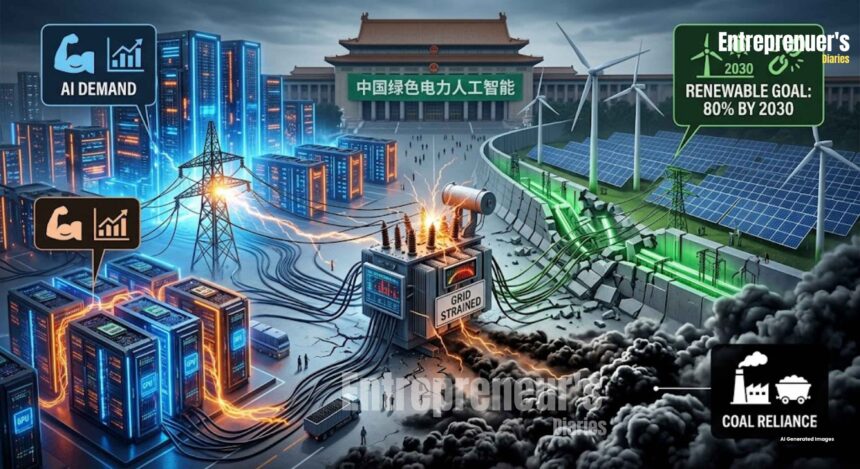
Beijing, June 22, 2026: Four out of every five kilowatt hours flowing into China’s AI data centres are supposed to come from wind, solar, and other clean sources by 2030 the center piece of what amounts to a China Green Power AI strategy already written into national policy. That target sits inside one of the most ambitious energy industrial pairings on the planet right now, and according to the power executives actually running the grid, it is colliding with a problem money alone cannot fix: AI infrastructure simply does not behave like the energy hungry industries China built its renewable strategy around.
For entrepreneurs, energy investors, and anyone pricing the AI infrastructure boom, this is not a side story about emissions targets. It is a live test of whether the world’s largest clean energy buildout can actually keep pace with the world’s fastest growing source of electricity demand.
THE HEADLINE NUMBER: FROM 11% TO 80% RENEWABLE POWER
Per Reuters, which reported from Beijing on June 22, 2026, Chinese authorities are aiming for renewables to supply 80% of the data center sector’s total power consumption by 2030.
That is a sharp jump. Reuters reports the comparable figure was just 11% in 2023.
Reuters’ reporting, by correspondents Che Pan and Eduardo Baptista, cites industry experts who warn the target is running into real friction on the ground, even as the policy goal itself has not changed.
WHAT BEIJING ACTUALLY WROTE INTO POLICY
Reuters reports that ensuring reliable electricity for AI focused data centers has become a strategic priority, underscored in China’s 2026 government work report released earlier this year, which pledged stronger integration between computing infrastructure and power supply networks.
People’s Daily, the official newspaper of the Communist Party of China, reported the exact language used. This year’s Government Work Report, per People’s Daily, stated for the first time that China would “create new forms of the smart economy” and “launch new infrastructure projects on hyperscale intelligent computing clusters and coordinated development of computing capacity and electricity supply.” That phrase, compute power coordination, is now a national infrastructure category rather than a regional pilot idea.
The shift did not stay on paper for long. Within weeks of the March 2026 government work report, multiple central agencies issued supporting measures, and a late April Politburo meeting placed computing networks alongside power grids inside a broader national infrastructure push, according to reporting from financial news outlet Jiemian.
That 2026 mandate builds on an earlier official blueprint. China’s State Council, on its official English language web portal, published an action plan stating that data centers should increase their renewable energy utilization rate by 10% annually, with the country’s overall data center power usage itself expected to climb by roughly 15% annually under the same plan.
THE DEMAND WAVE: UP TO 500 BILLION KILOWATT HOURS BY 2030
The renewable target only matters because of the sheer scale of demand growth behind it. Per Reuters, power demand from China’s data centers is projected to rise by 300 billion to 500 billion kilowatt hours between 2026 and 2030, equal to roughly 18% of China’s total electricity demand growth over the period. The figures come from Pei Shanpeng, a director at state owned power firm State Power Investment Corp, speaking at an industry conference in Beijing last week. Reuters adds scale: the bottom end of that range, 300 billion kilowatt hours, is roughly equivalent to the United Kingdom’s entire annual power consumption.
Independent estimates from energy research firm Rystad Energy land in a similar bracket, projecting China’s data center power consumption will reach 289 terawatt hours by 2030, more than double recent levels and about 2.3% of total electricity demand, growing at a compound annual rate of roughly 19% between 2025 and 2030, far outpacing the 3.9% rate Rystad projects for China’s total power demand. Academic analysis published in Frontiers in Energy Research, citing International Energy Agency projections, puts the 2030 figure at 277 terawatt hours instead, a 170% increase from 2024 levels. The exact numbers vary by methodology, but every credible estimate points the same direction: explosive growth concentrated in one sector.
WHY CHINA GREEN POWER AI BREAKS THE OLD PLAYBOOK
China’s renewable energy strategy was not built with AI workloads in mind. It was built around heavy industry.
Per Reuters, the data center sector is a poor fit for green power providers compared with traditional energy intensive industries such as aluminum smelting, largely because its peak demand is harder to predict.
Aluminum smelters, unlike GPU clusters, can power down during low wind or low solar hours and ramp back up when renewable output peaks. That flexibility is exactly what makes a customer attractive to a wind or solar operator trying to sell power around an intermittent generation curve.
Pei Shanpeng put it directly, according to Reuters: “At least for now, they do not appear to be very flexible (in managing power demand).”
He continued: “From what we understand, they (data centers) cannot really adjust power consumption load much. GPUs are very expensive, so once they are purchased, operators want to use them as quickly and as intensively as possible.”
A GPU cluster is a sunk cost the moment it ships. Idling it to wait for sunnier or windier hours destroys the return on that capital, so operators run hardware near constant full utilization regardless of what the grid is doing.
Pei also told the conference, per Reuters, that the push to expand green power use by data centers is aimed more at cutting emissions than at lowering electricity costs. That is a meaningful distinction for anyone modeling the unit economics of this transition, because it implies the green power shift is being driven by policy compliance and climate targets first, not by a near term cost advantage for operators.
THE GRID OPERATORS’ DILEMMA
A second hurdle is structural, not technical.
Reuters reports that experts say wider adoption of direct green power links to data centers could face resistance from grid operators themselves.
The concern, per Reuters, is that these dedicated networks would see electricity sales decline through the broader grid, making it harder for operators to recover heavy investments already made in transmission and distribution infrastructure if data center demand later slows or falls.
That is not a hypothetical risk sitting in a spreadsheet. Reuters reports China’s fast tracked data center rollout has already started straining the power sector in certain areas, increasing both average and peak grid loads and forcing operators to balance rising demand against reliability risk.
Wang Zelin, deputy director at State Grid Jibei Electric Power Research Institute, quantified what flexibility could be worth to the system. Per Reuters: “If 15% of the power consumption loads can be adjusted, it will significantly reduce capacity expansion pressure on the grid over the next three to five years.”
Taken together, the two officials’ remarks outline the bottleneck precisely: data centers cannot flex much today, but if even a modest share of their load could flex, the grid’s multi year capacity expansion burden would ease meaningfully.
INSIDE EAST DATA WEST COMPUTE
The compute power coordination concept now written into the 2026 government work report builds on an existing, longer running policy called East Data, West Compute.
The basic idea, per a February 2026 research comment from the Oxford Institute for Energy Studies, is to route data processing toward China’s western regions, which hold abundant wind, solar, and hydro resources, while keeping latency sensitive workloads closer to eastern population centers. This has been a centerpiece of Chinese data center policy for several years, with provinces such as Guizhou, Inner Mongolia, Gansu, and Ningxia handling AI training and storage tasks that do not require split second responsiveness.
The same research offers a reality check, too. Contrary to claims that Chinese electricity is essentially free for data center operators, the Oxford Institute for Energy Studies found Chinese power costs are roughly in line with those in the United States, though below levels seen in Europe. What China does offer, per that analysis, is faster infrastructure approval and a lower risk of the interconnection delays that have slowed some data center construction in Western markets.
Brokerage research from Zheshang Securities, reported by financial outlet Zhitong Finance, frames the underlying problem as a mismatch in both space and time: electricity heavy demand sits in the east, while curtailed, underused wind and solar power sits in the west. That report describes two coordination models now in policy use: “computing follows power,” where workloads shift to match renewable output, and “power follows computing,” where supply is routed to match where demand already exists.
PROOF POINTS ALREADY ON THE GROUND
Some of this is no longer theoretical. Rystad Energy’s analysis points to Zhongjin’s Ulanqab computing base, described by the firm as one of China’s first zero carbon computing projects, connected to 200 megawatts of wind power, 100 megawatts of solar power, and 45 megawatts of battery storage. China Mobile and Tencent run comparable hybrid setups pairing rooftop solar, on site battery storage, and green electricity certificate procurement, per Rystad Energy.
Financial news outlet Jiemian reports solar developer Jinko Power has gone further, announcing a 24.5 billion yuan investment in a computing facility in Ningxia, while China Southern Power Grid Energy Development, Envision Energy, and Sungrow Power Supply are each building integrated electricity, carbon, and computing management systems for data center operators.
Even in pilot regions built for this exact pairing, Jiemian reports practical friction remains. Wind and solar farms are often sited more than 100 kilometers from the data centers they are meant to supply, and in some cases surplus electricity cannot even be sold externally, weakening project economics.
WHY CHEAP POWER IS BECOMING A COMPETITIVE WEAPON
Electricity cost is not a side issue for AI companies; it is one of the largest line items they have. Per Jiemian, citing brokerage estimates, electricity accounts for more than half of total data center operating costs in China, and in some western regions solar and wind generation costs have fallen to around 0.1 yuan per kilowatt hour, well below coal fired benchmarks.
Jiemian links that cost structure to China’s AI pricing in global markets, noting DeepSeek charges roughly $0.42 per million tokens, far below the roughly $15 charged by comparable models elsewhere. Cheap, reliable power sitting upstream of training and inference costs is one input behind that gap, alongside other engineering and business factors.
People’s Daily frames the stakes in starker geopolitical terms, citing an online saying circulating as AI infrastructure competition intensifies: “the end of electricity is China.” That reflects an official Chinese narrative rather than an independent market judgment, and it sits alongside the outlet’s own comparison describing the United States power grid as fragmented across three largely separate interconnections, creating dispatch mismatches China’s more unified grid does not face in the same way.
STATE GRID’S NEARLY $600 BILLION BET
Behind all of this sits a capital commitment large enough to reshape entire equipment supply chains. Per People’s Daily, the State Grid Corporation of China announced its fixed asset investment during the 15th Five Year Plan period, covering 2026 through 2030, is expected to reach 4 trillion yuan, or roughly $579.98 billion, a 40% increase compared with the prior 14th Five Year Plan period. People’s Daily also reports power equipment manufacturers in provinces including Guangdong and Jiangsu are running at full capacity, with China’s overseas orders for power equipment on the rise.
State Power Investment Corp, whose director provided the demand figures at the center of this story, is itself one of China’s large state owned energy conglomerates, with a generation portfolio spanning nuclear, wind, solar, hydro, coal, gas, and biomass, according to company profile data published by GlobalData.
WHAT STILL HASN’T BEEN SOLVED
It is worth being precise about what remains unresolved, because the gap between policy ambition and operational reality is exactly where risk concentrates.
Climate and energy policy outlet Carbon Brief reports coal still accounts for about 60.5% of China’s overall power mix, and most data centers sit in the east, where roughly 70% of electricity supply still comes from coal. Carbon Brief, citing International Energy Agency analysis, reports renewables and nuclear power together are expected to make up only 60% of China’s data center electricity supply by 2035, meaning coal will stay relevant well past the 2030 target now in focus. A 2024 government update cited by Carbon Brief found more than 50 data centers nationwide had met an official “green” energy standard, a meaningful but still early stage share of the national fleet.
Jiemian’s reporting adds that regulatory barriers remain significant in practice: cross provincial electricity trading is complex, pricing mechanisms vary by region, approval processes for direct power connections are often slow, and long term contracts between power producers and data center operators remain difficult to structure given high storage costs and uncertain future demand.
WHY THIS MATTERS FOR INVESTORS AND FOUNDERS
Strip away the policy language, and the lesson for capital allocators is direct: in China’s AI buildout, the energy supply chain is now as strategically important as the chip supply chain.
A target of 80% renewable power for data centers by 2030 is not in dispute as a stated goal. What is in dispute, according to the power sector’s own experts, is whether grid infrastructure, contract structures, and storage economics can move fast enough to deliver it without slowing AI capacity growth or quietly leaning back on coal to fill the gap. For investors tracking the broader AI energy nexus already reshaping utility and grid infrastructure valuations from the United States to Europe, China’s experience is an unusually transparent data point, because the people flagging the problem are the state owned power companies tasked with solving it.
The named gaps point toward where capital is already flowing inside China’s energy sector: battery storage and demand response systems, smart dispatch software tying computing load to power availability, and renewable generation paired directly with computing hubs. Wang Zelin’s 15% demand adjustability figure is, in effect, a sizing exercise for that opportunity, and for founders building energy management technology, the demand signal is now coming directly from state grid entities and national planning documents, not just corporate sustainability pledges.
THE CLOSING ARGUMENT
There is a version of this story that fits in a single headline: China wants its AI boom to run on clean power, and the grid says that is harder than it sounds. That version is accurate, but it undersells what is actually happening.
What is unfolding is a real time stress test of an industrial policy built for a different kind of customer. China’s renewable strategy was engineered around factories that can pause and restart with the wind. AI data centers cannot behave that way, because the economics of an idle GPU cluster make flexibility prohibitively expensive for the operator running it.
That mismatch is not a flaw in China’s ambition. It is the actual frontier of the AI energy problem, and it is the same frontier utilities in the United States and Europe are quietly fighting through power purchase agreements, on site gas turbines, and nuclear deals of their own. China is simply further along in writing it into national planning documents and state owned companies’ public remarks.
The companies and policymakers who solve the load flexibility problem first, not the ones who simply announce the highest renewable percentage target, are the ones who will define who wins the AI infrastructure race over the next five years. For now, the people closest to China’s grid have said plainly that the answer is not yet built, a gap openly acknowledged by the very institutions responsible for closing it.
FREQUENTLY ASKED QUESTIONS
Why is China’s push for green power in AI data centers running into problems?
According to Reuters, industry experts say AI data centers are a poor fit for green power providers because, unlike traditional energy intensive industries such as aluminum smelting, they cannot easily adjust their power consumption to match variable wind and solar output. State Power Investment Corp director Pei Shanpeng told an industry conference in Beijing that once GPUs are purchased, operators want to run them as intensively as possible rather than idling them to match renewable supply.
What percentage of China’s data center power is supposed to come from renewables by 2030?
Reuters reports Chinese authorities are targeting 80% renewable power for the data center sector by 2030, up sharply from just 11% in 2023.
How much will China’s data center electricity demand grow by 2030?
Per Reuters, citing State Power Investment Corp director Pei Shanpeng, power demand from China’s data centers is projected to rise by 300 billion to 500 billion kilowatt hours between 2026 and 2030, equal to roughly 18% of the country’s total electricity demand growth over that period. Independent estimates from Rystad Energy and International Energy Agency backed academic research put related projections in the 277 to 289 terawatt hour range for total 2030 consumption, with estimates varying by methodology.
What is China’s “East Data, West Compute” strategy?
It is a national policy that routes data processing toward western Chinese regions such as Inner Mongolia, Gansu, Guizhou, and Ningxia, which hold abundant wind, solar, and hydro resources, while keeping latency sensitive computing closer to eastern population centers, according to the Oxford Institute for Energy Studies. The 2026 government work report’s compute power coordination language builds directly on this earlier framework.
Is China’s data center electricity still mostly powered by coal?
Yes, for now. Climate research outlet Carbon Brief reports coal accounts for about 60.5% of China’s overall power mix, and most data centers are located in eastern regions where roughly 70% of electricity supply still comes from coal. Carbon Brief, citing International Energy Agency analysis, reports renewables and nuclear together are expected to reach only 60% of China’s data center electricity supply by 2035.
Connect With Us On Social Media [ Facebook | Instagram | Twitter | LinkedIn ] To Get Real-Time Updates On The Market. Entrepreneurs’ Diaries Is Now Available On Telegram. Join Our Telegram Channel To Get Instant Updates.

Isabella is a global business journalist and former McKinsey analyst from Brazil. She brings sharp insights on economic shifts, policies, and founder journeys from around the world.

Luca is a tech ethicist from Italy exploring disruptive innovation through a human lens—from AI to biotechnologies to decentralization.