
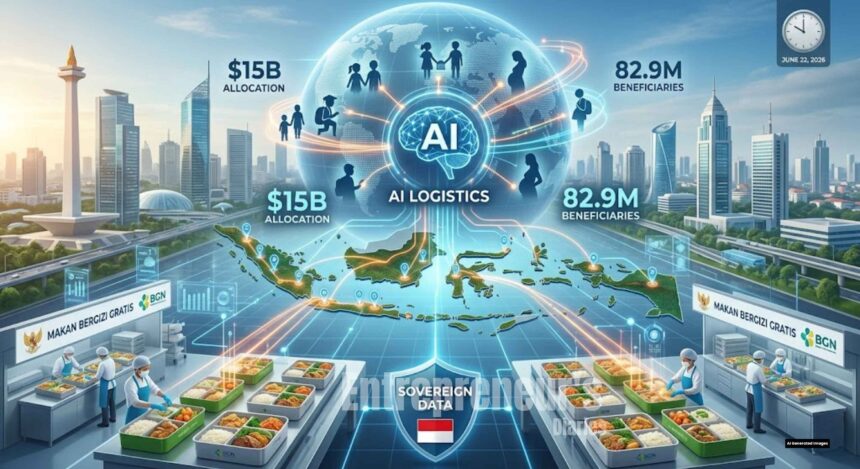
Jakarta, Indonesia, June 22, 2026: For entrepreneurs, institutional investors, and market strategists tracking how the Indonesia AI ecosystem and sovereign mandates collide with frontier technology adoption, the current developments in Southeast Asia’s largest economy represent a paradigm shift. This is not a standard government welfare rollout.
This is a real time case study of how a nation state can utilize a massive fiscal expenditure to forcibly accelerate the adoption of enterprise artificial intelligence, creating a predictable, multi billion dollar procurement pipeline for tech infrastructure.
At the center of this economic transformation is Indonesia’s “Makan Bergizi Gratis” (Free Nutritious Meal) program, a monumental initiative officially valued at approximately 71 trillion Indonesian Rupiah (roughly $15 billion USD). More importantly for the technology sector, the Indonesian government has explicitly mandated that Artificial Intelligence will be the operational backbone of this program.
According to official statements from the Ministry of Communication and Digital (Komdigi) and the National Nutrition Agency (Badan Gizi Nasional / BGN), AI is no longer an experimental side project for the state. It is now a mandated requirement for executing the largest single social welfare logistics operation in the country’s history.
THE INDONESIA AI MANDATE: DECONSTRUCTING THE $15 BILLION FISCAL ALLOCATION
To understand the market implications of the Indonesia AI push, one must first deconstruct the sheer scale of the fiscal engine driving it. The budgetary figures for the Free Nutritious Meal program originate directly from the National Nutrition Agency (BGN) and the Ministry of Finance.
According to official BGN portal publications and statements by BGN Head Dadan Hindayana, the program has been allocated a baseline budget of approximately 71 trillion Indonesian Rupiah (roughly $15 billion USD).

However, market economists must recognize that this $15 billion is not a traditional technology budget. It is a total operational expenditure legally bound by a presidential directive. According to the Ministry of Finance’s official budget summaries, this funding is sourced from reallocations of existing fuel and energy subsidies, channeled directly into BGN operational accounts.
The BGN officially states this allocation must facilitate the delivery of meals to 82.9 million beneficiaries. This target includes 15 million children in early childhood education, 29 million students, and nearly 39 million pregnant women. This is the exact point where a standard fiscal allocation transforms into an Indonesia AI mandate.
Distributing resources across an archipelago of over 17,000 islands to 82.9 million beneficiaries creates a logistical bottleneck that legacy enterprise systems cannot solve. Because the government is legally obligated to execute this $15 billion expenditure efficiently, AI logistics transition from an optional technology upgrade to a mandated procurement necessity.
For technology vendors and institutional investors, this creates a highly unusual market dynamic. The demand for Indonesia AI infrastructure is now backed by non discretionary state spending, fundamentally insulated from standard corporate budget cuts.
THE AI INTEGRATION DIRECTIVE: WHAT OFFICIALS ACTUALLY SAID
The explicit directive to embed AI into this massive logistical undertaking was confirmed by the highest levels of the Indonesian digital government apparatus. Presidential Special Envoy for Digital, Timothius Thomas (Tomy) Hakim, provided the definitive explanation of how AI would be utilized.
Speaking in official government briefings documented by the Presidential Secretariat, Hakim stated that AI would be deployed for two primary functions: “needs mapping” (pemetaan kebutuhan) and “supply chain optimization.”
According to Hakim’s official statements, the government cannot rely on manual census data to determine who receives meals, what specific nutritional profiles they require (e.g., addressing stunting or anemia), and when those needs fluctuate.
AI algorithms will be used to dynamically map these variables across Indonesia’s vast and geographically dispersed archipelago. Furthermore, Hakim explicitly stated that AI would manage the supply chain logistics.
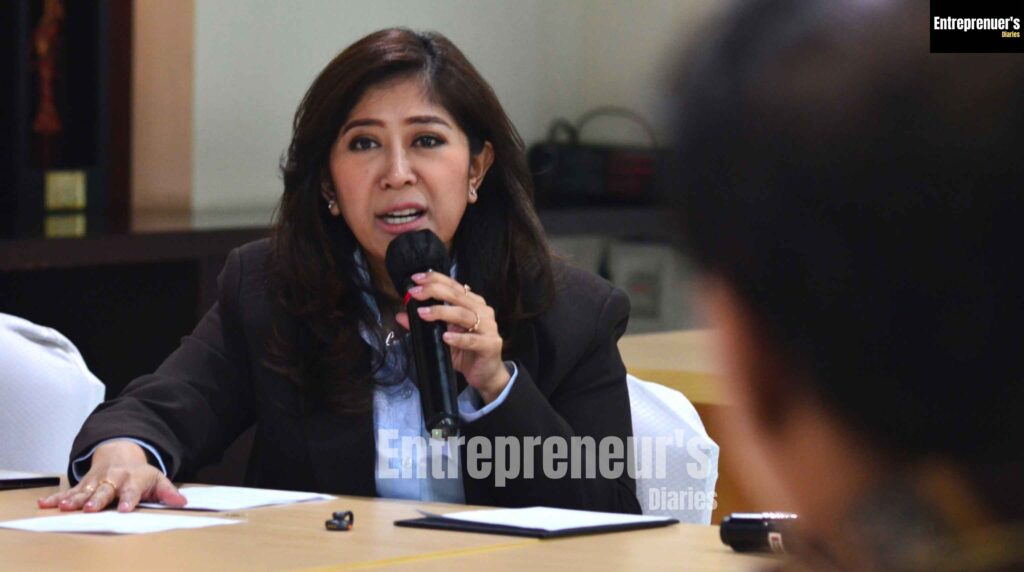
This involves using machine learning models to predict localized agricultural yields, optimize trucking routes across thousands of islands, and manage inventory turnover to prevent food wastage. These statements were subsequently reinforced by Minister of Communication and Digital, Meutya Hafid.

According to official releases from the Komdigi ministry, Minister Hafid framed the meal program not just as a health initiative, but as the primary anchor tenant for the government’s new “Sovereign AI” strategy.
The ministry officially stated that the complexity of the meal program provides the necessary scale to test and deploy domestic AI models in real world, high stakes environments.
THE SUPPLY CHAIN BOTTLENECK: WHY TRADITIONAL LOGISTICS FAILED
To appreciate why the government turned to AI, one must analyze the physical constraints outlined in the BGN’s official implementation guidelines. Indonesia is an archipelago of over 17,000 islands, presenting a logistical nightmare for standardized food distribution.
The BGN’s official portal details a decentralized “hub and spoke” model for the meal program. The government is not building central mega kitchens. Instead, it is contracting thousands of local catering units and community kitchens.
According to BGN data, the initial rollout requires establishing over 190,000 distinct service points across the country. Each of these service points must coordinate with local farmers for ingredient procurement, manage daily cold chain requirements, and verify the identity and eligibility of the beneficiaries receiving the meals.
Traditional enterprise resource planning (ERP) systems, which rely on static inputs and manual data entry, are structurally incapable of processing the daily micro fluctuations across 190,000 nodes. This is the exact market failure that AI is designed to solve, and it is the reason officials like Tomy Hakim stated that AI integration was not optional, but essential for the program’s survival.
THE MINISTRY OF DIGITAL’S MASTER PLAN: SOVEREIGN AI INFRASTRUCTURE
The integration of AI into the meal program cannot be separated from the broader infrastructure directives issued by the Ministry of Communication and Digital (Komdigi). Minister Meutya Hafid has officially articulated a vision for “Digital Indonesia,” which explicitly rejects the total reliance on foreign AI infrastructure.
According to Komdigi’s official strategic documents, the ministry views the massive data generated by state programs like the free meal drive as strategic national assets. This data cannot, under official policy, be processed exclusively on foreign owned cloud servers.
Therefore, the meal program’s AI requirements are being used to justify and accelerate the construction of domestic data centers and the deployment of local large language models (LLMs). Komdigi has officially partnered with domestic state owned enterprises and selected private tech consortia to build the computational infrastructure required to run these AI models.
The meal program acts as the guaranteed “baseline load” for this infrastructure. Just as a power plant needs a minimum guaranteed demand to justify construction, domestic AI data centers need a massive, guaranteed workload to attract investment. The $15 billion meal program provides that baseline workload.
THE DATA LOCALIZATION MANDATE: FORCING DOMESTIC CAPEx
The financial implications for cloud infrastructure providers are dictated by strict regulatory frameworks enforced by Komdigi. Indonesia enforces Government Regulation Number 71 of 2019 concerning the Implementation of Electronic Systems and Transactions (PP PSTE).
While this regulation has existed for years, Minister Hafid’s ministry has signaled aggressive enforcement of its data localization provisions regarding state data. According to Komdigi guidelines, any digital system processing critical public service data including the beneficiary data and logistical mapping of the BGN must utilize “Public Service Providers” certified by the government.
In practice, this certification requires data to be physically hosted within Indonesian borders. For global technology giants and local enterprise tech companies alike, this means that the AI models supporting the free meal program cannot simply run on US based AWS or Azure instances.
Capital expenditure (CapEx) must be directed toward building or leasing physical server space in Indonesia, utilizing local edge computing nodes, and partnering with Indonesian certified cloud operators.
This regulatory hardline transforms a software deployment into a heavy infrastructure play, shifting millions of dollars from operational software budgets into domestic real estate and hardware investments.
BEYOND THE MEAL PROGRAM: AI IN KEY NATIONAL PROGRAMS
The meal program is the largest, but not the only, key program receiving the AI integration mandate. The Presidential Special Envoy for Digital, Tomy Hakim, stated in official briefings that the government is systematically embedding AI across the bureaucratic apparatus.
According to the Ministry of Administrative and Bureaucratic Reform (KemenPAN RB), AI is being deployed to streamline public services, specifically targeting the elimination of bureaucratic bottlenecks in business permitting and civil documentation.
Furthermore, the Ministry of Agriculture, in official coordination with Komdigi, has initiated AI driven precision agriculture programs. These programs use satellite imagery and machine learning to predict crop yields and optimize fertilizer distribution.
The Coordinating Ministry for Economic Affairs has also officially integrated AI into its macro economic modeling, utilizing advanced predictive algorithms to forecast GDP growth and manage inflation targeting.
However, the meal program remains the cornerstone. As stated by Komdigi officials, it is the sheer volume and daily frequency of the meal program’s data that provides the training ground necessary to mature these other AI initiatives.
THE MARKET ECONOMICS: CREATING A FORCED DEMAND ECOSYSTEM
From a market economics perspective, the Indonesian government has engineered a “forced demand” scenario for enterprise AI. In a standard free market, AI adoption follows a curve of early adopters, proof of concept trials, and gradual enterprise integration. Indonesia is bypassing this curve entirely.
By tying AI adoption to a $15 billion presidential priority, the government has created an inelastic demand for specific technological capabilities: edge computing for remote kitchens, predictive AI for agricultural supply chains, and computer vision for beneficiary verification.
For venture capitalists and private equity firms monitoring Southeast Asia, this changes the risk profile of local AI startups. A startup developing AI logistics software in Jakarta no longer needs to convince a fragmented market of mid sized logistics firms to adopt its product.
It can target the BGN or its primary catering contractors, pitching a solution that directly solves a government mandated requirement backed by a multi billion dollar budget. This drastically reduces customer acquisition costs and time to revenue for domestic AI firms operating in the targeted verticals.
THE ENTERPRISE TECH PROCUREMENT PIPELINE
The specific technological components required to execute the AI integrated meal program have been outlined through the procurement guidelines of the BGN and its affiliated agencies.Based on official government tender documents and BGN implementation manuals, the procurement pipeline is heavily skewed toward several specific enterprise technologies. First, there is a massive requirement for Internet of Things (IoT) hardware.
To ensure food safety and prevent the spoilage of millions of meals, the BGN guidelines mandate strict temperature control. This requires IoT sensors in transport vehicles and storage facilities that continuously feed data back to central AI dashboards. Second, there is a high demand for biometric and identity verification systems.
To ensure the 82.9 million beneficiaries receive their allotted meals and to prevent “ghost beneficiaries” from siphoning funds, the government requires digital verification systems. These systems utilize AI to cross reference beneficiary databases with on site verification, often leveraging existing national ID databases managed by the Ministry of Home Affairs.
Third, there is the core requirement for AI driven Enterprise Resource Planning (ERP) software tailored for the food and beverage logistics sector. Traditional ERPs are insufficient. The government is actively seeking platforms that can ingest real time traffic data, weather forecasts, and local market price fluctuations for ingredients, and automatically reroute logistics accordingly.
REGULATORY RISK AND COMPLIANCE FRAMEWORKS
While the mandate creates opportunity, it is accompanied by severe compliance risks that enterprise tech providers must navigate. The Indonesian government operates under a strict “Responsible AI” framework articulated by Komdigi.
Minister Meutya Hafid has officially stated that any AI deployed in public services must be transparent, auditable, and free from algorithmic bias. For tech vendors, this means that “black box” AI models where the decision making process is opaque are unlikely to pass government procurement audits.
Vendors must be prepared to expose their model weights, training data origins, and decision logic to government auditors.
Furthermore, the Ministry of Finance’s strict audit protocols for state spending (BPK audits) apply fully to the technology components of the meal program.If an AI system fails to accurately predict supply needs, resulting in food wastage or missed deliveries, the tech vendor could be exposed to state liability claims.
The contractual frameworks being drafted by the BGN for its technology partners reflect this risk transfer, requiring vendors to guarantee specific accuracy thresholds for their predictive models.
THE GEOPOLITICAL ANGLE: COMPETING WITH SINGAPORE AND VIETNAM
Indonesia’s state backed AI push must be viewed through the lens of regional technological supremacy. For years, Singapore has been the undisputed tech hub of Southeast Asia, leveraging its regulatory clarity, rule of law, and capital markets to attract the regional headquarters of global tech giants. Vietnam has emerged as a fierce competitor in the offshore IT services and hardware manufacturing space.
Indonesia’s strategy, as articulated by Komdigi and the Coordinating Ministry for Economic Affairs, is different. It is leveraging its 270 million person domestic market as a weapon. By mandating that the infrastructure serving this massive market must be domestically hosted and locally integrated, Indonesia is effectively forcing global tech companies to treat it as a primary market, not just a secondary sales territory.
The $15 billion meal program is the most aggressive manifestation of this strategy to date. It signals to global investors that if you want to participate in the digital economy of Southeast Asia’s largest GDP, you must build your AI infrastructure inside Indonesia, under Indonesian regulatory oversight.
THE ANALYTICAL CLOSING: PRICING IN SOVEREIGN TECH RISK
There is a version of this story that fits neatly into a standard emerging market tech briefing: a developing nation is using modern software to improve its social services. That version is accurate, but it fundamentally misprices the risk and opportunity for professional investors.
What is actually happening in Indonesia is the deliberate weaponization of fiscal policy to force the maturation of a domestic AI ecosystem. The government has taken a $15 billion line item that must be spent, identified a logistical bottleneck that cannot be solved with legacy tech, and mandated a solution (AI and local data hosting) that must be built by the private sector.
This creates a highly asymmetric investment opportunity. The demand is guaranteed by the state; the supply is constrained by strict data localization and sovereign AI requirements. However, the risk profile has also fundamentally shifted.
Tech operators and investors in this space are no longer underwriting traditional software risk will the product work, will the customer buy it? They are now underwriting sovereign risk.
They are betting that the political will behind the “Makan Bergizi Gratis” program will survive potential budget cuts, administrative transitions, and the inherent friction of deploying untested AI models at a scale of 82.9 million human beings. They are betting that the regulatory enforcement of data localization will remain consistent, ensuring their heavy infrastructure CapEx is not stranded by a sudden shift in trade policy. The line between a lucrative government contract and a geopolitical bargaining chip is remarkably thin.
Enterprise founders and technology funds entering the Indonesian AI market post meal mandate must possess not just technical expertise, but deep competencies in sovereign risk analysis, state procurement law, and local geopolitical navigation. The $15 billion free meal drive is not just feeding a population. It is forcibly birthing a national AI industry. But in this market, the code is secondary to the contract, and the algorithm is entirely subordinate to the state.
FREQUENTLY ASKED QUESTIONS
How much is Indonesia spending on the Free Nutritious Meal program?
According to the National Nutrition Agency (Badan Gizi Nasional / BGN) and the Ministry of Finance, the program has been allocated a budget of approximately 71 trillion Indonesian Rupiah, which translates to roughly $15 billion USD.
How many people will the Indonesian free meal program feed?
Official data published on the BGN portal by agency head Dadan Hindayana states the program targets 82.9 million beneficiaries. This includes 15 million children in early childhood education, 29 million students, and nearly 39 million pregnant women and breastfeeding mothers.
What specific role does AI play in Indonesia’s meal program?
According to statements by Presidential Special Envoy for Digital Timothius Thomas Hakim and the Ministry of Communication and Digital (Komdigi), AI is mandated for “needs mapping” (dynamically identifying the nutritional requirements and locations of beneficiaries) and “supply chain optimization” (predicting agricultural yields, optimizing delivery routes across islands, and managing inventory to prevent spoilage).
Does Indonesia require AI data to be stored locally?
Yes. Under Government Regulation Number 71 of 2019 (PP PSTE) and strict enforcement directives from Komdigi led by Minister Meutya Hafid, critical public service data such as the beneficiary data and logistical data for the meal program must be processed on “Public Service Providers” certified by the government, which requires physical data hosting within Indonesian borders.
Can foreign tech companies like AWS or Google directly host the AI systems for the meal program?
They cannot do it using their standard international infrastructure. Due to the data localization mandates enforced by Komdigi, foreign cloud providers must partner with local Indonesian data center operators or establish physically localized, government certified infrastructure to participate in the procurement pipeline for state programs like the free meal initiative.
Connect With Us On Social Media [ Facebook | Instagram | Twitter | LinkedIn ] To Get Real-Time Updates On The Market. Entrepreneurs’ Diaries Is Now Available On Telegram. Join Our Telegram Channel To Get Instant Updates.

Isabella is a global business journalist and former McKinsey analyst from Brazil. She brings sharp insights on economic shifts, policies, and founder journeys from around the world.

Luca is a tech ethicist from Italy exploring disruptive innovation through a human lens—from AI to biotechnologies to decentralization.