
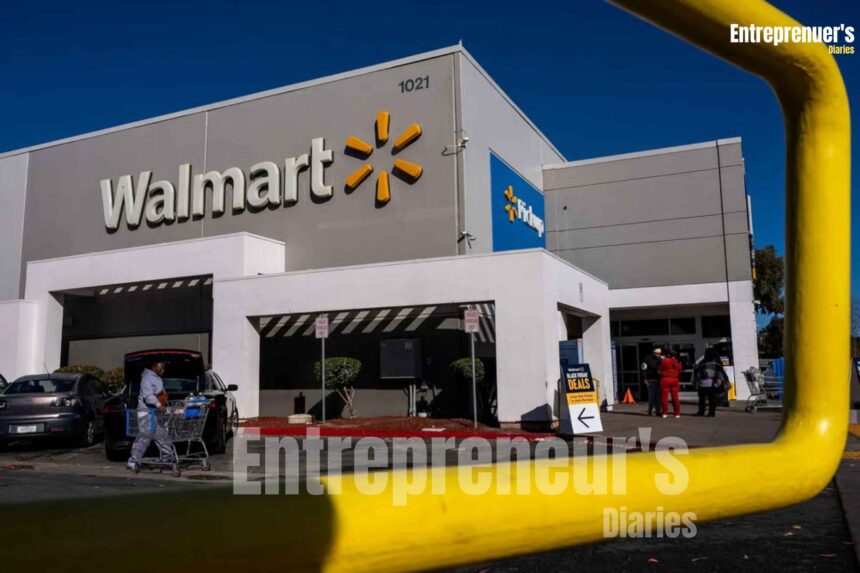
May 13, 2026: When the World’s Biggest Employer Reorganises Around AI, Everyone Should Pay Attention
There is something quietly significant about the way Walmart announced this.
No press conference. No investor call. No polished statement designed to manage perception. Just an internal memo, sent to corporate staff on a Tuesday, explaining that approximately 1,000 roles were being eliminated or relocated as the company consolidated its global technology and AI product teams into a single, unified structure.
The memo was blunt. In some cases, different teams had been working on similar problems. That needed to change. The reorganisation was the solution.
That is it. No language about transformation journeys or future-ready workforces. Just a clean, direct acknowledgment that the old structure no longer matches the work. For a company of Walmart’s scale, that kind of organisational honesty is actually rarer than it sounds.

The two executives who sent the memo are worth knowing. Suresh Kumar, Walmart’s global chief technology and development officer, has been with the company through its entire digital reinvention. Daniel Danker is newer. He joined from Instacart last summer to fill a role that did not previously exist at Walmart: head of global AI acceleration. His compensation package included a $37.7 million restricted stock grant and a $5 million sign-on bonus. Those are not numbers a company attaches to someone it expects to rearrange deck chairs.
Together, they looked at the internal structures they had inherited and decided to simplify them. The result was this week’s announcement.
What Actually Happened and Why the Timing Is Not Coincidental
To understand why this restructuring happened now, it helps to understand the year Walmart has been having.
The company’s fiscal 2026 annual report, published recently, showed total revenues of $715.9 billion. Global e-commerce grew 24 percent, reaching $150.4 billion. Those are not the numbers of a business in trouble. They are the numbers of a business that has been executing well and is now attempting to accelerate further.
What drove that e-commerce growth was, in large part, AI. Walmart has spent the last two years building technology infrastructure at a pace that, frankly, surprised a lot of observers who had written the company off as a legacy retailer. In July 2025, the company launched what it called super agents: a suite of AI tools designed to support associates, supply chain partners, and developers simultaneously. The internal logic was that AI should work across the organisation, not just in one corner of it.
By October 2025, Walmart had entered a partnership with OpenAI to build AI-first shopping experiences, allowing customers to interact through conversational interfaces rather than traditional search bars. Two months later, at the National Retail Federation’s annual conference in New York, incoming CEO John Furner stood alongside Google’s Sundar Pichai to announce a shopping integration inside Gemini. Walmart products would surface during natural Gemini conversations, with purchases completing within Walmart’s own checkout environment.
That is a company that is not cautiously experimenting with AI. That is a company betting its commercial future on it.
Which brings us back to the memo. When a company builds that fast, it almost inevitably creates overlapping structures. Teams get spun up to solve specific problems before anyone has had time to check whether another team is already working on the same thing. The speed that makes AI investment exciting also makes organisational coherence genuinely hard to maintain.
Danker’s review identified that problem. The restructuring is the correction.
The Bentonville Pull and What It Tells You About How Walmart Thinks
The relocation element of this announcement deserves more attention than it has received.
A significant portion of the affected employees are not being let go. They are being asked to move. Specifically, to Bentonville, Arkansas, or to Walmart’s offices in Northern California. For the technology professionals most affected by this change, those are two very different propositions.
Walmart has been executing a deliberate consolidation of its corporate footprint for several years. Earlier this year, the company filed a layoff notice in New Jersey affecting around 100 employees at its Hoboken offices. That was a smaller move, but it followed the same logic: pull talent toward the core hubs, close the peripheral offices that had accumulated through years of acquisitions and expansion, and create the kind of geographic proximity that makes a unified technology organisation actually function like one.
The Hoboken offices were a legacy of Walmart’s Jet.com acquisition. When Walmart bought Jet in 2016 for roughly $3.3 billion, it got a fast-growing e-commerce startup and a concentration of digital talent on the East Coast. Over the years, that talent helped Walmart build capabilities it desperately needed. But legacy office footprints have a way of persisting well past the point where they make structural sense.
Pulling those teams back toward Bentonville is a statement about how Walmart believes technology organisations should be built: physically proximate, culturally unified, operating on shared context rather than across time zones and separate reporting lines.
That may work brilliantly. It may also cost Walmart some of the most sought-after engineering and product talent in the country, people with families and lives in New York or San Francisco who have no particular desire to relocate to northwest Arkansas, however much the city has developed in recent years. Those outcomes will not appear in any memo. But they are real, and they will shape the composition of the team that Danker and Kumar end up leading.
The Number That Should Interest Every Founder Reading This
Buried in recent analyst notes, there is a single data point that reframes this entire story.
Walmart’s AI shopping assistant, known internally as Sparky, is generating 35 percent higher basket sizes among the customers who engage with it. Thirty-five percent. On Walmart’s transaction volumes, that number translates into revenue at a scale that very few technology initiatives in retail history have produced.
Jefferies analysts, in a note following Walmart’s fiscal 2026 results, flagged this figure while describing management’s view that the company is moving toward what they called agentic, contextual commerce. The premise is that Walmart’s years of authenticated customer data give it a structural advantage in personalisation that general-purpose AI platforms simply cannot replicate. Amazon built its recommendation engine over two decades. Walmart is now attempting to close that gap at AI speed using the purchase history and behavioural data of hundreds of millions of shoppers.
That ambition is what makes the internal restructuring consequential well beyond the 1,000 roles affected. Walmart is not trimming costs. It is consolidating capabilities around a specific commercial vision: a future where the shopping experience is so personalised and contextually intelligent that the idea of typing keywords into a search bar feels as dated as browsing a physical catalogue.
Whether that vision fully materialises is another question. But the infrastructure required to pursue it is what this week’s reorganisation is designed to build.
John Furner’s First Major Test at the Top

John Furner officially became President and CEO of Walmart Inc. on February 1, 2026, succeeding Doug McMillon, who had led the company through its decade-long transition from physical retailer to technology-enabled enterprise.
The handover was framed carefully. McMillon stayed on the board to support the transition. His departure letter described Furner as uniquely capable of leading the company through its next AI-driven transformation. Furner, for his part, has spoken about AI not as an initiative but as a capability that should permeate everything the company does, from customer experience to associate productivity to supply chain logistics.
Thirty-two years with Walmart, including several running the U.S. business, gives Furner a quality that many technology-first CEOs simply lack: he understands the stores. He has spent time in them. He knows what happens on the floor at 6am on a Tuesday. That operational fluency shapes how he approaches AI: not as a technology project managed separately from the business, but as something that should make the actual work of retail faster, cleaner, and more responsive.
The restructuring happening under his watch reflects that instinct. You cannot have technology and AI teams running as separate functions when the whole strategic premise is that AI capability should be woven into everything. Furner’s goal, as Danker and Kumar described it in their memo, is to make ownership clearer and better align roles to the work and skills needed going forward. That is an unusually candid way of saying: the old structure was built for a different era.
What This Means for the Founders and Leaders Watching From Outside
There is a version of this story that frames it simply as a large company cutting jobs. That reading is not wrong, but it misses most of what is actually happening.
Walmart is the world’s largest private employer. When it makes decisions about how to structure its technology organisation, it is not just making choices about its own future. It is producing a template that hundreds of other large organisations will study and, in many cases, adapt.
The specific lesson from this restructuring is something that founders building technology organisations at any scale should think carefully about. Parallel teams working on similar problems are not just inefficient. They are structurally incompatible with the kind of coherent AI strategy that actually delivers commercial results. The 35 percent basket lift from Sparky did not come from multiple disconnected teams each building their own version of a shopping assistant. It came from a concentrated capability developed with clear ownership and a unified direction.
Most organisations that are serious about AI already know this intellectually. Far fewer have been willing to do the organisational work required to actually live it. Walmart’s decision to absorb the reputational and operational cost of a 1,000-person restructuring in the middle of a strong performance year is a signal about how seriously the company is taking that discipline.
The external environment adds its own pressure. Furner has projected a cautious outlook for the coming year, citing concerns about U.S. consumer spending. Tariff uncertainty and ongoing inflationary pressure on lower-income households represent genuine headwinds for a business whose core customer base is more price-sensitive than most. Operational efficiency in that context is not just strategy. It is a form of protection.
The company that emerges from this reorganisation will have fewer people, a clearer structure, and a technology organisation built specifically for the commercial strategy it is trying to execute. Whether that combination produces the results Danker and Kumar are betting on will take time to know.
But the logic behind the bet is not difficult to follow. And for a business generating $715.9 billion in revenue and growing its e-commerce business at 24 percent a year, the ambition level seems proportionate to the opportunity.
Why is Walmart restructuring its technology teams now when the business is growing?
The cuts are not a response to poor performance. Walmart’s revenues and e-commerce metrics are strong. The restructuring reflects a recognition that fast-moving AI investment created overlapping teams working on similar problems, and that structural clarity is now more important than preserving headcount.
Who is Daniel Danker and why does his role matter here?

Danker joined Walmart last summer from Instacart specifically to lead AI acceleration. His $44 million first-year compensation package reflects how seriously the company took that hire. Along with global technology chief Suresh Kumar, he conducted the internal review that led to this week’s announcement.
What happens to the employees who are affected?
Affected staff have been told they can apply for other open roles within Walmart. Many have been asked to relocate to offices in Bentonville, Arkansas, or Northern California. Those who decline relocation and do not find other internal roles will exit the company.
What is Sparky and why does the 35 percent basket lift figure matter?
Sparky is Walmart’s internal AI shopping assistant. The 35 percent higher basket sizes reported among Sparky users represents a significant commercial return on Walmart’s AI investment, and illustrates why the company is reorganising its technology teams around a unified AI strategy rather than continuing with fragmented parallel efforts.
How does this restructuring connect to Walmart’s competition with Amazon?
Amazon built its AI-assisted commerce capabilities, including its Rufus shopping assistant, over many years before Walmart took AI seriously as a strategic priority. Walmart’s consolidation of its technology and AI teams is designed to accelerate the pace at which it can close that gap, by removing internal friction and creating a single, coherent AI development organisation rather than multiple competing ones.
Walmart has spent years building the infrastructure that made this restructuring necessary. The investment came first. The organisational logic is being applied now. What happens next depends entirely on whether the unified team that Danker and Kumar end up leading can translate a clear structure into the kind of AI-driven retail experience that actually changes how people shop. That is the real story, and it will take considerably longer than a Tuesday memo to resolve.
Connect With Us On Social Media [ Facebook | Instagram | Twitter | LinkedIn ] To Get Real-Time Updates On The Market. Entrepreneurs’ Diaries Is Now Available On Telegram. Join Our Telegram Channel To Get Instant Updates.

Isabella is a global business journalist and former McKinsey analyst from Brazil. She brings sharp insights on economic shifts, policies, and founder journeys from around the world.

Luca is a tech ethicist from Italy exploring disruptive innovation through a human lens—from AI to biotechnologies to decentralization.