
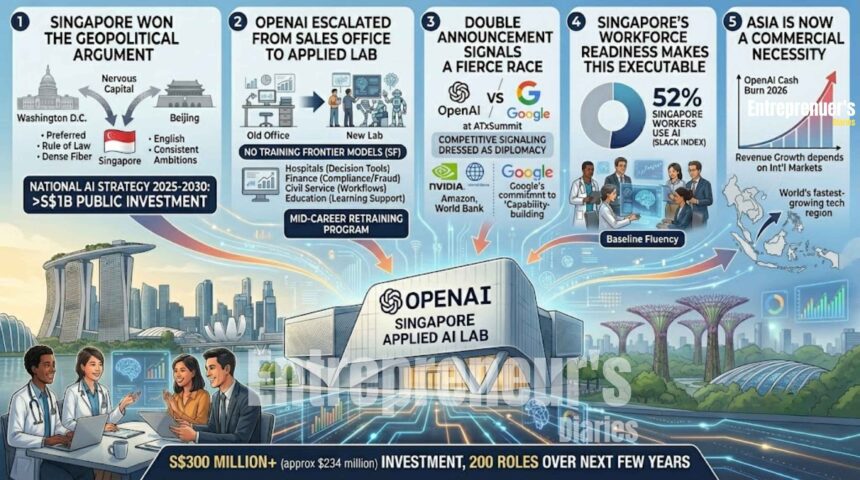
Singapore, May 20: OpenAI has chosen Singapore for something it has never done before: establishing an applied AI lab outside the United States. Announced Wednesday on the sidelines of the ATxSummit at Capella Singapore, the move came packaged with a formal memorandum of understanding between OpenAI and Singapore’s Ministry of Digital Development and Information.
The financial commitment attached to that agreement is not trivial. More than S$300 million, or roughly $234 million, will flow into Singapore’s AI ecosystem, according to Reuters. The facility, formally named the OpenAI Singapore Applied AI Lab, is the first of its kind the company has established beyond American borders. It is expected to scale to approximately 200 roles over the next few years.
That headcount may not sound like a seismic workforce event. But the symbolism of the location, and the specificity of the mandate behind it, matters far more than the launch-day numbers. There are 5 powerful reasons this move signals Asia’s moment in the global AI race.
Reason 1: Singapore Won the Geopolitical Argument
The city-state has spent the better part of three years quietly positioning itself as the preferred address for global technology capital that is nervous about operating too close to either Washington or Beijing.
With export controls tightening and every major AI company running a calculus about where it can build, deploy, and sell without regulatory whiplash, Singapore keeps winning that calculation. It offers functioning rule of law, dense fiber infrastructure, English as the working language of government and commerce, and a political establishment consistent enough in its ambitions to be taken seriously by boardrooms in San Francisco and Tokyo alike.
Frankly, that combination is rarer than the conference-circuit rhetoric suggests. The national AI strategy stretching from 2025 to 2030 comes with more than S$1 billion in committed public investment for AI research, as reported by CNBC. That is not a press release figure. That is budget allocation, signed and appropriated. When a government signals that kind of sustained commitment rather than a single-cycle initiative, it changes the math for private companies deciding where to anchor permanent infrastructure.
Reason 2: OpenAI Escalated From Sales Office to Applied Lab
OpenAI’s history in Singapore provides necessary context for understanding what Wednesday’s announcement actually represents.
The company opened a Singapore office in 2024, initially as a regional hub to support customers and partners across the Asia-Pacific. That footprint was commercial in nature: account management, partnerships, government relations. Standard international expansion playbook.
What the new lab represents is a structural escalation. The move is from sales-and-support presence to actual applied research and deployment capacity. The company is not sending a managing director and a handful of enterprise sales staff. It is building a facility with a technical mandate and a hiring target that puts engineers on the ground. Still, the distinction in what the lab will not do is equally important.
An applied AI lab focuses on deploying existing AI capabilities in real-world sectors like healthcare, finance, and government services rather than training new frontier AI models from scratch.
The OpenAI Singapore Applied AI Lab is not a research facility. It will not train new frontier models. It will not compete with the San Francisco operation on next-generation architecture. That work stays in the United States. What the lab will do is translate existing frontier capability into real-world deployments. That means working with hospitals on clinical decision tools. It means engaging financial institutions on compliance and fraud monitoring systems. It means building inside Singapore’s civil service, where procurement workflows are structured enough to allow serious AI integration if the right technical partners are present.
According to CNBC, the lab’s mandate spans national priorities including education, public services, finance, healthcare, and digital infrastructure. A dedicated training program for mid-career engineers is part of the package. So are co-developed AI startup accelerators and what OpenAI is calling citizen-centric applications under a broader “AI for All” initiative.
Mid-career engineer retraining is expensive, politically difficult, and logistically complex. Governments do not typically partner with private companies on that kind of program unless there is real architecture behind it. The same holds for public sector AI deployment in regulated industries: healthcare and finance in Singapore operate under strict oversight frameworks, and any meaningful AI integration requires the lab to engage with the Monetary Authority of Singapore and the Ministry of Health at a working level, not a ceremonial one.
Reason 3: The Double Announcement Signals a Fierce Race for Asia
OpenAI was not the only headline coming out of ATxSummit on Wednesday. Google announced a new National AI Partnership with Singapore on the same day, focused on education, healthcare, scientific research, workforce readiness, enterprise innovation, and building a secure AI ecosystem, according to CNBC.

Google‘s deal did not include a specific investment commitment figure. Its specifics lean toward capability-building: training government researchers to use agentic AI tools for scientific work, and separate engagement with Singapore’s Ministry of Education on educator training programs. Two of the most consequential AI companies in the world formalizing government agreements with a single city-state on the same day is not coincidence. It is competitive signaling dressed as diplomacy.
Both companies want to be the preferred partner when Singapore’s public agencies issue tenders, when the region’s sovereign wealth funds make investment decisions, and when Southeast Asia’s enterprise buyers choose which AI stack to standardize on. Being embedded at the government level, with a formal MOU and a physical lab, is a durable competitive advantage in markets where trust and access are built over years, not quarters.
Reason 4: Singapore’s Workforce Readiness Makes This Executable
The demand-side context for the OpenAI Singapore Applied AI Lab matters as much as the supply-side infrastructure choices. According to Slack’s Workforce Index, cited by CNBC, 52% of workers in Singapore currently use AI in their jobs. That figure, more than half the active working population engaging with AI tools in daily work, is not a number most developed economies have reached. It signals a level of adoption readiness that changes what an applied AI lab can realistically accomplish.
Applied AI work fails in markets where the workforce is not ready to integrate it. Tools built for deployment in organizations where the average employee has never worked with an AI-generated output require a different kind of implementation support, slower and costlier, than tools deployed in markets where the workforce already has baseline fluency.
Singapore’s numbers suggest the second condition. That makes the lab’s applied mandate significantly more executable than it would be if OpenAI had planted its first international lab in a lower-adoption market chasing a headline.
The ATxSummit itself drew more than 4,000 leaders from over 50 countries to Capella Singapore on May 20 and 21, per the Infocomm Media Development Authority. Participants included representatives from NVIDIA, Amazon, World Bank Group, Google, and OpenAI. The conference has become the annual moment where global tech strategy and Asian government priorities meet in a single room.
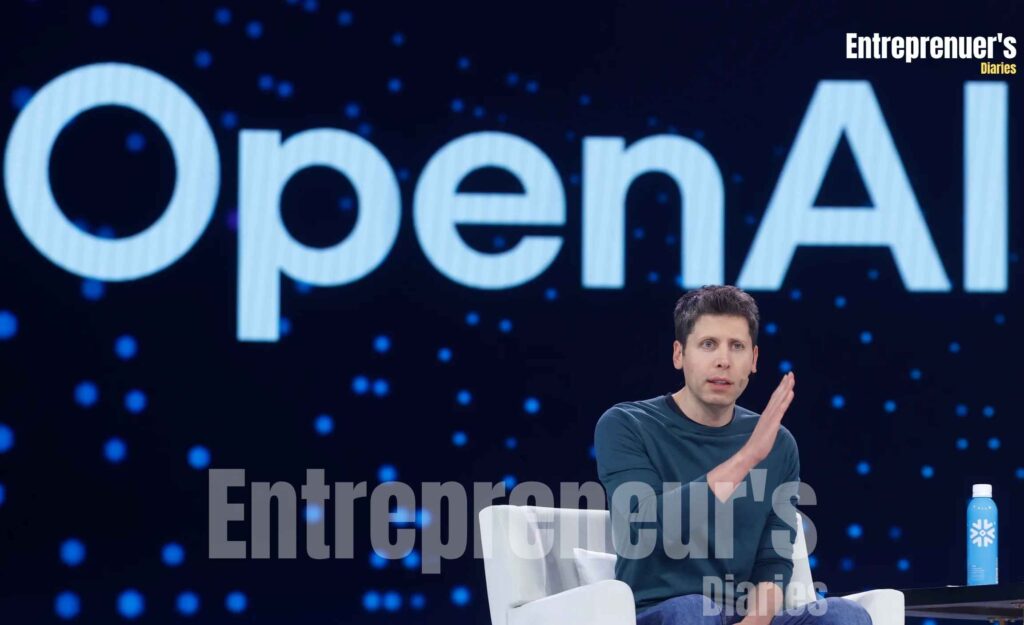
OpenAI chose to time the lab announcement to coincide with that moment rather than issue a standalone release from San Francisco. That timing is intentional. It reflects how the company is now thinking about its international presence: not as a growth supplement to the core American business, but as a structural component of global strategy.
Reason 5: Asia Is Now a Commercial Necessity, Not a Courtesy
It would be a mistake to analyze this announcement purely as a diplomatic gesture or a goodwill investment. OpenAI is carrying significant financial weight through 2026. Annual cash burn is projected to climb steeply through the decade, according to earlier reporting. Revenue growth depends on international market penetration. Competitors, particularly Google DeepMind, are not standing still on the global deployment front. And Chinese open-source contenders are applying real pricing pressure to the economics of frontier AI outside the American market.
Building the OpenAI Singapore Applied AI Lab is a commercial play in one of the world’s fastest-growing technology regions, executed through the vehicle that provides the most durable government access and the most defensible local footprint: a formal national partnership, backed by nine-figure investment, with a physical lab to show for it.
Singapore has attracted major commitments from Amazon‘s AWS and Microsoft alongside Google DeepMind and OpenAI, according to CNBC. The city-state is not neutral ground for AI by accident. It has been actively courting these commitments, offering land, talent pipelines, regulatory clarity, and co-investment vehicles that other markets in the region cannot yet match.
Turns out, international deployment is increasingly where the revenue growth story gets written for frontier AI companies in 2026. OpenAI is arriving into a competitive field, not an open one.
The Case for Measured Expectations
For what it’s worth, there are reasons to read this announcement with some reserve. Applied AI labs announced with fanfare and significant financial commitments do not always produce the operational depth their press releases promise. The gap between an MOU and a functioning mid-career retraining program run at scale is not a small one. Bridging it requires sustained political will on the government side, technical execution on the company side, and alignment on data access, privacy frameworks, and procurement timelines that are rarely as smooth as launch-day statements imply.
The 200-job target spread across “the next few years” is also a relatively modest footprint for a S$300 million commitment. The spending will likely flow substantially into partnerships, co-investments, startup accelerator funding, and infrastructure costs rather than direct headcount.
Managing expectations in public communication matters here. Overpromising on the research dimension and underdelivering would damage the credibility OpenAI is trying to build with Asian government partners over the long term.
What the Next 36 Months Will Determine
The architecture is in place. The investment is committed. The government relationship is formalized. None of that is nothing; most international AI expansion announcements never get this far.
The real test is whether the OpenAI Singapore Applied AI Lab builds deployment programs that materially improve how Singapore’s public hospitals handle patient data, how its SME finance sector manages credit risk, and how its school system provides differentiated learning support. Those outcomes are measurable. They will either materialize or they will not, and the regional AI community will be watching.
For Southeast Asia’s entrepreneurs, engineers, and policymakers, the more immediate implication is structural. A frontier AI company has made a sustained financial and institutional bet on this geography. That tends to pull talent, attract co-investment, and legitimize the region as a serious deployment frontier rather than a peripheral market. OpenAI has taken a position. Singapore has taken a partner. The applied work begins now.
Connect With Us On Social Media [ Facebook | Instagram | Twitter | LinkedIn ] To Get Real-Time Updates On The Market. Entrepreneurs’ Diaries Is Now Available On Telegram. Join Our Telegram Channel To Get Instant Updates.

Isabella is a global business journalist and former McKinsey analyst from Brazil. She brings sharp insights on economic shifts, policies, and founder journeys from around the world.

Luca is a tech ethicist from Italy exploring disruptive innovation through a human lens—from AI to biotechnologies to decentralization.