
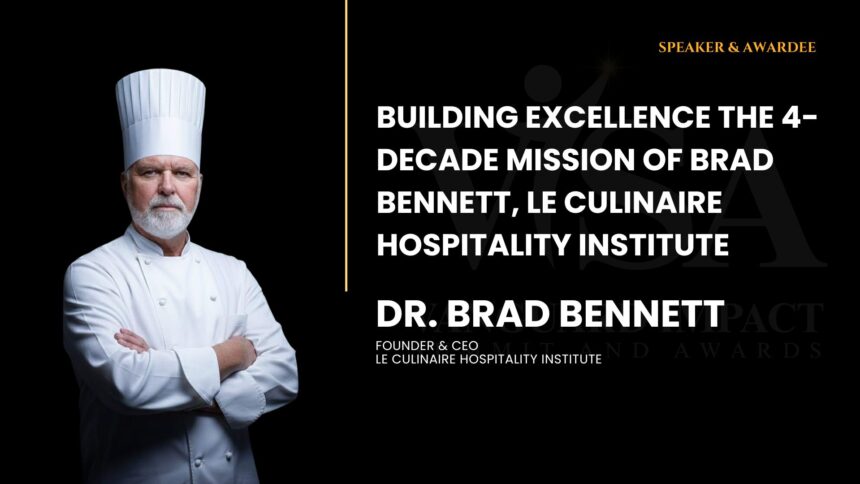
Brad Bennett, Le Culinaire Hospitality Institute founder and CEO, didn’t start his career in a boardroom. He started exactly where you’d expect a sixteen-year-old to start: at the very bottom.
As a kitchen hand in a busy Adelaide restaurant, his world consisted of peeling potatoes, hauling heavy stockpots, and trying not to get yelled at during the Friday night dinner rush. There was no master plan. There was no dream of global hospitality dominance. There was just the heat, the noise, and survival.
Fast forward four decades. That overwhelmed teenager is now an Industry Professor, overseeing an operation that trains over 800 students. But before Brad Bennett, Le Culinaire Hospitality Institute was a recognized name in Oceania, he had to identify a massive flaw in how the industry built its talent.
The “Classroom vs. Kitchen” Gap
Bennett had already put in the miles. He owned restaurants in Melbourne. He ran high-stakes hospitality operations in London and Monaco. He saw how the top 1% of the industry operated.
But he also noticed a recurring, fatal flaw in the talent pipeline. Culinary schools were churning out graduates who could perfectly julienne a carrot on a quiet Tuesday morning, but completely fell apart when thrown into a real-world Friday night service. The education system was too academic, entirely disconnected from the chaotic reality of actual hospitality.
He realized that if he wanted to change how the industry operated, he had to stop just hiring chefs and start building them from the ground up.
How Brad Bennett, Le Culinaire Hospitality Institute Redefined Culinary Training
Starting an educational institute from scratch is remarkably similar to opening a restaurant: cash flow is tight, the margins are brutal, and your reputation lives or dies by the quality of what you put out.
The school started small, with just a handful of students. Bennett treated the curriculum the way an executive chef treats a menu—ruthlessly editing out the fluff.
“We don’t train you to be average, we inspire you to be awesome.”
That isn’t just a marketing slogan pinned to the wall. It became the operational standard. Instead of focusing solely on passing exams, the philosophy that Brad Bennett, Le Culinaire Hospitality Institute operates on today is built around industry immersion. The key to scaling from ten students to over 800 wasn’t just adding more courses; it was maintaining rigid, real-world standards as the business grew.
The Beijing Olympics Test: Operating at Scale
You can claim to be a great educator in a controlled Sydney classroom. But Bennett’s mindset was stress-tested on a global stage long before his school reached its current size.
During his time as a lecturer in hotel management and Western cookery at Chengdu University of Technology, he was pulled into the hospitality training initiatives surrounding the Beijing Olympic Games.
Try helping to standardize hospitality and culinary training for an international event where millions of people will judge your country’s service in a matter of weeks. It required translating entirely different culinary cultures and operational mindsets. It was a crash course in scaling excellence under impossible pressure.
Why Mentorship is the Ultimate Business Model
The hospitality industry is facing a brutal reality check. Workforces are shrinking, burnout is rampant, and the “glamor” of being a chef has faded post-pandemic.
Many owners react to this by lowering hiring standards or cutting training budgets. To understand why this is a mistake, you have to look at how Brad Bennett, Le Culinaire Hospitality Institute approaches mentorship. Despite his accolades—Worldchefs Certified Culinary Educator, Ambassador of Taste, Disciple of Escoffier—his focus remains stubbornly fixed on individual students.
He knows that a chef who is technically skilled but emotionally fragile will eventually quit. So, the institution builds confidence and leadership alongside knife skills. The business model is simple: if your people succeed in the real world, your institution’s reputation markets itself.
The Founder’s Playbook: Actionable Takeaways for Service Businesses
What can entrepreneurs learn from this four-decade pivot?
- Train for the Worst, Not the Best: Stop training your team in perfect, controlled environments. If your onboarding doesn’t simulate the chaos of a “Friday night rush,” your employees will crumble when things go wrong.
- Standardize the Culture, Not Just the Product: As you scale, your product offerings will change, but your core ethos cannot. Scale your systems, but fiercely protect your standards.
- Legacy is a Byproduct, Not a Goal: Focus obsessively on mentoring the person standing in front of you today. The playbook built by Brad Bennett, Le Culinaire Hospitality Institute proves that if you invest heavily in your people, the legacy takes care of itself.
Connect With Us On Social Media [ Facebook | Instagram | Twitter | LinkedIn ] To Get Real-Time Updates On The Market. Entrepreneurs’ Diaries Is Now Available On Telegram. Join Our Telegram Channel To Get Instant Updates.

Ratnakar Upadhayay, known professionally as Ratnakar Mavilach, is an Indian businessman who is best known for coming up with the idea for Hinglishgram, the first content delivery platform in the world. His innovative endeavors range from launching Debonair Magazine back into the public sphere.

Isabella is a global business journalist and former McKinsey analyst from Brazil. She brings sharp insights on economic shifts, policies, and founder journeys from around the world.