
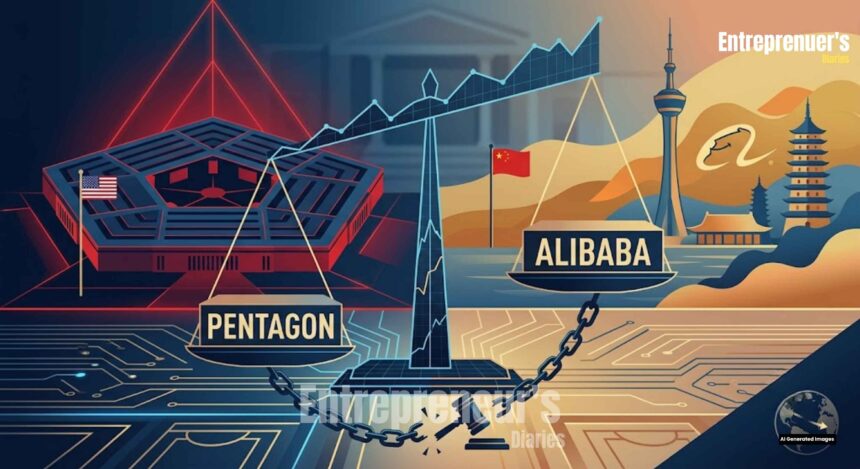
San Jose, California, June 23, 2026: The Alibaba Pentagon lawsuit is now official. Alibaba Group Holding has filed a federal lawsuit against the United States government, demanding removal from an official Pentagon registry that brands it a “Chinese military company.”
This is not a minor compliance dispute. It is a direct legal challenge to one of Washington’s most consequential trade and technology enforcement tools.
For professional and institutional readers tracking US business news around Sino American trade friction, this case sits squarely at the intersection of corporate law, national security policy, and global capital markets.
The Alibaba Pentagon Lawsuit: What Was Filed and Why
The Alibaba Pentagon lawsuit, also known as the Alibaba DoD lawsuit, began with a single federal filing. According to Reuters, Alibaba sued the U.S. government on Tuesday, June 23, over its placement on a Pentagon list linking the company to China’s military.
The complaint, an Alibaba US lawsuit, was filed in the U.S. District Court for the Northern District of California, in San Jose, according to both Reuters and Bloomberg.
Alibaba’s core argument is simple. The company says it has no military affiliation, and that the designation was reached without adequate evidence. “The determinations have no basis in fact or law,” Alibaba said, according to Reuters’ reporting. The lawsuit specifically seeks Alibaba’s removal from the list, not monetary damages, according to Reuters.
A Pentagon spokesperson declined to comment on the litigation, telling Reuters the agency does not discuss pending cases. This single filing now sits alongside a growing pile of corporate litigation challenging the same federal registry, a trend that is reshaping how US business news outlets cover the broader Sino American trade relationship.
The Official Designation: Inside the Pentagon’s 1260H List
To understand why Alibaba sued, it helps to look directly at the official government document at the center of the dispute. According to the official list published by the U.S. Department of War on its media.defence.gov portal, the Deputy Secretary of Defence determined that 188 entities qualify for designation as “Chinese military companies” as of June 8, 2026.
This official document is not a news summary. It is the primary federal source, and it contains specific, named justifications for every company on the list. The official entry for Alibaba reads as follows: “Alibaba is indirectly affiliated with SASAC. Alibaba is a military civil fusion contributor to the Chinese defence industrial base because it is affiliated with MIIT.”
SASAC refers to China’s State owned Assets Supervision and Administration Commission. MIIT refers to China’s Ministry of Industry and Information Technology.
This two sentence justification is the entire official evidentiary basis published for Alibaba’s inclusion. There is no additional detail in the official document about how Alibaba is “indirectly affiliated” with SASAC, or what the underlying MIIT relationship consists of. That brevity is precisely what Alibaba is now challenging in federal court.
The Statutory Foundation: Section 1260H Explained
The legal authority behind this entire process traces back to a single piece of legislation. According to the official Department of War release, the list was published “in accordance with the statutory requirement of Section 1260H of the National Defence Authorization Act for Fiscal Year 2021.”
Section 1260H requires the Secretary of Defence to identify and publish, on an annual basis, a list of “Chinese military companies” operating directly or indirectly inside the United States, according to legal analysis published by law firm DLA Piper.
Unlike a formal sanctions list, a 1260H designation does not freeze assets or bar a company from operating in the U.S. economy. But it does carry real legal teeth. According to law firm Cleary Gottlieb’s published trade analysis, the Department of War is prohibited from entering into, renewing, or extending contracts for goods, services, or technology with any listed entity, effective June 30, 2026.
A broader restriction follows in 2027. According to the same Cleary Gottlieb analysis, the Department will also be barred from procuring goods or services that arrive indirectly through a listed company’s supply chain, starting June 30, 2027.
For a company like Alibaba, whose direct exposure to Pentagon contracts is minimal, the more pressing risk is reputational. Many of Alibaba’s American partners are private businesses, not government agencies, and they now must weigh the optics of working with a federally designated “military civil fusion contributor.”
There is also a second order financial risk worth noting. According to a legal alert published by law firm Baker McKenzie, entities on the 1260H List face an increased risk of being designated on the Treasury Department’s separate Non SDN Chinese Military Industrial Complex Companies List, known as the NS CMIC List.
That distinction matters for investors specifically. According to Baker McKenzie’s analysis, a Treasury NS CMIC designation would prohibit U.S. persons from purchasing or holding any publicly traded securities of the listed company, a far more direct restriction on a stock like Alibaba’s NYSE listed shares than anything currently imposed by the 1260H List itself.
Alibaba has not been added to the Treasury’s NS CMIC List as of this report. The 1260H designation is a disclosure mechanism, not an automatic trigger, but the legal alerts reviewed for this report consistently flag it as a feeder list for that harsher Treasury action.
The Rebrand Context: From Department of Defence to Department of War
Readers may notice official sourcing in this report referring to the “Department of War” rather than the “Department of Defence.” This is not an error.
According to an official White House executive order signed on September 5, 2025, President Donald Trump authorized the Department of Defence and its leadership to use “Department of War” and “Secretary of War” as secondary titles in official communications.
The order does not formally rename the department. According to NPR’s reporting on the signing, a full legal renaming would require an act of Congress, since the department’s statutory name remains the Department of Defence.

In practice, the agency has fully adopted the new branding. Its official website now operates at war.gov, and the June 8, 2026 Chinese military companies list was published under the Department of War name, according to the agency’s own press release.
For business readers, the operative point is simple: legally, this is still the Department of Defence. Publicly and on every current official document, it now presents itself as the Department of War.
Alibaba’s Legal Arguments: Due Process and Free Speech
Alibaba’s lawsuit rests on more than a simple factual denial. According to Bloomberg’s reporting on the filing, Alibaba argues that the Pentagon’s decision violates constitutional due process, as well as the company’s right to free speech.
The due process argument centers on process, not just outcome. Alibaba contends the designation was reached without the kind of evidentiary record that should support a finding with real commercial consequences. Beyond the legal theory, Alibaba’s filing makes a direct commercial argument about harm already done.
“For many American businesses, Alibaba is the principal gateway to the Chinese market,” the company said in its filing, according to Reuters.
Alibaba also pushed back on the framing of the designation itself, arguing in its filing, as reported by GMA News Online via Reuters, that being branded a “Chinese military company” effectively casts the company as a threat to U.S. national security in the eyes of every American business partner it has.
The Official Pentagon Rationale for Alibaba’s Designation
It is worth separating what the Pentagon has said from what outside commentators have inferred. According to the official Department of War release dated June 8, 2026, the department stated only that it had “conducted its due diligence” before identifying the 188 qualifying entities.
The release does not include a public narrative justification beyond what appears in the official list document itself, which is the two sentence entry on SASAC and MIIT affiliation described earlier in this report.
A Pentagon spokesperson, when contacted about Alibaba’s lawsuit specifically, declined to comment further, citing the agency’s standard policy of not discussing pending litigation, according to Reuters. This narrow public posture is itself significant for investors. It means the legal fight will likely be decided on the administrative record the Pentagon compiled internally, not on any expanded public explanation.
Market Reaction: How BABA Stock Responded
Markets registered the news quickly. According to data published by Investing.com, Alibaba’s U.S. listed shares closed at $104.97 on June 23, down from a previous close of $107.10. The stock slipped further after hours, according to Investing.com, touching $102.18 and brushing against its 52 week low of $103.71.
Investing.com’s reporting tied part of the move to a separate but related development. China announced on June 22 that it would place ten American defence and rare earth companies on its own export control list, a step Investing.com characterized as a direct response to the Pentagon’s blacklist expansion.
This pattern, a Pentagon listing followed swiftly by a Chinese government countermeasure, is becoming a recognizable feature of 2026’s US China business news cycle.
For context on the broader pressure on the stock, Yahoo Finance reported that despite the regulatory overhang, Wall Street analysts have largely maintained constructive price targets on Alibaba, citing the company’s artificial intelligence and cloud computing growth as an offsetting factor.
Other Companies Caught in the Same Net
Alibaba is one of dozens of names on the expanded list, not a singular target. According to the official Department of War document, the June 8, 2026 update added Alibaba alongside Baidu, BYD, NIO, WuXi AppTec, Unitree (listed officially as Hangzhou Yushu Technology Co., Ltd.), and TP Link Technologies, among many others.
Each entity on the official list carries its own specific, named justification. Baidu, for example, is described in the official document as “indirectly affiliated with SASAC” and as a military civil fusion contributor “because it is affiliated with MIIT,” language that closely mirrors Alibaba’s own entry.
WuXi AppTec did not wait to see how Alibaba’s case would unfold. According to Reuters, the pharmaceutical and life sciences company filed its own lawsuit against the Pentagon on June 11, just days after the updated list was published.
That makes WuXi AppTec’s case, filed nearly two weeks before Alibaba’s, the more advanced of the two in the court system, and a likely early signal of how judges may treat this newly expanded 2026 list.
The June 8 list was not the Pentagon’s first attempt at this update. According to a client alert published by law firm DLA Piper, the Department of War published a substantially similar list in February 2026, then rescinded and removed it from the Federal Register shortly afterward without public explanation.
The June 8 version restored nearly all of the February content, according to DLA Piper, with one notable addition: chipmakers ChangXin Memory Technologies and Yangtze Memory Technologies, which had not been part of the earlier, withdrawn release.
The biotechnology additions carry their own separate regulatory thread. According to a client alert from law firm WilmerHale, the inclusion of WuXi AppTec, along with genomics firms Complete Genomics and Novogene, intersects with the BIOSECURE Act provisions in the 2026 NDAA, which restrict the use of federal funds to procure biotechnology equipment or services from companies designated as “biotechnology companies of concern.”
WilmerHale’s analysis notes that 1260H listed biotechnology companies are likely candidates for that separate BIOSECURE designation once its restrictions take effect, layering an additional compliance regime on top of the Pentagon contracting limits already in place.
The Legal Precedent: How Xiaomi Beat a Similar Designation
Alibaba’s legal team is not writing on a blank slate. According to a legal alert published by law firm Holland & Knight, smartphone maker Xiaomi was designated a “Communist Chinese Military Company” under a predecessor legal framework in January 2021.
Xiaomi sued the following month. According to Holland & Knight’s account of the court record, U.S. District Judge Rudolph Contreras granted Xiaomi a preliminary injunction on March 12, 2021.
The court’s reasoning is directly relevant to Alibaba’s current case. According to Holland & Knight, the judge found that the Department of Defence had failed to develop sufficient evidence to support the designation under the Administrative Procedure Act.
Rather than appeal, the government chose to settle. According to Caixin Global’s reporting, a federal court in Washington issued a final order in May 2021 formally vacating Xiaomi’s designation.
The Xiaomi case set a meaningful legal benchmark. It established that the Pentagon must clear a real evidentiary bar in federal court, not simply assert an affiliation, to sustain one of these designations.
Whether that same standard holds up against a far larger, more diversified company like Alibaba, operating under an expanded 2026 statutory framework, is the central legal question now before the San Jose court.
What This Means for E-Commerce and US China Business Relations
This lawsuit lands inside a US business news cycle already saturated with friction between Washington and Beijing. The Pentagon’s list expansion to 188 entities, combined with China’s retaliatory export control measures reported by Investing.com on June 22, suggests both governments are now trading structural, list based pressure rather than negotiating disputes case by case.
For American companies that rely on Alibaba’s cloud infrastructure, logistics network, or e-commerce platforms to reach Chinese consumers, the designation introduces a new layer of counterparty risk, regardless of how the lawsuit is ultimately decided.
Compliance and legal departments at U.S. firms must now weigh reputational exposure to a “Chinese military company” label, even in cases with no direct national security nexus. That chilling effect is exactly what Alibaba’s lawsuit explicitly warns against.
It also signals that the litigation strategy pioneered by Xiaomi in 2021, and revived by WuXi AppTec earlier this month, has become the standard corporate response to a 1260H designation rather than an exceptional one. Investors should expect additional companies named on the 2026 list to file similar lawsuits in the weeks ahead.
The Analytical Closing: The Bookmarkable Takeaway
Here is the strategic insight that investors, founders, and operators should take away from this case. A Pentagon blacklist designation is no longer a final word. It is the opening move in a now well established legal process, one with a real precedent of success for the company being listed.
Xiaomi proved in 2021 that a two sentence federal justification, unsupported by a detailed public record, can collapse under the scrutiny of the Administrative Procedure Act. Alibaba’s legal filing is built on that exact playbook.
But the strategic risk for Alibaba is not really the courtroom. Litigation can take months, and during that entire window, every U.S. enterprise client, cloud customer, and logistics partner is quietly running its own compliance calculation.
That is the deeper lesson for any company operating across U.S. China lines in 2026: a federal designation creates commercial consequences immediately, while a legal remedy arrives, if at all, on a much slower clock.
For businesses that depend on cross border platforms, the Alibaba case is a live test of how fast that gap between designation and resolution can be closed, and how much commercial damage accumulates while the case works its way through court.
Watch the WuXi AppTec case first. Filed nearly two weeks before Alibaba’s, it is likely to produce the first judicial signal on how this expanded 188 company list will hold up in 2026’s courts.
Frequently Asked Questions (FAQs)
Why is Alibaba on the Pentagon’s Chinese military company list?
According to the official Department of War document published June 8, 2026, Alibaba was designated because it is “indirectly affiliated with SASAC” and is considered a “military civil fusion contributor to the Chinese defence industrial base” due to an affiliation with MIIT, China’s Ministry of Industry and Information Technology.
Is Alibaba banned from doing business in the United States?
No. According to Reuters, inclusion on the Pentagon’s Section 1260H list does not mean formal sanctions. It restricts the Department of War from directly contracting with listed companies starting June 30, 2026, and from indirect procurement through their supply chains starting in 2027, but it does not bar the company from operating commercially in the U.S. economy.
What is the Section 1260H list and who maintains it?
The Section 1260H list, officially titled “Entities Identified as Chinese Military Companies Operating in the United States,” is published annually by the U.S. Department of War (the Department of Defence’s current operating name) under a statutory requirement in the National Defence Authorization Act for Fiscal Year 2021. As of June 8, 2026, it names 188 entities.
Has any company successfully sued to get removed from a similar Pentagon list before?
Yes. According to a legal alert from Holland & Knight, Xiaomi Corporation sued over a comparable designation in 2021 and won a preliminary injunction from a federal judge, who found the Pentagon’s evidence insufficient. The Department of Defence subsequently agreed to formally remove Xiaomi from the list rather than appeal.
How has Alibaba’s stock performed since the lawsuit was filed?
According to Investing.com, Alibaba’s U.S. listed shares closed at $104.97 on June 23, 2026, down from $107.10 the previous session, and touched $102.18 in after hours trading near a 52 week low of $103.71, though several Wall Street analysts have maintained constructive longer term price targets.
Connect With Us On Social Media [ Facebook | Instagram | Twitter | LinkedIn ] To Get Real-Time Updates On The Market. Entrepreneurs’ Diaries Is Now Available On Telegram. Join Our Telegram Channel To Get Instant Updates.

Isabella is a global business journalist and former McKinsey analyst from Brazil. She brings sharp insights on economic shifts, policies, and founder journeys from around the world.

Tokyo-based CFA translating global markets into clear insights for modern entrepreneurs.