
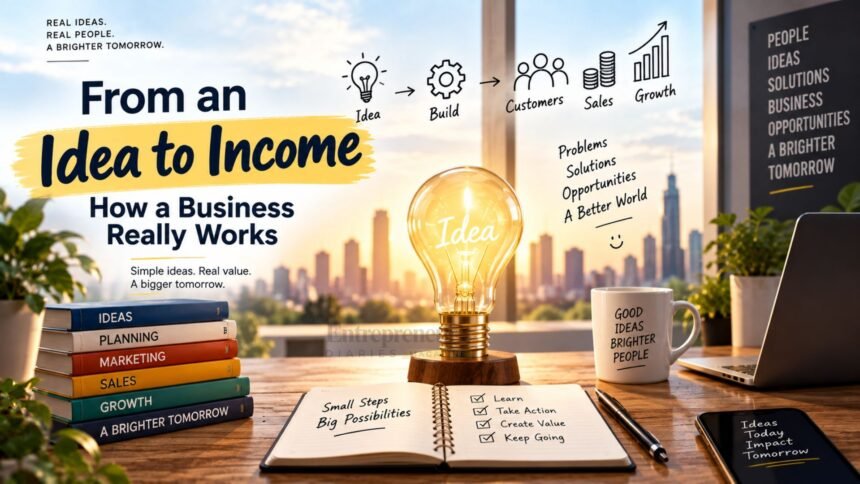
Almost everything we use every day comes from a business.
The phone in your hand, the clothes you wear, the food delivered to your home, the taxi you book, the hotel you stay in and even the app you use to pay your bills are connected to a business.
But what exactly is a business?
The simplest answer is this:
A business finds something people need or want, provides it to them and receives money in return.
Imagine a child selling lemonade outside their house.
People are thirsty. The child makes lemonade. Someone buys a glass. The customer gets a drink, and the child gets money.
That is the basic idea behind business.
Of course, large companies are much more complicated. They may have thousands of employees, offices in many countries and millions of customers. But the basic idea remains surprisingly similar.
A successful business needs to understand what people want, provide something useful and earn enough money to keep doing it.
Let us understand how that works.
What Is a Business?
A business is an activity or organisation that provides a product or service to customers.
A product is something you can buy or use.
For example:
- A mobile phone
- A pair of shoes
- A book
- A car
- A bottle of water
- A computer program
A service is something someone does for you.
For example, a barber cuts your hair. A lawyer gives legal advice. A hotel gives you a place to stay. A marketing company helps other businesses find customers.
Some businesses sell products. Some sell services. Many sell both.
The important point is that a business must provide something that another person or company finds useful enough to pay for.
Why Do People Start Businesses?
There are many reasons.
Some people start businesses because they want to earn money. Others want more freedom over their work. Some notice a problem and believe they can create a better solution.
Many of the best business ideas begin with a very simple thought:
“There must be a better way to do this.”
Imagine people in an area have difficulty finding healthy food.
Someone could see that problem and open a healthy food shop.
Now imagine small companies are finding it difficult to manage their accounts.
An accountant could start a business that handles their bookkeeping.
In both cases, the entrepreneur has noticed a problem and created a solution.
This is one of the easiest ways to understand business:
Problem → Solution → Customer → Money
A customer has a problem.
The business offers a solution.
The customer finds the solution useful.
The customer pays the business.
When enough customers keep doing this, a real business begins to form.
What Does a Business Actually Sell?
Most people think businesses simply sell products or services.
That is true, but there is another way to look at it.
Businesses sell solutions.
A restaurant may appear to sell food, but the customer could actually be paying for convenience, taste, experience or the ability to enjoy dinner without cooking.
A taxi company provides transportation, but the customer’s real need is getting from one place to another safely and conveniently.
A business consultant sells advice, but the client may really be paying for help to increase sales, reduce costs or solve a difficult problem.
This is important for entrepreneurs.
Instead of asking only:
“What am I selling?”
Ask:
“What problem am I solving for my customer?”
That small change in thinking can completely change how a business creates, markets and improves its offer.
How Does a Business Make Money?
Let us use a very simple example.
Imagine you make a cake.
The ingredients and packaging cost you £10.
You sell the cake for £20.
You receive £20 from the customer, but that does not mean you have made £20 in profit.
You spent £10 making the cake.
So, in this simplified example:
Selling price: £20
Cost: £10
Money left: £10
That remaining amount contributes towards your profit, although a real business may have many other expenses to pay.
For example, a bakery may also need to pay for:
- Staff
- Electricity
- Rent
- Equipment
- Marketing
- Delivery
- Taxes
- Insurance
This is why sales and profit are not the same thing.
A company can sell a lot and still lose money.
Suppose a company sells products worth £100,000 but spends £120,000 running the business.
It has plenty of sales, but it has still lost £20,000.
This is one of the most important lessons for new entrepreneurs.
A big business is not automatically a profitable business.
What Is Revenue?
You will often hear business owners talk about revenue.
Revenue is simply the money a business receives from selling its products or services before its expenses are taken away.
For example, imagine a shop sells 100 shirts for £20 each.
Its revenue is:
100 × £20 = £2,000
But the shop still has costs.
If buying those shirts, paying employees, rent and other expenses costs £1,500, the business does not get to keep the full £2,000.
This is why business owners need to understand both revenue and expenses.
What Is Profit?
Profit is the money left after the business pays its costs.
In simple terms:
Money earned − Money spent = Profit
Imagine you sell something for £100.
It costs you £60 to make, market and deliver it.
You have £40 left.
That is a simplified example of profit.
Profit is important because businesses need money to survive and grow.
A profitable business can use its money to hire employees, improve products, open new locations, invest in technology or save for difficult times.
What Are the Main Types of Businesses?
Businesses come in many shapes and sizes, but understanding a few common types makes the subject much easier.
Product Businesses
These businesses sell things.
A clothing company sells clothes.
A furniture shop sells furniture.
A bakery sells bread and cakes.
A software company may sell digital products.
The business makes or buys a product and then sells it to customers for more than its total cost.
Service Businesses
Service businesses sell skills, time or expertise.
Examples include:
- Lawyers
- Accountants
- Consultants
- Marketing agencies
- Hotels
- Salons
- Designers
- Repair companies
A graphic designer, for example, may charge a company to create a new logo.
There may be no physical product. The customer is paying for the designer’s skill and work.
Online Businesses
Many businesses now operate mainly through the internet.
An online shop can sell products without having a traditional high-street store.
A teacher can sell online courses.
A consultant can advise clients in different countries through video calls.
A software company can provide its service entirely online.
The internet has made it possible for even very small businesses to reach customers around the world.
Who Is a Customer?
A customer is the person or organisation that buys from a business.
This sounds obvious, but understanding the customer is one of the biggest challenges in business.
Imagine you open an expensive restaurant next to a university where most students are looking for low-cost meals.
Your food might be excellent.
Your restaurant might look beautiful.
But you could still struggle because the people around you may not want what you are selling at that price.
That is why good entrepreneurs ask questions before building something.
Who needs this?
Why do they need it?
How much will they pay?
Where will they buy it?
What are they using today?
Why would they choose us instead?
Businesses become stronger when they understand their customers clearly.
What Is a Business Model?
A business model is simply the way a business makes money.
Imagine two companies both provide films and television programmes.
One company might charge customers every month.
Another might let people watch for free and make money from advertisements.
Both provide entertainment, but they make money differently.
That difference is their business model.
There are many common business models.
A shop makes money by selling products.
A consultant charges fees.
A software company might charge a monthly subscription.
A marketplace may take a small fee whenever a buyer purchases something from a seller.
There is no single business model that works for everyone.
The important thing is that the model must eventually make financial sense.
What Is the Difference Between a Business and a Startup?
People often use the words business and startup as if they mean exactly the same thing.
They are related, but there can be a difference.
A normal business may be created to provide a known product or service and earn a steady income.
For example, someone might open a local café.
The owner probably knows what customers want, how cafés make money and roughly how the business will operate.
A startup often tries to build something new or find a new way of solving a problem. It may also aim to grow very quickly.
For example, instead of opening one local taxi company, an entrepreneur might create an app designed to connect drivers and passengers across hundreds of cities.
Both are businesses.
The difference is often in how they plan to grow and what kind of problem they are trying to solve.
What Does a Business Owner Do?
When a business is small, the owner may do almost everything.
One person might answer customers, sell products, manage social media, pay bills and even clean the office.
As the company grows, this becomes difficult.
The owner begins hiring people.
One person may handle sales.
Another may manage marketing.
Someone else may look after money.
Another person may take care of customers.
Eventually, the owner’s job changes.
Instead of doing every task personally, the owner must make sure the whole business works properly.
This is where leadership becomes important.
Why Do Some Businesses Fail?
Businesses can fail for many reasons.
Sometimes there are not enough customers.
Sometimes the price is too low.
Sometimes costs become too high.
Sometimes the product is not good enough.
Sometimes the business grows too quickly and runs out of money.
Poor customer service can also damage a business. So can weak leadership, bad financial decisions or failing to change when the market changes.
One particularly dangerous mistake is assuming that people will buy something simply because the founder thinks it is a good idea.
Customers decide whether an idea has real commercial value.
That is why testing an idea before spending too much money on it can be so important.
What Makes a Good Business?
A good business does not need to be enormous.
It needs to work.
At the most basic level, a healthy business usually does five things well.
It understands its customers.
It solves a real problem.
It delivers what it promises.
It controls its costs.
And it earns enough money to continue operating.
The strongest businesses usually go further.
They build trust.
When customers trust a business, they are more likely to return, recommend it to other people and choose it over competitors.
This is why reputation matters so much.
A business can spend years building a trusted name and damage it very quickly by treating customers badly or failing to deliver what it promised.
How Does a Small Business Become a Big Business?
Imagine you make excellent sandwiches at home.
At first, you sell ten sandwiches every day.
Then 50 people want them.
Soon, 500 people want them.
You cannot make all 500 yourself.
Now you need help.
You may need employees, a larger kitchen, better equipment, suppliers, delivery systems and someone to manage orders.
This is called scaling.
Scaling means building a business so it can serve more customers without everything depending on one person.
Many founders discover that getting the first few customers is very different from building a company capable of serving thousands or millions.
Growth therefore needs systems, people and planning.
Technology Has Made Starting a Business Easier
Years ago, starting many types of businesses required a large amount of money.
An entrepreneur might need an office, employees, expensive equipment and physical shops.
Today, some businesses can begin with a laptop and internet connection.
A person can create a website, speak to customers around the world, receive digital payments and market a product online.
Artificial intelligence and automation are making some tasks even easier.
But technology does not change the most important rule of business:
You still need to give people something they value.
A beautiful website cannot save a product nobody wants.
Artificial intelligence cannot fix a business that has no customers.
Technology is a tool. The business still needs a reason to exist.
A Simple Way to Understand Any Business
The next time you see a company, ask five questions:
Who is the customer?
What does the customer need?
What does the business provide?
How does the business make money?
Why would someone choose this business instead of another one?
If you can answer those questions, you already understand a large part of how that business works.
The Big Idea
Business can sound complicated because people use words such as revenue, strategy, operations, margins and business models.
But underneath all those terms is a very simple idea.
Someone needs something. Someone else provides it. Value is exchanged.
A good business repeats that process successfully.
A great business finds a way to do it for more people, more efficiently and for a long time.
For an entrepreneur, therefore, the first question should not be:
“How can I build a big company?”
A much better place to begin is:
“What useful problem can I solve for someone?”
Find a real problem. Create a useful solution. Make it easy for people to understand. Charge a price that works for the customer and the business. Deliver what you promise.
That is where business begins.
Connect With Us On Social Media [ Facebook | Instagram | Twitter | LinkedIn ] To Get Real-Time Updates On The Market. Entrepreneurs’ Diaries Is Now Available On Telegram. Join Our Telegram Channel To Get Instant Updates.

Ethan is a Lisbon-based leadership strategist who helps remote-first startups scale through systems, team clarity, and async culture.