

Seattle, April 30: Somewhere between the sixth analyst note predicting deceleration and Wednesday evening’s earnings release, reality intervened.
- AWS 28% growth Q1 2026: The Numbers Behind the Headline
- Why AWS 28% growth Q1 2026 Upended Every Forecast on the Street
- The Competitive Picture: Microsoft and Google Are Not Standing Still
- The Business Hiding Behind the Cloud Story
- The Capital Commitment Behind AWS 28% growth Q1 2026: $24 Billion in a Single Quarter
- What AWS 28% growth Q1 2026 Signals for the Technology Industry
- The Operating Model Behind AWS 28% growth Q1 2026
- The Bottom Line
AWS 28% growth Q1 2026 arrived not as a modest beat but as a full repudiation of the bear thesis that had settled across sell-side desks since late last year. Amazon reported first-quarter net sales of $181.5 billion, clearing consensus estimates by a meaningful margin, according to Bloomberg and CNBC.
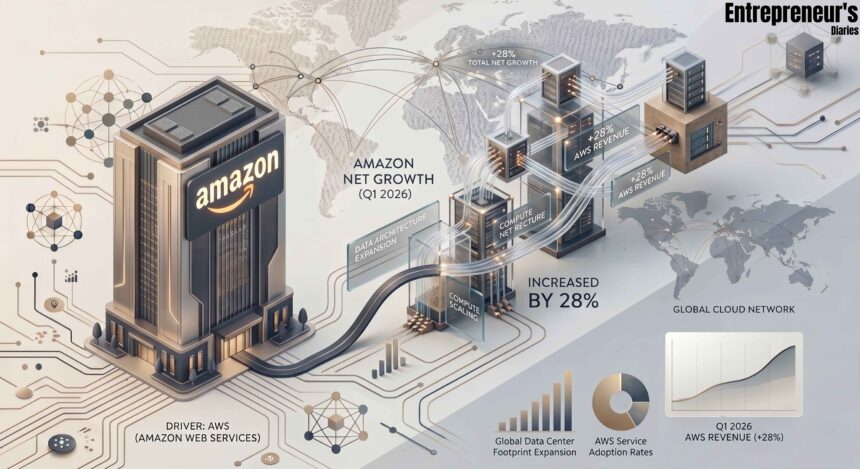
Amazon Web Services posted year-over-year revenue expansion of 28%, up from the 17% pace logged just two years earlier. For a division quietly written off as a maturing story, AWS 28% growth Q1 2026 landed with the force of a market correction.
Amazon shares surged more than 6% in after-hours trading, per Reuters, pushing market capitalization back above $2 trillion. The Street had been wrong. It knew it immediately.
AWS 28% growth Q1 2026: The Numbers Behind the Headline
The cloud division produced approximately $29.3 billion in revenue for the period, per Reuters and Amazon’s official release. Operating income from the unit reached an estimated $11.5 billion, with profit margins widening steadily as Amazon disciplines its cost base while enterprise demand continues to outstrip available capacity.
At the consolidated level, total operating income came in at roughly $18.4 billion, up sharply from the same period a year prior. Net income attributable to Amazon shareholders crossed $17 billion, one of the highest single-quarter profit figures in the company’s history, per Bloomberg’s coverage of the earnings call.
AWS 28% growth Q1 2026 did not emerge from a favorable accounting cycle or a one-time windfall. It reflects a platform that has been adding capacity, capability, and enterprise contracts for years, now entering a phase where those investments compound faster than the cost base expands.
That is a difficult position to compete against.
Why AWS 28% growth Q1 2026 Upended Every Forecast on the Street

The consensus heading into the quarter placed cloud revenue expansion somewhere between 21% and 24%, per Bloomberg Intelligence. Morgan Stanley, Goldman Sachs, and Barclays had all modeled within that range. Their reasoning was coherent: enterprise cloud migrations had largely run their course, the cost-optimization cycle of 2023 and 2024 had instilled new spending discipline, and generative AI experimentation budgets would taper as companies moved from proof-of-concept work into production.
That last assumption proved to be the fatal one.
Production arrived faster than any of those models captured. When it did, it demanded GPU-dense compute, low-latency networking, and managed AI infrastructure at a scale that only hyperscalers could deliver on short notice. Amazon was positioned to absorb that demand. It did.
On Wednesday’s call, Chief Executive Andy Jassy walked through the mechanics behind AWS 28% growth Q1 2026. Enterprises that pulled back on cloud deployment during the optimization cycle have returned to full pace. Generative AI workloads are intrinsically more hardware-intensive than anything enterprises previously ran, and on-premise alternatives cannot cost-effectively handle the load.
Amazon’s custom Trainium and Inferentia silicon chips allow it to offer AI training and inference at price points that outside infrastructure cannot reach. Three forces arriving simultaneously: that is the internal explanation for a result that exceeded every model on the Street.
Jassy also disclosed that Amazon’s standalone AI business is now running at a “multi-billion-dollar annual run rate” and expanding at triple-digit year-over-year percentages, per Reuters. Those figures were not broken out separately in the release, but the directional message was unmistakable.
Amazon Web Services is not a cloud provider that also does some AI. It is becoming the infrastructure foundation the AI economy is constructed upon. AWS 28% growth Q1 2026 is the clearest financial evidence of that positioning yet recorded.
The Competitive Picture: Microsoft and Google Are Not Standing Still
AWS 28% growth Q1 2026 does not exist in isolation. Both of Amazon’s primary hyperscale rivals have reported strong recent results, and the competitive pressure is genuine.
Microsoft Azure posted 33% revenue expansion in its most recent period, according to The Financial Times. The mechanism is straightforward: deep integration of OpenAI models inside Microsoft 365 creates cloud consumption as a byproduct of everyday enterprise software usage. Customers do not need a separate procurement decision. The compute bills simply appear.
Google Cloud reported approximately 28% revenue expansion in its latest period, per Alphabet’s earnings release. After years as the distant third in the hyperscale race, it has reached consistent profitability and is now competing seriously for enterprise AI workloads where its Gemini models provide native capability.
Three companies. Similar headline expansion rates. Fundamentally different strategic positions.
Amazon Web Services holds an estimated 31% of global cloud infrastructure spend, against Azure at 24% and Google at 12%, according to Synergy Research Group’s latest market share data. That installed base is a compounding structural moat. Every AI workload built by an existing customer is a retention event, not a new sales cost.
Microsoft’s edge is the enterprise software seat. Bundling Azure OpenAI services inside Microsoft 365 drives cloud consumption without a separate procurement conversation. Amazon has no equivalent productivity software layer, and the company knows it.
Where Amazon counters is on partnership depth, pricing architecture, and silicon access. Its expanded investment in Anthropic, reaching up to $4 billion in committed capital, gives the cloud division a credible frontier AI alternative for enterprise buyers seeking distance from the OpenAI-Microsoft alliance, as reported by The Wall Street Journal.
The competitive context makes AWS 28% growth Q1 2026 more impressive, not less. It came while Amazon was simultaneously onboarding new sovereign cloud regions, deepening its Marketplace partner network, and embedding Bedrock, its managed generative AI platform, deeper into existing enterprise agreements. None of those are temporary catalysts.
The Business Hiding Behind the Cloud Story
When AWS 28% growth Q1 2026 dominates the earnings headlines, the rest of Amazon tends to be compressed into a footnote. That compression is a mistake.
North American retail segment revenue expanded approximately 9% year-over-year to roughly $92 billion, per CNBC’s earnings breakdown. International segment revenue rose 7% to approximately $36 billion, with sustained momentum across India, Germany, and Japan.
Advertising services, the segment most financial coverage undervalues, climbed approximately 19% year-over-year to an estimated $15 billion, per Bloomberg. That single figure puts Amazon’s advertising business at a scale rivaling the entirety of Meta’s revenue from just four years ago. It carries some of the highest margins in the entire company.
Subscription services, covering Prime memberships and Prime Video, contributed approximately $11.7 billion at a steady 11% rate.
These segments matter beyond their individual line items. They generate the free cash flow that makes Amazon’s infrastructure ambitions financially executable. Without the retail and advertising engine running at full capacity, sustaining the capital commitment behind AWS 28% growth Q1 2026 would be a considerably heavier lift on the balance sheet.
The Capital Commitment Behind AWS 28% growth Q1 2026: $24 Billion in a Single Quarter

Amazon deployed approximately $24 billion in capital expenditures during the first quarter alone, per Reuters. Annualized, that projects to roughly $96 billion for the full year, well above the $77 billion the company spent in the prior year.
The capital flows into data centers across Northern Virginia, Ohio, Oregon, Ireland, Singapore, and Tokyo, along with networking infrastructure and custom chip development, per press releases and local government filings cited by multiple outlets.
Jassy’s language on Wednesday’s call is worth examining closely. He told analysts, per Bloomberg’s transcript coverage, that Amazon’s AI compute capacity is currently “constrained relative to demand” and that resolving that constraint is the company’s top operational priority through year-end.
Companies at Amazon’s level of sophistication do not characterize themselves as supply-constrained without deliberate intent. The message is specific: the factor limiting output is not weak demand. It is the physical pace of construction.
AWS 28% growth Q1 2026 represents a ceiling imposed by concrete and server racks, not a ceiling imposed by the market. Demand would support a higher figure if the infrastructure existed to serve it. That is a remarkable position for the world’s largest cloud provider to occupy.
What AWS 28% growth Q1 2026 Signals for the Technology Industry
Amazon’s earnings landed the same evening as strong numbers from Alphabet, and shortly after Microsoft’s own above-expectations release. All three hyperscale providers delivered above consensus in the same reporting cycle. That synchronized performance carries implications reaching well past any individual company’s balance sheet.
Enterprise software companies have spent roughly 18 months navigating customers who tightened infrastructure budgets. Those same customers are now accelerating investment again. Historically, that pattern precedes a broadening of application-layer spending within 12 to 18 months. AWS 28% growth Q1 2026 is the infrastructure signal that the next expansion phase has now begun.
For venture-backed AI startups, most of which operate on Amazon, Microsoft, or Google infrastructure, the news is structurally positive. Competition between the three providers continues to push commodity compute pricing lower. As that rivalry intensifies around AI workloads specifically, further cost reductions are likely. That compresses the infrastructure burden on capital-constrained early-stage companies.
For institutional investors, AWS 28% growth Q1 2026 confirms a thesis that has survived repeated stress-testing: the infrastructure layer of the AI economy is producing real, durable, auditable revenue. It is not a forward projection. It is a quarterly result that executives certify and auditors review. The demand cycle has years of runway remaining.
The Operating Model Behind AWS 28% growth Q1 2026
There is a version of the Amazon story that reduces everything to scale economics and first-mover advantages in cloud infrastructure. That version does not fully account for AWS 28% growth Q1 2026, and it does not explain the company’s operational coherence at its current size either.
Amazon operates with approximately 1.5 million employees across more than 50 countries, competing simultaneously in grocery logistics, satellite broadband, pharmaceutical distribution, and enterprise technology. At that size and across that range of categories, most organizations lose the operational sharpness that allowed them to expand. Amazon has not.
The cloud division launches more new services per year than any competitor, per Gartner. The retail fulfillment network sets delivery benchmarks that well-funded rivals have spent years attempting to close without succeeding.
The breadth underpinning AWS 28% growth Q1 2026 is part of what makes the trajectory durable. Amazon Bedrock, the managed platform for building generative AI applications, has attracted thousands of enterprise customers since its launch, per Amazon’s disclosures. Amazon SageMaker leads the machine learning platform market among Fortune 500 data science teams, per Gartner’s most recent Magic Quadrant analysis.
Amazon Q, the enterprise AI assistant introduced in 2023, is expanding into developer workflows and IT operations teams at large organizations. Revenue distributed across that many products and customer segments is considerably harder to disrupt than revenue tied to a single capability.
Jassy, who stepped into the chief executive role from Jeff Bezos in 2021, prioritized operational efficiency before the market demanded it. Amazon reduced its corporate headcount by more than 27,000 roles across 2023 and 2024, per The New York Times. The margin expansion visible in today’s results was seeded in decisions made during those leaner years.
Risks remain and deserve honest accounting. A federal antitrust inquiry into Amazon’s marketplace practices is active, per Reuters. The healthcare push through Amazon Pharmacy and One Medical has not yet produced the transformative outcomes that early projections implied. The logistics infrastructure carries substantial fixed costs that would become exposed in a sharp consumer spending downturn.
None of those headwinds, however, alter the structural trajectory that AWS 28% growth Q1 2026 has now confirmed for the cloud division.
The Bottom Line
For founders and operators building on cloud infrastructure, AWS 28% growth Q1 2026 translates directly into more services, shorter development cycles, and a broader enterprise customer base within reach. Hyperscale competition on pricing has lowered the infrastructure cost floor for early-stage companies, and that trend has room to continue.
For enterprise technology buyers, the urgency is harder to defer. AI infrastructure investment is accelerating industry-wide, and AWS 28% growth Q1 2026 is the sharpest available confirmation of that pace. Organizations without a committed cloud strategy are not simply running behind on a technology transition. They are widening a competitive gap that will not wait for internal consensus to form.
For investors, the quarter delivers the clearest evidence yet that the infrastructure thesis holds. The companies that built the AI economy’s foundation earliest are extracting durable returns, and the moats protecting those positions are widening, not narrowing.
The debate over whether generative AI investment would produce measurable commercial returns has found a concrete answer. AWS 28% growth Q1 2026 is part of that answer, and every analyst who modeled deceleration heading into Wednesday evening will be revising their numbers before the next release lands.
Connect With Us On Social Media [ Facebook | Instagram | Twitter | LinkedIn ] To Get Real-Time Updates On The Market. Entrepreneurs’ Diaries Is Now Available On Telegram. Join Our Telegram Channel To Get Instant Updates.

Isabella is a global business journalist and former McKinsey analyst from Brazil. She brings sharp insights on economic shifts, policies, and founder journeys from around the world.