
New York, May 11, 2026: Cerebras Raised Its IPO Price Range Twice in One Week. The Market Is Trying to Tell You Something.
There is a number worth sitting with for a moment.
Twenty times oversubscribed.
Not two. Not five. Twenty.
When Cerebras Systems walked into its IPO roadshow earlier this month, it came with what looked like a straightforward ask. Twenty-eight million shares. A price somewhere between $115 and $125. About $3.5 billion in total. Big money by any measure, but a reasonable opening position for a company of its size.
Then something unexpected happened.
Investors did not just show up. They showed up and kept showing up. The order book filled up faster than anyone had publicly predicted. By May 10, people close to the deal were telling reporters that the price range was moving again, this time toward $150 to $160 per share, with more shares being added to the offer. The total raise, which started at $3.5 billion, was now pointing toward $4.8 billion.
Two upward revisions. One week. The same company.
That does not happen very often. And when it does, it is usually worth asking why.
Who Is Cerebras, and Why Is Everyone Suddenly Paying Attention?
Most people outside the chip industry have never heard of Cerebras Systems. That is genuinely about to change, and the story behind the company is worth knowing before the name becomes everywhere.
It starts with a question that sounds almost too simple. What if instead of cutting a silicon wafer into hundreds of small chips, you just used the whole wafer as one chip?
That was the idea when Cerebras was founded in Sunnyvale, California, back in 2016. It sounds obvious when you say it out loud. In practice, it was considered somewhere between wildly ambitious and completely impractical by most serious people in the industry. Semiconductor manufacturing is one of the most precise and unforgiving processes humans have ever developed. Defects are inevitable. The entire reason chips are cut small is to contain the damage when something goes wrong.
Cerebras decided to solve that problem differently. And after years of engineering work that most people in the field would not have bet on, they got it to work.
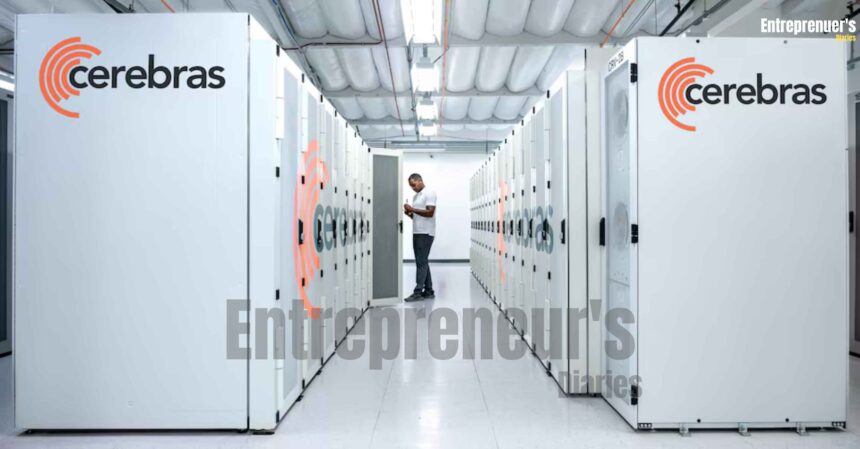
The result is the Wafer Scale Engine, currently in its third generation as the WSE-3. It is 58 times larger than Nvidia’s B200 chip. It has 900,000 compute cores all sitting on one piece of silicon. And it ships inside a water-cooled unit called the CS-3 that is roughly the size of a mini-fridge sitting in your kitchen.
Not exactly what you picture when someone says cutting-edge AI hardware. But what matters is not what it looks like. What matters is what it does.
When you run a large AI model across dozens of separate chips, information is constantly moving back and forth between them. Every transfer takes time. Those fractions of a second add up. At the kind of scale that companies like OpenAI operate at, latency is not a minor inconvenience. It is a real cost.
Cerebras removes that problem from the equation. Everything lives on one chip. Nothing has to travel. The whole relay race disappears because there is only one runner.
The IPO That Almost Never Happened
Here is the part of the Cerebras story that the financial coverage often breezes past. This company came frighteningly close to never reaching this moment.
In September 2024, Cerebras filed for an IPO. Things looked good on the surface. Revenue was growing. The technology was real. The company had generated genuine interest from the kind of institutional investors that matter.
Then the whole thing unravelled.
The problem had a name: G42. A UAE-based AI company that, at the time, accounted for more than 80% of Cerebras’ total revenue in the first half of 2024. That relationship caught the attention of the Committee on Foreign Investment in the United States, a federal body that reviews business arrangements involving foreign entities for potential national security risks.
When a company’s biggest customer is under federal scrutiny, investors do not wait around to find out how it resolves. The IPO was pulled. The company went back to work.
What happened over the next year and a half is the reason we are having this conversation today.
Revenue That Reframed the Entire Story
The numbers from fiscal 2025 are hard to argue with. Revenue went from $24.6 million in 2022 to $510 million in 2025. The company flipped from a $481.6 million net loss to $237.8 million in net income over the same stretch.
But honestly, the revenue figure is almost secondary to who is now behind it.
Cerebras signed a deal with OpenAI to provide as much as 2 gigawatts of computing capacity through 2030. The total value of that arrangement, spread across the contract period, runs into the tens of billions of dollars.
Think about what that means for a second. The company that makes ChatGPT, the product that put AI into the hands of ordinary people and sparked the current wave of investment and competition across the entire technology industry, looked at everything available to it and decided to make a long-term bet on Cerebras hardware. Not a pilot. Not a small trial. A commitment through the end of the decade.
And Then Amazon Walked Through the Door
If the OpenAI deal changed the story, the Amazon partnership changed the conversation entirely.

AWS announced a multiyear deal to bring the Cerebras WSE-3 into its cloud platform through Amazon Bedrock. It was the first time a hyperscale cloud provider had committed to deploying Cerebras hardware at that level. The two companies also worked together on something called a disaggregated inference architecture, where Amazon’s own Trainium chips handle one piece of the AI workload and the Cerebras CS-3 handles another. Early numbers from the arrangement suggested roughly five times more output capacity from the same hardware footprint.
Now yes, G42 still accounted for 24% of 2025 revenue, and a UAE university made up 62% of recognized revenue that year. Those concentrations are real, and any honest assessment of Cerebras has to acknowledge them.
But the company that walked into its 2024 IPO almost entirely dependent on one foreign customer is not the same company walking into this one with OpenAI and Amazon on the roster. That is a genuinely different business.
The Numbers, Honestly
The 20x oversubscription is a great headline. The successive price range increases make for a compelling story. But before anyone gets swept up in all of that, there are a few things inside the actual prospectus that deserve a straight look.
What That Profit Figure Actually Tells You
Cerebras posted $87.9 million in GAAP net income for fiscal 2025. That sounds like a profitable company. And in a narrow accounting sense, it is.
But a meaningful chunk of that figure comes from non-cash items. Warrant revaluations. Accounting adjustments tied to the specific structure of the OpenAI deal. Strip those out and the operating loss on a non-GAAP basis was $75.7 million.
The company is still spending more than it earns from actual operations. That is not a scandal. Plenty of great businesses have been in that position at this stage. But it is worth knowing the difference between what the income statement says at face value and what the underlying economics of the business actually look like right now.
The Number That Actually Explains the Investor Interest
If you want to understand why serious money is chasing this deal, stop looking at the quarterly results and look at the backlog.
Cerebras holds $25 billion in remaining performance obligations. That is money the company is contractually owed but has not yet put on its books as revenue. It will recognize 15% of that in 2026 and 2027. Another 43% in 2028 and 2029. The rest comes after that.
For context, this is a company that had $24 million in total revenue three years ago. A $25 billion contracted pipeline is a number that changes how every serious investor in the room has to think about the next five years.
The offering is led by Morgan Stanley, Citigroup, Barclays, and UBS Group AG. Pricing lands May 13. Trading starts May 14 on Nasdaq under the ticker CBRS. At the top of the revised range, this would be the biggest IPO anywhere in the world so far this year.
This Is About More Than One Company Going Public
Step back from the IPO mechanics for a moment and look at what is actually happening here.
For years, if you were building AI at any serious scale, you were buying Nvidia. Not because you necessarily wanted to. Because you had to. The hardware was the best available, the software ecosystem was miles ahead of anything else, and the supply chain relationships were built around Nvidia products. Switching costs were enormous. The grip was real.
That grip does not loosen easily. It takes time, it takes technical credibility, and it takes the kind of customer names that make other customers feel safe following. Cerebras now has those names.
What It Means When OpenAI Says Yes
When OpenAI commits its production inference workloads to Cerebras hardware, it is doing something more than signing a supply contract. It is telling every other AI lab, every enterprise technology team, and every CTO who has been quietly curious about non-Nvidia options that the risk of trying something different is lower than they thought.
That is how these markets actually shift. Not through press releases or benchmark papers. Through the decisions of companies whose judgment other companies trust. OpenAI’s name in the Cerebras customer list is quiet permission for a lot of people who were on the fence to start moving.
What This Should Mean to Anyone Building Something Right Now
This is the part that matters most if you are a founder or an entrepreneur watching this unfold from wherever you are.
The Cerebras story is not really about chips. It is about what happens when you build something that nobody is quite sure will work and you keep going anyway.
Wafer-scale manufacturing was genuinely considered impractical by serious people for a long time. The first IPO attempt collapsed publicly. The core thesis of the company was questioned at every stage. And the founders kept refining, kept building, kept finding a way through problems that probably looked fatal from the outside.
They showed up at the right moment with something real. That sequence is not luck. That is what building actually looks like when it works.
The Risks Nobody Wants to Talk About Right Now
A 20x oversubscribed book has a way of making people feel like the risks have already been priced in. They have not. Here are the ones that still matter.
The Customer Problem Is Not Fully Solved
Yes, the shift from G42 to OpenAI and Amazon is a genuinely better position. But Cerebras still relies heavily on a very small number of customers for the vast majority of its revenue. If OpenAI changes its infrastructure strategy, decides to build its own inference chips, or simply grows slower than expected, that hits Cerebras in a direct and significant way. Diversification at the customer level is still a work in progress.
The Operational Profitability Gap
The accounting profit is real but partly manufactured by non-cash items. The actual operating loss is still there. Cerebras is essentially asking investors to trust that converting a $25 billion backlog into revenue will eventually produce real margins at scale. That is a reasonable thing to trust given the evidence. But it is still trust, not proof.
Nvidia Has Resources That Nobody Else Has
Nvidia is not sitting quietly while Cerebras wins inference business. Blackwell is already in the market. Vera Rubin is coming. Nvidia has more money, more engineers, deeper customer relationships, and a software ecosystem that has been built over a decade. The performance edge that Cerebras holds today in specific inference workloads is real. Whether that edge still exists at the same magnitude in three years is genuinely unknown.
Watch the first few quarters of public earnings before drawing any firm conclusions. That is when the real picture starts to emerge.
What is the Cerebras IPO price range right now?
Cerebras opened its roadshow with a range of $115 to $125 per share. That moved to $125 to $135, and then to $150 to $160 as of May 10, 2026. At the top of the current range, the total raise comes to around $4.8 billion. The book was more than 20 times covered before final pricing.
When does Cerebras start trading and under what ticker?
Cerebras lists on the Nasdaq Global Select Market under the ticker CBRS. Final pricing is the evening of May 13, 2026. Trading begins the morning of May 14, 2026.
What does the company actually sell?
Cerebras makes wafer-scale AI chips called the WSE-3, which are considerably larger than Nvidia’s Blackwell B200. They ship inside a water-cooled unit called the CS-3. The hardware is built for AI inference, which is the process of an AI model actually responding to you, as opposed to the training process that teaches the model in the first place.
Why did the 2024 IPO not happen?
Cerebras filed for an IPO in September 2024 but withdrew after the federal government launched a national security review of its relationship with G42, a UAE-based company that made up more than 80% of Cerebras’ revenue at the time. The review created enough uncertainty that the company pulled the offering. It has since cleared the review and rebuilt its customer base around OpenAI and AWS.
Is the company actually making money?
On paper, yes. The 2025 GAAP net income was $87.9 million. But that number includes large non-cash accounting items. On an operational basis, the company ran a $75.7 million loss. It is growing fast, it has a $25 billion contracted backlog, and the investment case is built around what happens when that backlog converts into revenue at scale. But it is not yet profitable in the straightforward sense of the word.
Connect With Us On Social Media [ Facebook | Instagram | Twitter | LinkedIn ] To Get Real-Time Updates On The Market. Entrepreneurs’ Diaries Is Now Available On Telegram. Join Our Telegram Channel To Get Instant Updates.

Isabella is a global business journalist and former McKinsey analyst from Brazil. She brings sharp insights on economic shifts, policies, and founder journeys from around the world.

Ethan is a Lisbon-based leadership strategist who helps remote-first startups scale through systems, team clarity, and async culture.