
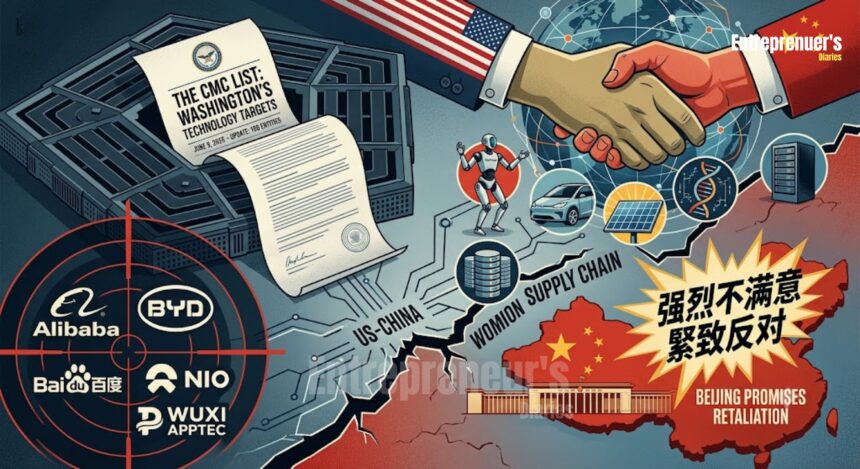
New York,June 9, 2026: The United States Department of Defense did something it had been threatening, delaying, and quietly drafting for months. The result: the Pentagon CMC List its most aggressive update ever now covers 188 entities, formally known as the Section 1260H or Chinese Military Companies List, placing the most recognisable corporate names in global technology squarely in Washington’s crosshairs. Alibaba. Baidu. BYD. NIO. Trina Solar. JA Solar. WuXi AppTec.
The list did not read like a roster of arms manufacturers. It read like a who’s who of China’s commercial technology sector companies whose products sit in American homes, hospitals, data centres, and electric vehicle charging networks. Four days later, on June 13, China’s Commerce Ministry made its position clear in language that left no room for diplomatic interpretation: “China is strongly dissatisfied and firmly opposes this.”
That statement was not background noise. It was accompanied by a threat of retaliation “resolutely and forcefully” if Chinese firms were not treated fairly issued in an official government statement, not an off the cuff briefing. Read alongside the Foreign Ministry’s separate condemnation and the Chinese Embassy’s formal protest in Washington, this is three layers of official Chinese government response in four days.
For investors, for technology executives, and for any business operating across the US-China supply chain, the question is no longer whether this escalation is real. It is how fast it moves, how far it reaches, and what it costs on both sides of the Pacific.
How the Pentagon CMC List Changed Its Own Rules
To understand why Alibaba and BYD are now on a military companies list, you have to understand how the Pentagon CMC List rewrote its own criteria and how that rewrite makes almost every major Chinese technology firm a potential target going forward. The list has existed since 2021, created by congressional mandate and required to be updated at least annually. Its original purpose was narrow: flag companies directly owned or controlled by China’s People’s Liberation Army or the Central Military Commission. That definition is gone.
The revised criteria now extend to any entity under the direction or control of a broader range of Chinese administrative bodies and their affiliates. What that means in practice is that companies with no overt military footprint whatsoever e-commerce platforms, electric vehicle manufacturers, internet search engines, solar panel makers can now be designated under the Pentagon CMC List on the basis of their relationship to civilian government bodies like the Ministry of Industry and Information Technology (MIIT) or the State Owned Assets Supervision and Administration Commission (SASAC) of the State Council.

This is not a technical adjustment. It is a doctrinal transformation. The Pentagon is no longer asking “does this company make weapons?” It is asking “does this company operate within China’s technology ecosystem and maintain ties to government bodies that Washington considers part of China’s military civil fusion strategy?”
That is an almost boundless criterion in a country where every major technology firm has some form of government affiliation. The Pentagon determined that Alibaba and Baidu qualify because both are indirectly affiliated with SASAC and are military civil fusion contributors to China’s defense industrial base through their MIIT ties. BYD and NIO were designated on the same grounds. When publishing the prior year’s update, the Pentagon stated that China’s military sought to acquire advanced technologies from companies, universities, and research programs that “appear to be civilian entities.”
That framing appear to be civilian tells you everything about where Washington’s strategic thinking on the Pentagon CMC List has now arrived.
Who Is Actually on the List and What It Means for Markets
The headline additions are companies whose combined scale makes this list unlike anything that came before it. With Alibaba and Baidu now included, the Pentagon’s designations cover all three of China’s largest publicly traded internet companies. Together Alibaba, Baidu, and Tencent, which was added to the CMC list in January 2025 they carry a combined market value of approximately $850 billion. Shares of Alibaba (NYSE: BABA) and Baidu (NASDAQ: BIDU) both moved into negative territory immediately after the announcement.
Beyond the headline names, the full scope of the update deserves a sector by sector read, because the breadth of coverage is itself a signal about Washington’s intent. In semiconductors and memory, the list includes CXMT and YMTC China’s leading memory chipmakers and the companies Beijing is banking on to reduce its AI infrastructure dependency on foreign chip supply.
In robotics, the list covers Unitree and RoboSense two of China’s most globally visible developers of humanoid, quadruped, and autonomous sensing systems. In networking, TP Link Technologies makes the cut a company commanding more than 30 percent of the U.S. market for certain networking devices including WiFi routers.
In biotechnology, WuXi AppTec is included one of China’s most globally integrated pharma services firms, embedded in drug development supply chains across the United States and Europe. In solar energy, both Trina Solar and JA Solar Technology were added in a subsequent update.
The updated roster also includes BOE Technology Group in displays, EVE Energy and CALB Group in batteries, Novogene in genomics, Baicells in telecom equipment, Tianma Microelectronics, and Zhongji Innolight in optical communications. Two CNOOC entities were removed while a third subsidiary was added. DJI, the consumer drone manufacturer, had already appeared before this update.
The pattern is impossible to miss. This list now covers the semiconductor stack, the AI infrastructure layer, the clean energy transition, the future of mobility, the global pharmaceutical supply chain, the networking infrastructure inside American homes, and the robotics platforms every major technology company is racing to deploy. That is not a targeted military designation. It is a structural intervention in the global technology economy.
What the Designation Actually Does and When
The CMC designation is not a sanctions designation. It does not freeze assets, halt trading, or ban commercial activity outright. But the consequences are real, structured, escalating, and already on a countdown clock that is closer than most people realise.
From June 30, 2026, the Defense Department is prohibited from contracting directly with any listed company what the Pentagon calls an “entity prohibition.” From June 30, 2027, that restriction extends through the supply chain: the Pentagon is barred from acquiring goods or services sourced from listed companies even when purchased through third parties.
That second deadline forces every major U.S. defense contractor and technology supplier with Pentagon business to audit their own supply chains for CMC list exposure and to make divestment or severance decisions accordingly. American technology companies can also be compelled to divest or sever ties with listed firms to preserve their own federal contracts.
Beyond the procurement timeline, listed firms face DoD investment restrictions, supply chain exclusions, heightened trade scrutiny, and additional barriers to obtaining U.S. technology licenses. The sectors covered semiconductors, artificial intelligence, robotics, electric vehicles, pharmaceuticals, and communications hardware are not peripheral to the global economy. They are the global economy. Any investor reading this as a niche defense policy story is misreading it entirely.
What the Companies Said and What They Were Actually Saying
Every major company on the list has issued a formal denial, and the language across those denials is striking not just in its consistency but in its legal precision. These are not companies caught flat footed. All of them are contesting the factual and legal foundation of their designation, not merely seeking administrative relief.
Alibaba stated there was no basis for its inclusion, calling itself “neither a Chinese military company nor part of any military civil fusion strategy,” and pledged to pursue all available legal action. Baidu called the suggestion that it is a military company “entirely baseless.” BYD, the world’s largest electric vehicle seller, said “there is no justification” for its inclusion and that the determination “contradicts the facts” pledging legal and administrative challenges while stating the decision had harmed its development achievements in the United States.
NIO went further than most in terms of formal record keeping, filing directly with the U.S. Securities and Exchange Commission via its Form 6-K. The language was precise: “The Company believes its inclusion on the CMC List is not justified as it is not a Chinese military company or a military civil fusion contributor to the Chinese defense industrial base.
” NIO also clarified for investors that “the U.S. government procurement limitations tied to the list will not impact the business of the Company, and the CMC List does not restrict transacting in the securities of the Company.” The company pledged to “proactively engage with the U.S. Department of Defense” to correct its inclusion.
WuXi AppTec called its inclusion “incorrect” and pledged immediate action. What all of these companies are signalling simultaneously to investors, to global customers, and to Washington is that they view this as legally contestable and intend to fight through every available channel. That process takes time. The compliance deadlines do not accommodate the litigation calendar. The reputational cost accumulates from the day of designation, regardless of what any courtroom eventually decides.
Beijing’s Official Response: This Is a Red Line
China’s Commerce Ministry statement on June 13, 2026 was not measured diplomatic language. It was escalatory, precise, and backed by an explicit on the record threat that no investor or supply chain executive should underestimate.
“China is strongly dissatisfied and firmly opposes this. China urges the U.S. to immediately stop its erroneous practices, immediately withdraw relevant measures and return to the correct track of building a constructive strategic and stable China-U.S. relationship.”
The ministry did not stop there. It warned that if Chinese firms are not treated fairly, Beijing will “inevitably retaliate resolutely and forcefully.” Source: Reuters, June 13, 2026 The word “inevitably” is doing significant work in that sentence. This is not a conditional threat it is a statement of declared policy intent.
The ministry statement also directly accused Washington of ignoring the consensus reached between the two nations’ leaders a pointed reference to the Trump-Xi Beijing summit of May 14, 2026, which had been described in both capitals as a step toward stabilising the trade relationship. The Pentagon published the CMC update less than a month after that summit.
Beijing’s framing that Washington ignored summit consensus positions the CMC update not as a routine annual exercise but as a diplomatic breach. That framing will shape how Beijing constructs its eventual retaliation.
China’s Foreign Ministry spokesperson Lin Jian added separately that China would “take necessary measures to protect the legitimate rights and interests of Chinese enterprises,” calling the list discriminatory and accusing it of placing “unreasonable pressure” on Chinese companies, urging the U.S. to “immediately correct its wrong practices, and lift the illegal unilateral sanctions and long arm jurisdiction on Chinese companies.”
The Chinese Embassy in Washington issued its own condemnation a third official channel accusing the U.S. of “overstretching national security concepts” and adding: “The U.S. should stop its wrong practice and create a fair, just and non discriminatory environment for Chinese companies.” Three official channels. Four days. The signal could not be clearer.
The Strategic Calculation Behind the Timing
The timing of this update is not incidental. In February 2026, the Pentagon briefly posted a preliminary version of the updated CMC list around the period when President Trump’s Beijing visit was being planned and then withdrew it the same day without explanation. That draft excluded memory chipmakers CXMT and YMTC, drawing sharp criticism from lawmakers who view both companies as central to China’s AI ambitions. The final version published on June 9 restored both firms and expanded the roster significantly.
Craig Singleton, senior fellow at the Foundation for Defense of Democracies, characterised the post summit timing as deliberately sequenced. “It serves as a post summit reality check,” Singleton told Reuters. “The administration is not treating the perception of summit success as a reason to stand down. It is using the post summit window to sequence pressure, leaving enough distance before a possible September Xi visit to manage diplomatic fallout.”
Singleton also made the observation that may be the most consequential framing to come out of this episode. Washington, he said, is no longer treating listed firms as isolated companies with specific military connections. It is viewing “the entire technology stack as strategically contested.”
The entire technology stack. Not individual companies. Not specific dual use hardware. The stack. That is a fundamental shift in how Washington thinks about economic engagement with China, and its implications extend far beyond any single list or designation.
What Congress Wants and What That Signals Next
Rep. John Moolenaar (R-MI), chair of the House Select Committee on China, made clear that for a significant and organised congressional bloc, the CMC list is not the ceiling it is a starting point. “These Chinese companies are working with the Chinese military against our national interests,” Moolenaar said. “Any of them that are publicly traded on U.S. exchanges should be immediately delisted and their products should be removed from supply chains our country depends on.”
That is a materially more aggressive position than what the CMC list itself currently imposes. The list prohibits Pentagon contracting it does not delist companies from U.S. exchanges or prohibit ordinary commercial activity. What Moolenaar is articulating is the next escalatory step that a significant portion of Congress is actively pursuing. For anyone holding positions in listed companies’ U.S. traded securities, that legislative ambition is a risk that needs to be priced.
The House Select Committee on the Chinese Communist Party called the list “a warning to American businesses, all levels of government and the American people,” stating that “no American company should do business with those named on the list because doing so would enable China’s military ascendance.”
Han Shen Lin, China Country Director at Asia Group, told CNBC the expanded list underscores “how national security concerns are increasingly shaping economic policy” in Washington. (Source: CNBC, June 9, 2026) Security logic is systematically displacing commercial logic as the primary organising principle of Washington’s economic engagement with China. That is the structural environment every investor, executive, and supply chain manager now operates in.
The Unitree Detail That No One Should Miss
One designation on the expanded list tells you more about where this technology confrontation is heading than almost any other. Unitree Robotics, the Hangzhou based maker of humanoid and quadruped robots, drew global mainstream attention when a troupe of its humanoid robots performed a dance routine on NBC’s “America’s Got Talent,” generating tens of millions of views. The Pentagon’s determination was specific: Unitree “knowingly received assistance from the Chinese government” through its official designation as a small or medium sized enterprise considered “highly innovative, highly competitive globally and critical to China’s supply chain.”
The week before the CMC list was published, Nvidia CEO Jensen Huang publicly announced that the chipmaker planned to partner with Unitree to develop robotic platforms for researchers. (Source: BetaNews, June 11, 2026) The collision between those two facts one of America’s most strategically critical semiconductor companies announcing a technology partnership with a firm that would be named a Chinese Military Company within days illustrates precisely how fast this landscape is moving, and how difficult ordinary business planning has become for any company operating at the US-China technology intersection.
Removal Is Possible. But It Is Rare.
For the companies named on the CMC list, the legal path forward is not closed. Companies can petition for removal, and the mechanism exists within the DoD administrative process. But the success rate is low. Xiaomi is the clearest precedent: the smartphone maker successfully sued to be removed from an earlier version of the list in May 2021 one of the very few cases in which a listed company has prevailed.
Every newly listed firm will be studying that case carefully. The challenge is structural: the litigation moves slowly, the compliance deadlines run on their own calendar, and the reputational cost accumulates from the moment of designation independently of whether any legal challenge ultimately succeeds. For a company like WuXi AppTec, whose global pharmaceutical services business depends on regulatory confidence from American and European clients, the reputational damage may prove more consequential in the short term than any direct procurement restriction.
The Investor Reality
For anyone tracking technology news in the US and globally, this is not background geopolitical noise. The CMC list’s expansion into civilian facing sectors e-commerce, electric vehicles, solar energy, biotech, robotics, networking hardware represents a fundamental shift in how Washington defines the boundary between commercial and strategic technology. The $850 billion in combined market value among the affected internet companies alone puts the financial scale of this in perspective.
The retaliation threat from Beijing is explicit, on the record, and delivered through three separate official channels in four days. The listed companies are mounting legal challenges that will take months or years to resolve. The procurement deadlines are already running. And the congressional appetite for further escalation including exchange delistings and commercial restrictions that go well beyond what the CMC list currently imposes is organised, bipartisan, and gaining momentum.
The broader pattern, in which Washington has decided to treat the entire Chinese technology stack as strategically contested rather than commercially separable, is not a temporary posture or a negotiating tactic. It is the settled strategic logic of the current moment, reinforced by bipartisan congressional pressure and the analytical consensus of the security community.
The critical question for the next twelve months is not whether Beijing retaliates. It is in which sector, on which timeline, and which American companies get caught in the crossfire when it does. The retaliation clock is running. It started the moment the list went live.
Connect With Us On Social Media [ Facebook | Instagram | Twitter | LinkedIn ] To Get Real-Time Updates On The Market. Entrepreneurs’ Diaries Is Now Available On Telegram. Join Our Telegram Channel To Get Instant Updates.

Isabella is a global business journalist and former McKinsey analyst from Brazil. She brings sharp insights on economic shifts, policies, and founder journeys from around the world.

Luca is a tech ethicist from Italy exploring disruptive innovation through a human lens—from AI to biotechnologies to decentralization.