
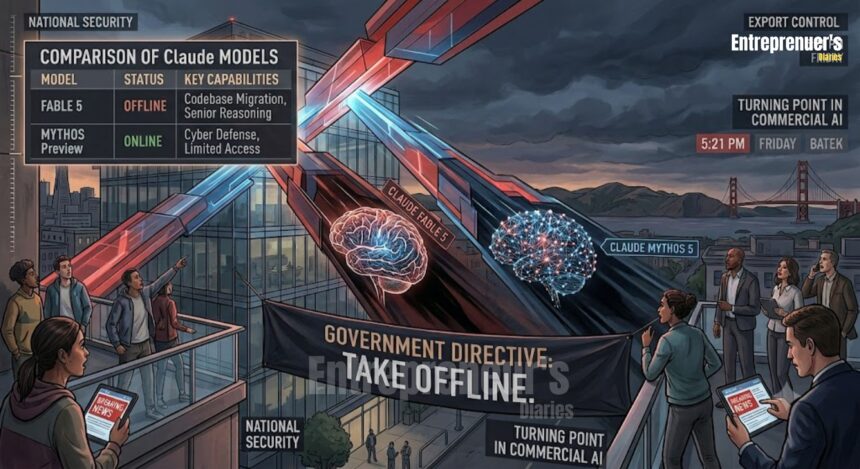
San Francisco, June 13, 2026.The United States government just shut down Anthropic Fable 5 and the AI industry will never look the same again. At 5:21 PM Eastern Time on Friday, June 12, 2026, a federal letter arrived at Anthropic. By nightfall, two of the most capable artificial intelligence models ever made available to the public had been taken offline. Not because of a technical failure. Not because of a company decision. Because the government ordered it.
That single fact marks a turning point in commercial AI history. For the first time, a leading AI company has been forced to remove a publicly deployed model from service due to direct federal intervention. The models in question are Anthropic Fable 5 and Claude Mythos 5. They had been live for exactly three days.
What Anthropic Said Word for Word
Anthropic published an official statement on its website on June 12, 2026. There is no need to speculate about what happened, because the company spoke plainly and on the record.
“The US government, citing national security authorities, has issued an export control directive to suspend all access to Fable 5 and Mythos 5 by any foreign national, whether inside or outside the United States, including foreign national Anthropic employees.” That sentence contains the full weight of the situation.
The directive did not just target foreign nationals accessing Anthropic’s models from other countries. It covered foreign nationals working inside Anthropic’s own offices in the United States. That scope made surgical compliance impossible. Anthropic confirmed this directly: “The net effect of this order is that we must abruptly disable Fable 5 and Mythos 5 for all our customers to ensure compliance.” The company also confirmed what was not affected: “Access to all other Anthropic models will not be affected.”
Why Anthropic Fable 5 and Mythos 5 Mattered Before the Government Pulled Them
Before you can understand what was lost on June 12, you need to understand what Anthropic Fable 5 actually was and how much it took to build. Anthropic launched Fable 5 on June 9, 2026, just three days before it was pulled offline. In its official announcement, the company called it a Mythos class model made safe for general use the first time a model of this capability tier had ever been released to the public.
Mythos class is not a marketing label. It is Anthropic’s designation for a tier of models that sit above its Opus class in raw capability. The first model in this class, Claude Mythos Preview, was released in April 2026 through Project Glasswing available only to a restricted group of cybersecurity partners and critical infrastructure providers. The public never had access to it. Fable 5 changed that.
According to Anthropic’s official launch blog, Fable 5 capabilities exceed those of any model the company has ever made generally available. It is state of the art on nearly all tested benchmarks of AI capability, showing exceptional performance in software engineering, knowledge work, vision, and scientific research. Anthropic also stated that the longer and more complex the task, the larger Fable 5’s lead over all other models.
Fable 5 and Mythos 5 are built on the same underlying model. The difference between them is one layer: safeguards. Anthropic Fable 5 was built with classifiers that automatically redirect sensitive queries in cybersecurity, biology, chemistry, and model distillation to Claude Opus 4.8, a less capable model that cannot complete high risk requests. Anthropic confirmed in its official launch blog that these classifiers trigger in fewer than 5 percent of sessions on average.
Mythos 5 is the identical model but with those cyber safeguards lifted in specific areas. It was made available only through Project Glasswing a small group of cyberdefenders and critical infrastructure providers, working in collaboration with the US government. Anthropic stated directly that Mythos 5 has the strongest cybersecurity capabilities of any model in the world.
That is what the government shut down. Not a beta. Not a prototype. The most capable publicly deployed AI model ever released three days into its life.
The Real World Proof That Preceded the Shutdown
Before they were pulled, these models had produced real world results that Anthropic documented publicly. The company’s official launch blog post includes testimony from early access customers.
Stripe reported that Fable 5 “compressed months of engineering into days.” Specifically, in a 50-million line Ruby codebase, the model performed a codebase wide migration in a day that would otherwise have taken an entire team more than two months by hand.
In knowledge work, Anthropic reported that Fable 5 achieved the highest score of any model on Hebbia’s Finance Benchmark for senior level reasoning, with gains in document based reasoning, chart and table interpretation, and problem solving.
In drug design, using Mythos 5, Anthropic’s internal protein design experts accelerated aspects of the drug design process by approximately 10 times. In one study, the model with protein design and bioinformatics tools but no human assistance matched or beat skilled human operators. Nine of 14 protein targets from this study yielded strong candidates currently being investigated.
In genomics, Mythos 5 conducted novel research in over a week of largely autonomous work, assembling single cell data for millions of cells across 138 animal species. The trained model outperformed a recent model published in the journal Science, despite being 100 times smaller.
Pricing for both models was set at $10 per million input tokens and $50 per million output tokens less than half the price of Claude Mythos Preview, which had been priced at $25 per million input tokens and $125 per million output tokens.
The Government’s Concern: A Jailbreak
So why did the government act? Anthropic’s official statement is the only authoritative public source on what the government communicated. “The letter did not provide specific details of its national security concern,” the company wrote.
What Anthropic does know: “Our understanding is that the government believes it has become aware of a method of bypassing, or ‘jailbreaking’ Fable 5.”
The company reviewed a demonstration of the specific technique. What it found: “We reviewed a demonstration of this specific technique being used to identify a small number of previously known, minor vulnerabilities. These vulnerabilities all appear relatively simple, and we have found that other publicly available models are able to discover them as well without requiring a bypass.”
Critically, Anthropic noted what the government actually presented: “To date, the government has only given us verbal evidence of a potential narrow, non universal jailbreak, which essentially consists of asking the model to read a specific codebase and fix any software flaws.”
That is the full extent of what has been formally disclosed.
Anthropic also confirmed it reviewed a report it believes forms the basis of the government’s directive. Its finding: “the level of capability displayed there is widely available from other models (including OpenAI’s GPT-5.5), and is used every day by the defenders who keep systems safe.”
What Anthropic Built And Why It Stood Behind It
The government’s concern centres on jailbreaking. Anthropic’s rebuttal centres on what it actually built, and how it was tested before launch. The company’s safeguard approach was not improvised. According to its official statement, in the weeks before launch, Anthropic worked with the US government itself, the UK AI Security Institute (AISI), multiple private third party organisations, and internal teams to red team Fable’s safeguards for thousands of hours in total.
The result of that testing, according to Anthropic: “Fable’s safeguards are substantially more effective than those of any previously deployed model.” And critically: “No testers have yet been able to find a universal jailbreak a jailbreak method that can very broadly bypass the model’s safeguards, unblocking a wide range of cyber capabilities.”
Anthropic’s launch blog post adds further detail on the external red teaming: the company ran an external bug bounty that produced no universal jailbreaks in over 1,000 hours of testing. External red teaming organisations it engaged also failed to find any universal jailbreaks on long form agentic tasks.
The company had also acknowledged in its launch materials that perfect jailbreak resistance is likely impossible for any model provider. This is why it adopted a “defense in depth” strategy making jailbreaks either narrow or very expensive to produce, and combining this with thorough monitoring to detect and shut down successful attacks quickly.
Part of that monitoring commitment: Anthropic required 30-day retention of all customer data for Mythos class models. The company acknowledged this carried real costs with customers, but stated it was essential to research and mitigate jailbreaks rapidly.
On cybersecurity specifically, Anthropic’s launch blog noted that one of its external partners found Fable 5’s safeguards against harmful cyber queries were the most robust of any model tested including Opus 4.8 and Opus 4.7. Fable 5 complied with zero harmful single turn requests relating to planning a cyberattack, exploit development, or defense evasion. This held across 30 different public jailbreak techniques.
Complying and Disagreeing At the Same Time
Anthropic’s response to the directive is worth examining carefully, because it is doing two things simultaneously. First, it is complying fully. The models were taken down. No legal challenge was filed to block the directive.
Second, it is disagreeing publicly and specifically. This is not a company that quietly accepted a regulatory order. It published a point by point technical rebuttal within hours. “We are complying with the government’s legal directive and are removing access to Fable 5 and Mythos 5 for all users,” the statement reads.
Then immediately: “However, we disagree that the finding of a narrow potential jailbreak should be cause for recalling a commercial model deployed to hundreds of millions of people.” The company went further: “If this standard was applied across the industry, we believe it would essentially halt all new model deployments for all frontier model providers.” That is not a narrow corporate complaint. It is a statement about the structural consequence of applying this regulatory standard universally.
Anthropic also addressed what proper oversight should look like, referencing positions it has stated publicly before: “We believe the government should have the ability to block unsafe deployments, as part of a statutory process that is transparent, fair, clear, and grounded in technical facts. This action does not adhere to those principles.”
The company closed with two commitments: an apology to its customers for the disruption, and a statement that it believes this is a misunderstanding and is working to restore access as soon as possible.
The Safeguard Architecture the Government Overruled
It is worth being specific about what the government’s directive overruled because the architecture Anthropic built was substantial. According to Anthropic’s official launch blog, Fable 5’s classifiers cover three domains: cybersecurity, biology and chemistry, and distillation.
On cybersecurity: the classifiers prevent the model from making any progress on exploitation and offensive cyber tasks. Internal evaluations showed this, and external partner testing confirmed it. On agentic hacking performing multiple steps of a cyberattack autonomously the safeguards held.
On biology and chemistry: Anthropic acknowledged the dual use nature of these capabilities directly. Mythos class models demonstrated the ability to outperform dedicated protein language models on tasks related to adeno associated virus design a capability relevant both to beneficial gene therapy research and to potential misuse. Because of this, Anthropic arranged for Fable to fall back to Opus 4.8 on most biology and chemistry requests.
On distillation: Anthropic had previously identified large scale attempts to extract its models’ capabilities to train competing models. Classifiers cover this too. The architecture was not theoretical. It was tested, documented, and published. The government chose to act anyway.
What Potential Jailbreaks Were Actually Disclosed
Anthropic was specific about what it was and was not told. “The potential jailbreaks that have been disclosed to us are either entirely benign responses or are minor findings that provide no Mythos specific uplift.”
And: “We have not even received a disclosure of a concerning non universal potential jailbreak that led to a harmful result.” The company noted it would share more technical details within 24 hours of its statement.
This matters for any professional trying to assess the situation objectively. The standard applied here halt deployment because a narrow, non universal jailbreak may exist is not a standard that has been previously applied in this industry. And as Anthropic notes, it is a standard that no deployed model from any provider could currently meet.
The Analytical Close: What This Actually Changes
Here is the part of this story that most coverage will not say directly. What happened on June 12, 2026 is not primarily a story about Anthropic. It is a story about the new operating environment for every company building or deploying frontier AI in the United States.
Before this week, a government shutdown of a commercially deployed AI model was theoretical. Now it is precedent. The mechanism is export control authority a legal framework with broad scope, a low evidentiary threshold for action, and no requirement for advance notice. Anthropic received the directive at 5:21 PM on a Friday. It had no transition window. Its enterprise customers on its platform, on AWS Bedrock, in Microsoft Foundry lost access that same evening.
Think about what that means operationally for any enterprise that builds workflow dependencies on frontier AI models. The risk is not just that a model could change or be deprecated. The risk is now that it could be taken offline in hours, by regulatory action, with no notice, for reasons that may not be fully disclosed.
Anthropic itself was explicit about the industry wide consequence: applying this standard would “essentially halt all new model deployments for all frontier model providers.” That is a statement of technical fact, not rhetorical excess. If a narrow, non universal jailbreak of the kind that exists in every model currently deployed is sufficient cause for shutdown, then no frontier model can survive that standard.
There is a second dimension worth understanding. Anthropic had done everything that responsible AI development is supposed to look like. It worked with the U.S. government itself to red team the models. It engaged the UK AISI. It ran external bug bounties. It published a system card. It instituted costly data retention policies. It was transparent about its approach and its limitations. And it was still shut down.
The message that sends to every other AI company is not subtle: even comprehensive, transparent, government collaborative safety work does not protect you from a unilateral executive action.
What this moment demands from policymakers, from industry, and from the enterprises that depend on AI is a serious, statutory framework for AI oversight. Anthropic has called for exactly this: a process that is transparent, fair, clear, and grounded in technical facts. The absence of such a framework is what made Friday’s abrupt shutdown possible. And until that framework exists, Friday’s shutdown will not be the last.
What to Watch Next
The most important near term signal is whether and how Anthropic restores access. If access is restored quickly and quietly, it suggests the directive was indeed a misunderstanding and that the underlying regulatory relationship between the government and frontier AI companies remains navigable.
If restoration is slow, conditional, or accompanied by new restrictions, it suggests the government is establishing a new oversight posture that the industry will have to operate within regardless of whether any individual action was technically justified.
And if this directive triggers a broader policy debate in Congress and the executive branch about how export control authority applies to AI, it could lead to the statutory framework that Anthropic has publicly argued for and that would ultimately benefit both the industry and the public. What is not in question is this: the frontier AI sector is no longer operating in a regulatory environment where governments merely observe, advise, or occasionally sanction. They can now turn the lights off.
Connect With Us On Social Media [ Facebook | Instagram | Twitter | LinkedIn ] To Get Real-Time Updates On The Market. Entrepreneurs’ Diaries Is Now Available On Telegram. Join Our Telegram Channel To Get Instant Updates.

Isabella is a global business journalist and former McKinsey analyst from Brazil. She brings sharp insights on economic shifts, policies, and founder journeys from around the world.

Luca is a tech ethicist from Italy exploring disruptive innovation through a human lens—from AI to biotechnologies to decentralization.