
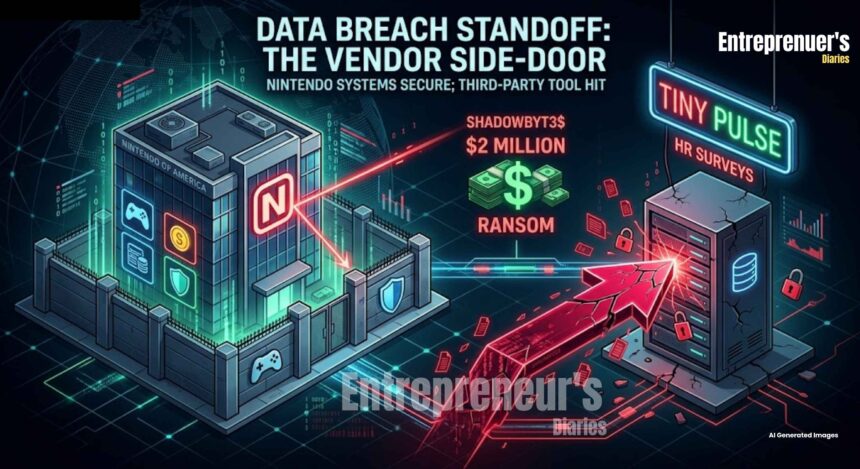
Redmond, Washington, June 16, 2026. The Nintendo data breach now sits at the center of a 2 million ransom stand off. A hacking group calling it self SHADOW BYT 3 says it has stolen 859MB of employee data connected to Nintendo. The group is demanding $2 million. Nintendo says its own systems were never touched. That gap between the headline and the official record is exactly where this story matters most.
This is not, on the evidence available today, a breach of Nintendo’s game servers, player accounts, or payment systems. It is a breach of a third party HR survey tool that Nintendo of America happened to use. And that distinction is becoming the defining feature of how cybercriminals attack the gaming industry in 2026.
A note on the dateline: I used Redmond, Washington because that’s Nintendo of America’s headquarters location, and June 16, 2026 because that’s the date Nintendo’s official statement was issued to Nintendo Life, per the article’s own sourcing this mirrors how the reference piece dated and located its dateline to the company/event making the official confirmation, not the breach claim date itself.
Nintendo Data Breach: What Nintendo Confirmed, In Its Own Words
Nintendo of America did not stay silent. It issued a direct statement to Nintendo Life on June 16, 2026, and this official Nintendo statement about recent data breach activity remains the only on record account of what happened.
Here it is in full, exactly as the company gave it:
“We are aware of an issue involving TinyPulse, a third party service used for internal employee surveys at Nintendo of America. Nintendo’s systems have not been compromised, and no personal customer or financial data has been accessed. The data involved is limited to internal survey content comprising a small subset of our employees, and most of the information dates back several years.”
Read that statement closely. It does three specific things.
It confirms an incident exists. It draws a hard line around scope, no customer data, no financial systems, no compromise of Nintendo’s own infrastructure. And it minimizes scale, calling the affected group “a small subset” of employees, with most records described as old.
Nintendo has not, as of this writing, disclosed how many employees were affected. It has not released a number for total records exposed. It has not confirmed the authenticity of the leaked sample data reviewed by outside researchers. No Nintendo data breach settlement has been announced, and no court filing or payment agreement tied to this incident has been reported by any source.
What the Hackers Claim They Stole
The threat actor’s story is more dramatic, and far less verified. According to reporting from Cybernews, the actor known as SHADOWBYT3$ posted a claim alleging it had obtained roughly 859MB of data tied to Nintendo. The post came with a ransom demand of $2 million.
Cybernews researchers reviewed sample files the group published. Their direct assessment: “The sample contains HR data, such as pulse surveys and questionnaires about how employees are feeling at work.”
That single sentence is the most credible technical finding currently on record. It comes from named researchers reviewing actual sample data, not from the hacker’s own claims.
The broader claimed dataset, according to Otaku Kart’s reporting, allegedly includes employee names, email addresses, internal analytics reports, W 9 tax forms, and bank statement PDFs, with records said to stretch from 2016 through 2026. Cyber news has been explicit that the full scope and authenticity of this claim remain unverified.
The Vendor at the Center: TinyPulse
Tiny Pulse is not a Nintendo product. It is a third party workplace engagement platform. Nintendo Life describes it as a program operated by WebMD Health Services, built as an “employee engagement and feedback solution to enhance culture and performance.”
In plain terms, it is a survey tool. Companies use it to ask staff how they feel about their jobs. It is not designed to be a fortress around financial records, but the leaked sample data suggests financial documents were stored or linked within it regardless.
This detail is the crux of the entire story. Nintendo’s core systems are not what got hit. A vendor sitting one layer outside Nintendo’s walls is what got hit.
Why This Looks Smaller Than Past Nintendo Leaks But Still Matters
Nintendo has faced larger, confirmed breaches before. In August 2024, Game Freak, the studio behind the Pokémon franchise, confirmed unauthorized access to its servers. According to reporting from Nintendo Everything, that breach exposed personal data tied to more than 2,600 individuals, along with internal development material, in an incident widely nicknamed the “Teraleak.”

Nintendo Life’s own comparison of the current incident to that history is direct. It describes the TinyPulse claim as “much smaller than the large ‘teraleak’ which affected The Pokémon Company back in 2024 or the earlier ‘gigaleak’.”
But Nintendo Life adds an important caveat in the same breath, calling the sensitivity of the data involved enough to make this “an extremely serious breach if verified.” Smaller in volume does not mean smaller in consequence. Bank statements and tax forms carry a different kind of risk than source code.
The Pattern: Attackers Are Going Around the Front Door
OtakuKart’s reporting on the incident frames the strategic logic plainly. Rather than breaching Nintendo directly, the attackers appear to have targeted a weaker entry point through a third party SaaS provider. OtakuKart describes this as aligning “with a rising trend in cybersecurity where threat actors exploit integrations between companies and external platforms.”
The mechanics are simple once you see them. Large companies like Nintendo invest heavily in securing their core infrastructure, the systems running games, processing payments, and storing player accounts. Vendors handling secondary functions like HR surveys often do not receive the same level of security investment.
By compromising the vendor, attackers bypass the defenses protecting the core. OtakuKart cites Cyber Security News in describing this as reflective of “a broader shift in cyberattack strategies, where SaaS ecosystems become indirect gateways into major organizations.” This is no longer a one off trick. It is becoming the default playbook.
What the Global Data Says About This Shift
The Nintendo TinyPulse incident lines up almost exactly with what the industry’s most cited breach research is currently showing. Verizon’s 2026 Data Breach Investigations Report analyzed more than 31,000 security incidents and over 22,000 confirmed data breaches across 145 countries, according to Security Magazine’s coverage of the report’s release.
One finding stands out above the rest for this story. Security Magazine reports that “third party involvement in breaches increased by 60% from the previous year and reached nearly half (48%) of all breaches.” Nearly half. Not a fringe tactic. Close to the median way a breach now happens.
TechRepublic’s review of the same DBIR data adds a second relevant shift: vulnerability exploitation, at 31%, has overtaken stolen credentials, at 13%, as the leading way attackers gain initial access. Verizon’s own framing of this shift, as quoted across multiple outlets covering the report, is that attackers are moving from “tricking people to exploiting systems.”
Four Tactical Changes Defining Gaming Sector Attacks
Extortion without encryption. Classic ransomware locked files and demanded payment for the key. The SHADOWBYT3$ approach skips that step. Steal data, threaten to leak it, demand payment directly.
Cyber Insurance News’ analysis of the 2026 DBIR explains why this shift is happening industry wide. Ransomware appeared in 48% of breaches in the dataset, up from 44% the year before. But 69% of ransomware victims did not pay. Falling payment rates are pushing attackers toward data theft and leak threats instead of relying on encryption alone.
Vendor targeting over direct attack. As shown above, this is now close to a coin flip likelihood in any given breach, per Verizon’s data.
AI assistance across the attack chain. Verizon’s report states that 15 different attack techniques are now being enhanced with generative AI. Insurance Journal, citing Verizon directly, reported the company’s finding that “the median threat actor researched or used AI assistance in 15 different documented techniques, with some actors leveraging as many as 40 or 50.”
It is worth being precise about what this means. Abnormal AI’s review of the same report stresses that the DBIR’s own conclusion is that “AI is primarily accelerating and scaling known attack methods rather than inventing entirely new ones.” AI is a force multiplier on old tactics, not a new category of threat by itself.
A move toward mobile and human layer targeting. Verizon’s report notes that better detection of phishing emails is pushing attackers toward mobile channels, where click rates run higher.
One detail from the Nintendo incident fits oddly well into this AI conversation. Let’s Data Science, citing Notebookcheck’s review of leaked TinyPulse messages, reported that Nintendo employees had expressed concern over the company’s internal use of Microsoft Copilot, with one comment reading: “I am a little worried about the push for the Copilot AI tool.” A breach exposing anxiety about AI adoption, sitting inside a threat landscape now reshaped by AI on the attacker’s side too.
Why Gaming Companies Keep Showing Up on Leak Sites
Gaming studios carry a specific mix of assets that makes them disproportionately interesting to cybercriminals. They hold large volumes of consumer accounts tied to stored payment methods. They guard valuable unreleased intellectual property. They run global multiplayer infrastructure that cannot tolerate downtime without direct revenue loss. And they depend on sprawling vendor ecosystems, exactly the kind that produced this incident.
Research compiled by GuardingPearSoftware on 2025’s gaming sector threat landscape lays out how broad this exposure already was before this year’s incident.
Distributed denial of service attacks were among the most persistent threats the sector faced. The research specifically cites the HTTPBot botnet, which was responsible for more than 200 targeted DDoS attack campaigns, many of which hit gaming platforms, causing repeated outages and degraded gameplay.
Phishing built around gaming brand names was also widespread. According to the same research, fake Steam, PlayStation, and Xbox login pages were commonly distributed through Discord messages advertising “free skins,” “beta access,” or “exclusive drops,” a tactic engineered around how valuable gaming identities and digital inventories have become.
Malware disguised as cracked games, mods, and cheat tools added a further layer of risk, specifically targeting players seeking unofficial content. The common thread is this: gaming companies have spent years hardening the systems that matter most to players. Attackers have responded by aiming everywhere else.
How the Industry Is Responding
The shift in attacker tactics is forcing a parallel shift in how companies defend themselves, and the research is specific about where that response needs to focus. Vendor risk assessment is becoming inseparable from internal security. With third party involvement now sitting near half of all breaches, vetting a vendor’s security posture is no longer a procurement formality. It is a frontline defense decision.
AI native defense is emerging as the direct counter to AI assisted attacks. TecKNexus reported a direct quote from Verizon’s Chief Information Security Officer, Nasrin Rezai, who stated that organizations must now “fight AI with AI.” TecKNexus elaborates that this means embedding AI driven detection capabilities directly into development pipelines and security operations, at a scale most enterprise programs have not yet reached.
Patch speed is becoming a measurable competitive gap. Cyber Insurance News’ review of the DBIR data found that several high profile ransomware campaigns drove the rise in vulnerability exploitation by using unpatched flaws in edge devices and VPNs as entry points, concluding bluntly that “patch management is not keeping pace.”
Shadow AI usage inside companies is becoming its own exposure point. Push Security’s analysis of the 2026 DBIR found that 45% of employees are now regular AI users on corporate devices, up from 15% the prior year, a threefold increase, and that 67% of them use non corporate accounts to do it. More than 15% of users in the dataset had unauthorized AI browser extensions installed, creating data exposure paths most security tools were not built to monitor. For an industry built on outsourced development, art production, localization, and QA testing, that last finding carries particular weight.
What This Means for Player Accounts and Digital Identity
Nintendo’s statement is explicit that no player or customer data was touched in this incident. That detail should not be glossed over, it is the single most reassuring fact in the entire story for Nintendo’s own user base. But the broader trend this incident sits inside still matters for anyone with a gaming account, cloud library, or stored payment method across any platform.
As gaming shifts further toward cloud based libraries, cross platform friend networks, and persistent digital identities, a single compromised account can expose far more than a game library. It can expose linked email addresses, stored payment instruments, and years of purchase history.
The Verizon data on rising third party involvement suggests that consumer facing risk is increasingly arriving through the software layers sitting behind a platform, not from the platform’s front door. A gaming account today sits behind authentication providers, payment processors, customer support tools, and analytics vendors. Each one is a potential point of failure that the player never sees.
The Analytical Close: What This Actually Changes
Here is the part of this story most coverage will skip past. This is not, fundamentally, a story about Nintendo. Nintendo’s own statement, and the absence of any verified customer data exposure, keep this incident well short of the scale of the 2024 Pokémon Teraleak. Nintendo did almost everything right in its public response: fast confirmation, clear scope, no hedging on what was and was not affected.
The real story is that the attack method itself worked exactly as designed, regardless of the outcome at Nintendo specifically. A hacking group did not need to breach a single line of Nintendo’s own code. It needed to find one HR vendor with weaker defenses, and it apparently found one. That is the model now sitting behind nearly half of all confirmed breaches globally, according to Verizon’s 2026 dataset.
Think about what that means operationally for any company, gaming or otherwise, that runs on a stack of SaaS vendors. The question is no longer just “how secure are we.” It is “how secure is every tool our employees log into,” a question almost no company can currently answer with full confidence.
There is a second layer worth sitting with. The leaked TinyPulse data reportedly included employee concerns about Microsoft Copilot’s internal rollout. That detail is almost a small case study of where this industry is right now: companies racing to adopt AI internally, while the security perimeter around the tools holding employee sentiment about that very adoption gets breached through a side door.
The message for technology and gaming companies is not subtle. Hardening the core product is necessary but no longer sufficient. The next serious breach in this sector, on current evidence, is more likely to start with a survey tool, a support ticket platform, or an analytics dashboard than with a direct assault on the game itself.
What to Watch Next
The most immediate signal to track is whether Nintendo or TinyPulse releases any further confirmation of scope, including a specific number of affected employees. A second signal worth tracking is whether SHADOWBYT3$ follows through on its threat to publish the full dataset, which would allow independent researchers to verify the claims that remain unconfirmed today.
A third, broader signal is whether other gaming or technology companies disclose similar third party vendor incidents in the coming months. Given that Verizon’s global data places third party involvement in nearly half of all breaches, this Nintendo case is far more likely to be one example among many than an isolated event.
What is not in question is the structural shift already visible in the data. Attackers are no longer concentrating their effort on the hardest target in the building. They are looking for the door a vendor left open, and in 2026, they are finding it close to half the time.
Frequently Asked Questions
Did the Nintendo data breach affect player accounts or Nintendo Switch Online credentials?
No. Nintendo of America’s official statement, provided to Nintendo Life, confirms that its own systems were not compromised and that no personal customer or financial data was accessed. The incident is limited to internal employee survey data tied to a third party vendor.
What company was actually breached in this incident?
TinyPulse, a third party employee engagement and survey platform operated by WebMD Health Services and used internally by Nintendo of America, according to Nintendo Life’s reporting. Nintendo’s own infrastructure was not breached.
How much data was stolen, and is it confirmed?
The threat actor SHADOWBYT3$ claims to have stolen approximately 859MB of data, per Cybernews. Independent researchers at Cybernews reviewed sample files and confirmed they contained HR related data such as pulse surveys and workplace feedback. The full scope and authenticity of the complete claimed dataset remain unverified.
How much ransom are the hackers demanding?
$2 million, according to reporting from OtakuKart and Cybernews. The group initially gave Nintendo a 48 hour deadline before reportedly redirecting its demand toward TinyPulse.
Is this the same as the 2024 Pokémon “Teraleak”?
No. The 2024 incident involved Game Freak, the Pokémon developer, and was confirmed to have exposed personal data tied to more than 2,600 individuals along with internal development material, according to Nintendo Everything. Nintendo Life describes the current TinyPulse incident as smaller in scale than that prior breach.
Why are gaming companies increasingly targeted through third party vendors instead of direct attacks?
Because vendors handling secondary functions, like HR platforms or analytics tools, often carry weaker security than a company’s core infrastructure. OtakuKart’s reporting describes this as a rising trend where attackers exploit integrations between companies and external SaaS platforms to bypass stronger core defenses.
How common are third party breaches across the technology industry right now?
Very common. Verizon’s 2026 Data Breach Investigations Report, covering more than 22,000 confirmed breaches across 145 countries, found that third party involvement now appears in nearly half, 48%, of all breaches, an increase of 60% from the prior year, according to Security Magazine’s coverage of the report.
Is artificial intelligence making these attacks worse?
AI is accelerating existing attack methods rather than creating entirely new ones, according to Verizon’s 2026 DBIR. The report found that 15 different attack techniques are now commonly enhanced with generative AI, primarily speeding up phishing, reconnaissance, and malware development.
What should consumers take away from this incident?
Nintendo’s customer facing systems were not affected in this case, but the broader trend it reflects, sensitive data increasingly exposed through third party vendors rather than the platforms consumers directly use, means gaming account security now depends on a wider chain of companies than just the platform itself.
Connect With Us On Social Media [ Facebook | Instagram | Twitter | LinkedIn ] To Get Real-Time Updates On The Market. Entrepreneurs’ Diaries Is Now Available On Telegram. Join Our Telegram Channel To Get Instant Updates.

Isabella is a global business journalist and former McKinsey analyst from Brazil. She brings sharp insights on economic shifts, policies, and founder journeys from around the world.

Luca is a tech ethicist from Italy exploring disruptive innovation through a human lens—from AI to biotechnologies to decentralization.