

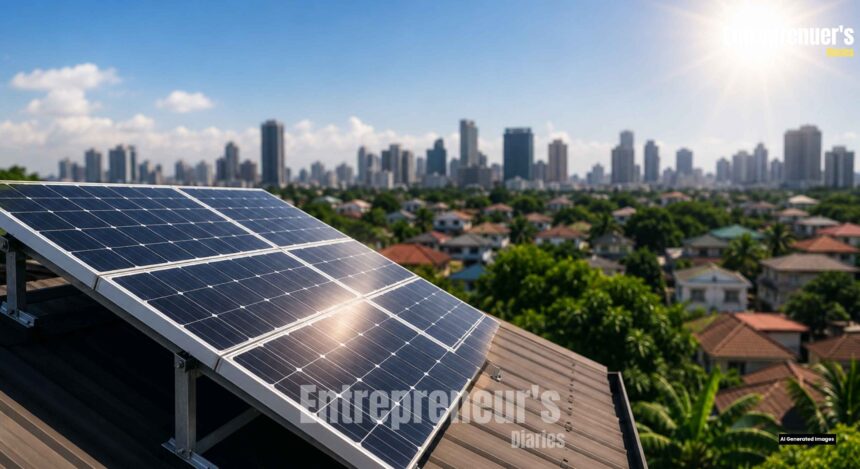
MANILA/SINGAPORE, June 29, 2026: Filipino households are buying solar panels faster than anyone else on the planet right now. Solar panels Philippines import data, tracked through Chinese customs figures, show the trigger is not a green policy push. It is a power bill that has become too expensive to keep paying.
- Solar Panels Philippines: Why Filipino Households Are Rushing to Rooftop Power
- Inside the Record Solar Panel Import Surge
- Why Soaring Electricity Bills Are the Real Trigger
- The Capital Shift Reshaping the Philippine Power Sector
- What the Peso, Inflation and the BSP Mean for Power Markets
- What History Says About Tariff Driven Solar Booms
- The Risks That Could Still Derail the Solar Rush
- The Analytical Closing: What the Solar Rush Tests for Investors
- Frequently Asked Questions (FAQs)
For professionals and entrepreneurs tracking market and economic Business News US, the Philippines is now a live test of how fast household capital reallocates away from a centralized grid once an energy price shock makes waiting too expensive.
Every claim in this analysis is rooted exclusively in official government data or named, credible news outlets. We do not rely on rumors, anonymous chatter, or unverified social media commentary.
Instead, we examine only what the Philippine Statistics Authority, the Bangko Sentral ng Pilipinas, the Department of Energy, the Office of the President, and named financial and news organizations have officially reported.
Solar Panels Philippines: Why Filipino Households Are Rushing to Rooftop Power
Solar panels Philippines import data confirm the scale of the shift: the country has become the world’s single biggest buyer since the war in Iran began, Reuters reported. The rush is being driven by ordinary households, not utilities or government programs.
Top power distributor Meralco has raised electricity rates by 10% since the Middle East conflict escalated in late February, according to Reuters. A median household using 200 kilowatt hours a month now spends roughly 12% of its income on electricity.
The Philippines is one of the few countries in Southeast Asia with minimal power subsidies. Its residential electricity rates are the highest in the region, Reuters said.
Only Singapore comes close on price. But Singaporean households have nearly 13 times the purchasing power of their Filipino counterparts, per the same Reuters report.
Inside the Record Solar Panel Import Surge
The Philippines imported $407 million worth of solar panels in the three months through May, a 145% jump from a year earlier, Reuters reported, citing Chinese customs data that accounts for most global panel supply.
That surge held up even as overall Chinese panel exports fell 13% in May after Beijing withdrew a tax rebate. Shipments to the Philippines still rose by almost a third over the same period, according to Reuters.
Installer demand confirms the trend. Philergy German Solar, a Manila based installer, received more than two and a half times as many customer enquiries in the first five months of 2026 as in the same period last year, Reuters reported.
At one point, the company fielded 3,000 inquiries in a single day. “Demand will continue to be driven by high electricity prices,” Philergy managing partner Jochen Staudter told Reuters.
Energy think tank Ember estimates distributed solar capacity could nearly triple to 3,500 megawatts within two years. That would match the country’s entire existing utility scale solar fleet, Ember analyst Alnie Demoral told Reuters.
On paper, the Netherlands posts even larger panel import figures than the Philippines. But that is because Dutch ports function mainly as a transshipment hub for panels re-exported elsewhere in Europe, Reuters reported, citing trade experts.
Solar still meets under 4% of national power consumption, according to Philippine government data cited by Reuters. The growth rate, not the current base, is what is drawing investor attention.
Why Soaring Electricity Bills Are the Real Trigger
Loan payback periods for rooftop systems have compressed to 3.1 years from 4 years, Demoral told Reuters, as falling panel costs and rising grid tariffs move in opposite directions at once.
The government offers solar loans of up to 500,000 pesos at a subsidized 5% interest rate, well below market rates, according to Reuters. The program excludes private sector workers.
The upfront cost still typically exceeds the average annual household income of 353,200 pesos, Reuters reported. “The upfront cost is often too high,” Demoral said.
Manila entrepreneur Jason Porciuncula installed a 12 kilowatt system with battery storage in January, Reuters reported. As prices hit record highs in May, his monthly bill dropped to a fifth of what he paid the previous summer.
Software engineer Adrian Sabatera installed a 570,000 peso system at the Manila house he shares with three others, after years of finding the technology too costly, according to Reuters. He told Reuters he would not be surprised if a third of the country’s middle class eventually adopts similar setups.
Installations are still lagging behind demand. Component hoarding, volatile equipment costs, and inconsistent quality checks are slowing rollout, Brenda Valerio, Philippines director at New Energy Nexus, told Reuters.
The Capital Shift Reshaping the Philippine Power Sector
This is a capital allocation story before it is an energy story. Households are reallocating savings and credit toward private generation assets at a pace utilities did not plan for.
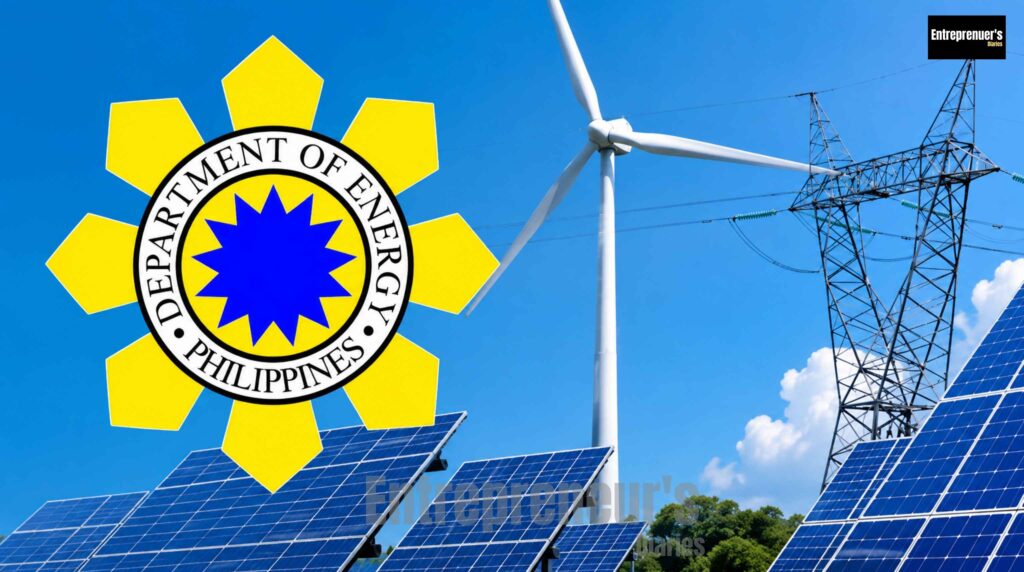
The Department of Energy’s Philippine Energy Plan targets a 35% renewable share of power generation by 2030 and 50% by 2040, according to the department’s own published plan. The Renewable Portfolio Standard already requires distribution utilities to source a rising share of supply from renewable developers.
ACEN Corporation, the Ayala linked listed renewable energy platform, reports a total renewable generation portfolio of 7,001 megawatts. That includes 4,624 MW of solar, 1,958 MW of wind, 115 MW of geothermal, and 304 MW of battery storage tied to its solar assets, according to company data published by Investing.com.
ACEN’s footprint sits mostly in utility scale and commercial generation, not residential rooftops. That means the household level boom captured in the import data is, for now, largely bypassing the country’s largest listed renewable developer.
Meralco remains a blue chip, dividend paying anchor of the Philippine Stock Exchange index. The stock carries a market capitalization near ₱643 billion, a price to earnings ratio around 12.5, and a dividend yield close to 4.9%, with a consensus analyst rating of “Buy,” according to data published by StockAnalysis.com.
That valuation still reflects a defensive utility holding. It does not yet appear to price in meaningful long term load loss to behind the meter solar.
No single share price move has been tied directly to this rooftop solar report. This is a structural, multi quarter story, not a one day trade.
A national emergency push to fast track renewable supply is already underway. The Department of Energy moved to connect roughly 1,471 megawatts of approved renewable and storage projects to the grid by April, according to a Zero Carbon Analytics report covered by Eco Business.
The country activated 250 megawatts of solar alongside 450 megawatt hours of battery storage in March. At the time, that was the country’s largest operational storage system, Eco Business reported.
“Scaling up solar is one of the fastest and most effective ways” to cut fossil fuel exposure, Zero Carbon Analytics researcher Yu Sun Chin told Eco Business. The same report estimated the Philippines could avoid roughly $28 million in coal and gas import costs by hitting a conservative 9.5 gigawatt solar target by 2030.
The competitive winners from here look fairly distinct. Scaled developers such as ACEN can finance utility scale solar plus storage at a lower cost of capital than individual households can access on their own.
Installers like Philergy are capturing the residential wave directly, as their surging enquiry volumes show. Battery storage providers stand to benefit too, since a grid absorbing more uncoordinated daytime solar will need more dispatchable storage to manage the resulting load curve.
What the Peso, Inflation and the BSP Mean for Power Markets
This boom did not happen in a vacuum. President Ferdinand Marcos Jr. declared a state of national energy emergency on March 24 under Executive Order 110, citing the closure of the Strait of Hormuz, according to the Presidential Communications Office and the Philippine News Agency.
The order warned of “imminent danger of a critically low energy supply,” per the Philippine News Agency’s coverage of the executive order. It created the UPLIFT Committee, chaired by the president, to coordinate the government’s response.

It was the first time a Philippine president had exercised that emergency authority under the Department of Energy Act of 1992, Philstar reported. The law allows the president to declare a critically low energy supply and order fuel and energy allocation measures.
Headline inflation hit a three year high of 7.2% in April before easing to 6.8% in May, according to Philippine Statistics Authority data. The year to date average is still running at 4.5%, above the central bank’s 2% to 4% target band.
The housing, water, electricity, gas and other fuels component of the inflation index ran at 7.8% in May, PSA data show. First quarter GDP growth came in at 2.8%, according to the same agency.
Department of Economy, Planning and Development Secretary Arsenio Balisacan has warned that growth could slow further, toward 3.5% to 4%, under a worst case oil price scenario, Philstar reported.
A weakening peso, trading near 61.29 to the US dollar, has compounded the squeeze, Reuters reported, because the Philippines imports most of the coal and gas it burns for power.
The Bangko Sentral ng Pilipinas raised its policy rate to 4.75% on June 18, its second consecutive hike, Rappler reported. The move is meant to contain inflation now forecast to average 6.4% for the year.
BSP Governor Eli Remolona has said that even with a ceasefire in the Middle East, markets “will still need several months to rebuild the infrastructure” before oil prices normalize, he told Rappler. That is a candid admission that monetary policy cannot fix an energy supply shock at its source.
For investors, the read through is straightforward. Rooftop solar adoption is doing some of the inflation fighting work that interest rates alone cannot, by structurally cutting one household’s exposure to an imported fuel cost shock that policy rates cannot reverse.
What History Says About Tariff Driven Solar Booms
The Philippines is not the first Asian economy to see tariff driven households flood into rooftop solar. Pakistan offers the clearest precedent, and a cautionary one.
Pakistan imported roughly 17 gigawatts of solar panels in 2024 alone, more than double the prior year, making it the world’s third largest importer, according to data from energy think tank Ember reported by CNN. Solar’s share of Pakistan’s generation mix rose from about 4% in 2021 to between 14% and 25% by 2024-2025.
Net metering had let Pakistani households offset their electricity bills at the same rate they paid for grid power, before the rules changed, Arab News reported.
The lesson is what came next. As distributed solar eroded grid revenue, Pakistan’s regulator moved in February 2026 to replace generous net metering with a less favorable net billing framework, cutting the rate paid for exported solar power by roughly 60%, Arab News reported.
Distribution utilities had warned that net metering was undermining their revenue base and shifting costs onto non solar customers, according to Arab News. The Philippines is at an earlier stage of that cycle, with solar still under 4% of consumption versus Pakistan’s much higher penetration.
But the regulatory pattern is now documented across at least two large Asian power markets. Rapid adoption tends to be followed by utility pushback and policy tightening once revenue losses become visible.
The Risks That Could Still Derail the Solar Rush
Financing remains the biggest near term obstacle. The upfront cost of a rooftop system still exceeds average annual household income, and subsidized government loans exclude private sector workers, Reuters reported.
Installation quality is the second risk. Component hoarding and inconsistent quality checks are already slowing rollout, New Energy Nexus’s Valerio told Reuters, a pattern that tends to surface as warranty and performance problems two to three years after a boom, not during it.
Currency and import cost exposure is the third. Because panels and equipment are priced in dollars, a weakening peso raises the cost of new installations even as it raises the value of switching away from grid power.
Policy reversal is the fourth, and the one Pakistan’s experience makes hardest to ignore. If distributed solar grows fast enough to meaningfully erode utility revenue, Philippine regulators could eventually face the same pressure that pushed Pakistan toward less generous compensation for solar exports.
Geopolitical risk sits underneath all of it. The entire boom is downstream of a Middle East energy shock; a durable ceasefire and falling fuel prices would ease the very pressure now driving households toward solar.
The Analytical Closing: What the Solar Rush Tests for Investors
Strip away the panel import headlines, and this is a test of how fast capital reallocates when a regulated utility model stops working for its customers. Three things should anchor how professional readers price it going forward.
First, this is a capital allocation event before it is an energy event. Households and small businesses are moving savings and credit toward private generation assets faster than the formal renewable investment pipeline is expanding, and that gap is where new financing products, and new installer consolidation, will be built.
Second, the listed utility sector has not yet repriced for disintermediation risk. Meralco’s valuation still reflects defensive dividend positioning rather than structural load loss modeling, leaving room for a sentiment shift if Ember’s 3,500 megawatt, two year projection materializes.
Third, the macro and the micro are now feeding each other. A geopolitical energy shock pushed inflation and interest rates higher, and the resulting tariff pain is funding the very rooftop adoption that could eventually erode utility revenue and invite a regulatory response, as Pakistan’s net billing reversal shows.
For investors with exposure to Philippine utilities, renewable developers, consumer finance, or regional solar supply chains, the next twelve months matter more than this week’s import figures. Department of Energy project completions, BSP rate decisions, and Energy Regulatory Commission tariff rulings will do the real work of setting the trajectory.
They will decide whether this becomes a durable structural shift in Southeast Asian power markets, or a tariff shock driven spike that fades once the Middle East crisis eases.
Frequently Asked Questions (FAQs)
Why is the Philippines buying more solar panels than any other country in 2026?
Filipino households are installing rooftop solar to escape soaring electricity prices, after top distributor Meralco raised rates 10% since February’s Middle East conflict, Reuters reported. The country imported $407 million in panels in the three months through May, a 145% jump from a year earlier.
Why are electricity prices so high in the Philippines right now?
Prices have climbed because the Philippines relies on imported coal and gas, and a weakening peso combined with a national energy emergency tied to the Middle East crisis has pushed up fuel and power costs, according to Reuters and the Philippine News Agency. The Bangko Sentral ng Pilipinas raised interest rates twice in response to the resulting inflation, Rappler reported.
How long does it take rooftop solar to pay for itself in the Philippines?
Loan payback periods for residential solar systems have shortened to about 3.1 years from 4 years, according to energy think tank Ember, as panel costs fall and grid electricity rates climb at the same time, Reuters reported.
What is the Philippines’ renewable energy target for 2030?
The Department of Energy’s Philippine Energy Plan targets a 35% renewable share of power generation by 2030 and 50% by 2040, according to the department’s official plan. Solar currently supplies under 4% of national power consumption, per government data.
Could the Philippines reverse its solar incentives the way Pakistan did?
It is too early to say, since Philippine solar penetration remains far below Pakistan’s. But Pakistan cut payments for solar exported to the grid by about 60% in February 2026 after utilities said rapid adoption was eroding their revenue, Arab News reported, a regional precedent worth watching as Philippine rooftop adoption scales.
Connect With Us On Social Media [ Facebook | Instagram | Twitter | LinkedIn ] To Get Real-Time Updates On The Market. Entrepreneurs’ Diaries Is Now Available On Telegram. Join Our Telegram Channel To Get Instant Updates.

Isabella is a global business journalist and former McKinsey analyst from Brazil. She brings sharp insights on economic shifts, policies, and founder journeys from around the world.

Tokyo-based CFA translating global markets into clear insights for modern entrepreneurs.