
LONDON/DUBAI, June 19, 2026:Four months ago, Dubai International the busiest airport on the planet for international travel was running on fumes, severely restricted for days on end. Doha and Abu Dhabi weren’t far behind. Tens of thousands of passengers got stuck wherever they happened to be when the conflict broke out.
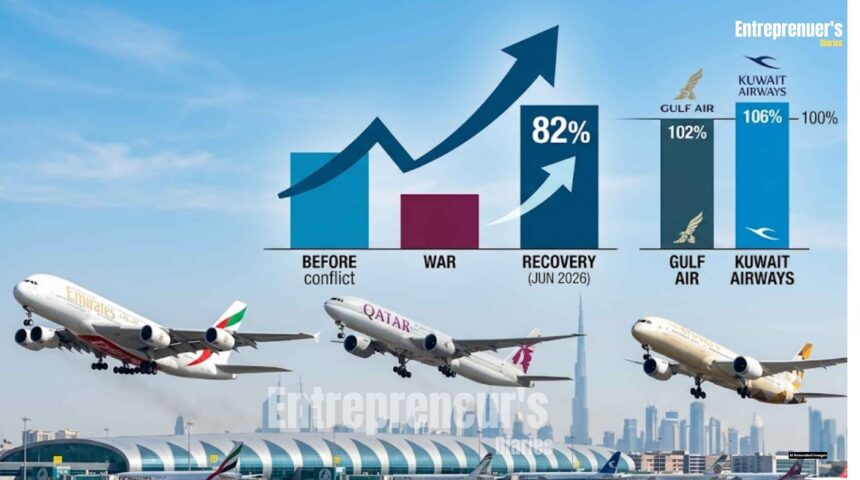
Today, the Gulf airlines recovery is picking up real speed. The same carriers that once grounded most of their networks are flying at roughly 82% of pre war levels, and two of them have already blown past 100%.
That’s the headline number out of Reuters reporting published June 19, 2026, drawn from flight tracking data on Flightradar24.com. Four months of cancellations, diversions and warehoused jets, and the numbers finally look like they’re bending the right way.
THE CORE FINDING: WHAT THE GULF AIRLINES RECOVERY DATA SHOWS
Here’s what the Gulf airlines recovery actually looks like in numbers. Reuters, citing Flightradar24.com data, puts the overall flight volume of major Gulf airlines at roughly 82% of where it stood on February 27, 2026 the last normal day before the conflict began. Two carriers have already cleared that bar. Gulf Air and Kuwait Airways have topped 100% of their pre war flight volumes in recent days, Reuters reports.
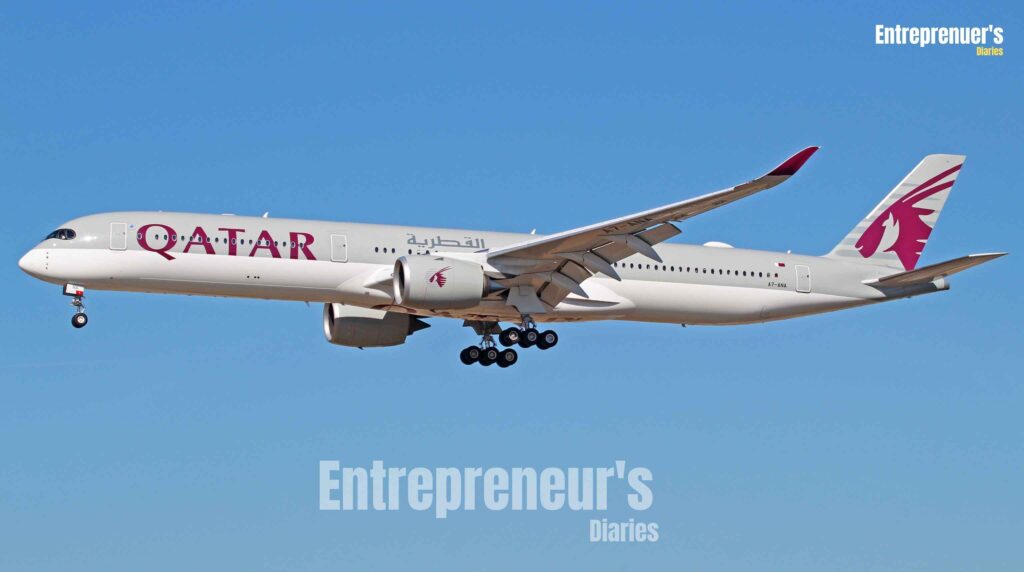
The rest of the field is messier. Emirates, Qatar Airways and Etihad, the region’s three biggest names, are sitting above or near 90%. Not bad, considering where they were sitting a month ago. And where was that? Reuters notes Etihad and Qatar Airways were down around 40% to 50% of pre war capacity just weeks back. Going from there to near 90% in a month isn’t a gentle recovery curve. It’s closer to a sprint.
Emirates played it differently from the start. The carrier “spent big to keep flights going” through the worst of the disruption, according to Reuters which is presumably why it’s been running hotter than its peers for longer.
HOW WE GOT HERE: THE 2026 IRAN WAR AND THE AIRSPACE SHUTDOWN
An 82% recovery only sounds impressive once you remember how low the floor was. Go back to February 28, 2026. The United States and Israel struck targets inside Iran. Iran hit back across the region. That’s the start date, according to the European Union Aviation Safety Agency’s own published airspace bulletin, and the retaliation came fast.
Within hours, at least eight states Iran, Israel, Iraq, Jordan, Qatar, Bahrain, Kuwait and the UAE among them shut their airspace, fully or partially, per Al Jazeera’s reporting from that week. Syria closed its southern corridor along the Israeli border for twelve hours. Airlines worldwide started canceling flights wholesale.
The numbers from those first days are still jarring. Al Jazeera, citing Flightradar24 data, reported roughly 21,300 cancelled flights across seven major airports, Dubai, Doha and Abu Dhabi among them. Dubai International itself, the busiest international hub on Earth, stayed closed or badly restricted for four straight days, per Al Jazeera’s early March coverage.
All three of the Gulf’s flagship carriers suspended most of their schedules in those opening days, TRT World reported at the time. Emirates and Etihad paused the bulk of their networks. Qatar Airways shut down Doha service entirely, waiting on the green light from the country’s civil aviation authority.
It didn’t end fast. EASA’s bulletin notes a temporary U.S. Iran ceasefire was announced April 8, then extended April 21. That held through the spring and into June and on Wednesday, June 17, the U.S. and Iran signed an interim agreement aimed at formally closing out a conflict that, by then, had dragged on for nearly four months. Reuters reports further talks on implementing that ceasefire were expected Friday, June 19 the same day this story published.
CARRIER BY CARRIER: WHO’S LEADING AND WHO’S LAGGING
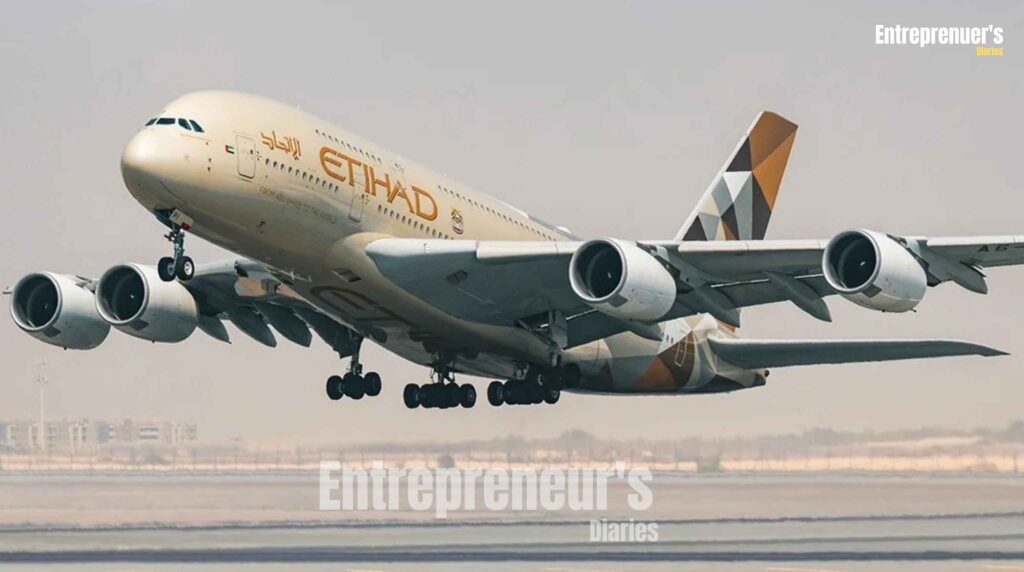
Break the Flightradar24.com numbers down by carrier and a clearer pattern shows up. Gulf Air and Etihad Airways are both running around 93% of pre war flight volume the strongest of the bunch outside Kuwait Airways’ brief stretches above 100%. Qatar Airways sits near 87%. Kuwait Airways is around 86%. Emirates, per Reuters, is also around 86% of its pre conflict volume. Air Arabia trails at roughly 75%. And Flydubai, the slowest of the majors to come back, is still down near 57%.
There’s a story buried in that spread. Flydubai at 57%, Gulf Air above 90% that’s not a small gap. The bigger, deeper pocketed flag carriers, the ones with state backing and diplomatic weight behind them, appear to be clawing their way back faster than the smaller, regional, low cost operators.
Emirates President Tim Clark seemed to acknowledge as much, in his own way. He told Reuters last week that the airline’s near term priority is convincing travelers it’s safe and reliable to fly with them again which tracks with a carrier that chose to keep spending through the worst of it rather than retreat.
WHAT AVIATION EXPERTS ARE SAYING
Ask an industry analyst where this goes next, and the answer tends to be binary: either the airspace reopens fully, or it doesn’t. James Halstead, managing partner at Aviation Strategy, put it to Reuters this way: a complete reopening would let Gulf carriers resume operations in full, and once that happens, he expects them to come back “in full force.”

Worth sitting with that for a second. The 82% figure isn’t some ceiling these airlines are bumping up against. It’s a number that’s been climbing fast, capped mostly by airspace risk, not by any shortage of people wanting to fly.
THE SAFETY OVERHANG: WHY EUROPE AND ASIA ARE STILL CAUTIOUS
So what’s holding back that last stretch from 82% to “normal”? Mostly fear, not demand. Reuters reports that Iranian missile and drone activity has, at various points, forced diversions and occasionally shut airports outright, squeezing Gulf bound traffic into a narrow set of approved corridors.
European and Asian carriers, for their part, have largely stayed grounded on routes into the region. Multiple government travel advisories are still live, Reuters notes. The European Union Aviation Safety Agency hasn’t budged on its conflict zone warning either. EASA told Reuters it will weigh recent diplomatic progress when it reassesses that warning currently set to expire June 24. But the agency isn’t ready to call it. EASA’s own words, given to Reuters, were that it’s still “too early to determine” whether the de escalation will hold long enough to meaningfully lower the risk to civil aviation.
Not every regulator is dragging its feet, though. Australia eased its travel advisories for several Middle Eastern countries this week, Reuters reports a small but real boost for transit traffic running through the Gulf.
THE FINANCIAL TOLL: IATA’S DOWNGRADED 2026 FORECAST
Zoom out past the Gulf and the bill for all of this lands on the entire global airline industry. The International Air Transport Association, which speaks for more than 370 airlines and roughly 85% of global air traffic, used its annual general meeting in Rio de Janeiro to take a hatchet to its 2026 profit outlook. That’s according to IATA’s own annual report, as cited by Reuters.
The new number: $23 billion in combined net profit for the global industry in 2026. That’s down hard from the $41 billion IATA was projecting before, and down from the actual $45 billion airlines made in 2025. IATA Director General Willie Walsh didn’t sugar coat it. “War related disruptions in the Middle East and rising fuel costs have shifted the outlook for airlines to the worse,” he said, per FTN News’s coverage of the briefing.
Margins tell the same story in smaller print: 2.0% industry wide in 2026, Walsh said, down from 4.2% in 2025. Fuel is the culprit doing most of the damage. IATA expects the global airline fuel bill to balloon to roughly $350 billion this year, up from about $252 billion in 2025, with jet fuel averaging $152 a barrel nearly 70% above last year’s $90, according to Travel Weekly’s reporting on the IATA figures.
Run that through to the passenger level and it gets uglier. Airlines are now expected to clear about $4.50 in profit per passenger in 2026, down from $9.10 in 2025, per a write up of the IATA briefing from ustransportnews.com.
The Middle East specifically is taking the worst of it. IATA forecasts the region’s carriers will post a combined loss of $4.3 billion this year a loss of $21.40 per passenger according to Travel Weekly’s coverage of the same forecast. A year ago, that number ran the other direction entirely. Middle Eastern carriers, with Emirates and Qatar Airways out front, posted a combined $7.2 billion profit in 2025, per IATA’s own figures.
Even IATA’s language on the region sounds hedged. Per Travel Weekly, the trade body said any near term recovery for Middle Eastern carriers is more likely to come from pricing than from a quick rebound in passenger volume.
There’s also a supply problem layered on top of the demand problem. IATA’s annual report, cited by FTN News, puts the global order backlog for new aircraft at 18,100 planes as of May 2026 up from 17,000 in 2024, and equal to more than half the entire active commercial fleet. That backlog means carriers are stuck flying older, thirstier aircraft longer than they’d like, which pushes up both maintenance bills and lease rates, Reuters reported from Walsh’s comments at the Rio meeting.
If there’s a silver lining, it’s on the top line. IATA still expects industry revenue to climb 9.4% to around $1.16 trillion in 2026, helped along by steady demand, higher fares, and the usual extras seat upgrades and the like per Reuters.
CORPORATE RESPONSE: HOW AIRLINES ARE RACING TO REBUILD TRUST
Flying the planes again is the easy part. Getting people to actually want to book seats on them is a different problem entirely. Tim Clark made roughly the same point to Reuters last week: Emirates’ real job right now isn’t scheduling, it’s reassurance convincing travelers the airline is both safe and reliable.
Etihad has gone a step further than talk. The carrier is handing out free medical travel insurance to visitors flying into Abu Dhabi from July through December 2026, Reuters reports a fairly blunt instrument for winning back nervous tourists.
That fits a pattern that predates this whole conflict. Reuters notes the Gulf states have poured money into airports, hotels and marquee events for years specifically to lock in their status as global aviation and tourism hubs. A full reopening of the skies doesn’t just help the airlines’ books. It helps everyone downstream of them too.
WHY THIS MATTERS FOR INVESTORS AND BUSINESS LEADERS
Strip this down to what actually matters for anyone tracking aviation, travel or Gulf markets, and three things stand out. Start with speed. Going from 40-50% capacity to 82%, with two carriers already past their pre war baseline, in roughly seven weeks, says something real about how fast this kind of capacity can come back once the underlying risk clears. Anyone modeling recovery curves after a geopolitical shock should be paying attention to that timeline.
Then there’s the safety gate, which is really a regulatory calendar question. EASA’s June 24 reassessment is a genuine near term catalyst. If that warning eases, expect a wave of European and Asian carrier traffic that’s been sitting on the sidelines to start moving again, with bookings into Dubai, Doha and Abu Dhabi picking up the fastest.
And then there’s margin arguably the part getting the least attention. Filling seats was never really the Middle East’s problem in 2026. Filling them at a profit is. A forecast $4.3 billion regional loss against last year’s $7.2 billion profit makes that obvious. Fuel, not demand, is the number to watch from here.
THE BOTTOM LINE
Pull the politics out of this story and what’s left is a fairly clean case study: how fast can a high margin, hub dependent industry claw its way back once an external shock starts to lift, and what does that comeback actually cost along the way?
On the first question, Gulf carriers have basically already answered it. Forty to fifty percent capacity to 82%, with two airlines back past their old baseline, inside a matter of weeks that’s not a slow grind. That’s a sprint, and it’s already happened.
The second question is still open. IATA’s own numbers show the region swinging from a $7.2 billion profit to a forecast $4.3 billion loss in twelve months, almost entirely because fuel went from $90 to $152 a barrel. Nobody’s solved that yet.
Which leaves one date worth circling: June 24, when EASA reassesses its warning. If that warning softens and the ceasefire holds through its implementation talks, the gap between 82% and what Aviation Strategy’s James Halstead called “full force” should close fast faster than most of this recovery so far.
If it doesn’t hold, watch Flydubai and Air Arabia, the two laggards at 57% and 75%. They’re the ones with the least room to absorb another setback. Either way, the next couple of weeks of diplomatic headlines will probably tell this story better than any airline’s press release will.
FREQUENTLY ASKED QUESTIONS
Are flights to Dubai, Doha, and Abu Dhabi back to normal in 2026?
Not fully, but close. According to Reuters, citing Flightradar24.com data published June 19, 2026, major Gulf airlines have collectively recovered to roughly 82% of pre war flight levels, with Gulf Air and Kuwait Airways already exceeding their pre war baseline. Emirates is at roughly 86% and Qatar Airways at roughly 87% of pre conflict volume, per the same data.
Is it safe to fly to the Middle East right now?
Safety assessments vary by authority and remain under active review. The European Union Aviation Safety Agency (EASA) has kept its conflict zone warning for the region in place, telling Reuters it is still too early to determine whether the recent de escalation will produce a sustained reduction in risk to civil aviation. That warning is valid through June 24, 2026, and will be reassessed considering the latest developments, per EASA.
What caused the 2026 Iran war and the Gulf airspace shutdown?
According to EASA’s own published airspace bulletin, the conflict began on February 28, 2026, when the United States and Israel conducted military strikes on sites inside Iran, prompting Iranian retaliatory attacks across the region. At least eight countries, including the UAE, Qatar, Bahrain and Kuwait, declared airspace closures within hours, according to Al Jazeera.
How much money has the airline industry lost because of the Iran war?
According to IATA’s annual report, cited by Reuters, the global airline industry’s 2026 net profit forecast has been cut to $23 billion, down from a prior projection of $41 billion and down from $45 billion in actual 2025 profit. IATA separately forecasts that Middle Eastern carriers specifically will post a combined loss of $4.3 billion in 2026, reversing a $7.2 billion profit in 2025, per Travel Weekly’s coverage of the IATA briefing.
When will Gulf airlines fully return to pre war flight schedules?
No official date has been confirmed. Aviation Strategy managing partner James Halstead told Reuters that a full reopening of regional airspace would allow Gulf carriers to resume operations completely, predicting they would return “in full force” once conditions normalize. The next concrete checkpoint is EASA’s scheduled reassessment of its conflict zone warning on June 24, 2026.
Has the US-Iran ceasefire deal affected Gulf airline recovery?
Yes, indirectly. Reuters reports that the United States and Iran signed an interim agreement on June 17, 2026, aimed at ending the nearly four month conflict, with further talks on implementing the ceasefire expected June 19. That diplomatic progress is the backdrop against which Gulf carriers’ flight volumes have climbed toward pre war levels in recent weeks, according to Reuters.
Connect With Us On Social Media [ Facebook | Instagram | Twitter | LinkedIn ] To Get Real-Time Updates On The Market. Entrepreneurs’ Diaries Is Now Available On Telegram. Join Our Telegram Channel To Get Instant Updates.

Isabella is a global business journalist and former McKinsey analyst from Brazil. She brings sharp insights on economic shifts, policies, and founder journeys from around the world.

Tokyo-based CFA translating global markets into clear insights for modern entrepreneurs.