
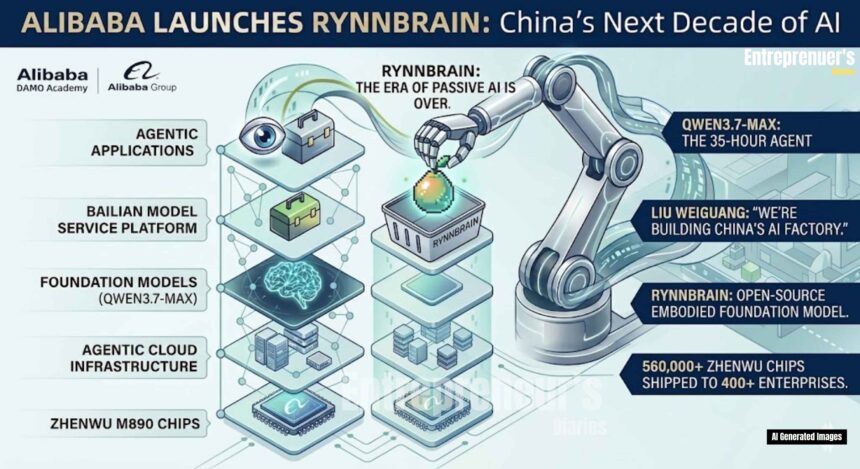
Beijing, June 16, 2026: A robot arm reached forward. It identified a piece of fruit. It placed it in a basket. The whole thing took less than a minute and it changed everything. That footage, published Tuesday morning by Alibaba’s DAMO Academy, was the world’s first look at Alibaba’s AI for robots the most complete, vertically integrated physical AI system any Chinese technology company has publicly launched.
With RynnBrain now live, the era of passive AI the kind that sits in a chat window answering questions is officially over. The agents are here. And Alibaba intends to own the infrastructure that runs them.
This is not a single product launch. It is the most visible output of a strategy that spans custom silicon, cloud infrastructure, foundation models, and physical AI systems designed to act in the real world. Every element of it is backed by verified official communications from Alibaba Group and its subsidiary platforms. Here is what most coverage missed.
THE SHIFT THAT MADE THIS ANNOUNCEMENT INEVITABLE
As Reuters reported on June 16, 2026, China’s technology industry is executing a deliberate pivot away from chatbots and toward the more lucrative business of agents that can execute complex tasks and make machines more intelligent. It is precisely this pivot that made Alibaba’s AI for robots not just possible but inevitable.
This is not a Chinese phenomenon alone. Every major AI economy is moving in the same direction. But the moment Alibaba unveils AI models for robots, the conversation shifts from possibility to execution. What Alibaba announced on June 16 is the clearest proof yet that physical AI has moved from research labs into production infrastructure.
In China, the shift carries added urgency. It is happening simultaneously with a forced domestication of the AI hardware supply chain a direct consequence of U.S. export controls that have progressively blocked access to frontier Nvidia chips.
The H100 was restricted from China in 2023. The A100 and H800 followed. In March 2026, restrictions extended to the H20 the chip Nvidia had specifically designed to remain within prior export control limits. Each successive ban made AI for robots in Alibaba’s roadmap not a choice, but a strategic necessity accelerating domestic investment in both AI hardware and the software stack sitting above it.
Alibaba’s June 16 announcement is the most comprehensive product of that investment made visible in a single day.
RYNNBRAIN: WHAT ALIBABA ACTUALLY BUILT
The official description comes directly from Alibaba Cloud Community, the company’s own platform. Alibaba DAMO Academy unveiled RynnBrain as “an open sourced embodied foundation model based on Qwen3 VL.”
The model is designed to move beyond passive observation. Per the official Alibaba Cloud Community post, RynnBrain is “grounded in the physical world through comprehensive environmental cognition, precise spatiotemporal understanding and task planning,” enabling it to “perform physics aware reasoning and execute complex real world tasks.” Those are Alibaba’s own words, sourced directly from their official platform.
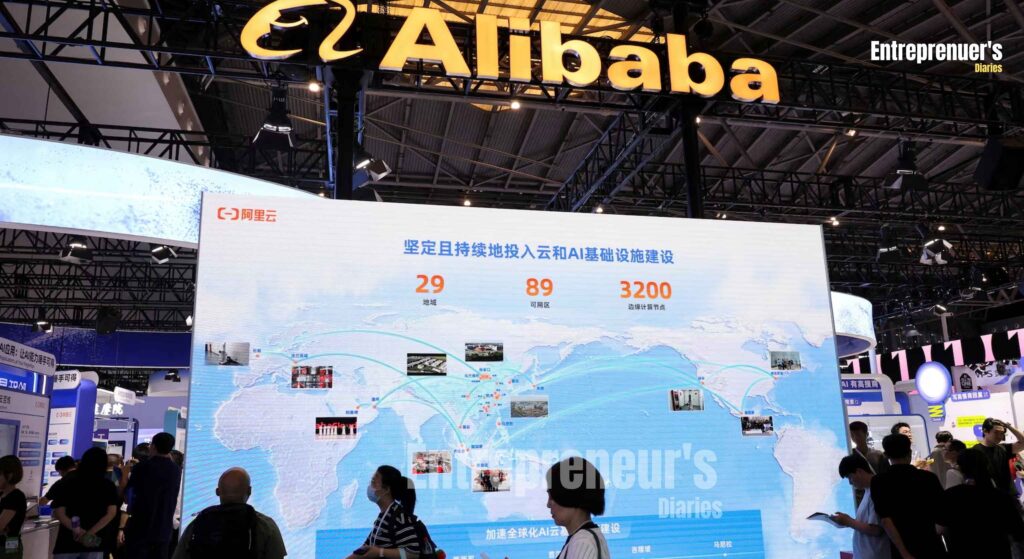
The model ships in multiple configurations, as confirmed by the Alibaba Cloud Community blog and independently verified via the DAMO Academy’s Hugging Face repository: Dense variants at 2B and 8B parameters, and a Mixture of Experts (MoE) variant at 30B A3B.
The 30B A3B configuration activates only 3 billion parameters during inference, despite its full 30 billion parameter scale. Per the AASTOCKS financial news summary of the DAMO Academy announcement, the model sets new records across 16 embodied open source evaluation leaderboards.
Per the official Alibaba Cloud Community blog, RynnBrain’s performance is “competitive with other leading embodied models such as Gemini Robotics ER 1.5 and Cosmos Reason 2” referring to models from Google and Nvidia respectively. The model also includes three specialized sub systems, as stated in Alibaba’s official announcement:
RynnBrain Plan, for manipulation planning. RynnBrain Nav, for navigation. And RynnBrain CoP, for spatial reasoning. RynnBrain is trained using DAMO’s proprietary RynnScale architecture which the official post states was used for optimization and is publicly accessible on Hugging Face, GitHub, and the Chinese open source platform ModelScope, per Alibaba Cloud Community.
The open source release is strategic. It mirrors the playbook Alibaba used to build the Qwen model developer ecosystem: release widely, seed your architecture as the default, and collect the switching costs that accumulate once developers build on your foundation.
QWEN3.7 MAX: THE 35 HOUR AGENT AND WHY THAT NUMBER MATTERS
Running alongside the robotics announcement, Alibaba formalized the broader agent positioning of Qwen3.7 Max its flagship large language model unveiled at the Alibaba Cloud Summit in Hangzhou on May 20, 2026.
The specifications come directly from Alibaba Cloud Community’s official post and the Alibaba Group’s own investor facing news page. Per the official Alibaba Cloud Community announcement, Qwen3.7 Max is “engineered for advanced agentic coding, complex reasoning, and long horizon task execution.”
The defining performance claim, stated directly in the official Alibaba Group press release: “Qwen 3.7 Max can autonomously execute long horizon agentic tasks sustaining continuous operation for up to 35 hours and managing over 1,000 tool calls without performance degradation.”
The official Alibaba Group page provides the specific test context: working without human intervention, the model ran for 35 consecutive hours on a Zhenwu M890 chip, executed over 1,000 tool calls, and “delivered a production grade AI computing kernel that outperformed the chip manufacturer’s official version by tenfold.”
That benchmark is Alibaba’s own, stated on their investor facing communications platform, alibabagroup.com. The 35 hour figure is not a minor technical specification. It defines commercial viability for agentic work.
An AI agent that degrades after two or three hours cannot complete multi day software engineering projects, extended logistics optimization runs, or complex supply chain coordination tasks that enterprises actually need to automate. The 35 hour threshold is an engineering response to a specific commercial requirement and Alibaba is the first major player to state that number publicly with a concrete test behind it.
Per the official Alibaba Cloud Community post, Qwen3.7 Max is also “deeply optimized for leading agent frameworks including OpenClaw, Hermes Agent, Claude Code, Qwen Paw and Qoder” broadening its deployment surface across existing enterprise development infrastructure.
THE “AI FACTORY” STRATEGY AND THE MAN WHO NAMED IT
The most important statement in Alibaba’s recent product cycle came not from a model specification, but from a person with a title. At the Alibaba Cloud Summit in Hangzhou, Liu Weiguang, Senior Vice President of Alibaba’s cloud computing unit, made a declaration reported by the South China Morning Post and confirmed across multiple credible outlets.
“What we’re building is China’s AI factory,” Liu said. He described Alibaba as the only AI and cloud company in China operating all five layers of the full AI stack chips, agentic cloud, AI models, model service platforms, and agentic applications. The attribution matters. This is a named senior executive at a named event making a specific strategic claim not anonymous briefing material.
The “AI factory” framing is precise. It positions Alibaba not as a company competing on any single AI product, but as the infrastructure through which China’s entire AI economy runs. The comparison is deliberate: just as industrial economies needed factories that could integrate raw materials into finished products at scale, AI economies will need integrated platforms that can move from silicon to software to deployed agent in a single continuous system.
Alibaba is claiming that role for itself. And the products launched across May and June 2026 are the operational evidence supporting that claim.
In a joint shareholder letter, Chairman Joe Tsai and CEO Eddie Wu went further. Per South China Morning Post’s May 21 reporting of that letter, they stated that “AI agents will become the core interface of the digital economy” language that frames robotics and autonomous agents not as a product category but as the fundamental architecture of future commerce.
THE ZHENWU M890: CHINA’S SILICON ANSWER TO NVIDIA
Every software capability in Alibaba’s AI stack runs on hardware. And in 2026, the hardware story is where the strategic depth becomes most visible. All specifications below are sourced directly from the official Alibaba Cloud Community post published May 20, 2026, and the official Alibaba Group investor page.
T Head, Alibaba’s semiconductor design subsidiary, debuted the Zhenwu M890 at the Alibaba Cloud Summit. The chip delivers three times the performance of its predecessor, the Zhenwu 810E. It carries 144 gigabytes of GPU memory and 800 gigabytes per second of inter chip bandwidth.
It natively supports multiple data precision formats from FP32 (32 bit floating point) down to FP4 (4 bit floating point) allowing a single device to handle both high accuracy model training and rapid, low cost inference. T Head also unveiled the ICN Switch 1.0. Per the official Alibaba Cloud Community post, the switching chip delivers up to 25.6 terabits per second of aggregate bandwidth and enables congestion free communication across clusters of 64 accelerators.
The commercial traction figure is confirmed in both the official Alibaba Cloud Community post and the Alibaba Group investor page: T Head has delivered over 560,000 Zhenwu units to date, with more than 400 external customers across 20 industries including leading automakers and financial services companies.
That is not pilot hardware. That is production scale deployment across a commercially diverse customer base. Packaging this hardware into a rack scale system, Alibaba Cloud launched the Panjiu AL128 Supernode Server. Per the official announcement, the system integrates 128 AI accelerators into a single rack and delivers internal bandwidth at the petabyte per second scale purpose built to handle the unpredictable, high frequency concurrency patterns that agent workloads generate.
The Panjiu AL128 is now available through Bailian, Alibaba’s domestic model service platform, for Chinese enterprise clients, per the official Alibaba Cloud Community post.
THE REVENUE STORY INVESTORS NEED TO READ
The product launches make more sense when placed against Alibaba’s financial disclosures. All revenue figures below come from official earnings communications, as reported by CNBC and confirmed in Alibaba’s official investor facing materials.
On Alibaba’s earnings call, CEO Eddie Wu stated that the company expects annualized recurring revenue from its AI model and application services to surpass RMB 10 billion approximately US$1.4 billion in the current quarter through June 2026. He projected that figure to reach RMB 30 billion approximately US$4.1 billion by year end.
Per CNBC’s May 13, 2026 earnings coverage, Wu also forecast that AI related product revenue will surpass conventional cloud compute sales as Cloud Intelligence Group’s largest revenue line within approximately one year.
An Alibaba executive was also quoted on the earnings call, per CNBC: “We’ve been very resolute in making those investments over the past year and looking forward to the next two years, we intend to be equally resolute in continuing these investments because we see this as a critical window of opportunity.”
That language does not describe a company reacting to a trend. It describes a company that has diagnosed a market window and is making a permanent capital commitment to exploit it.
The commercial signal is consistent across every layer of what Alibaba announced on June 16. Open source robotics models that seed its architecture. An agent LLM that sustains 35 hour continuous operation. Custom silicon shipped to 400+ enterprise customers across 20 industries. A rack scale server available immediately on the domestic platform. All of it pointing in the same direction.
THE CLOSING ARGUMENT: WHY THIS ANNOUNCEMENT DOESN’T END HERE
There is a version of this story that a reader can put down and move on from. In that version, a large technology company launched an open source robotics model, a capable agent LLM, and some new chips. It’s a solid product cycle from a company that knows how to execute. That version is incomplete.
What Alibaba announced on June 16, 2026 is a bet on the architecture of the next decade of enterprise technology. It rests on a specific thesis: that the most valuable position in the AI economy is not the best model, nor the best chip, nor the best cloud platform but the deepest integration across all of them simultaneously.
When that integration is functioning, a better chip produces better training data. Better training data produces a better model. A better model drives higher cloud adoption. Higher cloud revenue funds the next chip generation. The loop compounds, and each iteration deepens the advantage.
Alibaba has now publicly staked its identity as an AI company and Liu Weiguang’s “AI factory” framing is the strategic declaration on the premise that vertical integration of this kind is defensible and that it is building it faster than anyone else in China.
The open source release of RynnBrain is the move that most clearly signals confidence in that strategy. You only give your architecture to developers for free if you believe that seeding your stack across the ecosystem creates advantages that outweigh the commercial value of keeping it proprietary.
Alibaba has made that calculation. The RynnBrain repository is live on Hugging Face. The Qwen3.7 Max API is available. The Zhenwu M890 is shipping.
The question for investors, enterprise buyers, and technology observers is not whether Alibaba is building something significant. It clearly is. The question is whether vertical integration at this scale from the chip fabrication instruction set to the robot arm placing fruit in a basket constitutes a moat that compounds over time, or a sprawling surface that competitors can attack from any angle.
The answer to that question will define where Alibaba stands in the global AI economy five years from now. Tuesday’s announcement was the company’s most direct statement yet of which answer it believes.
FREQUENTLY ASKED QUESTIONS
What is RynnBrain and where does it come from?
RynnBrain is an open sourced embodied foundation model developed by Alibaba’s DAMO Academy research institute. It is built on Alibaba’s Qwen3 VL vision language architecture and fine tuned using DAMO’s proprietary RynnScale system. The model is designed to give robots the ability to understand space, objects, and motion in the physical world. All specifications come from the official Alibaba Cloud Community blog, published February 24, 2026.
What are the model size options for RynnBrain?
Per the official Alibaba Cloud Community post, RynnBrain is available in dense versions with 2B and 8B parameters and a Mixture of Experts (MoE) variant called 30B A3B. Three specialized sub models are included: RynnBrain Plan for manipulation planning, RynnBrain Nav for navigation, and RynnBrain CoP for spatial reasoning.
What does Qwen3.7 Max do that previous Qwen models could not?
Per the official Alibaba Cloud Community announcement and the Alibaba Group investor page, Qwen3.7 Max can sustain autonomous execution for up to 35 consecutive hours without performance degradation and manage over 1,000 tool calls in a single continuous session. It is specifically engineered for long horizon agent tasks requiring hundreds or thousands of sequential actions a capability not present in prior Qwen model generations.
What is the Zhenwu M890 and how does it differ from Nvidia chips?
The Zhenwu M890, developed by Alibaba’s T Head semiconductor subsidiary, is a domestic AI training and inference processor. Per the official Alibaba Cloud Community post, it delivers three times the performance of its predecessor the Zhenwu 810E, with 144 GB of GPU memory and 800 GB per second of inter chip bandwidth. It is explicitly positioned as a domestic alternative to Nvidia processors, developed against the backdrop of U.S. export controls that have progressively restricted China’s access to Nvidia’s advanced chips.
How many Zhenwu chips has Alibaba shipped?
Per the official Alibaba Cloud Community post published May 20, 2026, and confirmed on the Alibaba Group investor page, T Head has delivered over 560,000 Zhenwu units to date, with more than 400 external customers across 20 industries deploying them, including leading automakers and financial services companies.
What revenue targets has Alibaba set for its AI business?
Per CNBC’s earnings coverage of May 13, 2026, CEO Eddie Wu stated that Alibaba expects annualized recurring revenue from AI model and application services to surpass RMB 10 billion (approximately US$1.4 billion) in the June 2026 quarter, and reach RMB 30 billion (approximately US$4.1 billion) by year end. Wu also forecast that AI product revenue will exceed conventional cloud compute revenue within approximately one year.
Who made the “China’s AI factory” statement and in what context?
Liu Weiguang, Senior Vice President of Alibaba’s cloud computing unit, made this statement at the Alibaba Cloud Summit in Hangzhou, as reported by the South China Morning Post. He described Alibaba as the only AI and cloud company in China operating all five layers of the full AI stack chips, agentic cloud, AI models, model service platforms, and agentic applications.
Is RynnBrain publicly available?
Yes. Per the official Alibaba Cloud Community post, RynnBrain is accessible on Hugging Face, GitHub, and the Chinese open source platform ModelScope.
Connect With Us On Social Media [ Facebook | Instagram | Twitter | LinkedIn ] To Get Real-Time Updates On The Market. Entrepreneurs’ Diaries Is Now Available On Telegram. Join Our Telegram Channel To Get Instant Updates.

Isabella is a global business journalist and former McKinsey analyst from Brazil. She brings sharp insights on economic shifts, policies, and founder journeys from around the world.

Luca is a tech ethicist from Italy exploring disruptive innovation through a human lens—from AI to biotechnologies to decentralization.