
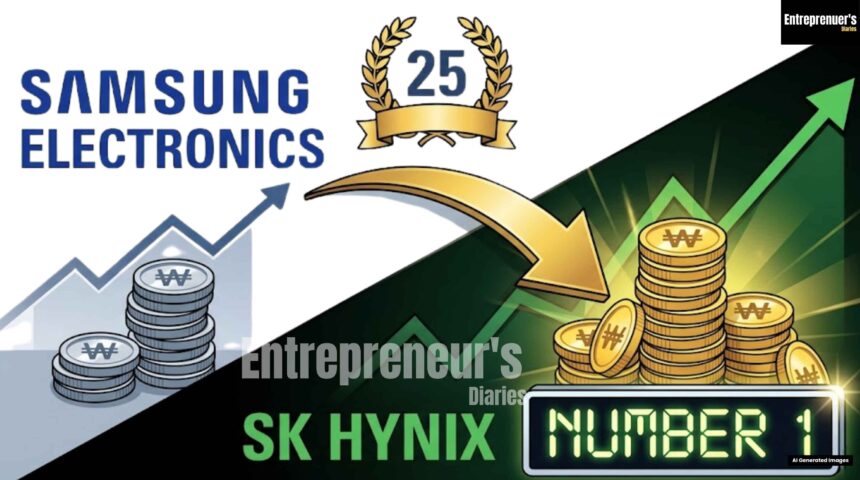
SEOUL, Monday, June 22, 2026: Samsung Electronics lost something Monday it hadn’t lost since November 21, 2000: the title of South Korea’s most valuable listed company. Around midday in Seoul, the market value of memory chip maker SK Hynix slipped past Samsung’s on the Korea Exchange. For the first time ever, SK Hynix was number one.
It didn’t stay simple. The two companies traded places more than once before SK Hynix’s lead actually held. And it’s worth sitting with that for a second, because SK Hynix shares are up well over 300% this year. That’s not a typo.
Here’s what actually moved, by how much, and according to which named source. A few figures didn’t line up across trackers. Those get flagged below instead of quietly smoothed over.
SK Hynix Overtakes Samsung: What Happened, by the Numbers
Samsung started the day on top, like always. At 9:58 a.m. local time, its market cap stood at roughly 2,084 trillion won against about 2,053 trillion won for SK Hynix, a 31 trillion won cushion, according to The Asia Business Daily, citing Korea Exchange data.
That cushion didn’t last. By around 12:47 p.m., SK Hynix had climbed to 2,082.5 trillion won (about $1.35 trillion), nosing past Samsung’s 2,081.3 trillion won on a common share basis, Reuters reported.
And it stuck. The Asia Business Daily, citing the same exchange data, had SK Hynix at 2,087 trillion won versus Samsung’s 2,078 trillion won at 12:50 p.m. Businesskorea, working from its own snapshot three minutes later, put SK Hynix at 2,083.9417 trillion won, or about $1.38 trillion, with Samsung still behind.
One catch, though. Throw in Samsung Electronics’ preferred shares, worth roughly 184 trillion won, and Samsung’s total listed equity value was actually still bigger that day, per The Asia Business Daily. So “most valuable company” depends a little on how you’re counting.
The share price moves tell the real story. SK Hynix closed the day up 5.7%, Samsung up just 0.4%, Reuters reported. Businesskorea’s own numbers had SK Hynix’s intraday gain somewhere between 5.32% and 5.82%, depending on the exact timestamp, with Samsung barely moving at 0.14% to 0.71%.
Zoom out further and it gets almost absurd. SK Hynix is up 341.9% so far in 2026, according to Business korea’s analysis of Korea Exchange data. Samsung, which most investors would call a great year in its own right, is up 197.7%. Reuters’ rounder figures, “more than 340%” versus “200%,” say the same thing in plainer language.
None of this happened overnight. SK Hynix joined Samsung and U.S. rival Micron Technology in crossing the $1 trillion market-value mark for the first time back in May 2026, a milestone Reuters tied directly to the broader AI rally sweeping through chip stocks. That run set up the bigger prize Monday: the title of Korea’s most valuable company.
The 25 Year, 7 Month Reign Samsung Just Lost
Samsung first touched the number one spot on July 29, 1999, according to Business korea, citing Korea Exchange records. It wobbled for a bit after that. Then, starting November 21, 2000, it just didn’t let go. Not once, for 25 years and 7 months, per Businesskorea’s count.
Sit with that number for a moment. An entire generation of Korean investors has lived their whole investing life and never seen another company on top of the Kospi.
SK Hynix got here the hard way. It started as Hyundai Electronics back in 1983, nearly went under during the 2001 global memory chip crash, got renamed Hynix Semiconductor, and was finally bought out by SK Telecom for $3 billion in 2012, becoming SK Hynix under the SK Group umbrella, according to publicly available corporate records.
The two companies’ fortunes this year have diverged about as sharply as their histories did. As of late May 2026, Samsung’s market cap was up roughly 429% over the prior 12 months, Seoul Economic Daily reported, citing the Korea CXO Institute, a corporate research firm. SK Hynix’s was up 977.5% over the same stretch. Read that twice if you need to.
There’s a smaller, almost trivial data point buried in the same CXO Institute analysis: SK Hynix President Kwak Noh jung has reportedly overtaken the Samsung executive who long held the title of South Korea’s richest non owner stockholder, per Blooming bit. It doesn’t move markets. It just points in the same direction as everything else.
What’s Driving the Flip: The AI Memory Supercycle and HBM
Strip away the stock ticker drama and there’s a simpler story underneath. Chipmakers across South Korea are posting record profits because U.S. tech giants can’t build AI data centers fast enough, and that’s choking the supply of memory chips while sending prices up, Reuters reported.
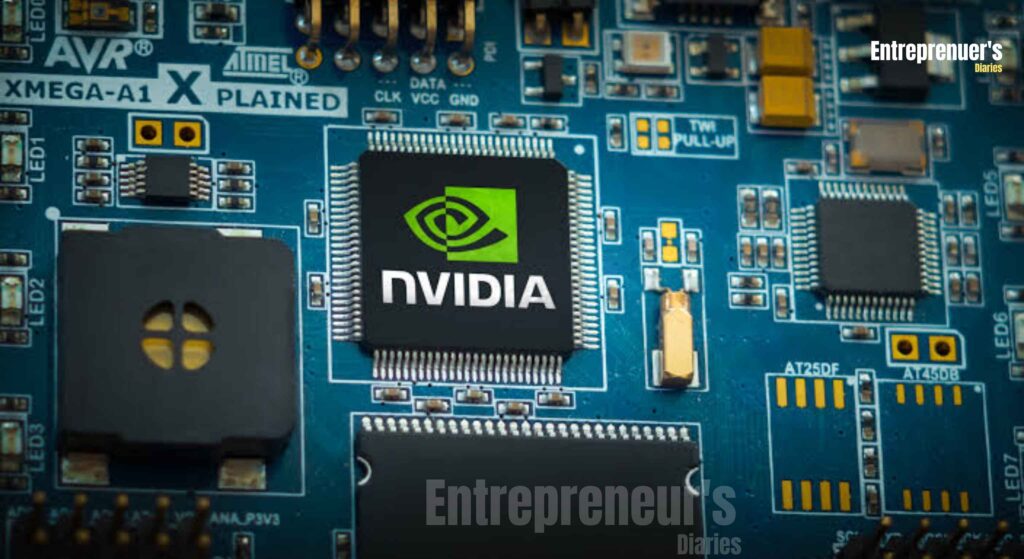
The specific chip everyone wants is High Bandwidth Memory, or HBM, the stuff that feeds AI accelerators like Nvidia’s GPUs. SK Hynix got there first, and it shows.
Counterpoint Research data cited by CNBC put SK Hynix’s HBM market share at 57% in the fourth quarter of 2025, even in a quarter when Samsung actually reclaimed the lead in overall DRAM revenue. BigGo Finance’s own analysis pegged SK Hynix’s full year 2025 HBM share a bit higher, at 59%, and expects the company to hold above 50% through 2026.
Samsung’s stumble here has a clear cause, not a mysterious one. Its fifth generation HBM3E chip got approved for Nvidia supply months later than expected, Business korea reported, and that delay reportedly cost Samsung much of the early upside from the AI boom. Samsung didn’t start shipping its first HBM4 chips until February 2026, CNBC reported, nearly a year behind SK Hynix’s own HBM4 samples.
A lot of this comes down to one relationship. Businesskorea described SK Hynix as having effectively been Nvidia’s sole HBM supplier, and pegged Nvidia’s own share of the AI accelerator market at more than 90%. When you’re the only supplier to the company that dominates the entire market, the math kind of takes care of itself.
Record Earnings: Inside SK Hynix’s Q1 2026 Results
The numbers behind all this are SK Hynix’s own, pulled straight from the company’s official newsroom, not an analyst’s spreadsheet. And they’re genuinely extraordinary.
First quarter 2026 revenue hit 52.5763 trillion won, up 60% from the prior quarter and 198% from a year earlier, according to the company’s own Q1 2026 earnings release. That’s the first time SK Hynix has ever cleared 50 trillion won in a single quarter.
Operating profit nearly doubled from the quarter before, landing at 37.6103 trillion won, for a record 72% operating margin, the earnings release stated. Net profit was 40.3459 trillion won, a 77% net margin, per the same release.
Worth noting: the first quarter is normally the slow season for memory chips. Not this year. SK Hynix’s own release said AI infrastructure spending kept demand strong straight through, with HBM, server DRAM, and enterprise SSD sales doing the heavy lifting.
The balance sheet tells a similar story. Cash and cash equivalents climbed by 19.4 trillion won to 54.3 trillion won. Debt fell to 19.3 trillion won. Net cash position: 35 trillion won, all according to the company’s own disclosure.
For context, BigGo Finance’s analysis put that 72% operating margin ahead of Nvidia’s 65%, ahead of TSMC’s 58.1%, and well past Samsung Electronics’ own 43% for the same stretch. Few companies anywhere post margins like that. Ever.
On the earnings call, an SK Hynix executive put it bluntly: customers are “prioritizing procurement over price,” CNBC reported. That’s corporate speak for nobody’s haggling anymore. They just want the chips.
This quarter didn’t come out of nowhere either. The full 2025 fiscal year was already a record on its own, with SK Hynix’s official 4Q25 and FY25 results showing full year revenue of 97.1467 trillion won, up 47% year on year.
Capacity Crunch and the Road to HBM4E
Here’s the thing about all this demand: SK Hynix can’t actually keep up with it. Its own earnings materials say customer orders for HBM over the next three years already exceed what the company can produce right now. That single fact is steering most of its near term strategy.
The plan is to start sampling its seventh generation HBM4E chip in the second half of 2026, with full mass production aimed at 2027, according to the company’s official disclosures.
SK Group Chairman Chey Tae won reportedly went further in March 2026, saying the global chip wafer shortage could drag on until 2030 because HBM demand just keeps outrunning supply. Expanding capacity, he reportedly said, could take four to five years, with a possible shortfall of more than 20%, per CNBC.
Money is following the words. SK Hynix has announced 19 trillion won for a new fab in Cheongju, the M15X facility, plus roughly $3.87 billion for a plant in Indiana, according to BigGo Finance and StorageNewsletter’s reporting on the company’s disclosures.
CEO Kwak Noh jung told shareholders the company wants north of 100 trillion won in net cash on hand, calling a strong balance sheet non negotiable for weathering market swings, per BigGo Finance. Meanwhile, analysts cited by Seoul Economic Daily are watching for a possible U.S. ADR listing, maybe as early as July 2026, which could pull in more foreign investors and get SK Hynix onto U.S. semiconductor indices.
Bulls vs. Bears: Fundamentals Story or Bubble Warning?
Not everyone agrees on what to make of this. Not in Seoul, not anywhere.
Lee Jae man, a researcher at Hana Securities, brought up a comparison that should make any investor a little uneasy, per Seoul Economic Daily. When the market’s single most valuable company changes hands, he said, that can be an early warning sign that an earnings driven bull run is running out of road. He pointed to 2000, when Cisco Systems briefly passed Microsoft and General Electric in market value right before the dot com bubble popped, despite Cisco’s profits being a fraction of either company’s.
Then again, there’s a fundamentals case that’s hard to wave away. Samsung’s 2026 net profit is forecast at roughly 280 trillion won, against about 208 trillion won for SK Hynix, according to estimates cited by Seoul Economic Daily. If today’s market cap shuffle were pure hype, you’d expect that gap to run the other way.
Other analysts just shrug at the whole thing. Kim Dong won, who heads KB Securities’ research center, told Seoul Economic Daily that SK Hynix can run hot when the semiconductor cycle favors it, but the two stocks tend to move together over the long haul. A one day crossover, in his view, doesn’t decide much of anything.
Where the Reported Numbers Don’t Quite Line Up
A few details in this week’s reporting didn’t fully match across sources, and it’s worth being upfront about them rather than smoothing them over.
One widely syndicated report, originally from Hankyung.com and carried by Blooming bit, cited SK Hynix’s market value at 12:51 p.m. as “208.46544 trillion won ($150.9 billion),” versus Samsung’s “208.41983 trillion won ($150.8 billion).” Those figures are roughly a factor of ten smaller than the 2,082 to 2,087 trillion won range reported at nearly the same timestamp by Reuters, The Asia Business Daily, and Business korea, and the implied won to dollar exchange rate doesn’t match figures used elsewhere in this story. Our best guess: a transcription error somewhere in the chain. This report leans on the mutually consistent Reuters, Business korea, and Asia Business Daily numbers instead.
Minor differences also turn up in the precise market cap figures reported within the same ten minute window around midday: 2,082.5 trillion won from Reuters at 12:47 p.m., 2,083.9 trillion won from Business korea at 12:53 p.m., 2,087 trillion won from The Asia Business Daily at 12:50 p.m. These almost certainly reflect different snapshot timestamps during a fast moving session, not an actual disagreement between outlets. Either way, this report cites each number with its specific source and time instead of pretending there’s one tidy figure to point to.
Finally, whether SK Hynix’s lead counts as a clean win depends on how you count. On a common share basis, yes, SK Hynix’s market cap passed Samsung’s, as reported across every source above. Add in Samsung’s preferred shares, worth roughly 184 trillion won, and Samsung’s total listed equity value was still bigger that day, per The Asia Business Daily. Neither fact is wrong. They’re just answering slightly different questions.
What This Means for Entrepreneurs and Investors
Pull back from the minute by minute numbers for a second. Three things actually matter here.
Memory has become a genuine bottleneck for the entire AI economy, not some side story about chip stocks. A company posting a 72% operating margin, more than double TSMC’s and way past Samsung Electronics’ own 43%, while customers, per CNBC, are taking whatever supply they can get instead of haggling over price, isn’t a niche industry quirk. That’s memory costs getting baked into the price of every AI data center on Earth, not just the ones in Korea.
There’s also a concentration problem brewing in one of the world’s most important stock markets. Samsung and SK Hynix together make up more than half the Kospi’s total value, the Korea Herald reported, and Korea is now the only market outside the U.S. with two companies each individually worth over $1 trillion. That’s been great for the index, driving it to record after record this year. It also means the Kospi’s fortunes are riding almost entirely on one cycle staying hot.
And then there’s the question nobody’s actually settled: is this crossover proof the rally is real, or the first crack in a bubble? Hana Securities’ Lee Jae man points back to 2000 and Cisco’s brief, fateful run past Microsoft and GE. KB Securities’ Kim Dong won, backed by Samsung’s still higher 2026 profit forecast, says not so fast, arguing these two stocks move together over time and one crossover doesn’t decide anything. Both sides are staring at the same numbers and walking away with opposite conclusions. That disagreement matters more than the 1.2 trillion won that separated the two companies on Monday.
So what actually settles it? Not this week’s headline. Watch whether Samsung’s HBM4 chips clear Nvidia’s qualification process and start shipping in real volume. Watch whether SK Hynix hits its 2027 target for HBM4E mass production. And watch whether that U.S. ADR listing, floated for as early as July 2026, actually happens and changes who’s buying the stock.
Frequently Asked Questions
1. Why did SK Hynix overtake Samsung Electronics as South Korea’s most valuable company?
SK Hynix’s market capitalization briefly surpassed Samsung Electronics’ on a common share basis around midday on June 22, 2026, according to Reuters, The Asia Business Daily, and Business korea, all citing Korea Exchange data. The shift was driven by SK Hynix’s dominant position in High Bandwidth Memory, or HBM, the chip technology used in AI accelerators, which has powered record profits and a 341.9% surge in its share price so far in 2026, per Business korea’s analysis of Korea Exchange figures, far outpacing Samsung’s 197.7% gain over the same period.
2. What was SK Hynix’s market cap compared to Samsung’s on the day it overtook it?
At around 12:47 p.m. Seoul time, SK Hynix’s market value reached 2,082.5 trillion won, or about $1.35 trillion, against 2,081.3 trillion won for Samsung on a common share basis, according to Reuters. The Asia Business Daily and Business korea reported similar figures, in the 2,083 to 2,087 trillion won range, within minutes of that timestamp, citing Korea Exchange data.
3. What is HBM, and why is it so important to SK Hynix’s rise?
HBM, or High Bandwidth Memory, is a specialized memory chip technology used in AI accelerators like Nvidia’s GPUs, and it has become one of the most profitable and supply constrained products in the entire semiconductor industry. SK Hynix held an estimated 57% to 59% share of the global HBM market through 2025, according to Counterpoint Research data cited by CNBC and a separate analysis from BigGo Finance, a lead built in part on Samsung Electronics’ delayed qualification of its own HBM3E chips for Nvidia, as reported by Businesskorea.
4. How long had Samsung Electronics been South Korea’s most valuable company before losing the title?
Samsung Electronics had held the top market cap spot on the Korean stock market continuously since November 21, 2000, a run of 25 years and 7 months, according to Business korea, citing Korea Exchange records. The company first touched the number one position briefly on July 29, 1999, before fluctuations gave way to its uninterrupted run from late 2000 onward.
5. Is SK Hynix now permanently more valuable than Samsung Electronics, or could the ranking flip back?
The June 22, 2026 crossover was intraday and narrow, with a gap of roughly 1.2 trillion won out of a combined market value exceeding 4,000 trillion won, based on Reuters’ figures, and Samsung Electronics’ total listed equity value, including preferred shares worth about 184 trillion won, remained larger on the same day, per The Asia Business Daily. Analysts are split on durability: KB Securities’ Kim Dong won told Seoul Economic Daily the two stocks tend to move together over the long run and that a single crossover should not be treated as decisive, while bullish brokerages have set SK Hynix price targets implying further outperformance if its HBM leadership and planned U.S. ADR listing both play out as expected.
Connect With Us On Social Media [ Facebook | Instagram | Twitter | LinkedIn ] To Get Real-Time Updates On The Market. Entrepreneurs’ Diaries Is Now Available On Telegram. Join Our Telegram Channel To Get Instant Updates.

Isabella is a global business journalist and former McKinsey analyst from Brazil. She brings sharp insights on economic shifts, policies, and founder journeys from around the world.

Tokyo-based CFA translating global markets into clear insights for modern entrepreneurs.