
LONDON, June 23, 2026: As global investors and policymakers parse this week’s biggest climate and technology headlines, artificial intelligence’s resource consumption has moved from a sustainability footnote to a formal United Nations policy target.
According to Reuters, this marks the first time the United Nations has proposed a standardized, named transparency framework specifically for the AI sector’s environmental footprint, placing AI environmental disclosure at the centre of the global conversation around responsible AI development.
The intervention arrives precisely as global AI infrastructure spending accelerates, expanding the same data centre footprint over which the United Nations is now demanding new accountability.
This report draws exclusively on the official United Nations statement on the address, UN News’s coverage of the underlying UN University research, and on the record reporting from Reuters, the Associated Press, AFP, Euronews and Bloomberg Philanthropies to verify exactly what was announced, what the data shows and what remains unconfirmed.
This is not a story about AI’s compute power or revenue growth. According to the United Nations’ own figures, it is a story about the electricity, water, land and minerals that AI’s growth is consuming at a pace regulators say can no longer stay undisclosed.
AI Environmental Disclosure: UN Launches New Transparency Initiative
On Tuesday, United Nations Secretary General António Guterres formally launched the AI Environmental Transparency Initiative during a special address at London Climate Action Week, according to Reuters, placing AI environmental disclosure at the heart of the United Nations’ latest push for greater transparency across the AI industry.

The address was delivered in London at what the Associated Press describes as Europe’s largest independent climate conference. According to Reuters, Guterres called on AI companies to measure and publicly disclose the water, carbon and land use impacts of their data centres as part of the proposed transparency framework.
He also urged every major AI company to commit to powering all of its data centres with renewable energy by 2030, Reuters reported. The Associated Press independently confirmed the initiative’s name and framing, reporting that Guterres proposed the AI Environmental Transparency Initiative and argued that AI companies should measure and disclose the environmental impact of their technology.
According to Reuters and the Associated Press, this is the first time the United Nations has formally proposed a standardized, named disclosure framework specifically targeting the AI sector’s environmental footprint.
GUTERRES’S OFFICIAL WORDS ON AI’S HIDDEN COSTS
The United Nations’ own published summary of the Secretary General’s remarks at London Climate Action Week quotes Guterres directly on the AI disclosure question. According to the official statement published on the United Nations website, Guterres said: “If AI is to help build a better future, it must be honest and transparent about what it costs us now.”
Reuters additionally reported a specific statistic Guterres cited during the address. By 2030, Guterres said, data centres could draw more power than all but five countries on Earth, Reuters reported. He added that the water required could meet the basic needs of all 1.3 billion residents of sub Saharan Africa for a full year, per the same Reuters report.
The Associated Press separately quoted Guterres declaring: “No more hidden costs.” In the same remarks, Guterres said it is “time to come clean,” according to the Associated Press. The AP also reported that Guterres said communities are often left in the dark about the environmental impact of infrastructure rising around them.
THE UN UNIVERSITY DATA: ELECTRICITY, WATER AND LAND FOOTPRINTS QUANTIFIED
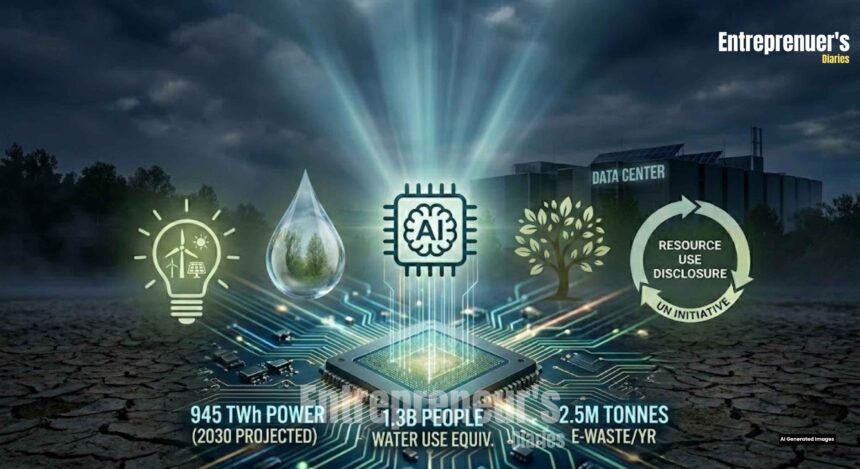
Guterres’s disclosure demand builds directly on a study published earlier in June by UN University, covered officially by UN News. According to UN News, data centres could consume 945 terawatt hours of electricity annually by 2030. That figure is nearly triple the combined annual electricity use of Pakistan, Bangladesh and Nigeria, three countries collectively home to more than 650 million people, per UN News.
The same UN News report states that AI related water consumption could equal the basic annual domestic needs of 1.3 billion people by the end of the decade. UN News also reports that AI’s land footprint may exceed 14,500 square kilometers, an area roughly twice the size of the Jakarta metropolitan region.
Separately, the Associated Press reported that data centres accounted for approximately 1.5% of global electricity consumption in 2025. That share is projected to rise to nearly 3% of the world’s electricity use by 2030, according to the same AP report.
Euronews additionally reported that the underlying UN study found data centres already consumed more electricity in 2025 than all but 10 countries. The Associated Press reported one further finding from the same study: the water use, energy use and pollution associated with AI are expected to double within just four years.
WHY DAILY USE, NOT TRAINING, DRIVES THE FOOTPRINT
Public attention has focused heavily on the energy required to train large AI models. The underlying UN University data tells a different story. According to UN News, day to day usage of AI tools accounts for roughly 80% to 90% of total energy demand, not training.
UN News reports that one widely used AI service alone is estimated to process around 2.5 billion prompts every day. That single service consumes hundreds of gigawatt hours of electricity annually, according to the same report.
Energy demand also varies sharply by task type. UN News reports that generating a single AI image can require more than a thousand times the energy of a simple text classification task. Video generation requires even more energy than image generation, per the same UN News coverage.
The report further warns of a “rebound effect,” in which efficiency improvements lower costs and improve performance, according to UN News. That, in turn, drives higher overall usage and ultimately increases total resource consumption rather than reducing it, the report states.
THE E WASTE AND CRITICAL MINERALS PROBLEM
Electricity and water are not the only resources at stake, according to the official UN University research summarized by UN News. UN News reports that AI infrastructure could generate up to 2.5 million tonnes of electronic waste annually by 2030.
Much of that e waste burden is likely to fall on lower income countries with limited capacity for safe disposal, the UN News report states. The same coverage notes that the production of critical minerals needed for AI hardware raises additional concerns. Those concerns include environmental degradation and social inequities in the regions where the minerals are extracted, according to UN News.
THE GLOBAL COMPUTE DIVIDE: TWO COUNTRIES, 150 LEFT BEHIND
The UN University research also quantifies how unevenly AI’s infrastructure, and its costs, are distributed worldwide. According to UN News, more than 90% of the world’s AI specialized computing capacity is concentrated in just two countries: the United States and China.
At the same time, more than 150 nations lack significant domestic AI infrastructure of their own, per the same report. UN News states that this imbalance limits economic opportunity for those left out countries. It also raises questions of environmental justice, since some countries bear environmental costs without sharing in AI driven economic growth, the report notes.
CORPORATE RESPONSE: VOLUNTARY PLEDGES MEET A NEW DISCLOSURE STANDARD
Reuters reports that AI companies currently rely on voluntary net zero commitments and renewable electricity targets to decarbonize their operations. Many of those same companies are simultaneously turning to gas power or promoting nuclear energy as a source for new AI projects, according to Reuters.
Euronews reports that several major technology companies, including Amazon and Google, have pledged to power operations with cleaner energy sources, in some cases by the end of the decade. Those pledges increasingly point to solar and nuclear power, Euronews reported.

However, Euronews also reports that the race to deploy AI has complicated those commitments and contributed to rising greenhouse gas emissions across the sector. No AI company had publicly responded to the specific terms of the new AI Environmental Transparency Initiative as of this report, based on all available named source coverage of the London announcement.
THE BROADER CLIMATE CONTEXT: A “TALE OF TWO CRISES”
Guterres framed the AI disclosure push inside a wider warning about the world’s continued reliance on fossil fuels. According to Euronews, Guterres described the current moment as “a Tale of Two Crises,” a reference to the Charles Dickens novel “A Tale of Two Cities.”
The climate crisis and the global energy crisis “share the same destructive origin,” fossil fuels, Guterres said, per Euronews. The Associated Press reported genuine progress alongside that warning. Clean power generation, led by solar and wind, exceeded overall global electricity demand growth last year, per the AP.
Renewables’ share of the world’s electricity mix topped one third for the first time in modern history in 2025, the AP reported. In that same year, coal’s share of global power generation fell below one third for the first time, according to the AP. The Associated Press also reported sharper remarks from Guterres regarding United States energy policy.
Guterres said the United States, under President Donald Trump, has embraced coal, oil and gas while cutting support for renewables, the AP reported. Guterres described the global energy crisis, worsened by the war in Iran, as “the mother of all energy shocks,” according to the Associated Press. AFP separately reported that Guterres urged governments to tax the windfall profits of oil and gas companies.

AFP also reported Guterres’s call for a renewed push to cut methane emissions, which he said account for roughly one third of global warming. Methane is significantly more potent than carbon dioxide, though it breaks down in the atmosphere far faster, AFP reported.
According to AFP, Guterres said both the agriculture and waste sectors must take steps to curb methane output, while placing what he called a “special focus” on the fossil fuel industry. The London address also came against a backdrop of extreme weather. Euronews reported that the speech was delivered as Europe endured its second heatwave in as many months.
The same Euronews report states that the world has just endured its 11 hottest years on record. AFP separately reported that Guterres’s warning came as the latest heatwave brought record temperatures to France and seared other European countries.
On the energy transition itself, Euronews reported that China continues to drive the world’s clean energy transition. Fossil fuel power generation is generally trending downward across Europe, according to the same Euronews report.
INSIDE LONDON CLIMATE ACTION WEEK: THE VENUE AND THE STAKES
The setting for the announcement carries its own market relevance for technology and market economics readers tracking global climate diplomacy. According to Bloomberg Philanthropies, which helped anchor major events during the week, London Climate Action Week is now in its eighth year and is Europe’s largest city wide climate gathering.
The event brings together nearly 50,000 participants across more than 700 events, per Bloomberg Philanthropies. Guterres delivered his address at Guildhall in London, hosted by Mike Bloomberg in his capacity as the Secretary General’s Special Envoy, according to Bloomberg Philanthropies.
The same week also hosted the International Energy Agency’s Global Energy and Climate Ministerial, a high level dialogue convening ministers and senior industry leaders ahead of COP31, Bloomberg Philanthropies reported. Euronews separately described London Climate Action Week as an annual gathering of policymakers, company executives and non governmental organizations.
THE ROAD TO COP31: WHAT COMES NEXT
Guterres did not limit his London address to AI disclosure alone. According to Reuters, he also announced he would convene world leaders in September 2026 ahead of the UN Climate Conference, COP31, in Antalya, Turkey.
That September gathering is intended to help drive forward a “just transition” away from fossil fuels, Reuters reported. Euronews reports that Guterres’s term as Secretary General is set to end on December 31, 2026, making the London address one of the final major climate speeches of his tenure.
Bloomberg Philanthropies, which helped host the event in its role supporting the Secretary General’s Special Envoy, similarly describes the speech as among the final major climate addresses Guterres will deliver before leaving office.
WHAT REMAINS UNVERIFIED: RECONCILING THE CLIMATE DATA GAPS
Two figures circulating in wire coverage of the address do not fully align, and readers should treat them with appropriate caution. AFP reported that scientists say the 1.5 degree Celsius warming threshold set under the 2015 Paris Agreement could be breached by around 2030.
Euronews, covering the same event, separately reported that last year was the first time the three year global temperature average broke through that same 1.5 degree threshold. Neither figure was confirmed in the official United Nations summary of the address available to this publication, so the precise framing Guterres used in his original remarks could not be independently verified.
It is also worth noting that no source consulted for this report, official or otherwise, named the specific five countries that data centres are projected to surpass in power consumption by 2030. Similarly, no official UN document available at the time of this report specifies an enforcement mechanism, audit process or compliance deadline for the AI Environmental Transparency Initiative.
Any figures or claims describing penalties, deadlines or named corporate commitments tied to the initiative beyond what is reported above should be treated as unverified until the United Nations publishes the initiative’s full framework.
THE ANALYTICAL CLOSING: AI’S RESOURCE BILL COMES DUE
For years, the AI industry has been measured almost exclusively by compute power, model performance and revenue growth. The United Nations has now placed a parallel, harder to ignore metric on the table: physical resource consumption.
The UN University’s own figures make the scale unmistakable. A projected 945 terawatt hours of annual electricity demand by 2030 is not an abstraction; it is nearly triple the combined power draw of three nations housing 650 million people.
A water footprint equal to the basic annual needs of 1.3 billion people is not a rounding error in a sustainability report; it is a resource claim with direct consequences for regions already short of water.
What makes the UN’s intervention significant for markets is the timing. AI capital expenditure across the technology sector is currently at its most aggressive point in the industry’s history, and the bulk of that spending is going directly into the data centres the UN is now targeting.
Guterres’s framework does not ask companies to slow that buildout. It asks them to publish, in standardized form, exactly what the buildout costs in carbon, water and land. That single shift, from voluntary marketing claims to measured disclosure, is what should command attention from investors, regulators and competitors alike.
Companies that get ahead of standardized environmental disclosure may gain a durable credibility advantage with institutional and ESG aligned capital as data centre expansion accelerates further.
Companies that resist disclosure, by contrast, now do so against a public, UN quantified backdrop: a resource footprint already rivaling some of the world’s largest economies, and a UN University projection showing it could double again within four years.
With COP31 now confirmed for Antalya and a leaders’ summit planned for September, the AI industry’s environmental accounting is no longer a side conversation. It is becoming a fixture of the same diplomatic calendar that already governs global climate policy, and that is precisely why this story is worth bookmarking.
FREQUENTLY ASKED QUESTIONS
1. What is the UN’s AI Environmental Transparency Initiative?
It is a disclosure framework launched by UN Secretary General António Guterres on June 23, 2026, at London Climate Action Week. According to Reuters, it calls on major AI companies to measure and publicly disclose the water, carbon and land use impacts of their data centres, and to commit to powering all data centres with renewable energy by 2030.
2. How much electricity will AI data centres use by 2030?
According to UN News, citing a UN University study, data centres could consume 945 terawatt hours of electricity annually by 2030 nearly triple the combined annual electricity use of Pakistan, Bangladesh and Nigeria. The Associated Press separately reported that data centres could account for nearly 3% of global electricity use by 2030, up from about 1.5% in 2025.
3. What did António Guterres say about AI and the environment?
According to the official United Nations statement on his London Climate Action Week address, Guterres said: “If AI is to help build a better future, it must be honest and transparent about what it costs us now.” The Associated Press also quoted him saying, “No more hidden costs,” and that it is “time to come clean.”
4. Which countries have the most AI computing infrastructure?
According to UN News, more than 90% of the world’s AI specialized computing capacity is concentrated in just two countries, the United States and China. The same report states that more than 150 nations lack significant domestic AI infrastructure of their own.
5. Is AI’s water use really a global problem?
Yes, according to official UN University research reported by UN News. The study found that AI related water consumption could equal the basic annual domestic needs of 1.3 billion people by the end of the decade, with impacts concentrated in regions already facing water scarcity and drought.
Connect With Us On Social Media [ Facebook | Instagram | Twitter | LinkedIn ] To Get Real-Time Updates On The Market. Entrepreneurs’ Diaries Is Now Available On Telegram. Join Our Telegram Channel To Get Instant Updates.

Isabella is a global business journalist and former McKinsey analyst from Brazil. She brings sharp insights on economic shifts, policies, and founder journeys from around the world.

Luca is a tech ethicist from Italy exploring disruptive innovation through a human lens—from AI to biotechnologies to decentralization.