
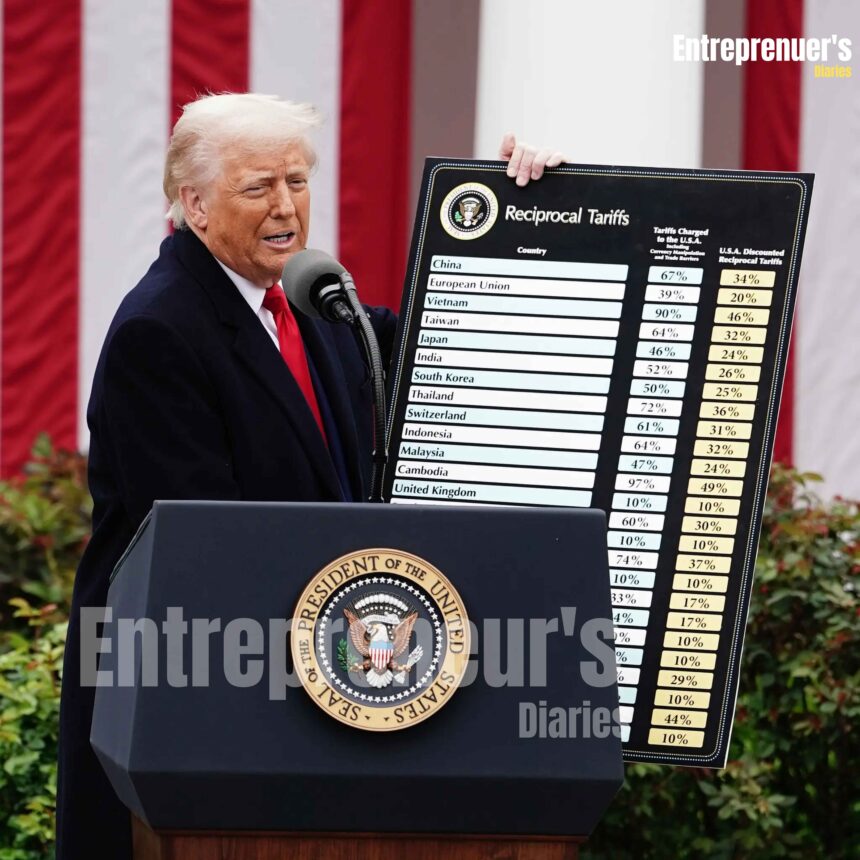
Washington, D.C., May 9: The Trump administration lost again. On May 7, a specialized federal court in New York ruled that the president’s 10 percent global tariffs are unlawful, delivering the second consecutive legal blow to the White House’s trade agenda in less than three months. The timing could hardly be worse. Trump is due in Beijing next week to meet Chinese President Xi Jinping for trade talks, and the courtroom defeats are piling up faster than the administration can find new legal workarounds.
A three-judge panel of the U.S. Court of International Trade, splitting 2-1, found that the administration overstepped its authority when it imposed these tariffs on virtually all U.S. imports under Section 122 of the Trade Act of 1974. That statute was the administration’s fallback after the Supreme Court invalidated its earlier tariff strategy in February. The Department of Justice filed its notice of appeal the following morning, and the case now heads to the U.S. Court of Appeals for the Federal Circuit.
For importers, the ruling on these tariffs is vindicating but not immediately useful. The legal victory is real. The practical relief, for most businesses, is not.
The Tariff Law at the Center of Everything
Section 122 was not some obscure provision the administration stumbled upon. It was a deliberate pivot, chosen specifically because it offered an alternative statutory basis for tariffs after IEEPA collapsed. The law allows the president to impose temporary tariff surcharges of up to 15 percent for up to 150 days when the country faces “fundamental international payments problems,” including what the statute calls “large and serious” balance-of-payments deficits.
The administration’s argument was straightforward enough. The United States ran a roughly $1.2 trillion trade deficit in 2025. That, the White House contended, satisfied the statutory threshold justifying these tariffs. The court looked at that argument and said no.
The majority found that “balance-of-payments deficits,” as Congress understood the term when it drafted the law in 1974, describes something fundamentally different from the kind of persistent trade imbalance the U.S. has carried for decades. The statute was designed to address acute international payments crises, not chronic structural trade gaps. The judges acknowledged the phrase “causes some confusion” but were clear that the administration had misread the law underpinning these tariffs.
The dissent, written by Judge Timothy Stanceu, is worth noting specifically because of what it does not say. Stanceu did not argue the tariffs were legal. His primary objection was procedural: that the majority resolved the case on legal theories the parties had not fully briefed. The administration cannot walk into the Federal Circuit and claim its own dissenting judge thought the tariffs were sound policy. He did not say that, and that distinction matters considerably going into appeal.
A Tariff Victory with a Narrow Reach
The consolidated cases, Oregon v. Trump and Burlap and Barrel, Inc. v. Trump, produced a permanent injunction against the tariffs, but one that applies only to the named plaintiffs: spice importer Burlap and Barrel, toy company Basic Fun!, and the State of Washington. Every other importer in the country keeps paying these tariffs until someone else sues or until they expire on their own on July 24.
That limited scope has shaped how analysts are reading the ruling’s immediate economic impact. Capital Economics puts the average effective U.S. tariff rate on imports at 7.2 percent following the decision. Chief North America economist Stephen Brown wrote in a research note, cited by CBS News, that given the narrow injunction and the tariffs’ impending expiration, “none of this has any immediate implication for the U.S. tariff rate.”
Accurate, as far as it goes. But the legal precedent is a different matter entirely. Courts have now rejected the administration’s tariff justifications twice, under two entirely separate statutory frameworks. That is not a streak that inspires confidence in the legal defenses being prepared for the next round.

Basic Fun! CEO Jay Foreman was not hiding his satisfaction. “We fought back today and we won, and we’re extremely excited,” he told reporters Thursday, as quoted by NBC News. His company makes toys. His supply chain depends entirely on imported goods subject to these tariffs. His company sued the United States government and won.
How the Tariff Fight Reached This Point
The sequence of events matters for understanding why the White House is now scrambling through its third statutory tariff strategy in under a year. The original tariffs, imposed under the International Emergency Economic Powers Act, covered virtually every country with double-digit rates. The Supreme Court struck them down in February 2026, in a 6-3 decision, ruling that IEEPA simply does not give the president authority to impose tariffs.
Within hours of that ruling, Trump announced replacement tariffs: a flat 10 percent on all imports, this time under Section 122. That section expires by design after 150 days, making it a stopgap rather than a solution to the administration’s tariff problem. Lawsuits followed within weeks. Multiple states, led by Oregon Attorney General Dan Rayfield, filed suit at the Court of International Trade in March, joined by attorneys general from more than twenty other states. Burlap and Barrel and Basic Fun!, represented by the libertarian Liberty Justice Center, filed separately.
The IEEPA defeat also triggered what is shaping up to be an enormous refund process tied to those earlier tariffs. Reported figures suggest the federal government may owe importers up to $175 billion as a result of the original IEEPA ruling alone. U.S. Customs and Border Protection launched a refund portal in late April, and the first payments reportedly began reaching importers’ bank accounts this week. The May 7 ruling on Section 122 tariffs adds a separate layer of refund exposure on top of that already staggering figure.
Trump’s public response was predictable. He blamed “two radical left judges,” referring to Chief Judge Mark Barnett and Judge Claire Kelly, both Obama appointees, as reported by Reuters. “Nothing surprises me with the courts,” he told reporters. “We get one ruling, and we do it a different way.”
The different way is Section 301. And the race to get there is already underway.
Business Groups React to the Tariff Ruling
Reaction from the business community came quickly and ran largely in one direction. Import-dependent industries that have spent months absorbing elevated costs from these tariffs welcomed the ruling, even while acknowledging its limited immediate reach.
Trade organizations representing retailers, manufacturers, and consumer goods companies have argued since the tariffs were first imposed that the legal foundations were shaky and the economic consequences were real. Small businesses bore a disproportionate share of the burden. Companies without the scale to renegotiate supplier contracts or diversify sourcing quickly found themselves absorbing cost increases that eroded margins in ways that larger competitors could more easily manage.
The Liberty Justice Center, which represented Burlap and Barrel and Basic Fun! in the case, framed the ruling as a structural statement about presidential tariff authority, not just a victory for two small companies. Jeffrey Schwab, the center’s director of litigation, was careful to note after the ruling that it remained unclear whether other businesses would be automatically exempted from the tariffs going forward. That ambiguity is itself a signal of how narrow the court’s relief actually is.

White House spokesman Kush Desai defended the administration’s position in a statement to CBS News. “President Trump has lawfully used the tariff authorities granted to him by Congress to address our balance of payments crisis,” he said. That claim will now be tested before the Federal Circuit, with the Supreme Court waiting as a possible final arbiter.
Section 301: The Next Tariff Battle
Every serious trade attorney in Washington is focused on Section 301 of the Trade Act of 1974, and for good reason. Unlike IEEPA or Section 122, Section 301 requires the U.S. Trade Representative to conduct formal investigations into specific countries’ trade practices before any new tariffs can be imposed. Public comment periods, hearings, interagency review: the full procedural architecture. That process is precisely why Section 301 tariffs have survived legal challenges that emergency measures like IEEPA and stopgap tools like Section 122 could not withstand.
Blake Harden, a trade policy expert at Ernst and Young, was direct about what this ruling means strategically for the tariff fight ahead. “This decision reinforces that 301 is the tool they are most likely to rely upon and have the best chance at a durable tariff regime,” she told CBS News. “I think 301 is the name of the game for them moving forward.”
Patrick Childress of Holland and Knight, who served at the Office of the U.S. Trade Representative under both Trump and Biden, offered a less alarmed read of the ruling’s immediate impact on the administration’s broader tariff ambitions. “For the Administration, today’s ruling will be disappointing but not devastating,” he said, as reported by the Washington Post. “The Section 122 tariffs have a 150-day time limitation, and thus, they were always meant as a stopgap.”
The USTR launched Section 301 investigations in March targeting structural excess manufacturing capacity across 16 economies, including China, the European Union, Vietnam, South Korea, Indonesia, and Mexico. A parallel investigation covers forced labor practices across a separate set of trading partners. Public hearings ran through late April and early May at the U.S. International Trade Commission. Findings are expected in July, which is precisely when Section 122 tariffs are scheduled to expire.
That convergence of dates is not coincidental. The administration is trying to ensure no gap opens in tariff coverage between the death of Section 122 and the arrival of whatever comes next under Section 301. Whether the USTR can complete the kind of rigorous, legally defensible investigations that will hold up in court on a politically compressed timeline is a legitimate open question. Nobody inside the administration seems eager to address it publicly.
There is also the question of what Section 301 tariffs will look like in practice. Earlier Section 301 tariffs on Chinese goods, many of which remain in place from the first Trump administration, ran considerably higher than 10 percent in specific product categories. A new round of Section 301 tariffs, covering 16 economies across multiple sectors, could be far more targeted and legally complex than anything the administration has attempted under IEEPA or Section 122.
The Global Dimension of the Tariff Dispute
Trading partners have been watching this legal saga with considerable interest, and not simply out of diplomatic curiosity. The tariffs struck down by the Court of International Trade were applied globally, affecting imports from allies and adversaries alike. The legal uncertainty surrounding the administration’s tariff program has complicated trade negotiations that the White House is simultaneously trying to conduct.
The European Union, which imposed retaliatory measures in response to U.S. tariffs earlier in the cycle, is now in a position of strategic ambiguity. Does it maintain retaliatory tariffs while the American legal dispute works through the courts? Does it use the ruling as leverage in negotiations? European trade officials are still working through the implications, and the answer may depend substantially on how quickly the Federal Circuit acts and whether it grants the administration a stay pending appeal.
For Beijing, the calculus is different. The baseline Section 122 tariffs are only a small part of a much larger tariff architecture targeting Chinese goods, much of which rests on Section 301 authorities that the May 7 ruling does not touch. The core of the U.S.-China trade confrontation remains largely intact, which means Trump’s Beijing meetings next week will not be fundamentally altered by this ruling. That said, arriving for trade talks fresh off a court loss does not strengthen a negotiating position.
Canada and Mexico, operating under the United States-Mexico-Canada Agreement, occupy their own position in this landscape. Both countries have faced separate tariffs justified on different grounds under different legal authorities. The May 7 ruling does not directly address those measures, and the bilateral trade relationships with both neighbors carry their own distinct legal and political dynamics.
What Importers Should Actually Do Right Now
The ruling does not help most businesses today. That is the blunt reality, and trade counsel across major firms are saying so clearly. Unless a company is Burlap and Barrel or Basic Fun!, the 10 percent tariff still applies. U.S. Customs and Border Protection will keep collecting tariff duties while the administration appeals, and while the broader universe of importers waits to see how the Federal Circuit rules.
The practical advice from trade counsel is consistent: do not wait. Importers that have already paid Section 122 tariff duties should evaluate immediately whether to file suit at the Court of International Trade, submit formal protests to Customs and Border Protection, or pursue other strategies to preserve their right to refunds. The window to act may narrow considerably as the appeals process moves forward and procedural deadlines pass without action.

Snell and Wilmer LLP, in guidance issued to clients following the ruling, noted that importers of record should not assume the ruling will automatically result in across-the-board relief from these tariffs. The firm advised clients to evaluate litigation, protest, and contractual-preservation strategies immediately, before further legal and procedural developments narrow the available options.
Two statutory frameworks. Two court defeats on tariffs. One administration still searching for a legal theory that survives federal judicial scrutiny. Section 301 may eventually deliver the durable tariff regime the White House has been attempting to build since the first day of this trade campaign. But it will not arrive fast enough to prevent a period of genuine legal exposure, and the courts have now established a pattern of skepticism toward the administration’s tariff legal reasoning that will follow every new attempt into the courtroom.
For trading partners watching from Brussels, Tokyo, Ottawa, and Beijing, that pattern makes the negotiating environment harder to read, not easier.
What did the Court of International Trade decide on May 7, 2026?
The court ruled 2-1 that the Trump administration’s 10 percent global tariffs, imposed under Section 122 of the Trade Act of 1974, are unlawful. A permanent injunction was issued declaring the tariffs invalid, but the relief applies only to two private companies, Burlap and Barrel and Basic Fun!, and the State of Washington. Every other importer continues paying these tariffs while the case is appealed before the Federal Circuit.
Are tariffs coming down for all American importers now?
No. The injunction is narrow. U.S. Customs and Border Protection is expected to keep collecting these tariffs from all importers not named in the case while the Trump administration pursues its appeal. For most businesses, nothing changes at the border today, and trade counsel is advising importers not to assume otherwise.
How does this ruling differ from the February Supreme Court decision on tariffs?
The February ruling was a 6-3 Supreme Court decision striking down tariffs imposed under the International Emergency Economic Powers Act, finding that IEEPA does not authorize the president to impose tariffs. After losing that case, the administration shifted to Section 122 of the Trade Act of 1974 to impose replacement tariffs. May 7’s ruling found that second attempt also exceeded presidential authority, but under a completely separate legal analysis. Two different laws, two separate defeats.
What makes Section 301 tariffs more legally durable than IEEPA or Section 122?
Section 301 of the Trade Act of 1974 requires the U.S. Trade Representative to conduct formal investigations, hold public hearings, and complete an interagency review process before tariffs can be imposed. That procedural rigor is precisely what has historically allowed Section 301 tariffs to survive legal challenges that emergency and temporary measures could not. The USTR currently has active Section 301 investigations targeting 16 economies for excess manufacturing capacity and a separate probe covering forced labor practices, with findings expected in July 2026.
Can businesses outside the court case recover what they paid in Section 122 tariffs?
Not automatically. The refund order covers only the named plaintiffs. Importers that paid Section 122 tariff duties without filing suit should consult trade counsel immediately about whether to file at the Court of International Trade, submit a protest to Customs and Border Protection, or take other steps to preserve their refund claim. Several major law firms are warning that delay could close off available options as the appellate timeline advances.
Connect With Us On Social Media [ Facebook | Instagram | Twitter | LinkedIn ] To Get Real-Time Updates On The Market. Entrepreneurs’ Diaries Is Now Available On Telegram. Join Our Telegram Channel To Get Instant Updates.

Isabella is a global business journalist and former McKinsey analyst from Brazil. She brings sharp insights on economic shifts, policies, and founder journeys from around the world.

Tokyo-based CFA translating global markets into clear insights for modern entrepreneurs.