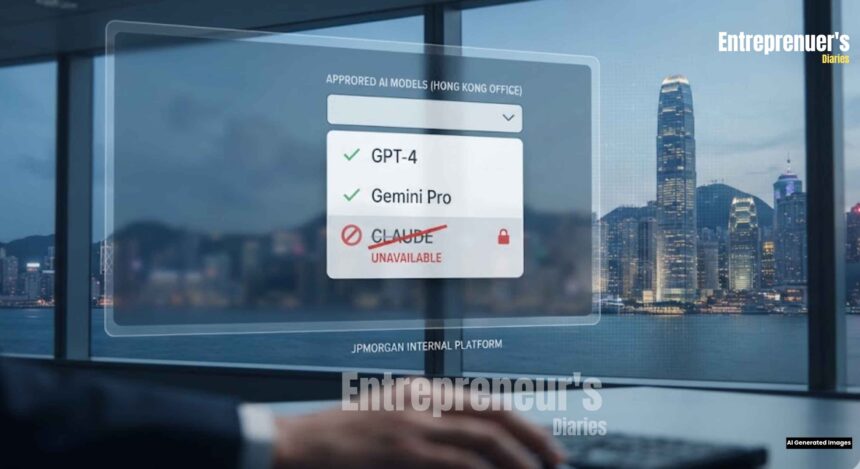
Hong Kong, June 18, 2026: A drop down menu lost an option. That is, on its surface, the entire event. But inside JPMorgan Chase’s internal AI platform, the disappearance of one entry from a list of approved large language models has become the clearest signal yet that enterprise AI deployment is now being shaped as much by geopolitics and export control law as by model capability.
Per the Financial Times, citing three people familiar with the matter, JPMorgan has stopped its staff in Hong Kong from accessing Anthropic’s AI models, effective this week.
Staff at the bank’s Hong Kong office can no longer select Claude from the internal drop down list of approved large language models, according to the FT’s reporting as relayed by Reuters and Investing.com.
Reuters, which carried the story to a global audience on June 18, stated explicitly that it “could not immediately verify the report” independently a standard caveat for wire reporting built on another outlet’s sourcing.
That caveat doesn’t diminish the underlying significance for anyone tracking how frontier AI gets deployed inside regulated industries. This is now the second major Wall Street bank in under two months to pull Claude access for its Hong Kong based employees and for an AI vendor like Anthropic, it represents a live case study in how quickly a model access list can become a geopolitical fault line.
THE CONTRACTUAL TRIGGER BEHIND THE BLACKOUT
The decision, per MarketScreener’s account of the FT’s reporting, came down to wording. The wording of Anthropic’s usage terms in its licensing agreement with JPMorgan reportedly prompted the bank to remove Claude models from that internal list available to employees in the Asian financial hub.
This was not framed, in any verified reporting, as a directive from Hong Kong’s government or financial regulator. It was a contractual reading by JPMorgan’s own compliance teams a reminder that enterprise AI rollouts now run through legal review as much as technical evaluation.
Market Screener’s report adds a detail with real weight: JPMorgan and Anthropic did not respond to Reuters’ requests for comment outside business hours. Neither company has, as of this writing, issued an on record statement specifically addressing the JPMorgan decision.
A SECOND BANK, THE SAME PLAYBOOK
JPMorgan is not writing this script alone. The move follows a similar decision by Goldman Sachs, which in April removed Claude from a list of approved tools available to its Hong Kong based bankers, per MarketScreener’s account of the FT’s reporting.
The Goldman story first broke via the Financial Times on April 28. Reuters confirmed elements of it independently the following day, citing a source with direct knowledge of the situation.
According to that Reuters report, dated April 29, Goldman employees in Hong Kong had previously been able to interact with Claude through an internal AI platform, but in recent weeks no longer had access to it. Other AI models, including Google’s Gemini and OpenAI’s ChatGPT, were still available on Goldman’s platform, the same Reuters source said meaning this is a vendor specific restriction, not a blanket retreat from AI tooling.
Reuters’ own reporting states it “could not immediately ascertain the reason for the move,” but noted that, per the FT, the trigger was Goldman taking a strict interpretation of its contract with Anthropic following a consultation with the company concluding that Goldman’s Hong Kong employees, despite the city being the bank’s main Asia Pacific business hub, should not be able to use any Anthropic products.
That detail “following a consultation with the company” is the most important fact in the entire Goldman episode for anyone studying AI vendor governance. It indicates active dialogue between bank and vendor over model access policy, not a unilateral misreading by Goldman alone.
Seen together, the two cases form a pattern rather than a coincidence. JPMorgan blocks Anthropic in almost the exact same way Goldman did two months earlier, suggesting Anthropic’s own contract language not bank specific caution is the common thread.
With JPMorgan Chase blocks Anthropic AI in Hong Kong now confirmed by the Financial Times, the city has effectively seen two separate, independently sourced instances of an Anthropic ban Hong Kong banks have each arrived at on their own, after consulting directly with the vendor.
That JPMorgan blocks Anthropic AI access for Hong Kong staff using language almost identical to Goldman’s earlier restriction is, on its own, a meaningful data point for how Anthropic is now enforcing its usage terms across its largest financial sector clients.
WHAT ANTHROPIC HAS ACTUALLY SAID AND WHAT ITS OWN WEBSITE SHOWS
There is exactly one verified, on record comment from Anthropic tied to either restriction. An Anthropic spokesperson told the Financial Times, in connection with the Goldman story, that Claude models had never been officially “supported” in Hong Kong, declining to comment further.
Reuters’ own April 29 report adds a harder, independently checkable fact: Hong Kong is not listed as a market where Anthropic’s API and Claude.ai are officially accessible, according to the company’s website.
That is a meaningful distinction for any enterprise AI buyer to note. It is not just a spokesperson’s characterization it is a documented detail Reuters confirmed by checking Anthropic’s own published market access list, suggesting model access geography is now something companies need to actively audit, not assume.
Goldman Sachs, for its part, declined to comment when approached by Reuters, and Anthropic did not immediately respond to Reuters’ requests for comment when the Goldman story first broke.
BLOOMBERG’S DETAIL: A LOCATION SPECIFIC LOCKOUT, NOT A USER LOCKOUT
Bloomberg’s reporting on the Goldman restriction, carried via MSN, added an operational detail that matters specifically for AI deployment teams. The restriction is location specific: staff visiting Hong Kong from overseas offices would also lose access to Claude while physically present in the city, according to a person familiar with the matter cited by Bloomberg.
Bloomberg’s source also said the technology was predominantly used by software engineers at Goldman confirming this is, in large part, a developer tooling and AI coding assistant story, not simply a chatbot for bankers story. For automation teams relying on Claude Code or similar agentic coding tools, a geography based access cutoff carries direct productivity consequences.
HONG KONG’S UNUSUAL POSITION IN THE GLOBAL AI ACCESS MAP
Western AI models, including OpenAI’s ChatGPT and Anthropic’s Claude, are prohibited in mainland China as part of the country’s internet censorship infrastructure, per Investing.com’s June 18 report. Hong Kong has usually been exempt from this censorship, the same report notes.
That historical exemption is what makes the JPMorgan and Goldman restrictions unusual from an AI governance standpoint. These are not cases of a government technically blocking access at the network level. They are cases of the AI company’s own commercial and licensing terms, interpreted and enforced by its banking clients, producing a similar practical outcome a private sector access control layered on top of, but distinct from, state level censorship.
THE HKMA STARTS WATCHING MODEL RISK DIRECTLY
Hong Kong’s financial regulator did not stay silent on the sidelines. The Hong Kong Monetary Authority Hong Kong’s de facto central bank told Reuters directly that it has contacted “a range of major banks” to understand the latest developments around Anthropic’s Mythos model and to remind them to update risk assessments and take appropriate measures, per Reuters’ April 29 report.
That same Reuters report states the Hong Kong government did not respond to a Reuters request for comment, while the HKMA declined to comment specifically on Goldman’s move.
For AI and automation observers, this is the more structurally important detail: a financial regulator is now treating a specific AI model’s capability profile as a standalone category of institutional risk requiring its own assessment framework, distinct from generic IT or data security risk.
WHY MYTHOS CHANGED THE RISK CALCULUS FOR THE WHOLE INDUSTRY
Reuters’ April 29 report states explicitly: Goldman’s move in Hong Kong also comes as Anthropic’s latest AI model Mythos has drawn scrutiny from global banks and financial regulators over potential risks to banking systems.
That scrutiny escalated sharply weeks later, in an episode with direct relevance to anyone following frontier model governance. On June 13, Anthropic disclosed in its own public statement reported by Bloomberg, CNN, and the Yahoo News/Reuters account that the U.S. government had ordered it to suspend access to its Fable 5 and Mythos 5 models for any foreign national, “whether inside or outside the United States.”
Per Reuters’ detailed account (via Yahoo News and The Standard), U.S. Commerce Secretary Howard Lutnick sent the order in a letter to Anthropic CEO Dario Amodei on Friday, June 12. Reuters states it reviewed a copy of that letter directly.
The letter ordered Anthropic to suspend export of the Mythos and Fable models to destinations worldwide and to all foreign nationals, wherever located, because officials feared the models could be deployed by or diverted to military intelligence users in China, Russia, or other countries of concern.
Bloomberg, which also reviewed a copy of the directive, reported that Lutnick warned Anthropic it would need government permission before exporting Fable 5 and Mythos 5 to any destination or foreign national, and threatened criminal and civil penalties for noncompliance the first known use of this specific export control authority applied to an AI model rather than to hardware.
CNN’s reporting adds that Anthropic said the government did not provide specific details about its national security concerns, though the company said it believed officials had “become aware” of a method for partially circumventing Fable 5’s safety guardrails a so called “jailbreak.”
Anthropic, quoted directly by CNN, pushed back on the severity of the finding: “We reviewed a demonstration of this specific technique being used to identify a small number of previously known, minor vulnerabilities.
These vulnerabilities all appear relatively simple, and we have found that other publicly available models are able to discover them as well without requiring a bypass.” The company added that applying this standard industry wide “would essentially halt all new model deployments for all frontier model providers.”
This is the climate the JPMorgan and Goldman Hong Kong restrictions are unfolding inside one where the same model family driving enterprise automation gains is simultaneously triggering the most aggressive AI export control action a government has yet taken.
THE INTELLECTUAL PROPERTY AND MODEL DISTILLATION ANGLE
Reuters’ April 29 report notes that the world’s leading AI companies do not offer access to mainland based users and have, in the recent past, expressed concern about their models being used by Chinese rivals for training purposes a practice often referred to in the AI industry as distillation, where heavy interaction with a frontier model can help a competitor train a rival system.
The same report states the U.S. government had, the week prior, issued a global warning about alleged AI thefts by Chinese AI operators, a claim Reuters attributed to an official document it had reviewed.
Reuters also notes, for additional context, that in 2024 OpenAI moved to restrict China traffic to its API establishing a precedent that geography based access restriction is not unique to Anthropic, but an emerging norm across frontier model vendors.
TRUMP WEIGHS IN AT THE G7, IN PERSON
The political backdrop extends to the very top of the U.S. government, with direct relevance to how quickly this dispute might resolve for enterprise users. According to a separate Reuters dispatch dated June 17, filed from Evian les Bains, France, President Donald Trump told reporters at the G7 summit that negotiations with Anthropic are “going fine.”
Per that same Reuters report, Trump made the comment after a meeting between G7 leaders and technology executives that included Anthropic CEO Dario Amodei the first public meeting between Trump and Amodei since the export control order was issued. Reuters noted a Trump spokesperson declined to provide further detail about the discussions, and Anthropic’s spokesperson did not immediately respond to Reuters’ request for comment on that story.
The Standard’s account, also sourced to Reuters, adds that senior Anthropic technical staff met with Commerce Department officials in Washington, and that the two sides were described as being in “neardaily discussions” since the Friday letter, with Lutnick personally involved in efforts to reach an agreement suggesting this entire access dispute, including its downstream effects on enterprise users in Hong Kong, remains an active, unresolved negotiation rather than settled policy.
THE PARADOX: JPMORGAN IS ALSO ANTHROPIC’S DEEPEST AUTOMATION PARTNER
Here is what makes the Hong Kong restriction genuinely notable from an AI automation lens: JPMorgan is not a distant or skeptical Anthropic customer. It is arguably Anthropic’s flagship banking and automation relationship.
Fortune’s May 5 reporting on Anthropic’s Wall Street push described the first ever shared stage appearance of Dario Amodei and JPMorganChase Chairman and CEO Jamie Dimon, at the company’s invite only “Briefing: Financial Services” event in New York an event built specifically around launching pre-built AI agents for back office automation.
Dimon, per Fortune’s direct quotation, said that over the prior weekend he had logged onto Claude Code himself: “I want to know about asset swaps and Treasury bid ask spreads, and quitting the markets, and investment grade.” In 20 minutes, he said, it created a dashboard “with all the backup, and all the research, and it was very accurate about what I wanted.” Fortune reports Dimon also said JPMorgan first began using AI in 2012 and now has automation use cases ranging from risk and fraud detection to marketing, design, and note taking.
JPMorganChase Chief Information Officer Lori Beer, speaking on a panel at the same event per Fortune, framed the real bottleneck in enterprise AI adoption: “There’s this capability overhang. The technology can do so much. It’s the actual organization’s ability to digest and absorb it that tends to be where the gap is.”
Fortune’s reporting also confirms that, since launching Claude for Financial Services in July 2025, Anthropic has placed Claude into production at JPMorganChase, Goldman Sachs, Citi, AIG, Visa, and others and that Goldman Sachs contributed $150 million to a $1.5 billion AI joint venture with Anthropic, Blackstone, and Hellman & Friedman announced the day before that May briefing, per the Wall Street Journal figure cited by Fortune (which notes Anthropic itself had not confirmed that specific number).
Goldman Sachs CIO Marco Argenti, on the same Fortune reported panel, described the shift in enterprise automation philosophy this way: “This is the first time that instead of buying infrastructure, you can actually buy intelligence.”
In other words: the same two banks restricting Claude access in Hong Kong are, at their global headquarters, running some of the most ambitious enterprise AI agent deployments in the entire financial sector. The restriction is a geography specific carve out inside an otherwise accelerating automation partnership not evidence of cooling enthusiasm for Claude broadly.
WHAT THIS MEANS FOR ENTERPRISE AI GOVERNANCE GOING FORWARD
It remains unclear, based on available reporting, whether additional banks or multinational enterprises will follow Goldman and JPMorgan in restricting Hong Kong access to Anthropic’s models. None of the sources reviewed for this report confirm further institutions have taken similar steps as of June 18, 2026.
Reuters’ April 29 report places the original Goldman restriction inside a specific context: rising tension between the U.S. and China over AI technology, data security, and access to advanced computing tools issues expected to feature in a planned mid May summit between Presidents Trump and Xi Jinping. MarketScreener’s June 18 report on the JPMorgan decision states the restrictions by the two Wall Street banks come amid those same rising U.S. China tensions.
For any enterprise running AI agents or coding assistants across multiple jurisdictions, this is the operative lesson: vendor terms of use are no longer a one time legal sign off. They are a live compliance surface that can shift mid deployment, geography by geography, based on a single vendor’s own evolving relationship with a single government.
THE CLOSING ARGUMENT: A QUIET STORY WITH LOUD IMPLICATIONS FOR AI DEPLOYMENT
There is a version of this story a reader can close the tab on quickly. In that version, a bank tweaked an internal software menu, a vendor’s contract language got enforced a little more strictly, and nothing about anyone’s actual job changed in any city that matters to global automation strategy. That version misses what’s actually happening.
What JPMorgan and Goldman Sachs have done, independently but in near identical fashion, is draw a line on a map that no government drew for them. Beijing did not order this. Hong Kong’s regulators did not order this the HKMA itself declined to comment on the specific decisions, even as it quietly asked banks to reassess their AI risk frameworks.
The companies did this themselves, reading the fine print of their own contracts with one AI vendor, after consulting that vendor directly, and concluding that a financial hub long treated as exempt from mainland style restrictions should, for this one product, be treated differently.
That is a new kind of border for the AI industry not a national one, but a contractual one, drawn by a private AI company and enforced voluntarily by its biggest enterprise clients, even as those same clients build some of the deepest AI agent deployments in the industry at their headquarters. If this pattern holds, the open question for every bank, fintech, and multinational still running Anthropic’s models out of Hong Kong is no longer whether the city is “open” to Western AI in principle.
It’s whether that principle still means anything once Anthropic’s own published market list and now two of Wall Street’s biggest names have quietly agreed it doesn’t apply there. For enterprise AI buyers everywhere, the lesson travels well beyond Hong Kong: geography is now a live variable in your model’s terms of service, and it can change without a press release.
FREQUENTLY ASKED QUESTIONS
Why did JPMorgan block Anthropic’s AI models for its Hong Kong staff?
Per the Financial Times, the decision rested on the wording of Anthropic’s usage terms within JPMorgan’s licensing agreement. Staff in Hong Kong can no longer select Claude from the bank’s internal list of approved AI models. Neither JPMorgan nor Anthropic has issued a public statement specific to this decision.
Is this the first bank to restrict Anthropic access in Hong Kong?
No. Goldman Sachs removed Claude access for its Hong Kong bankers in late April 2026, first reported by the Financial Times and independently confirmed in part by Reuters on April 29.
Has Anthropic confirmed that Hong Kong is an unsupported market?
Yes, in two ways. An Anthropic spokesperson told the Financial Times that Claude had never been officially “supported” in Hong Kong. Separately, Reuters independently verified that Hong Kong is not listed as a market where Anthropic’s API and Claude.ai are officially accessible, according to the company’s own website.
Is the restriction the result of Chinese censorship or the Great Firewall?
No. Claude and ChatGPT are already blocked in mainland China under that system, but Hong Kong has historically been exempt. Both bank restrictions stem from contractual decisions by JPMorgan and Goldman Sachs themselves, not from Hong Kong or mainland Chinese regulation.
Does the restriction apply to other AI tools, like ChatGPT or Gemini?
No. A Reuters source confirmed that other models, including Google’s Gemini and OpenAI’s ChatGPT, remained available on Goldman’s internal platform after Claude access was removed indicating this is a vendor specific restriction tied to Anthropic’s contract terms, not a broader retreat from AI tooling.
What is Anthropic’s Mythos model, and why does it matter for this story?
Mythos is Anthropic’s most advanced model family. Reuters reported it had drawn scrutiny from global banks and regulators, including the Hong Kong Monetary Authority, over potential risks to banking systems, particularly its cybersecurity capabilities.
Did the U.S. government separately restrict Anthropic’s models?
Yes. Anthropic disclosed that on June 12, 2026, Commerce Secretary Howard Lutnick sent CEO Dario Amodei a letter, reviewed directly by Reuters and Bloomberg, ordering the company to suspend access to its Fable 5 and Mythos 5 models for all foreign nationals worldwide, citing risk of diversion to military or intelligence users in China, Russia, and other countries of concern. Anthropic disabled access for all users globally to comply.
What has President Trump said about the Anthropic situation?
Per Reuters, Trump told reporters at the G7 summit in Evian les Bains, France, on June 17 that negotiations with Anthropic are “going fine,” following a meeting between G7 leaders and tech executives including Amodei.
Is JPMorgan ending its overall AI partnership with Anthropic?
No. Fortune reported that JPMorganChase CEO Jamie Dimon shared a stage with Anthropic CEO Dario Amodei in May 2026 and described using Claude Code personally, with Claude already deployed across multiple JPMorgan automation use cases. The Hong Kong restriction appears limited to that specific office.
Could other banks or enterprises follow JPMorgan and Goldman Sachs in restricting Anthropic access in Hong Kong?
This remains unconfirmed. No source reviewed for this report names additional banks or companies that have taken similar action as of June 18, 2026.
Has the Hong Kong government responded to these AI access restrictions?
Per Reuters, the Hong Kong government did not respond to a request for comment on the Goldman Sachs restriction, and the HKMA declined to comment on that specific decision while confirming it had separately contacted major banks about Anthropic’s Mythos model.
Connect With Us On Social Media [ Facebook | Instagram | Twitter | LinkedIn ] To Get Real-Time Updates On The Market. Entrepreneurs’ Diaries Is Now Available On Telegram. Join Our Telegram Channel To Get Instant Updates.

Isabella is a global business journalist and former McKinsey analyst from Brazil. She brings sharp insights on economic shifts, policies, and founder journeys from around the world.

Luca is a tech ethicist from Italy exploring disruptive innovation through a human lens—from AI to biotechnologies to decentralization.